Antonio Vivaldi (1678–1741), known as the “Red Priest” due to his fiery hair and brief priestly career, stands as one of the most influential composers of the Baroque era. The most original and influential Italian composer of his generation, Vivaldi laid the foundations for the mature Baroque concerto.
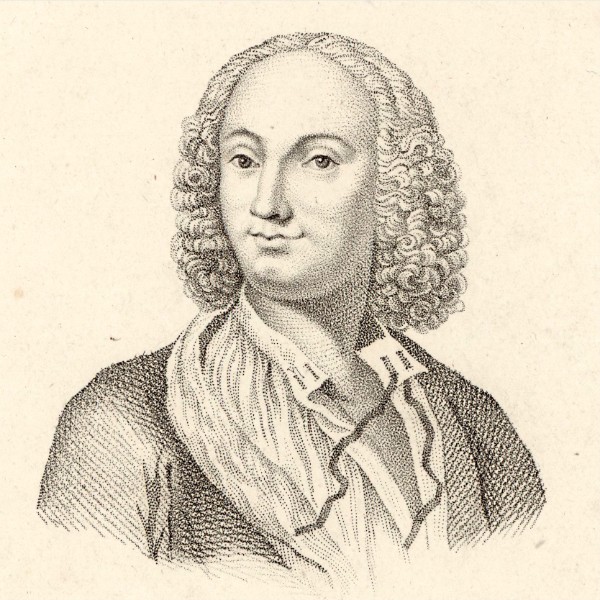
Antonio Vivaldi
Vivaldi’s life was marked by innovation, resilience, and a relentless pursuit of musical expression as he contributed to musical style, violin technique, the practice of orchestration, and to orchestral programme music. His vibrant compositions, entrepreneurial spirit, and complex personal life shaped a legacy that continues to resonate in concert halls worldwide.
Antonio Vivaldi: Four Seasons, “Winter” (Largo)
Early Life and Venetian Roots
Antonio Vivaldi was born on 4 March 1678 in the city of Venice, a city pulsating with cultural and musical vitality. His father, a professional violinist, likely introduced him to the violin, fostering his early musical development. Antonio’s fragile health at birth, possibly due to bronchial asthma, necessitated an emergency baptism. As Michael Talbot writes, “Vivaldi’s asthma, while a hindrance, never curtailed his ambition or his ability to undertake arduous journeys.”
Venice was a hub of commerce and art, and the city’s vibrant musical culture included opera houses and churches. By 1696, Antonio was performing as a violinist at St. Mark’s, and his training for priesthood culminated in ordination in 1703.
However, Vivaldi’s health and growing musical commitments led him to abandon saying Mass by 1706, a decision he later attributed to his asthma. Karl Heller suggests, “Vivaldi’s withdrawal from priestly duties was likely pragmatic, allowing him to focus on music, though he maintained a veneer of piety.”
Antonio Vivaldi: Dixit Dominus
The Ospedale della Pietà and Pedagogical Innovation
Vivaldi received his appointment at the Ospedale della Pietà, a Venetian institution for orphaned and abandoned girls, in 1703. This position, which he held intermittently until 1740, was pivotal in shaping his compositional output. The Ospedale was not merely a charitable institution but a renowned musical academy where girls received rigorous training, and Vivaldi’s duties included teaching, composing, and directing performances.
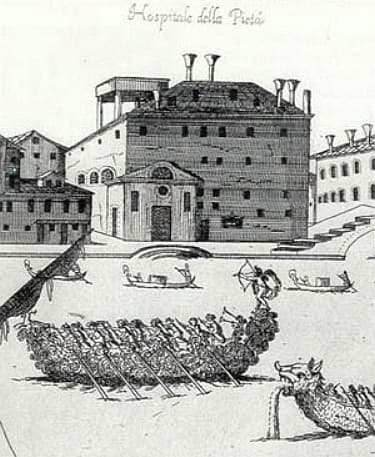
Ospeddale della Pietà
The Ospedale’s concerts attracted Venetian elites and foreign visitors, elevating Vivaldi’s reputation. As Jane L. Baldauf-Berdes observes, “The Ospedale provided Vivaldi with a unique laboratory for musical experimentation, allowing him to develop his distinctive concerto style.”
Vivaldi’s pedagogical approach was innovative, as it emphasised technical precision and expressive freedom, all tailored to the all-female ensemble. His teaching methods fostered a generation of skilled female musicians, and the environment allowed Vivaldi to experiment with instrumentation, incorporating unusual instruments into his concerto compositions.
Antonio Vivaldi: Concerto for 2 Mandolins in G major
The Concerto and The Four Seasons
Vivaldi’s most enduring contribution to music is his development of the Baroque concerto, particularly the solo concerto form. His L’estro armonico (Op. 3), a collection of twelve concertos, revolutionised the genre with its three-movement structure and dynamic interplay between soloist and ensemble. Published in Amsterdam, the collection gained international acclaim.
Of course, his Four Seasons, part of a different collection, is Vivaldi’s most iconic work. Each concerto, accompanied by descriptive sonnets, vividly depicts seasonal imagery through music techniques. A scholar writes, “The Four Seasons transcends mere program music, blending technical virtuosity with poetic narrative.”
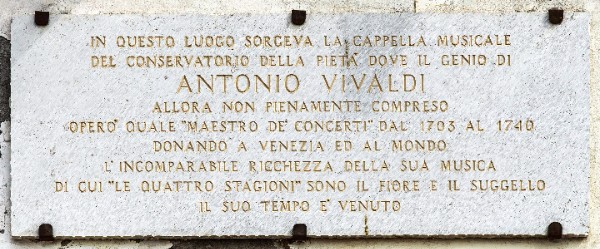
Vivaldi’s plaque on Chiesa della Pieta
Vivaldi’s concertos, numbering over 500, demonstrate his versatility and prolific output. He composed for diverse instruments, from violin to bassoon, and his ritornello form, a recurring orchestral theme interspersed with solo episodes, became a hallmark of the Baroque concerto.
Susan McClary argues, “Vivaldi’s concertos embody the Baroque ideal of contrast and unity, creating a dialogue between individual expression and collective harmony.”
Antonio Vivaldi: L’estro armonico, Concerto No. 10 for 4 violins
Opera and Entrepreneurial Ventures
Beyond the composition of various concertos, Vivaldi was a prominent figure in Venetian opera, composing nearly 50 works and managing productions as an impresario. His operatic career began with Ottone in villa (1713) and included works like Orlando furioso (1727). Vivaldi collaborated with his father in navigating the competitive and financially risky world of opera production.
Reinhard Strohm notes, “Vivaldi’s operas, while less celebrated today, were central to his career, reflecting his ability to adapt to the tastes of Venetian audiences.” His entrepreneurial spirit also extended to publishing, with a number of collections showcasing his market savvy.
Vivaldi travelled to cities like Verona and Mantua, often accompanied by the singer Anna Girò, a rumoured romantic partner. His travels greatly expanded his influence but also sparked controversy, as he faced censure from the Church for conduct unbecoming of a priest. Be that as it may, Vivaldi’s defiance of ecclesiastical norms clearly reflected the priority of artistic freedom over clerical duty.
Antonio Vivaldi: Orlando furioso, “Sol da te, mio dolce amore”
Later Years and Legacy
In 1740, seeking new opportunities, Vivaldi left Venice for Vienna, hoping to secure patronage from Emperor Charles VI. However, the emperor’s death shortly after Vivaldi’s arrival left him without support. Struggling financially, Vivaldi died in Vienna on 28 July 1741, and he was buried in a pauper’s grave.
In the immediate aftermath of his passing, Vivaldi’s music fell into relative obscurity, overshadowed by the emerging Classical style. His prolific output was largely neglected, with manuscripts scattered across Europe or lost. However, the early 19th century saw a gradual rediscovery, sparked by the Bach revival, as scholars noted Johann Sebastian Bach’s transcriptions of Vivaldi’s concertos, which highlighted their structural ingenuity and expressive vitality.
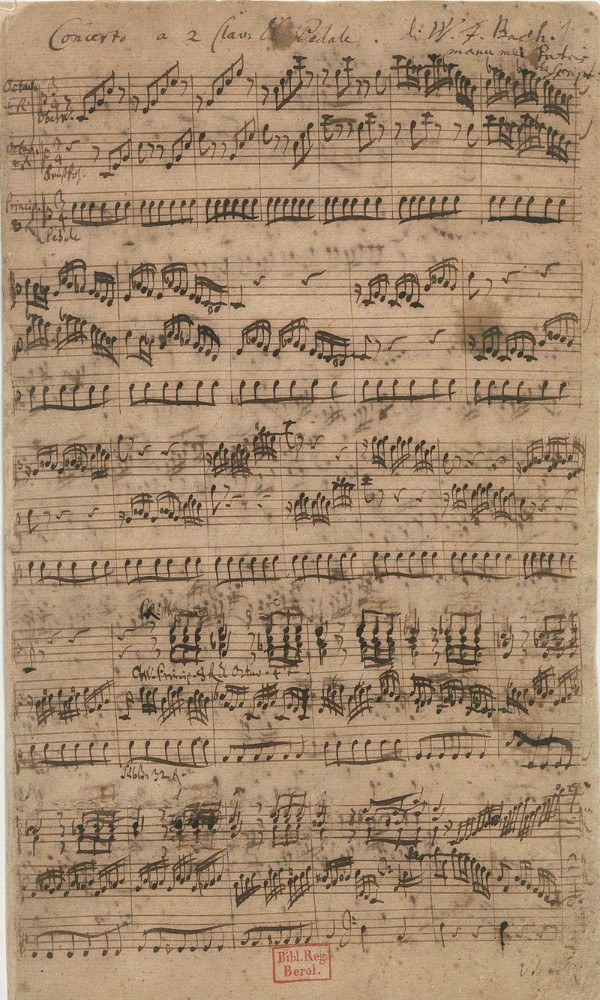
Bach’s transcription of Vivaldi (BWV 596)
By the late 19th and early 20th centuries, musicologists like Arnold Schering and performers like Fritz Kreisler began championing Vivaldi’s works, particularly his concertos, for their rhythmic energy and innovative use of solo instruments within the concerto grosso form. This resurgence culminated in the 20th-century “Vivaldi Renaissance,” driven by the rediscovery of manuscripts, such as those found in Turin in the 1920s.
Antonio Vivaldi: Trio Sonata in D minor, “La Folia”
Vivaldi Today
Today, Vivaldi’s legacy is firmly entrenched in both academic study and popular culture, with The Four Seasons serving as a cornerstone of the Baroque repertoire and a cultural touchstone. His influence extends beyond classical music, inspiring adaptations in film, television, and even popular music, while his innovative approach to programmatic music continues to captivate audiences.
Modern scholarship, such as the work of Michael Talbot and Susan Orlando, emphasises Vivaldi’s role in shaping the concerto form and his impact on the development of virtuosic violin techniques. Institutions like the Istituto Italiano Antonio Vivaldi and ongoing cataloguing efforts, such as the Ryom-Verzeichnis, underscore his enduring significance, ensuring that his works remain accessible to performers and researchers.
Antonio Vivaldi’s genius lies in his ability to weave vibrant musical narratives that capture the exuberance of Baroque Venice while transcending time. His innovative concertos blend technical virtuosity with evocative imagery, transforming notes into vivid depictions of nature and human emotion. His relentless creativity and entrepreneurial spirit reshaped the musical landscape, influencing contemporaries like Bach and leaving a legacy that resonates in modern performances.
In the words of Michael Talbot, “Vivaldi’s genius was to make the ordinary extraordinary!” Despite personal challenges, including chronic illness and ecclesiastical scrutiny, Vivaldi’s fiery spirit burns brightly, ensuring his place as a timeless luminary in the pantheon of Western music.
For more of the best in classical music, sign up for our E-Newsletter