For very different reasons, we can refer to both Hector Berlioz and Richard Wagner as ‘musical monsters’, but in the awe-inspiring, rather than the frightening, sense.
Hector Berlioz (1803–1869) took care to show music what it could really do. From dancing skeletons in the Symphonie fantastique to the Storm Scene in Les Troyens, he constantly pushed the boundaries of what music could express.
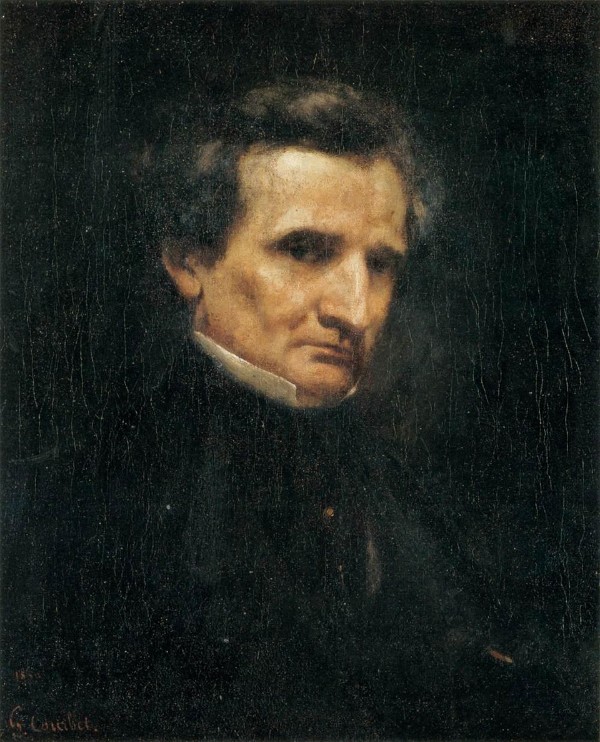
Gustave Courbet: Hector Berlioz, 1850 (Musée d’Orsay)
Even in the caricatures of Berlioz at the helm of an orchestra, overstatement becomes understatement. The caricature of Berlioz conducting in 1846 picks up not only on his style and wild hair but also adds a cannon into the percussion lineup.
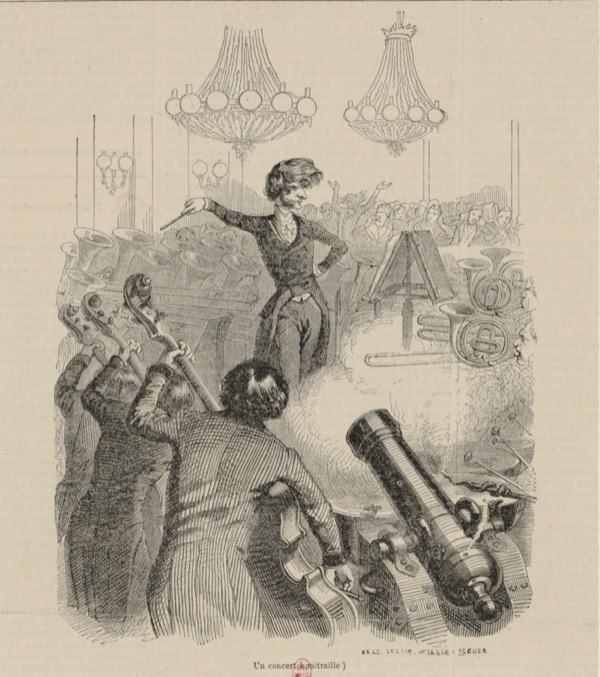
Grandville: Un concert à mitraille, 1846 (Gallica: btv1b8415763t)
In December 1899, English conductor Sir Thomas Beecham (1879–1961) made his professional debut (replacing an ailing Hans Richter) conducting Berlioz’ Hungarian March from La Damnation de Faust, leading the Hallé Orchestra. Throughout his career, Berlioz was someone that Beecham returned to again and again, taking on not only the orchestral works such as the Symphonie fantastique and Harold in Italy but also the largest works, such as the Te Deum, the Requiem, L’Enfance du Christ, and the operas, La Damnation de Faust (at Covent Garden) and Les Troyens (BBC broadcast in 1947).
Hector Berlioz: La Damnation de Faust – Hungarian March
This live recording was made at the Royal Festival Hall on 7 May 1955, in a program that also included two selections from Les Troyens (the Prelude and the Royal Hunt and Storm from The Trojans at Carthage), Lalo’s Symphony in G minor, Delius’ Sea Drift, and Debussy’s Nocturnes. Beecham was leading his Royal Philharmonic Orchestra.
Beecham recognised how unusual Berlioz’ work was in the normal Romantic canon, saying that ‘such extraordinary portents as the Symphonie fantastique or La Damnation de Faust broke upon the world like some unaccountable effort of spontaneous generation which had dispensed with the machinery of normal parentage’.
Another composer outside the norm was Richard Wagner. Beecham conducted Der fliegende Holländer in 1909, his first Wagner opera. He was an ‘enthusiastic Wagnerite’ throughout his career and brought a different response to the music. Whereas most conductors of The Ring cycle concentrated on harmonic change and fullness, Beecham focused on the dramatic and picturesque, as critic Neville Cardus pointed out.
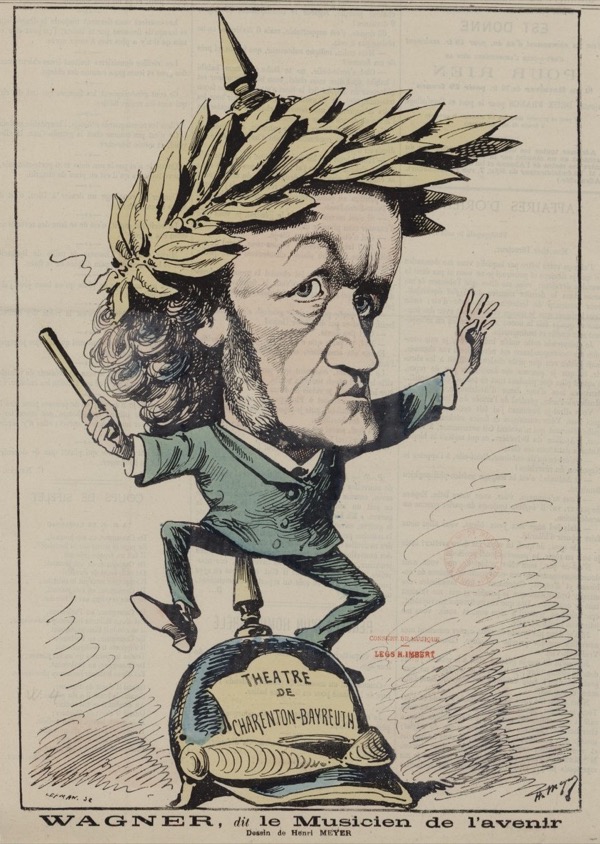
Henri Meyer: Wagner dit Le Musicien de l’avenir (Wagner, known as The Musician of the Future), 1876 (Gallica: btv1b8426731f)
The Wagner works on this recording, the Overture and Venusberg Music from Tannhäuser, the Good Friday Music from Parsifal, Siegfried’s Rhine Journey from Götterdämmerung, and the Prelude to Act I of Die Meistersinger, were recorded live on 17 December 1958 in a concert at the Royal Festival Hall. That was just the first half of this concert with the Royal Philharmonic. The second half was all French: Saint-Saëns’s Le Rouet d’Omphale, Debussy’s Prélude à l’après-midi d’un faune, the ballet music from Gounod’s Faust, and Berlioz’s Trojan March.
As Cardus noted, it’s easy for conductors to emphasise the beauty of Wagner’s writing, but in Beecham’s hands, the music carries a particular urgency. German music critic Richard Pohl (1826–1896) noted that the Prelude to Act I of Die Meistersinger, conducted by Wagner in a concert in Mannheim in 1871, took a little over 8 minutes. That speed is rarely matched today (exception: the Stuttgart Radio Orchestra under Norrington recorded it in 08:17), and one of the longest has been Otto Klemperer and the Philharmonia Orchestra at just under 11 minutes. Beecham comes in at a respectable 09:20, and we can hear how much the speed adds life to the performance. Colour and drama are to the fore, matched by an animation and lightness we rarely associate with the work.
Richard Wagner: Die Meistersinger von Nürnberg – Prelude to Act I
These recordings, part of a new series of Beecham releases created under the hand of audio restorer Lani Spahr, show us more than any words could about how dynamic Beecham was as a conductor. Listen to the audience’s roar at the end of the Prelude. That was the final work on a very long concert, and the audience’s enthusiasm brings us into the excitement of a Beecham performance.
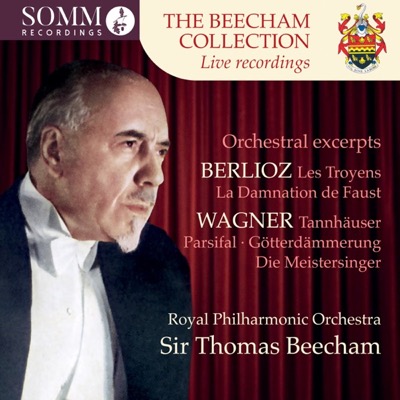
The Beecham Collection – Berlioz & Wagner: Orchestral Excerpts
Royal Philharmonic Orchestra, Sir Thomas Beecham, cond.
SOMM Recordings SOMM-Beecham 35
Official Website
For more of the best in classical music, sign up for our E-Newsletter