Once the modern early music field was established, one of its favourite composers was John Dowland. Rather than characterless songs setting undistinguished poetry, here was a composer who was known for his melancholy, for his dark sounds, and for an entire genre of crying songs (predating Johnnie Ray by centuries).
In this new recording by tenor Kieran White, with Cédric Meyer on lute, we revisit a beloved genre with music by two distinct masters: John Dowland (1563–1626) and John Danyel (1564–ca 1626). One characteristic of Renaissance lute song, as it has developed over time, has been its increasing freedom. Singers are more inspired to add trills and runs to held notes, thus bringing the genre to life.
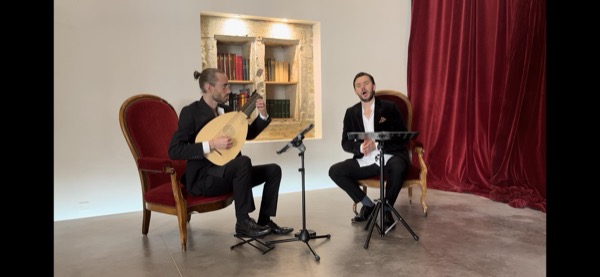
Kieran White and Cédric Meyer
John Dowland is represented by songs from just over a decade of Dowland’s works, with selections from the first, second, and third books of airs (1597, 1600, 1603) and 1610’s A Musical Banquet. The other composer on the recording, John Danyel (1564–ca 1626), a far less well-known composer, is represented by 6 works, and the recording invites us to reconsider him in relation to Dowland. Andrew King, in his notes to this album, says that the Danyel / Daniel family wealth made it unnecessary for Danyel to earn a living from his music; there was no need to publish. However, we should note that Thomas Tomkins (1572–1656) dedicated one of the madrigals in his Songs of 3.4.5. & 6. Parts of 1622 to both Dowland and Danyel. Other dedicatees in the collection include Orlando Gibbons and William Byrd, as well as John Coprario and William Heyther (first music professor at Oxford), so they were in distinguished company.
All the songs on this recording seem to be part of the Lacrimae tradition of songs about weeping and unhappiness. Dowland was well aware of his propensity for these kinds of songs, making the joke of it in the lute piece Semper Dowland, semper dolens (Always Dowland, always doleful). Even Danyel’s music follows this line, culminating in the extraordinary three-part song Mrs M.E. her funeral tears for the death of her husband. Neither the identity of Mrs. M.E. nor her husband is known, but in the work, where every verse declares that her heart will “Pine, fret, consume, swell, burst and die’.
The performance by Kieran White shows off his beautiful high tenor voice and, indeed, the works have been transposed to better fit his voice. He would benefit, however, from a better reading of the lyrics, particularly where certain words are used in the poetry and could be set off better in the performance. In Dowland’s Flow My Tears, for example, the inclusion of the word ‘hell’ at the end has been used by performers such as Rogers Covey-Crump as a focus for an incredible amount of pain in one word, completely transforming the ending. That kind of inner read is missing here.
For the Danyel songs, we encounter a composer who stands down from Dowland’s accomplishments. His sole publication, Songs for the Lute, Viol, and Voice of 1606, gives us songs that are akin to Dowland’s work, but without the grasp of what can be conveyed in the melodies.
There are some glimpses of innovation in White’s application of word-painting to the songs, but he needs to be able to match, if not surpass, the great singers of this repertoire from the past. The lutenist, Cédric Meyer, provides a solid accompaniment and has 4 solo lute pieces by Dowland to perform as well. In many of the songs, there seems to be a note that just jars, such as in Time, cruel Time at 02:35.
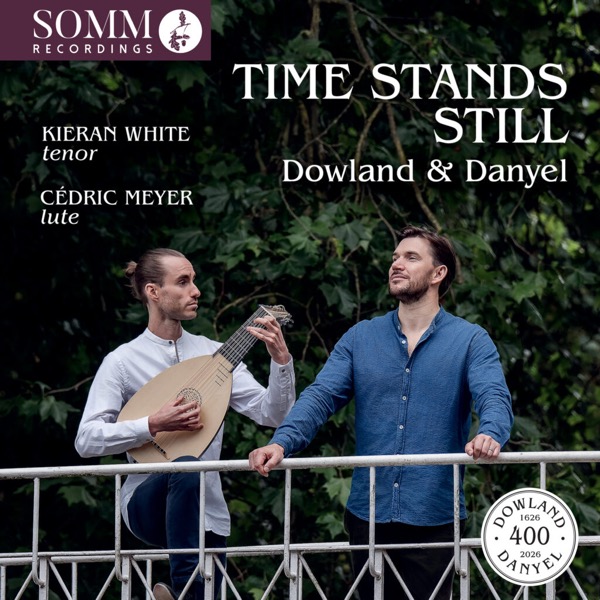
Time Stands Still: Dowland and Danyel
Kieran White, tenor; Cédric Meyer, lute
SOMM Recordings SOMMCD 0718
Release date: 13 March 2026
Official Website
For more of the best in classical music, sign up for our E-Newsletter