Franz Liszt was many things: the most celebrated piano virtuoso of the nineteenth century, a prolific composer, a conductor, a teacher, and a Catholic abbé.
He was also a prodigious letter-writer, and his correspondence reveals a mind that was restless, opinionated, and surprisingly self-aware.
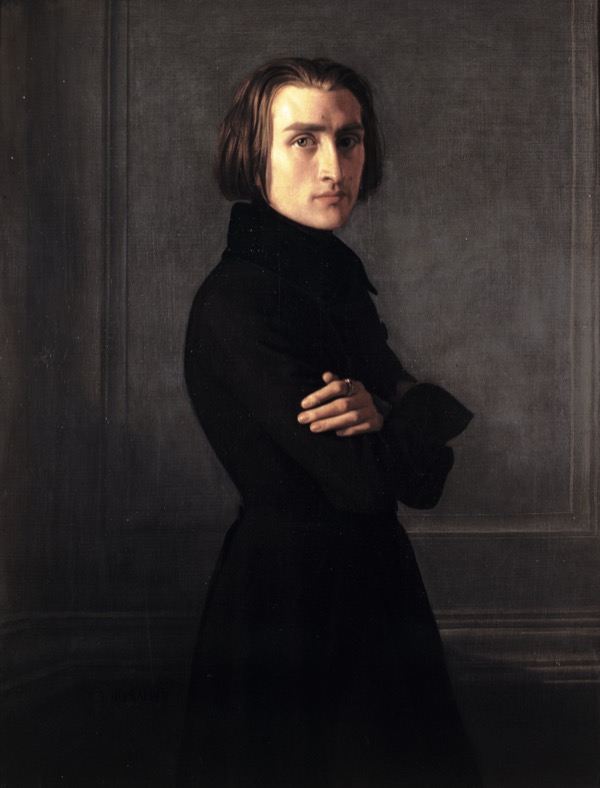
Franz Liszt
The quotes below are drawn from his letters and journals across six decades – from a frenetic young man pushing himself to the edge, to an old man who had outlived two of his children and most of his contemporaries.
Liszt on Other Composers
Liszt on Beethoven
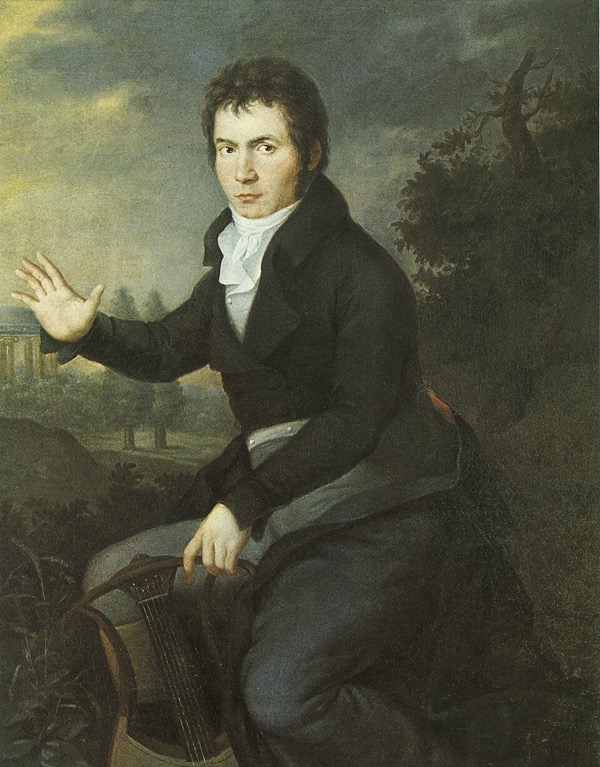
Ludwig van Beethoven, 1804 (Joseph Willibrord Mähler)
Beethoven wasn’t just an influence on Liszt and his contemporaries; he was a compass.
In 1852, Liszt reached for one of the most striking metaphors in his entire correspondence to explain what Beethoven’s music meant to him.
For us musicians, Beethoven’s work is like the pillar of cloud and fire which guided the Israelites through the desert – a pillar of cloud to guide us by day, a pillar of fire to guide us by night, “so that we may progress both day and night.” His obscurity and his light trace for us equally the path we have to follow; they are each of them a perpetual commandment, an infallible revelation.
– Liszt writing to his friend Wilhelm von Lenz, 1852 (age 41)
Liszt’s transcription of Beethoven’s Symphony No. 5
Liszt on Schumann
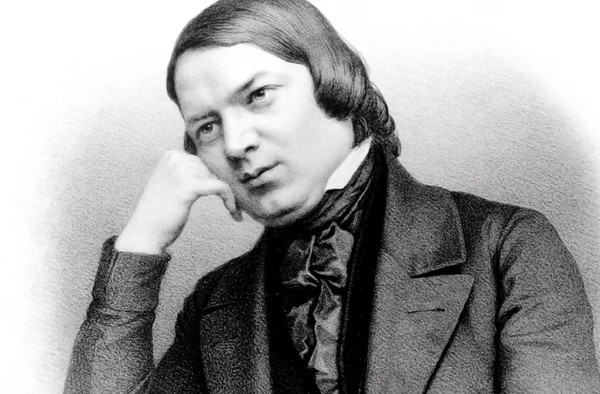
Robert Schumann
Liszt and Schumann both had great respect for one another. The specific and enthusiastic praise Liszt offered Schumann in the late 1830s is noteworthy.
[Your] Carnaval and the Fantasiestücke have interested me excessively. I play them really with delight, and God knows that I can’t say as much of many things. To speak frankly and freely, it is absolutely only Chopin’s compositions and yours that have a powerful interest for me. The rest do not deserve the honour of being mentioned…
– Liszt to Robert Schumann, 1838 (age 27)
As to the Kinderscenen, I owe to them one of the greatest pleasures of my life. You know, or you don’t know, that I have a little girl of three years old, whom everybody agrees in considering angelic (did you ever hear such a commonplace?). Her name is Blandine-Rachel… [She is] the most silent child, the most sweetly grave, the most philosophically gay in the world. I have every reason to hope also that she will not be a musician, from which may Heaven preserve her!
Well, my dear Monsieur Schumann, two or three times a week (on fine and good days!) I play your Kinderscenen to her in the evening; this enchants her, and me still more, as you may imagine, so that often I go over the first repeat twenty times without going any further.
– Liszt to Robert Schumann, 1839 (age 28)
Robert Schumann: Kinderscenen, Op. 15: VII. Träumerei (Dreaming) (Detlef Kraus, piano)
Liszt on Wagner
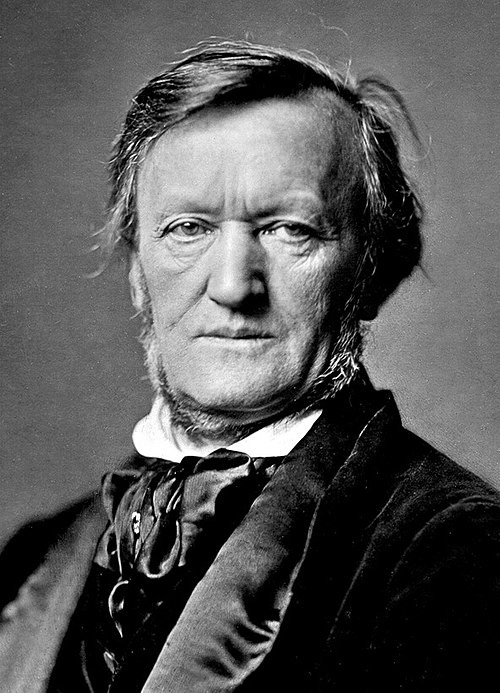
Richard Wagner
When Wagner arrived in Weimar in 1849 – a fugitive from the Dresden uprising, broke and politically radioactive – Liszt was one of the few people willing to receive him. Liszt’s assessment of Wagner was characteristically direct.
Richard Wagner, a conductor from Dresden, has been here since yesterday. That is a man of wonderful genius, such a brain-splitting genius indeed as beseems this country, – a new and brilliant appearance in Art.
– Liszt writing to his friend Gaetano Belloni, 1849 (age 38)
Liszt’s piano transcription of Wagner’s Liebestod from Tristan und Isolde
Liszt on Berlioz
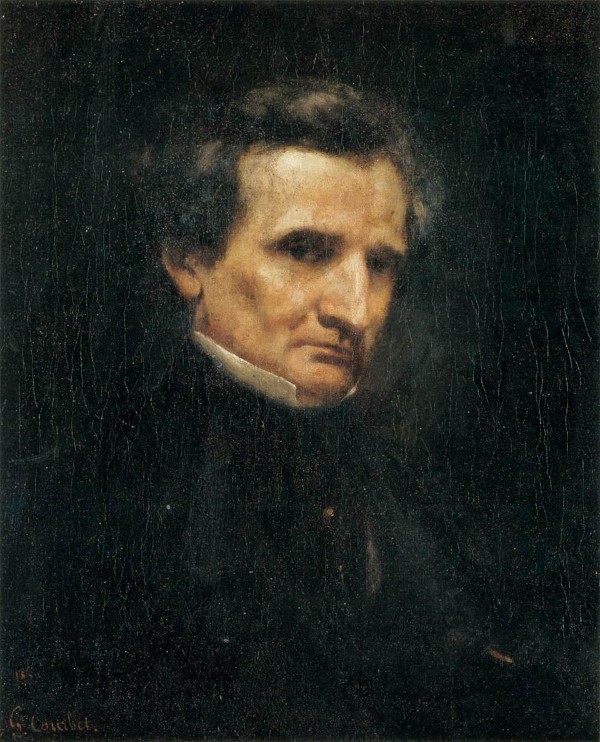
Gustave Courbet: Hector Berlioz, 1850 (Musée d’Orsay)
Liszt was one of Berlioz‘s most committed champions, programming his work at Weimar when almost no one else would. But his admiration came with clear-eyed conditions, as this letter shows.
But it will be necessary for you to have several rehearsals – and indeed separate rehearsals for the quartet, and separate rehearsals for the wind instruments. The effect of Berlioz’s works can only be uncommonly good when the performance of them is satisfactory. They are equally unsuited to the ordinary worthy theatre and concert maker, because they require a higher artistic standpoint from the musician’s side.
– Liszt writing to his friend Gustav Schmidt, 1853 (age 42)
Liszt on Craft and Difficulty
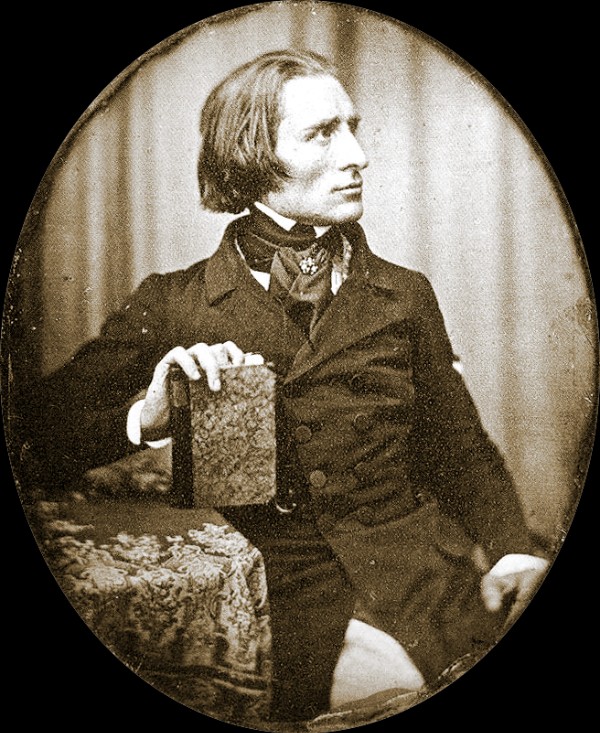
Franz Liszt, 1843 (photo by Herman Blow)
Liszt on What He Practised – and Read
At twenty-one, Liszt was in the middle of a period of ferocious self-reinvention – linking his studies of literature and music, reading everything, playing everything, pushing his pianistic technique to the edge of what was considered possible. This letter captures that frenetic youthful mood.
Here is a whole fortnight that my mind and fingers have been working like two lost spirits, – Homer, the Bible, Plato, Locke, Byron, Hugo, Lamartine, Chateaubriand, Beethoven, Bach, Hummel, Mozart, Weber, are all around me. I study them, meditate on them, devour them with fury; besides this I practise four to five hours of exercises (3rds, 6ths, 8ths, tremolos, repetition of notes, cadences, etc., etc.). Ah! provided I don’t go mad, you will find an artist in me!
– Liszt to his friend Pierre Wolff, Jr., 1832 (age 21)
Liszt on the Differences Between Publishing Music and Literature
Here Liszt made a quiet but pointed observation about the difference between how writers and composers treat publishing their own work.
In literature, the production of very much altered, increased, and improved editions is no uncommon thing. In works both important and trivial, alterations, additions, varying divisions of periods, etc., are a common experience of an author. In the domain of music such a thing is more minute and more difficult – and therefore it is seldom done. Nonetheless, I do consider it very profitable to correct one’s mistakes as far as possible and to make use of the experiences one gains from the editions of the works themselves.
– Liszt to his friend Alfred Dörffel, 1855 (age 44)
Liszt on Standing on Artistic Principles
This is one of Liszt’s most candid letters: a frank admission of a mistake he made during his concert touring years, and the lesson he drew from it.
The frequent ill-success of my performances of Schumann’s compositions, both in private circles and in public, discouraged me from including and keeping them in the programmes of my concerts which followed so rapidly on one another – programmes which, partly from want of time and partly from carelessness and satiety of the “Glanz-Periode” [Splendor Period] of my pianoforte-playing, I seldom, except in the rarest cases, planned myself, but gave them now into this one’s hands, and now that one, to choose what they liked. That was a mistake, as I discovered later and deeply regretted, when I had learned to understand that for the artist who wishes to be worthy of the name of artist the danger of not pleasing the public is a far less one than that of allowing oneself to be decided by its humors – and to this danger every executive artist is especially exposed, if he does not take courage resolutely and on principle to stand earnestly and consistently by his conviction, and to produce those works which he knows to be the best, whether people like them or not.
– Liszt to his friend J.W. von Wasielewski, 1857 (age 45)
Franz Liszt: Schumann — Liebeslied, S566/R253, “Widmung” (Louis Lortie, piano)
Liszt on How Much Pianists Should Program Him
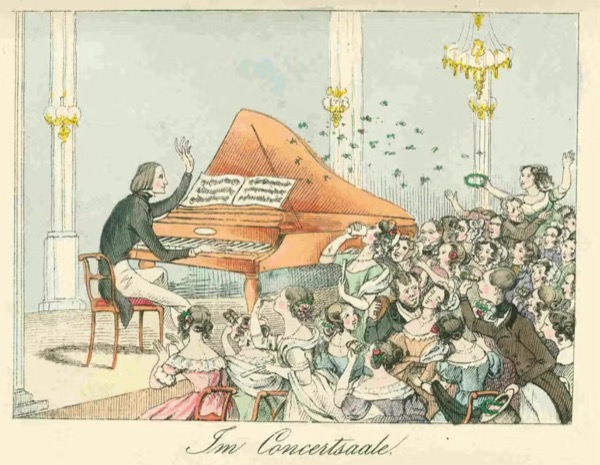
Liszt concert cartoon
Based on his exuberant, extroverted, virtuosic music, you might think that Liszt had a massive ego – but as this wry observation from his old age indicates, he had a noticeable streak of humility…or at least self-awareness.
An hour and a half of my pianoforte music, however admirably played, is more than sufficient.
– Liszt to his friend Jules de Zarembski, 1881 (age 70)
Liszt on Genius
Genius is the agency through which the supernatural is revealed to man.
– Liszt, date unknown
Liszt on People and Disappointment
Liszt on His Friends and Enemies
By 1838 Liszt was famous enough to have accumulated a significant number of people who wanted something from him. He had taken their measure.
I know that a great many of the people who approach me with a smile on their lips, and protestations of friendship on their tongues, have nothing better to do than to pull me to pieces as best they can as soon as they are outside my door. It is, moreover, the fate of all the world. I resign myself to it willingly, as I do to all the absurd and odious necessities of this lower world. There is, besides, just this much good in these sad experiences of various relations with men – which is, that one learns to relish and appreciate better the devotion of the few friends whom chance has thrown in your path.
– Liszt to his friend Simon Lowy, 1838 (age 27)
Liszt on Useless People
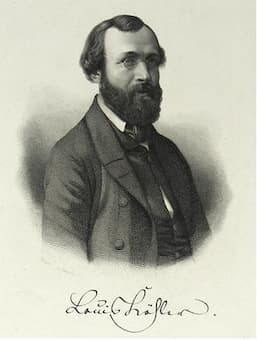
Christian Louis Köhler
Liszt wrote this complaint to his friend Louis Kohler in 1853. By that time, he’d largely retired from the concert stage in favour of composing and leading the Weimar court orchestra, but he still had issues budgeting his time and energy.
Suppose I could only dispose of my time better! But it is a wretched misery to have to spend one’s time upon so many useless things and people, when one’s head is quite full of other things! – Well, it must be so.
– Liszt to his friend Louis Kohler, 1853 (age 42)
Liszt on Suffering
By the end of his life, Liszt had survived several personal losses and tragedies. Late in life, he became reflective about how to grapple with them.
Suffering, pain, and sorrow are the lot of mankind… Since we all must live and die, let us know how to do so in noble simplicity.
– Liszt to his friend Olga Von Meyendorff, 1881 (age 70)
Liszt on Making the Most of Life
Two quotes, fifty-nine years apart. The first comes from his journal at sixteen; the second recorded by his student Arthur Friedheim when Liszt was seventy-five. His desire to live life to its fullest never changed.
Wasting time is one of the worst faults in the world. Life is so short, every moment is so precious; yet we live as if life will never end.
– Liszt in his journal, 1827 (age 16)
You are inclined to come too late. Beware of missing chances; otherwise it may be altogether too late someday.
– Liszt as quoted by student Arthur Friedheim, 1886 (age 75)
Liszt’s Bagatelle sans tonalité, 1885
Conclusion
What strikes you, reading Liszt’s letters across the span of his life, is how consistent he was.
The twenty-one-year-old devouring Homer and Bach and pushing himself to madness is recognisably the same person as the seventy-five-year-old warning his student not to come too late.
His appetite for art, music, and life never dimmed. Neither did his clarity about what mattered – and what didn’t.
For more of the best in classical music, sign up for our E-Newsletter