As you make your way around the musical world, you start with the easy ones – a bit of Haydn, some Mozart, a venture into Beethoven. Then what? As your tastes mature and you desire something more, there’s Mahler. Each of his symphonies is interesting in its own unique way, and they have been described as ‘full of iconic moments, larger-than-life (and fervently argued) stories, and innovations (formal, conceptual, and in their approach to instrumentation)’. In addition, they are filled with as much emotion and life as with death. Explore Mahler’s 10 with us in celebration of Mahler’s birthday on 7 July.
As with so many composers’ first symphonies, Mahler’s First Symphony was some time in the making. And his concept, with two folk dance movements followed by a funerary movement, was problematic for its first audience. Symphony No. 1 in D major, given the nickname of Titan, started life in some early compositions, but it wasn’t until late 1887 that he worked on the body of the symphony and brought everything together. It was completed in March 1888 and was given its premiere in Budapest, Hungary, in 1889.
After the lacklustre reception of the premiere, Mahler went back and revised it and brought it back to the stage in October 1893 in Hamburg. Before the work was published in 1898, Mahler made further revisions.
For the first 3 performances of the work (Budapest, Hamburg, and Weimar), an additional movement, Blumine, was inserted between movements 1 and 2. This was dropped and wasn’t used after the 1894 Weimar performance, and wasn’t found until 1966. Some performances include this additional movement, but most do not; they may play it separately. It’s important to know about Blumine because Mahler includes references to its main theme in the second movement and in the final movement.
Mahler gave the work the name Titan, taken from a novel of the same name by Jean Paul. He applied it only to the 1893 Hamburg and 1894 Weimar versions of the work; by the time of its publication in 1898, that title had been dropped.
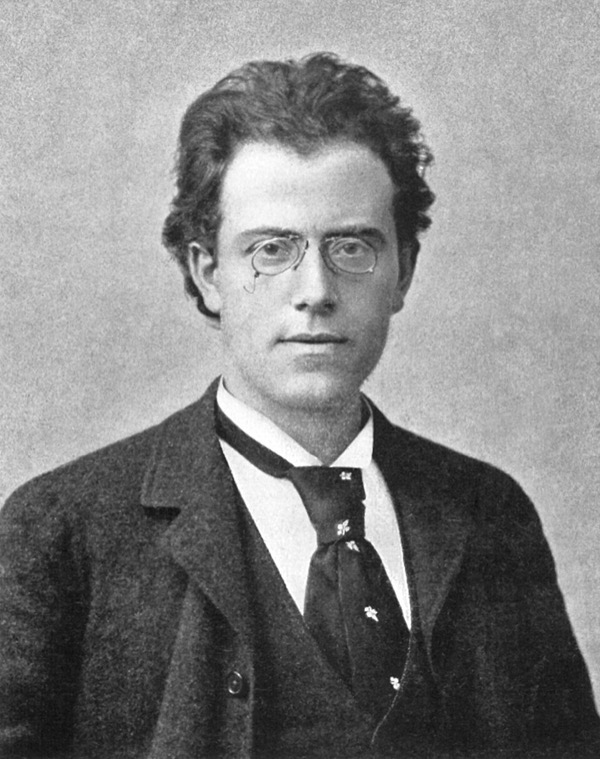
Leonard Berlin: Gustav Mahler, 1892
Gustav Mahler: Symphony No. 1 in D Major, “Titan”: I. Langsam, schleppend (Baltimore Symphony Orchestra; Marin Alsop, cond.)
Mahler started work on his Symphony No. 2 in C minor in 1888 and worked on it after the premiere of Symphony No. 1. He completed work on it in 1894, and it was given its premiere in 1895. The drama is inherent in the work from the first note.
Known as the Resurrection symphony, the work ‘contemplates life and death on a cosmic scale, culminating in an ecstatic hymn of resurrection’. Even Mahler, after the early rehearsals, modestly noted its effect: ‘One is battered to the ground and then raised on angel’s wings to the highest heights’.
The first movement began as the sequel to Symphony No. 1, a symphonic poem titled Todtenfeier (Funeral Rites). If Titan was the musical portrait of a hero, then Todtenfeier was the music for his funeral. However, when he played it for his mentor, Hans von Bülow, von Bülow’s reaction to its overly histrionic qualities (it made Tristan und Isolde sound like a Haydn symphony!) made Mahler reconsider it as a separate work and fold it into his Second Symphony.
Gustav Mahler: Symphony No. 2 in C Minor, “Resurrection”: I. Allegro maestoso (Sydney Symphony Orchestra; Simone Young, cond.)
Already in his 2nd symphony, Mahler was looking for additional material and so included sung texts, requiring 2 soloists (a soprano and an alto) and a chorus for later movements.
By Symphony No. 3, Mahler was finding his place in the symphonic world. He started work on the sketches in 1893, spent most of 1895 putting most of it together, and completed it in 1896. At six movements, it’s already beyond the normal 4-movement symphony, and he again adds a soprano soloist and choir to the orchestra. At the end, the symphony is the longest written by a major composer, with a giant first movement that, luckily, is followed by shorter movements.
The work was written to a programme that he described in 1896 as ‘A Summer’s Midday Dream’ with movements entitled
I. Pan Awakes, Summer Marches In
II. What the Flowers in the Meadow Tell Me
III. What the Animals in the Forest Tell Me
IV. What Man Tells Me
V. What the Angels Tell Me
VI. What Love Tells Me
A final movement, VII. What the Child Tells Me was dropped and made its way into his next symphony.
All of these titles were dropped before the work was published in 1896.
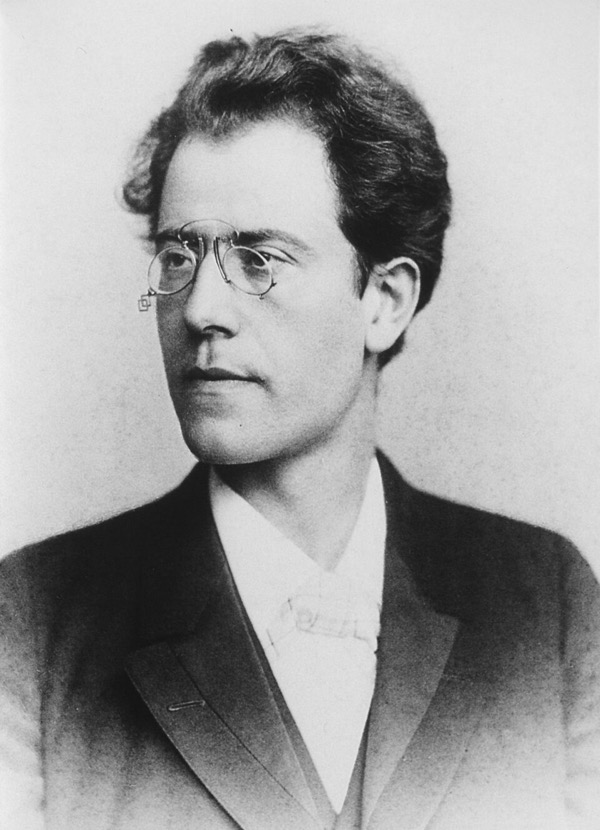
Gustav Mahler, 1896
Gustav Mahler: Symphony No. 3 in D Minor: VI. Langsam. Ruhevoll. Empfunden (New York Philharmonic Orchestra; Leonard Bernstein, cond.)
After the solemnity of Symphony No. 3, the next symphony is a delicate dancing delight. He composed the work from 1899 to 1900 and included the child’s view of heaven that was first intended for Symphony No. 3. He returns to standard orchestral forms: a first movement sonata form, a second movement scherzo, and theme and variations for the third movement and then his innovative final movement, for solo voice and orchestra, a symphonic first.
The final movement is a set of strophic variations, with the soprano singing the verses with orchestral refrains. The text describes the joys of heaven, using the text ‘Das himmlische Leben’ (The Heavenly Life) from Des Knaben Wunderhorn. The bells come from the opening of the first movement, and the whole work seems filled with a curious innocence.
At the end, our child falls asleep, knowing that ‘all things awake to joy’.
Gustav Mahler: Symphony No. 4 in G Major: IV. Sehr behaglich (Edith Mathis, soprano; Berlin Philharmonic Orchestra; Herbert von Karajan, cond.)
Symphony No. 5’s opening trumpet call (which originated in Symphony No. 4) tells us immediately that we’re in a new world. Rhythms reminiscent of Beethoven’s Symphony No. 5 are everywhere.
This symphony was written in the summers of 1901 and 1902 in his lakeside villa in Carinthia, Austria. His new country villa provided him with a place of rest and relief from his duties in Vienna, and a ‘composing’ hut for working.
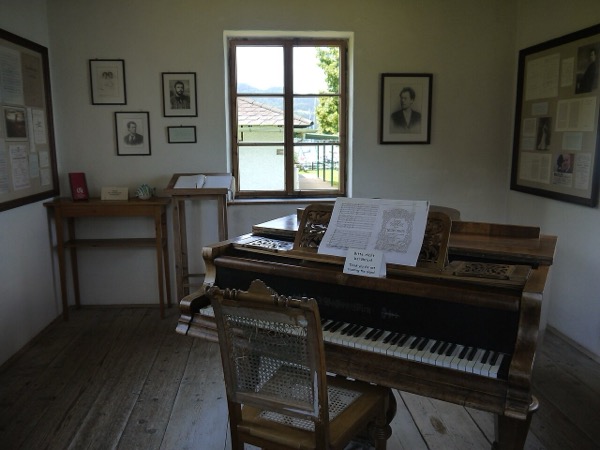
Thomas Ledl: Mahler’s piano in his composing hut, Maiernigg, Austria, 2013
Symphonies 5, 6 and 7, all composed during his summers out of Vienna, have certain similarities, the most striking of which is the lack of a vocal voice. What is also striking is Mahler’s study of the works of J.S. Bach, which shows an increasing emphasis on counterpoint, i.e., ‘the relationship of two or more simultaneous musical lines (also called voices) that are harmonically dependent on each other, yet independent in rhythm and melodic contour’.
The fourth movement, the Adagietto, was written in honour of his new wife, Alma Schindler, whom he met in November 1901 and married in March 1902. Their first child, Maria Anna, was born in November 1902.

Alma Mahler and the daughters Maria (at left) and Anna (at right), c. 1906
The fourth movement, given the unusual title Adagietto, is often performed on its own, a signal honour for a symphonic movement. It’s been described as ‘an exquisitely poetic meditation on the deepest sensations of feeling alive in the universe, of having a place in the boundlessness and beauty of divine creation’. It’s also been called a ‘love song without words’, to be delivered to Alma’s ear alone.
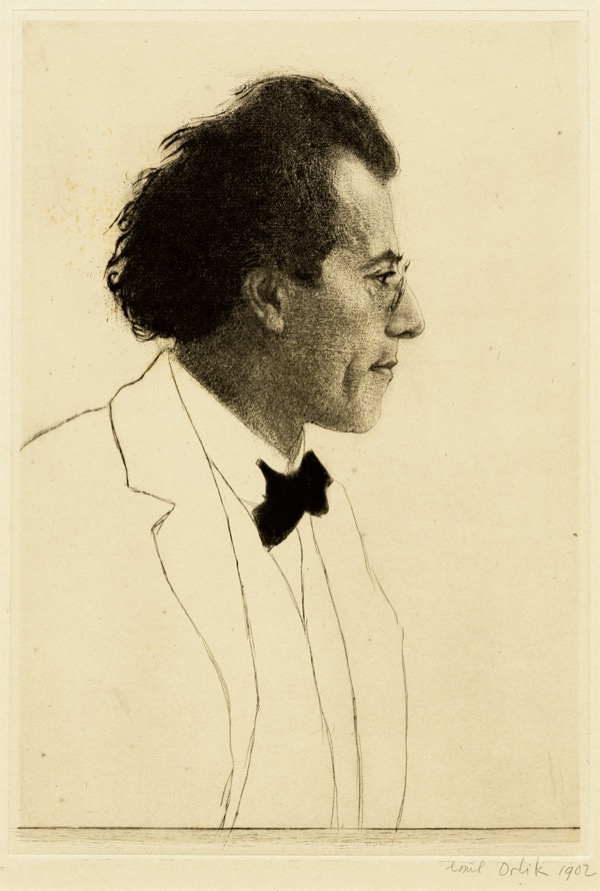
Emil Orlík: Gustav Mahler, 1902
Gustav Mahler: Symphony No. 5 in C-Sharp Minor: IV. Adagietto (Chicago Symphony Orchestra; Claudio Abbado, cond.)
Symphony No. 6 was another of his summer projects, written in 1903 and 1904. It bears the nickname Tragic, although the source of the name is unclear.
At work, Mahler was facing increasing difficulties. He was appointed director of the Hofopera (Vienna State Opera) in October 1897, and immediately the criticism started: he’s too young (38 years old), his first opera was Smetana‘s Dalibor, and immediately questions arose from the nationalists asking why he was ‘fraternising with the anti-dynastic, inferior Czech nation’. His conducting style was seen as histrionic and dictatorial (forgetting the fact that he had vastly improved standards).
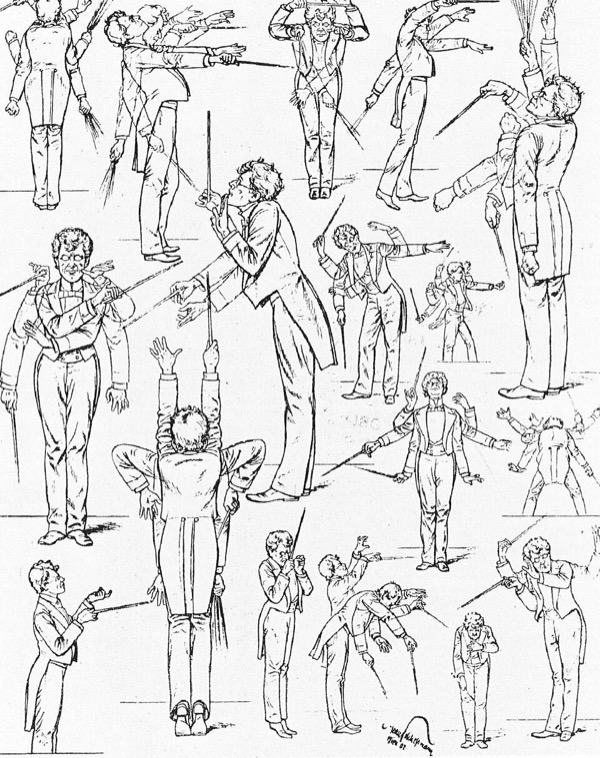
Hans Schließmann: Caricature of Mahler’s conducting style at the Vienna State Opera, 1901 (Fliegende Blätter)
His Jewish background was also suspect, ignoring the fact that he had converted to Catholicism. The anti-Semitic press wondered if he was truly capable of performing true German works.
Alma Mahler, in her book of Memories and Letters, associated the last movement with tragedy, saying that Mahler himself saw the movement as depicting ‘…the hero on whom fall three blows of fate, the last of which fells him, as a tree is felled’.
Gustav Mahler: Symphony No. 6 in A Minor, “Tragic”: IV. Finale: Allegro moderato – Allegro energico (London Philharmonic Orchestra; Klaus Tennstedt, cond.)
The final symphony of this period was his Seventh, composed in 1904 and 1905, sometimes titled Lied der Nacht (Song of the Night).
By 1904, Mahler’s reputation as a composer was starting to rival his reputation as a great conductor. He again returned to his composing hut for the summer’s work on this piece, completing the score in August 1905 and the orchestration in 1906. The work was given its premiere in Prague with the Czech Philharmonic on 19 September 1908.
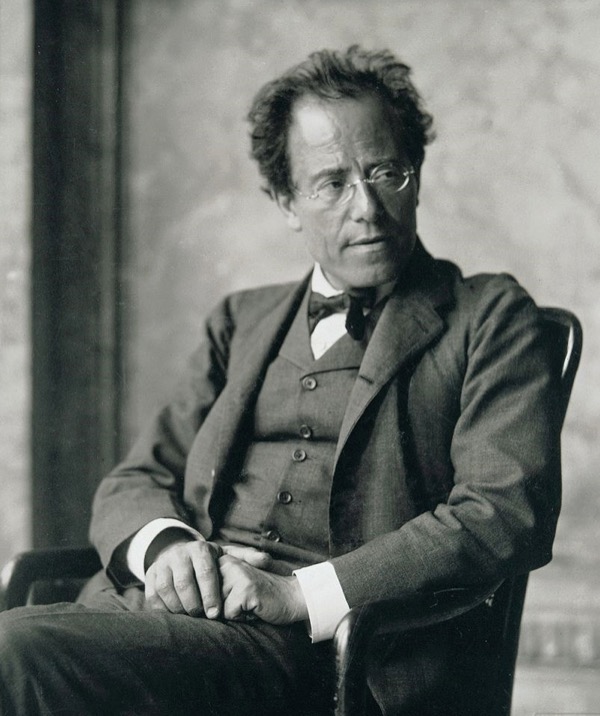
Moritz Nähr: Gustav Mahler, 1907
When he started the work, he was the director of the Vienna State Opera. When the work had its premiere, he had resigned from Vienna and taken up a four-year appointment in New York to conduct at the Metropolitan Opera. He made his Met debut on 1 January 1908 with Wagner’s Tristan und Isolde. He shared conducting duties with Arturo Toscanini. He also conducted three concerts with the New York Symphony Orchestra, a rival to the New York Philharmonic. This return to orchestral conducting convinced him to take up the position of principal conductor with the New York Philharmonic in 1909. With new support from a group of Guarantors, the Philharmonic’s season was expanded from 8 to 54 concerts and included a tour of New England. Mahler led the Philharmonic until his unexpected death in 1911.
Gustav Mahler: Symphony No. 7 in E Minor: I. Langsam – Allegro con fuoco (Bavarian Radio Symphony Orchestra; Bernard Haitink, cond.)
Mahler’s Symphony No. 8 was composed in a single writing burst during the summer of 1906. It was given its premiere by the Munich Philharmonic in September 1910, with the composer conducting.
With this work, he brings the voice back to the orchestra. The performing forces are enormous, and it was quickly dubbed ‘Symphony of a Thousand’; Mahler hated the name. This return to song and symphony, as we saw in his early symphonies, and, like those symphonies, this work breaks all the rules. It’s not in 4 movements but in 2 parts, covering 24 movements. The first part is based on the Latin hymn Veni creator spiritus (“Come, Creator Spirit”), a ninth-century hymn for Pentecost, and Part II takes the distinctly secular theme from Goethe‘s Faust, setting the words from the play’s closing scene. The parts are joined by the shared idea of love’s power and its role in redemption.
The work was Mahler’s expression of confidence in the human spirit, and one critic views it as equivalent to Beethoven’s Symphony No. 9 as the ‘defining human statement for its century’.
The opening of the first part is a glorious declaration from the chorus.
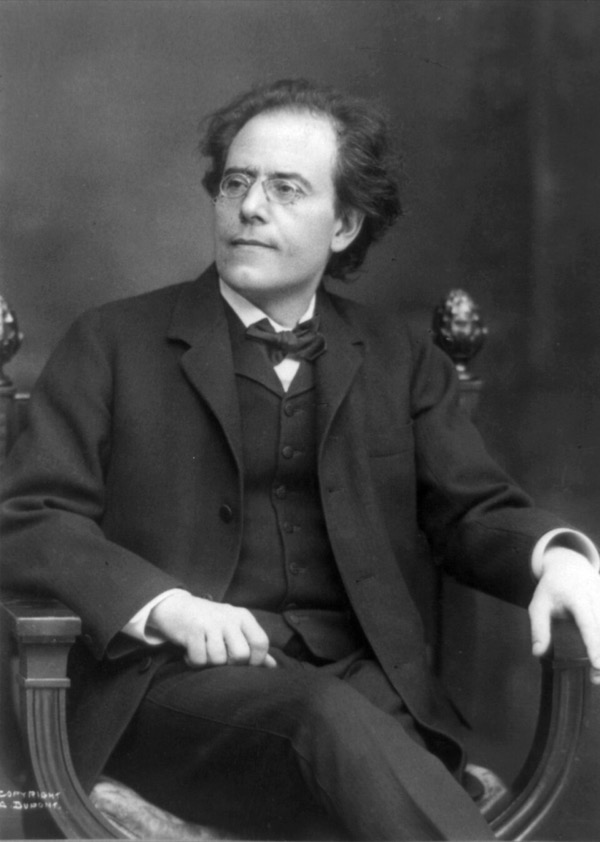
Dupont: Gustav Mahler, 1909
Gustav Mahler: Symphony No. 8 in E-Flat Major, “Symphony of a Thousand”: Part I: Veni, creator spiritus (Minnesota Chorale; National Lutheran Choir; Minnesota Orchestra; Osmo Vänskä, cond.)
The opening of Part II takes us to a much darker world.
Gustav Mahler: Symphony No. 8 in E-Flat Major, “Symphony of a Thousand”: Part II: Final Scene from Faust: Poco adagio (Minnesota Orchestra; Osmo Vänskä, cond.)
This was the last of Mahler’s works to be given its premiere in his lifetime. Two more works were to follow.
Symphony No. 9 was written between 1908 and 1909. While he has returned to 4-movement form, he breaks the rules by making the first and last movements slow (Andante and Adagio) rather than the normal Allegro.
In the second movement, Mahler returns to the Austrian countryside with a movement based on the ländler. However, as the movement continues, our happy and optimistic folk dance changes and distorts. A big-city waltz interrupts, and at the end, we return to our countryside dance, but not with the same opening innocence.
Gustav Mahler: Symphony No. 9 in D Major: II. Im Tempo eines gemächlichen Ländlers – Etwas tappisch und sehr derb (Stuttgart Radio Symphony Orchestra; Roger Norrington, cond.)
Mahler began writing his 10th symphony in 1910 and, at his death in 1911, left the work unfinished. The work was substantially complete but had not been elaborated or orchestrated. It wasn’t performable as it was left, and early attempts to create performing editions were unsatisfactory.
British musicologist and Mahler expert Deryck Cooke started working on his edition in 1959 and completed it in 1976. Alma Mahler at first forbade him to work on the material, but was eventually persuaded to change her mind after seeing his score and hearing a recording.
The work received its premiere at the BBC Proms on 13 August 1964, after which the family gave Cooke access to more of Mahler’s sketches, and he revised his version twice more, completing a final version in 1976.
Gustav Mahler: Symphony No. 10 in F-Sharp Major (performing version by D. Cooke): I. Andante: Adagio (South West German Radio Symphony Orchestra, Baden-Baden; Michael Gielen, cond.)
Mahler had been diagnosed with heart problems in 1907, shortly after his first daughter died of scarlet fever and diphtheria. Mahler was supposed to avoid over-fatigue, but how much he could do this as an active conductor remains a question. He held his last concert in New York at Carnegie Hall on 21 February 1911, whereupon he was confined to a hospital with bacterial endocarditis, common in people with cardiac problems. He returned to Europe by boat and arrived in Paris 10 days later. He entered a French clinic in Neuilly, France. On 11 May, he was at the Löw sanatorium in Vienna, where he developed pneumonia and died on 18 May 1911, at the age of 50.
We celebrate his birth on 7 July 1860 and recognise that Mahler changed our concept of symphonic music forever by expanding its horizons from simply orchestral to one that encompasses the world.
For more of the best in classical music, sign up for our E-Newsletter