The Mexican artist Frida Kahlo (1907–1954) was one of the first women artists who changed the role of women in art. She illustrated concepts and ideas rarely explored by male artists to the foreground in her work, including chronic pain, postcolonialism, gender, and class. She also mixed realism and fantasy, adding in strong autobiographical elements.
Born on 6 July 1907 in Coyoacán, Mexico, of a German father and a Mexican mother, she found her way to art at an early age. Her father’s friend, the printmaker Fernando Fernández, gave her drawing instruction, and after high school graduation, she became an assistant to Fernández. He found her talented, but she didn’t feel art was her field.
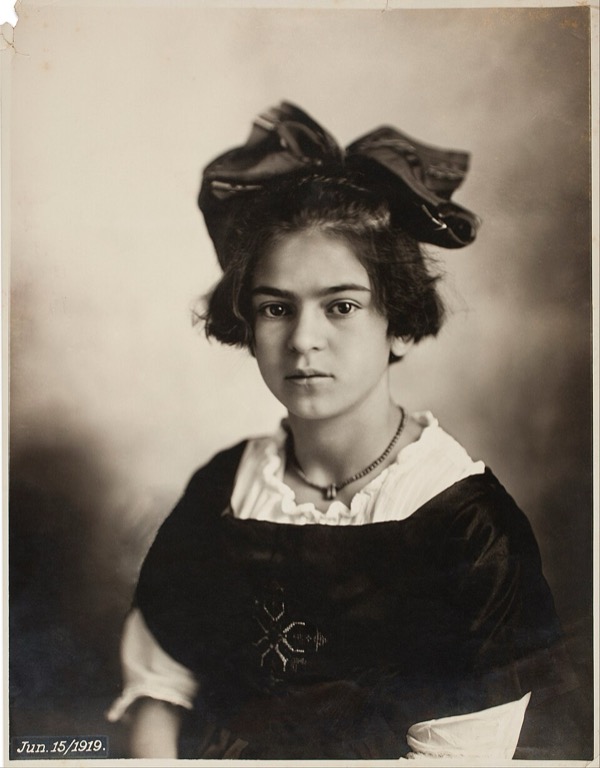
Guillermo Kahlo: Frida Kahlo age 11, 1919 (Museo Frida Kahlo)
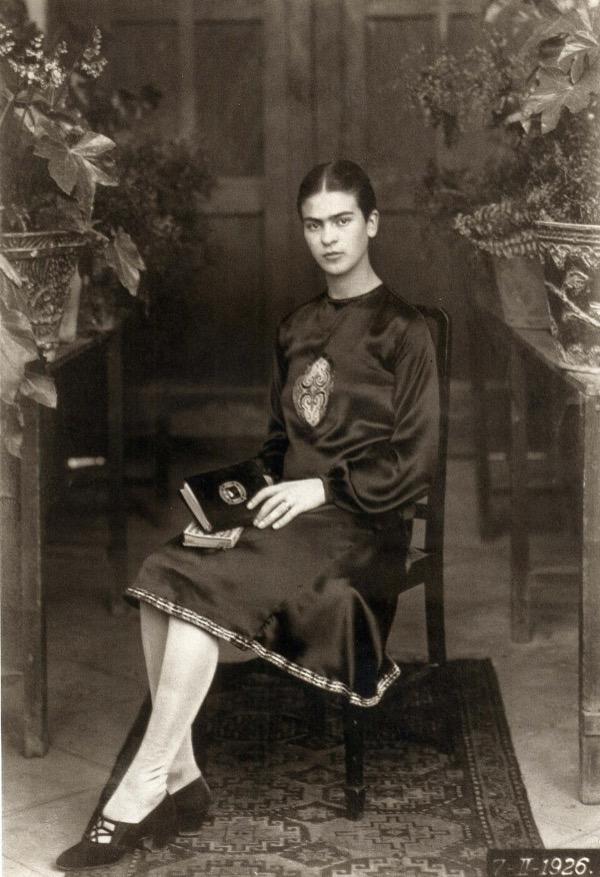
Carl Wilhelm Kahlo Kauffmann: Frida Kahlo at age 18, 1926 (Washington Post)
A bus accident when she was 18 left her in lifelong pain. Forced to remain in bed for the three months after the accident, she began to paint. Her mother made her an easel that permitted her to paint in bed, and she put a mirror above the easel. This permitted her to focus on the liveliest thing in the room, herself, as she waited in isolation for her recovery.
Confined to bed, her early subjects were herself, her sisters, and her school friends who visited. Her inspirations were Renaissance artists such as Botticelli and Bronzino, and avant-garde styles such as Cubism. She was the third wife of Mexican artist Diego Rivera (1886–1957), who was 21 years older and an established international artist. They married in 1929.
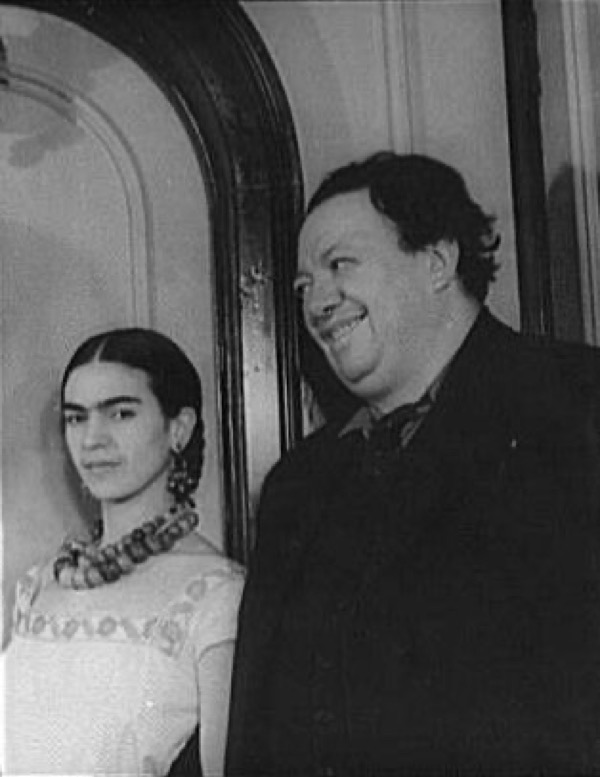
Carl Van Vechten: Frida Kahlo and Diego Rivera, 1932 (Library of Congress, LC-USZ62-42516 DLC)
Their life was passionate and high-spirited. Their mutual infidelities and his temper resulted in their divorce in 1939; their passion meant that they remarried in 1940 and remained together until her death in 1954.
As an artist, Kahlo became increasingly focused on drawing her inspiration locally, rather than from Europe. Mexican folk art, with its lack of perspective and its combination of pre-Columbian and colonial elements, made time become as flat as the perspective.
The couple moved to San Francisco, CA, in 1930 where Kahlo met some of the West Coast’s leading artists, including Edward Weston. She further developed her artistic style, and had her first painting exhibited in San Francisco.
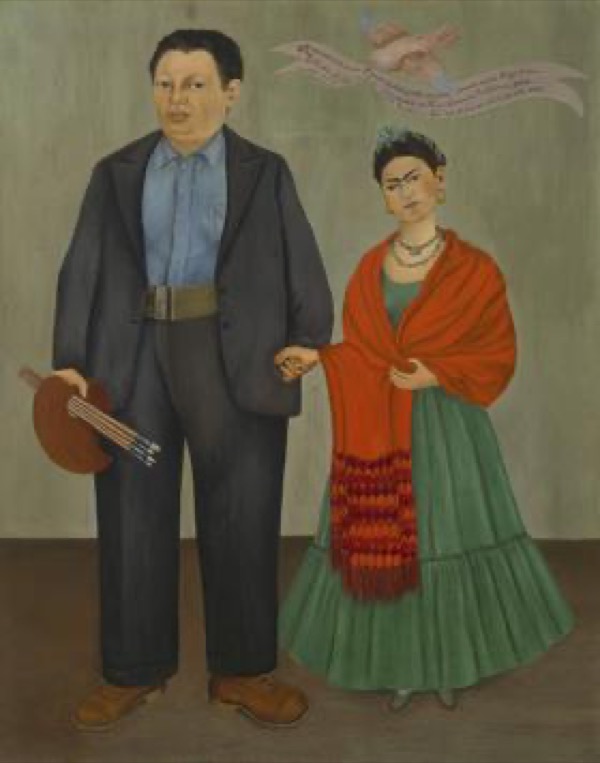
Kahlo: Frida y Diego Rivera, 1931 (San Francisco Museum of Modern Art (SFMOMA))
From San Francisco, the couple moved to Detroit, where Diego worked on his 27-mural series known as the Detroit Industry Murals. She used her time to develop her artistic style, experimenting beyond painting into etchings and frescoes. She began to work on the narrative of a painting and placed emphasis in her works on ‘terror, suffering, wounds, and pain’.
Frida’s health was always poor, and a failed pregnancy in Detroit and other body problems meant that upon her return to Mexico City in 1934, she didn’t paint much for two years. Starting in 1937, however, her inspiration returned, and she became extremely productive. She had an exhibition in Mexico in 1938 and started making important sales, including 4 paintings to the actor Edward G. Robinson. Commissions by wealthy Americans while she was in New York for her first solo exhibition proved lucrative, and she went next to Paris in January 1939 at the invitation of André Breton. Her exhibition there was problematic. Breton had lost his gallery and hadn’t cleared her paintings through customs. She got the help of Marcel Duchamp and arranged for a show at the Renou et Colle Gallery. The Gallery, however, considered her paintings too shocking and only showed 2 of her pieces. Breton interfered with her exhibition and filled the empty spaces with photographs by Manuel Álvarez Bravo, pre-Columbian sculptures, and other works that she considered junk that Breton had bought in the markets while he was in Mexico.
The exhibition was a failure, and a follow-up exhibition in London was cancelled. War loomed on the horizon. One good outcome of the Paris exhibition was the Louvre’s purchase of The Frame, making her the first Mexican artist in their collection.
With her return to the US in 1941, her artistic star continued to rise. She was featured in an exhibition in Boston, was part of two important exhibitions in New York, was part of a Mexican exhibition in Philadelphia, and was in the exhibition of women artists (Exhibition by 31 Women) at Peggy Guggenheim’s The Art of This Century gallery in New York in 1943.
In 1943, Kahlo returned to Mexico and taught at the ‘recently reformed, nationalistic’ Escuela Nacional de Pintura, Escultura y Grabado, “La Esmeralda”, in Mexico City. She had a number of private client commissions and, by the mid-1940s, no group exhibition in Mexico was without her representation. Her health continued to fail, and an operation to strengthen her spine failed. She increasingly worked from home and held her classes there, too. Her style intensified, and her use of colour became brighter.
Unsuccessful operations on her back, an amputated leg, recurring infections, and her constant pain drove her to commit suicide on 13 July 1954, at age 47, a week after her birthday.
It was with her rediscovery in the 1970s that Frida started emerging from the shadow of Diego Rivera. While she was in the US in the 1930s, as seen in her picture above, she depicted Diego as the artist and herself as his support.
One of the most significant works of music based on her art was a 7-movement suite for guitar duo by the Italian composer Simone Iannarelli (b. 1970), based on seven paintings by Kahlo. He sees it, much like Mussorgsky did, as a promenade around an exhibition.
The composer writes:
This work for two guitars, in the form of a suite, is a promenade over seven iconic pictures of the famous Mexican painter Frida Kahlo. Each piece tries to recreate the images, atmosphere, inside feelings or background of these works of Frida. Sometimes these are more descriptive, as in Unos cuantos piquetitos (‘A Few Small Nips’) and Mi nacimiento (‘My Birth’), through the use of special guitar effects to catch the inner suffering of the artist, or, as in Las dos Fridas (‘The Two Fridas’), use imitative (canon) style. Other times they are more oneiric (surrealistic), as in Lo que vi en el agua (‘What I Saw in the Water’), or El sueño (‘The Dream’), using harmonies borrowed from Impressionism.
The first painting, variously titled Lo que vi en el agua (What I Saw in the Water) or What the Water Gave Me (Lo que el agua me dio) from 1938, has been called a biographical painting. Only her toes and her thighs appear in this self-portrait, while roots, plants, flowers, corpses, insects, birds and people she knew float and are reflected. What is in the water includes the Empire State Building in New York shooting out of a Mexican volcano, a skeleton resting on a hill, a faceless man strangling a woman, a floating naked female figure, and various forms from nature.
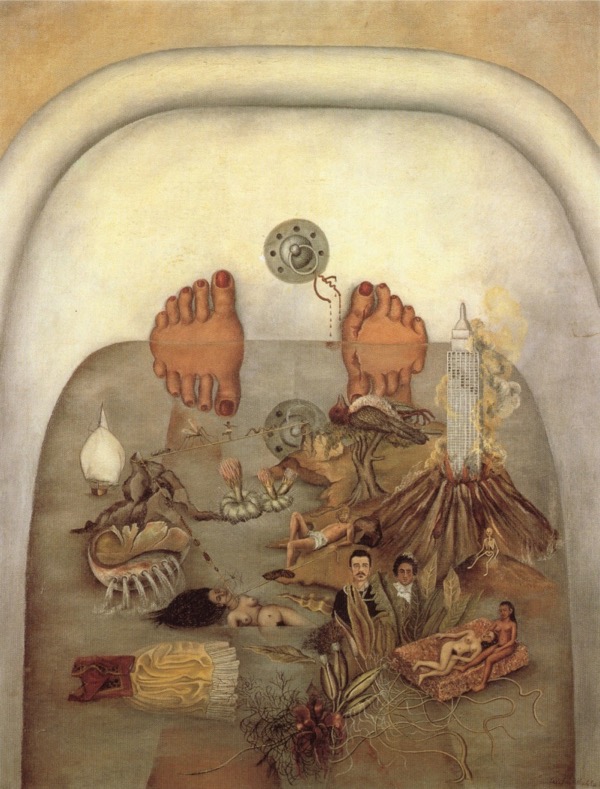
Kahlo: Lo que vi en el agua (What I Saw in the Water), 1938 (Paris: Collection Daniel Filipacchi)
Simone Iannarelli: Siete pinturas de Frida Kahlo, No. 1. Lo que vi en el agua (What I Saw in the Water) (ChromaDuo)
Unos cuantos piquetitos comes from a report in the paper about a man who murdered his girlfriend, stabbing her over and over again. Confronted about his crime, the murderer said in court, “But I just gave her a couple of little nips!” Kahlo’s painting says otherwise; the police report said 20 stab wounds. The woman’s body is turned in two different directions, and is still partially clothed in a single high-heeled shoe, an extravagant trim strap, and a fallen stocking. Aside from the brilliant colour of the blood, the painting is done in incongruous pastels. The pillowcase is elaborately trimmed. Two pigeons, one dark and one light, hold the title banner. Blood is everywhere – on the bed, the floor, his shirt and hands, and even on the frame of the painting.
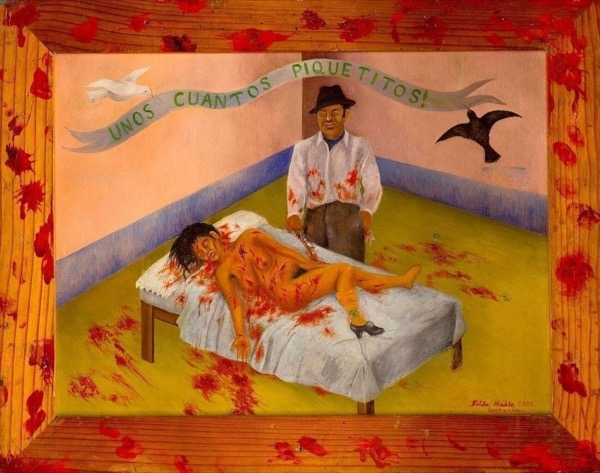
Kahlo: Unos cuantos piquetitos (A Few Small Nips), 1935 (Mexico City: Museo Dolores Olmedo)
In the music, the sound turns violent, with guitar slaps and an urgent tempo.
Simone Iannarelli: Siete pinturas de Frida Kahlo, No. 2. Unos cuantos piquetitos (A Few Small Nips) (ChromaDuo)
Completed in 1939 after her divorce from Diego Rivera, Las dos Fridas (The Two Fridas), shows the two Fridas, one on the left in a traditional Tehuana costume, with a broken heart, and the other in modern dress. The clouds behind are stormy and seem to reflect her feelings of ‘desperation and loneliness with the separation from Diego’.
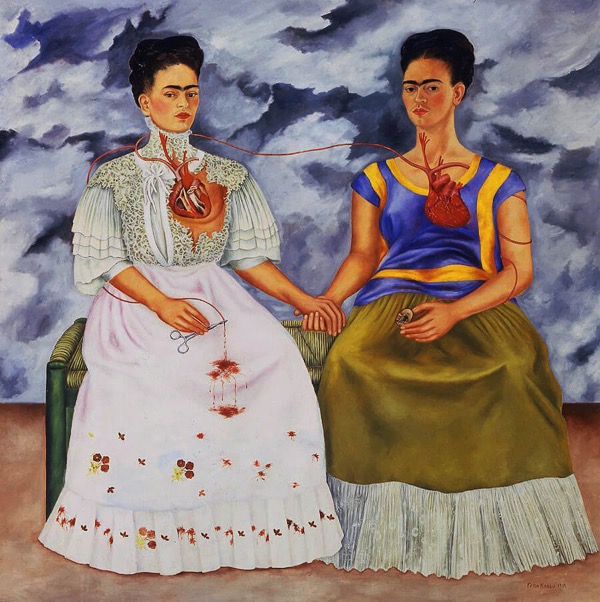
Kahlo: Las dos Fridas (The Two Fridas), 1939 (Mexico City: Museo de Arte Moderno)
In his music, Iannarelli gives us a sympathetic and emotional portrait of Kahlo’s feelings – release from the past and the promise of the future, tempered with regret. The movement seems to end on a question. He uses canon to show the two women.
Simone Iannarelli: Siete pinturas de Frida Kahlo, No. 3. Las dos Fridas (The Two Fridas) (ChromaDuo)
One of her most famous pictures is a self-portrait done in 1938. The glass frame, already decorated, was purchased in a village market. She added her own portrait, done on a sheet of aluminium. The frame, exuberantly painted in bright colours with birds (a traditional motif in Mexican folk imagery), sets off her image, which looks out uncompromisingly. The style is not unlike a religious icon.
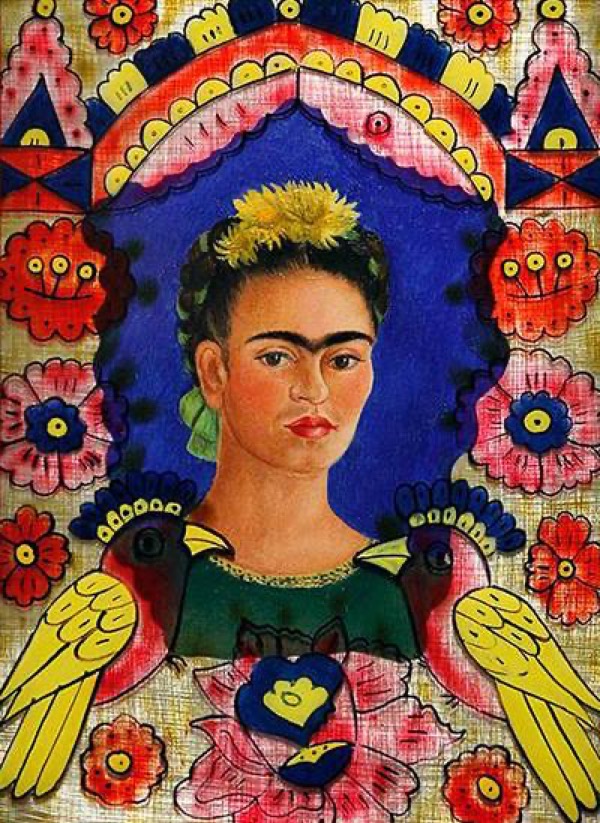
Kahlo: Autorretrato, “El Marco” (Self-Portrait, The Frame), 1938 (Paris: Musée National d’Art Moderne)
The picture was shown in Paris in January 1939 as part of a collective exhibition entitled Mexico, organised by the surrealist André Breton. This picture was sold to the Louvre and was her first sale to a high-profile collection.
Iannarelli’s music seems to take us into a dream state, with a plucked melody emerging from the air to become a lyrical statement against an arpeggiated backdrop.
Simone Iannarelli: Siete pinturas de Frida Kahlo, No. 4. Autoretrato, “El Marco” (Self-Portrait, “The Frame”) (ChromaDuo)
Sleep, death, life and dreams all come together in Kahlo’s 1940 painting, El sueño (La cama) (The Dream (The Bed)). In the bed, Kahlo sleeps, intertwined in ivy. It creeps up from the foot of the bed to cover her. Above her, on the canopy, lies a skeleton; its lower body has a similar tangle, but it’s made of explosives, not ivy. The skeleton holds a bouquet and is much larger than the figure in the bed. The dreams appear against the cloud background.
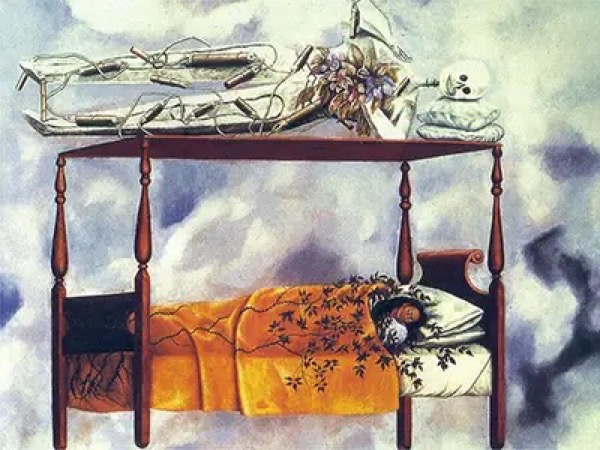
Kahlo: El sueño (La cama) (The Dream (The Bed)), 1940 (New York: Collection of Selma and Nesuhi Ertegun)
The music for The Dream is repetitive, reflecting reality and its dream world. Time passes in ticks of an invisible clock, or is that the tick of the bombs?
Simone Iannarelli: Siete pinturas de Frida Kahlo, No. 5. El sueño (The Dream) (ChromaDuo)
Her 1932 painting on metal, Mi nacimiento (My Birth), shows the fully formed Frida emerging from her mother’s womb, with a full head of hair and prominent eyebrows complete. A sheet covers the mother’s face, so she is left anonymous but may refer to her own mother, María Ysabel González Garduño, who died the same year as this painting. Or, in a more pragmatic way, the only parent to the completed Frida Kahlo was Kahlo herself. Above the bed is a traditional weeping ‘Virgin of Sorrows’, but all she can do is look on and weep, but not provide any actual help.
This was the first painting done by Kahlo with the support of her husband, who encouraged her in a project to paint her ‘major life events’.
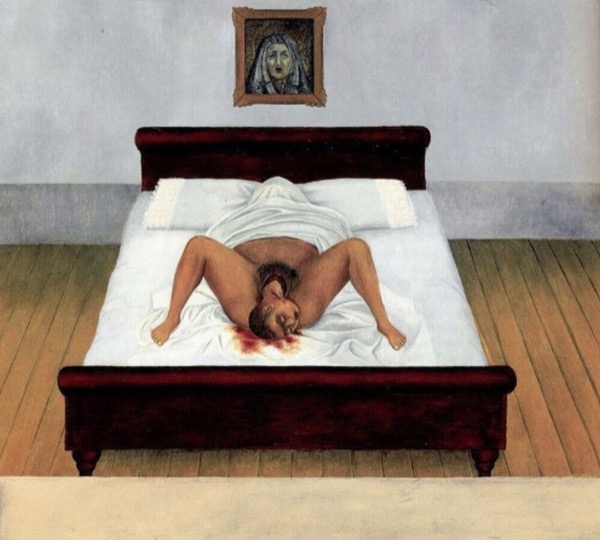
Kahlo: Mi nacimiento (My Birth), 1932 (New York: Collection of Madonna)
The violent actions of the two guitarists underscore the bloody imagery of the birth on a white bed.
Simone Iannarelli: Siete pinturas de Frida Kahlo, No. 6. Mi nacimiento (My Birth) (ChromaDuo)
The last painting Iannarelli chooses is the 1949 work El abrazo de amor de el universo, la tierra (México), yo, Diego, y el Señor Xolotl (The Love Embrace of the Universe, the Earth (Mexico), Myself, Diego, and Señor Xolotl). As their relationship matured, Kahlo found herself dealing with Diego Rivera more as her child than her husband. In her journal, she wrote ‘At every moment he is my child, my child born every moment, diary, from myself’. His sexual transgressions hurt her less if she could think of him as other than her husband.
Here, she holds the baby Diego, representing the child she could never bear. Below Diego is her itzcuintli dog, Xolotl, curled up for sleep. She is in the lap of Mother Earth (Mexico), which in turn is held by the Universe. A bloody gash cuts across the neck and torso of the innocently pictured Kahlo, who calmly sits with tears on her face and a stream of milk from her chest. Diego is shown with wide eyes as befitted a painter of ‘spaces and multitudes’, and on his forehead is the third eye of ‘Oriental wisdom’.
They are surrounded by the plants and flowers of Mexico, the roots slipping through the hands of Mother Earth and the Universe.
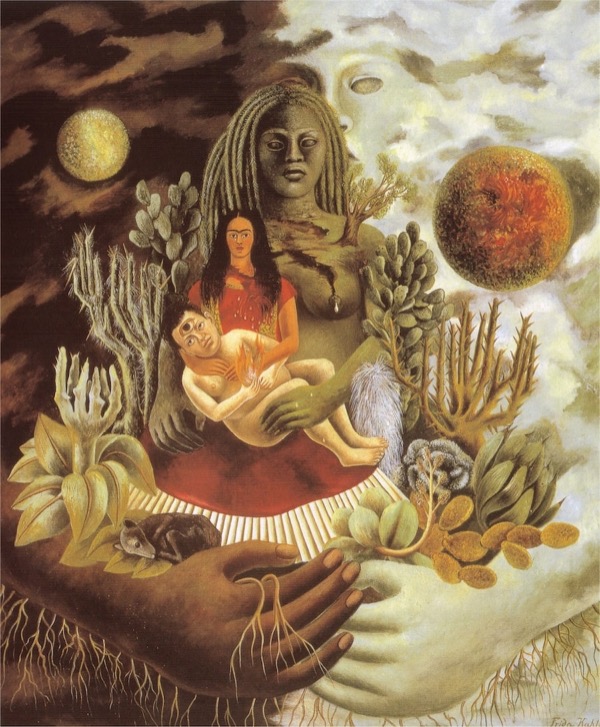
Kahlo: El abrazo de amor de el universo, la tierra (México), yo, Diego, y el Señor Xolotl (The Love Embrace of the Universe, the Earth (Mexico), Myself, Diego, and Señor Xolotl), 1949 (Mexico City: Collection of Jacques & Natasha Gelman)
The music, after the tumult of the last movement, seems to have settled into a peaceful declaration of love – love of a person and the love of the world around.
Simone Iannarelli: Siete pinturas de Frida Kahlo, No. 7. El abrazo de amor de el universo (The Love Embrace of the Universe) (ChromaDuo)
Iannarelli uses Kahlo’s self-focus on her life and world, a violent and painful world, as the inspiration for a work that shows the many sides of Frida Kahlo. He enables us to see behind the image to the emotional life beneath the surface. Frida Kahlo was the product of a particular time and place, a successful woman in the shadow of a much older and more successful man, where her expected subservience was not in her character. From the 1930s onward, she moved from strength to strength, but it wasn’t until two decades after her death that she was recognised as an artist in her own right.
For more of the best in classical music, sign up for our E-Newsletter