For many of us, specifically if you’re not a wind player, the composer Anton (Antoine) Reicha is practically unknown. He does, however, appear frequently as a footnote in books on Beethoven. They were teenage buddies in Bonn and even played in the same orchestra. Anton, born in Prague, played the flute and violin, while Beethoven played the viola.
He met Joseph Haydn and Luigi Cherubini, studied with Antonio Salieri, and was a close friend of Sébastien Erard. As a professor of counterpoint and fugue at the Paris Conservatoire, he used his own textbooks to instruct luminaries such as Louise Farrenc, Franz Liszt, Hector Berlioz, Charles Gounod, César Franck, and Pauline Viardot.
Anton Reicha: Wind Quintet in E-flat Major, Op. 88, No. 2 “Lento-Allegro moderato”
Fame in Life, Obscurity in Death
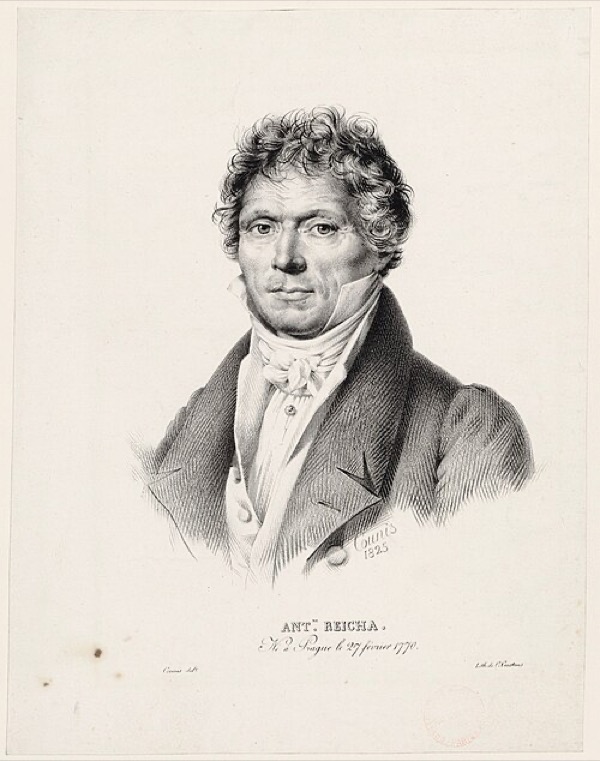
Antoine Reicha (lithograph, 1825)
Such was his fame that even Chopin considered becoming his student. As a composer, he crafted well over a hundred works, and he is generally known as the “Father of the Wind Quintet.”
Reicha died on 28 May 1836, and was interred at Père Lachaise Cemetery in Paris. He fell into obscurity soon after his death, and his life and works have yet to be intensively studied. As far as I know, we still don’t have a definitive catalogue of his compositions.
To commemorate his passing, let us take a moment to rediscover some of his long-forgotten symphonies.
Anton Reicha: Symphony in E-flat Major, Op. 41 (Wrocław Baroque Orchestra; Jarosław Thiel, cond.)
Lost Scores
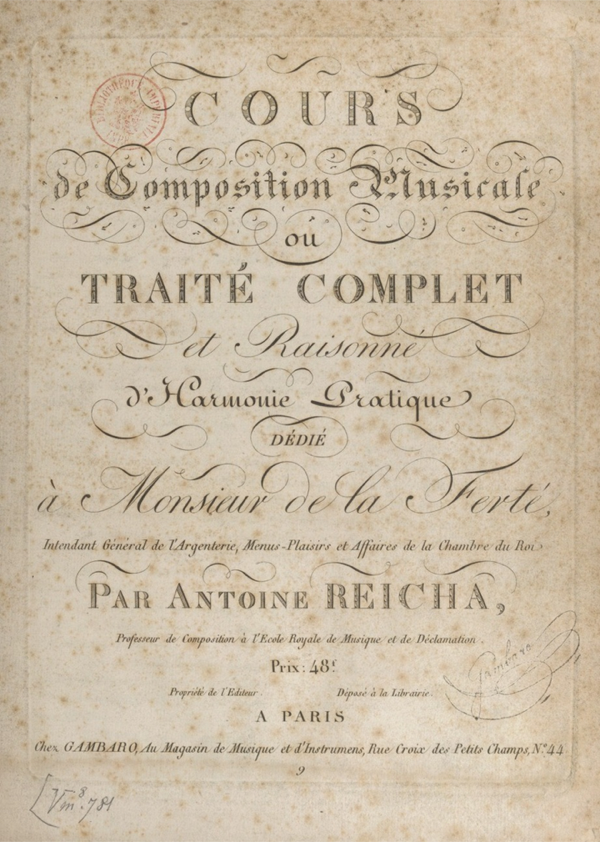
Reicha, Cours de Composition Musicale (title page)
So, how many symphonies did Reicha actually compose? Surprisingly, we still don’t have exact numbers, but let’s start with the works he actually completed. An early symphony, performed in Bonn in 1787 is lost and we only know about it from his autobiography.
The Symphony in E-flat Major, Op. 41 was written during the composer’s first stay in Paris in 1799/1800, but it was printed in Leipzig in the year of his arrival in Vienna. There is no evidence that this work was performed in Vienna, as Reicha mentioned that Viennese audiences had lost interest.
A further symphony composed in Paris but published in Leipzig is titled Symphony à grand orchestre. It dates from the same period and carries the opus number 42. Even though the full score and parts are available on IMSLP, this work has received little attention.
Anton Reicha: Symphony No. 3 in F Major (Dvořák Chamber Orchestra; Petr Altrichter, cond.)
Amid Giants in Vienna
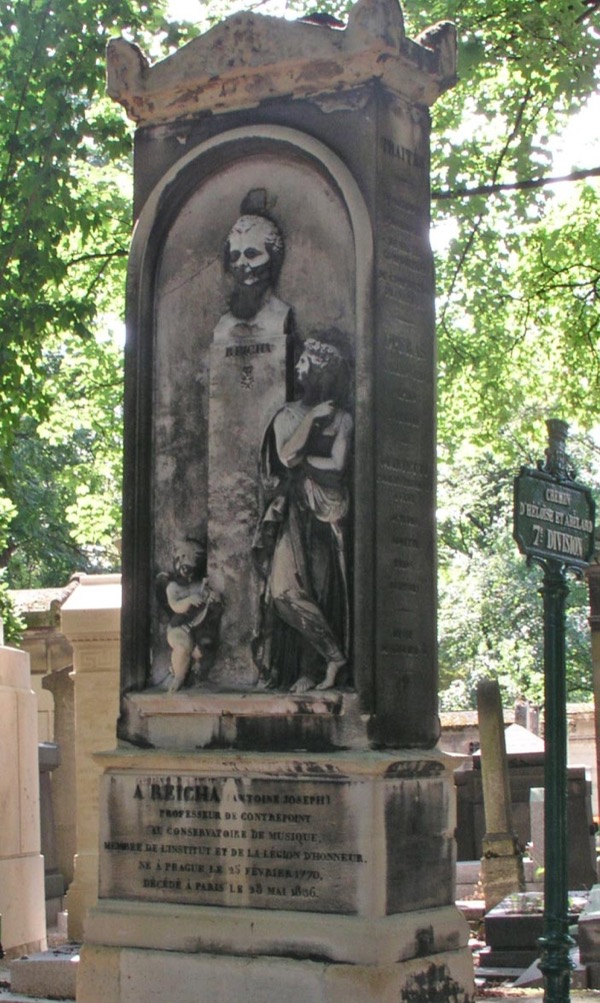
Grave of Anton Reicha, Père Lachaise Cemetery, Paris
Reicha composed a number of symphonies during his time in Vienna. In doing so, he participated in the great emancipation of instrumental music. While the concerto was at the top of the hierarchy of instrumental music, the symphony gradually became the true cornerstone of the classical music repertoire.
Yet, in this particular environment, aspiring composers had to compete against the masterworks of the three Viennese stars: Mozart, Haydn, and Beethoven. Other outstanding musical centres existed too, as we only need to think of Mannheim, Berlin, London, and Paris.
It seems that musicians and composers from Bohemia, including Anton Reicha, were present in the majority of these places. As part of the Austrian Empire, composers from the Czech lands, who lacked sufficient opportunities to show their skills in their homeland, decided to emigrate to the musical centres mentioned above.
Anton Reicha: Symphony in F Minor (Dvořák Chamber Orchestra; Petr Altrichter, cond.)
A Golden Period
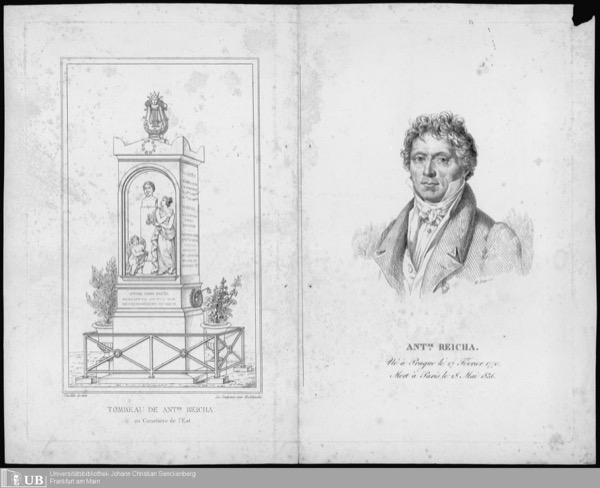
Tombeau de Antoine Reicha (engraving by Dien)
Reicha moved to Vienna from Paris in 1801, and he made contact with Haydn and rekindled his friendship with Beethoven. Beethoven was busy working on his Eroica Symphony, and some reports indicate that they might have exchanged ideas on fugues in modern composition.
In the event, Reicha’s move to Vienna marked the beginning of a productive and successful period in his life. As he wrote in his memoirs, “The number of works I finished in Vienna is astonishing. Once started, my verve and imagination were indefatigable.”
“Ideas came to me so rapidly that it was often difficult to set them down without losing some of them. I always had a great penchant for doing the unusual in composition. When writing in an original vein, my creative faculties and spirit seemed keener than when following the precepts of my predecessors.”
Anton Reicha: Symphony in D Major, “Sinfonie à grand orchestre” (Dvořák Chamber Orchestra; Petr Altrichter, cond.)
Time to Rediscover
During his time in Vienna, Reicha composed about 50 pieces, mostly chamber works rich in melody and folk elements. Reicha departed for his second stint in Paris in 1808, and a number of symphonies appear to date from, or from before this particular time period.
The Symphony No. 1 in G Major has survived, as has the Symphony No. 3 in F Major. The Symphony No. 2 in D Major has not survived, but Reicha apparently composed several symphonies upon his return to Paris.
The forgotten Reicha symphonies are firmly rooted in the late-Classical tradition established by Joseph Haydn. While they maintain structural clarity and witty orchestral interplay, they gravitate towards Romantic expression by favouring spacious forms and ambitious durations.
Particularly noteworthy is Reicha’s exceptionally colourful and idiomatic orchestration. As a flautist and wind player, Reicha cast the woodwinds in lyrical and conversational roles, sometimes even in extended solo passages.
The Reicha symphonies, as far as they have been recorded, are charming, warm, and graceful compositions. It is high time we properly organise the sources and produce reliable performing editions so that these delightful pieces can be heard more widely.
For more of the best in classical music, sign up for our E-Newsletter
Anton Reicha: Symphony à petit orchestre No. 1 in C Minor (Dvořák Chamber Orchestra; Petr Altrichter, cond.)