Beethoven may be the most famous composer in history…which means that many people have many questions about him.
For instance, was Beethoven German? Did he really study with Mozart? Who was his “Immortal Beloved”? And most importantly of all, how did he compose after he went deaf?
To write this guide, we looked at Google autocomplete to find the most asked questions about Beethoven. These questions address his origins, teachers, religion, health, love life, and more.
Whether you’re a casual classical music listener or a lifelong fan, here are the answers to all of the questions you ever wanted to ask about Beethoven.
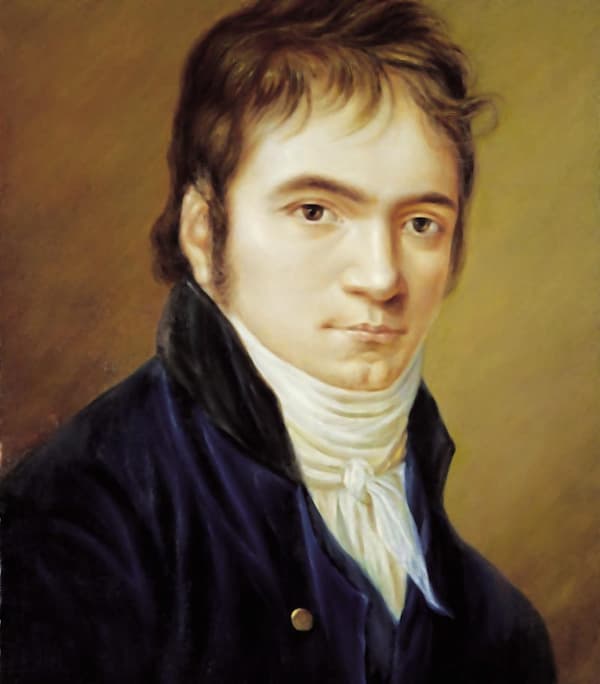
Beethoven in 1803
Was Beethoven German?
Yes. He was born in Bonn, Germany. However, his paternal grandfather was born in present-day Belgium.
Where did Beethoven live?
Beethoven was born in Bonn, Germany, in 1770. He left to make his career in Vienna in 1792. He then lived in Vienna until his death in 1827.
A short documentary on Beethoven’s connections with Bonn
Who did Beethoven study with?
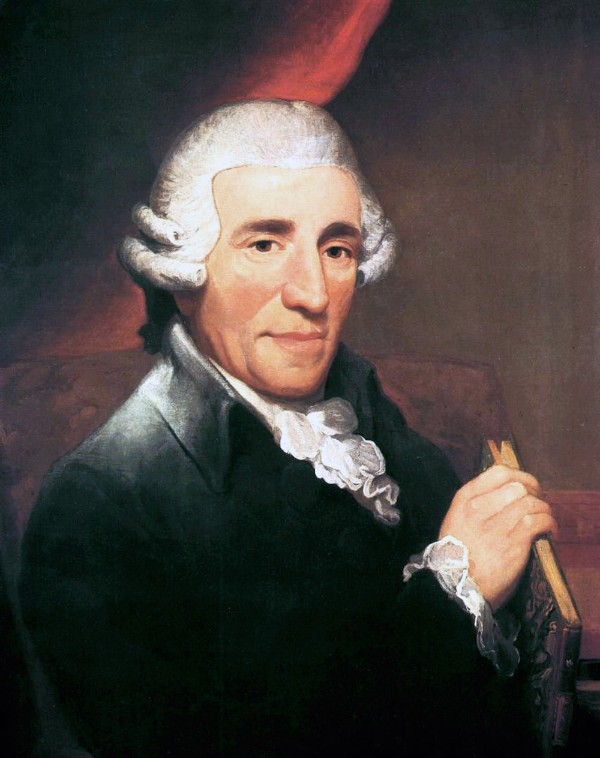
Joseph Haydn
Beethoven studied with several teachers.
- Johann Beethoven. His first teacher was his alcoholic musician father, who forced him to practice and abused him regularly.
- Christian Gottlob Neefe. Neefe was a Bonn-based opera composer who was Beethoven’s primary early piano teacher.
- Joseph Haydn. Haydn met Beethoven while traveling through Bonn and invited him to come study with him in Vienna. At first, Beethoven didn’t appreciate him as a teacher, but the early wrinkles in their relationship were eventually ironed out.
- Antonio Salieri. He studied vocal composition with Salieri, one of Mozart’s colleagues.
- Johann Georg Albrechtsberger. Beethoven studied counterpoint and fugue-writing with Albrechtsberger.
Did Beethoven Meet Mozart?
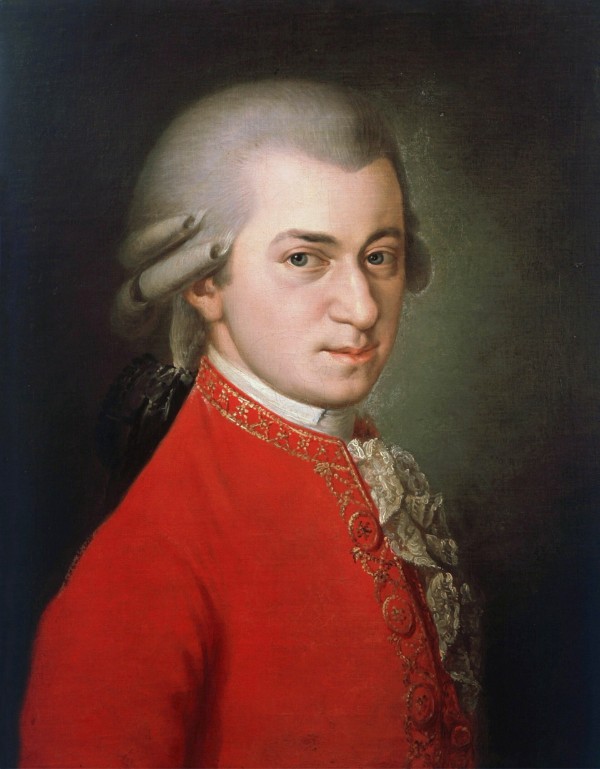
Wolfgang Amadeus Mozart
Beethoven was just fourteen years younger than Mozart, and Mozart’s professional example loomed large throughout Beethoven’s life.
In fact, Johann Beethoven dreamed of sending his young son on European tours modeled after the child prodigy Mozart’s. (That said, Johann’s alcoholism kept him from following through on those plans.)
As a boy, Beethoven played Mozart’s compositions both on the piano and in the Bonn court orchestra.
In 1787, Beethoven spent ten weeks in Vienna before having to return to Bonn to care for his terminally ill mother. It’s possible that the two composers met then, but there’s no hard evidence.
Beethoven only returned to Vienna in 1792, the year after Mozart died.
Whether they ever met or not, they never enjoyed the kind of time or geographical closeness that would have allowed them to become close friends.
Was Beethoven Catholic?
Beethoven was born into a Catholic family and baptised in the Catholic Church.
In 1840, years after Beethoven’s death, his former secretary Anton Schindler wrote about the subject:
It was one of [Beethoven’s] peculiarities that he never spoke on religious topics or concerning the dogmas of the various Christian churches in order to give his opinion about them. It may be said with considerable certainty, however, that his religious views rested less upon the creed of the church than that they had their origin in deism.
However, this assessment should be taken with a grain of salt, given that Schindler was infamous for distorting the truth elsewhere in his writings.
Beethoven wrote a number of Catholic-themed works, including the oratorio Christ on the Mount of Olives, the Mass in C, and the Missa Solemnis. He once claimed that the Missa Solemnis was his greatest work: a bold claim!
In the end, we don’t have enough first-hand evidence to pin down Beethoven’s religious beliefs in detail, or how they may have evolved throughout his life. However, generally speaking, he was clearly influenced by deism and other related concepts popular in the Enlightenment.
Beethoven’s Missa Solemnis
Was Beethoven deaf, and how did he go deaf? Was he born deaf?
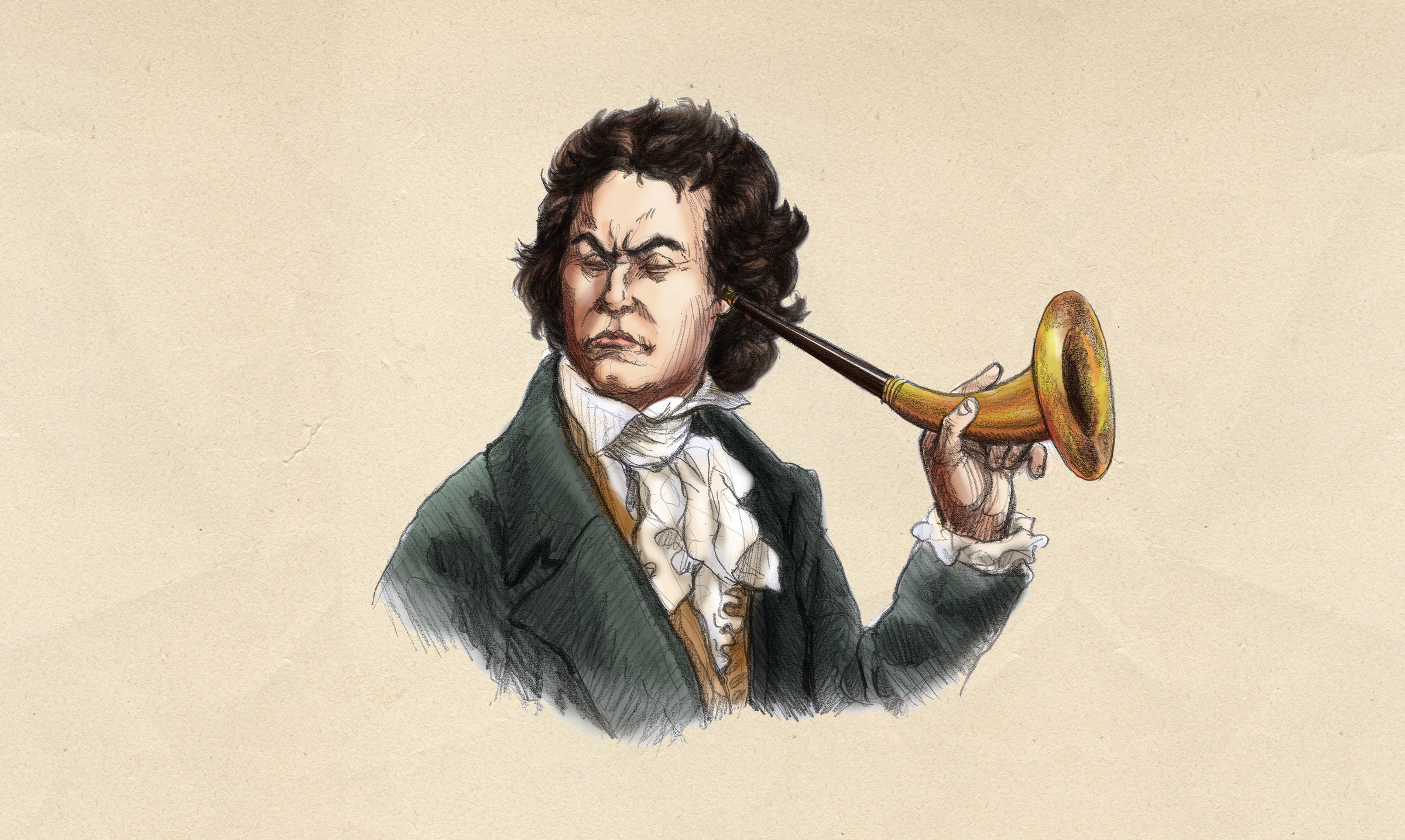
Beethoven with the ear trumpet © historydaily.org
Beethoven was not born deaf.
He began losing his hearing in his mid-twenties. It was not a quick process. For many years, he suffered from pain and tinnitus, perceiving a variety of muffled and distorted sounds. It took two decades until his hearing was gone altogether.
What caused the deafness? Even today, we don’t know for sure. There are a number of theories:
- Heavy metal poisoning (analysis of Beethoven’s hair has revealed large amounts of lead in his system)
- Being physically abused as a child and injured by his father
- Sarcoidosis
- Paget’s disease
- Tertiary syphilis
- Lupus
- Cogan syndrome
Unfortunately, we can’t know exactly what caused Beethoven’s hearing loss.
A mini documentary about how Beethoven heard music
How did Beethoven compose if he was deaf?
Over time, composers develop an inner ear. Much like you can read words silently in your head, many composers can read, write, and “hear” music in their head.
Of course, refining that skill to the degree that Beethoven did was an extraordinary achievement. But it also wasn’t magic.
As listeners and performers, we’re left with fascinating questions about how Beethoven’s compositions might have changed – or not – had he been able to hear them. Would the later ones still have embraced dissonance quite so insistently? Would he have changed the tempo at which he wanted his works performed? We’ll never know.
Did Beethoven use a metal rod?
Yes, Beethoven used a metal rod to better “hear” his piano.
After he lost his hearing, he began biting on a wooden or metal rod and using it to touch his piano. The vibrations of the piano were then transferred from the rod into his teeth, skull, and even inner ear. This was the best way for him to “hear” music, even as he struggled with hearing difficulties.
Was Beethoven Black?
For well over a century, observers have wondered if certain physical features of Beethoven suggest Black ancestry.
British mixed-race composer Samuel Coleridge-Taylor noted after a tour in 1907 that if Beethoven ever visited America under Jim Crow laws, “he would find it impossible to obtain hotel accommodation in certain American cities.”
It’s true that Beethoven was referred to as “swarthy” by contemporaries, suggesting that his skin was darker than expected.
If Beethoven had African ancestry, it would necessitate his mother having had an affair or his Flemish ancestors having had Black roots. This could have been possible, given that Flanders often hosted Spanish traders, who in turn frequently traded with African Berbers. (We often think of eighteenth-century Europe as being much whiter than it really was.)
That said, there is no historical evidence for any of those scenarios occurring in Beethoven’s ancestry.
In the mid-twentieth century, the slogan “Beethoven Was Black” was meant to be a provocative statement, intended to get people asking questions about the canonisation of composers, the potential whitewashing of various historical geniuses, and other issues relating to race that came to the forefront during the American civil rights movement.
Musicologist Kira Thurman told the Smithsonian Magazine in 2020:
“There’s a way in which white people, historically, have constantly denied Black people any kind of association with genius. And in a lot of ways, there is no figure that we associate more with genius than Beethoven himself. The implication of the idea that Beethoven might be Black was so powerful, was so exciting and so tantalising, because it threatens to overturn how people have understood or talked about race and racial hierarchy in the United States and around the world.”
Who was Beethoven’s wife?
Beethoven never married.
Who did Beethoven write Für Elise for?
Beethoven’s Für Elise
“Für Elise” is a short piano piece that was published after Beethoven’s death.
It gets its name from the inscription on the manuscript: “Für Elise am 27 April [1810] zur Erinnerung von L. v. Bthvn” (“For Elise on April 27 in memory by L. v. Bthvn”).
A musicologist named Ludwig Nohl made a transcription of the work from the original, now-lost manuscript.
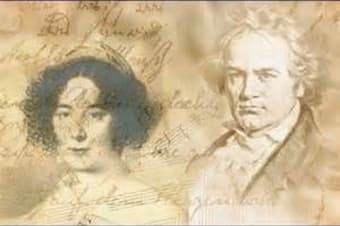
Ludwig van Beethoven and Therese Malfatti
We don’t know who Elise was, but here are a few potential candidates:
- Therese Malfatti. This theory suggests that Nohl made a mistake transcribing the name, and it actually said “Für Therese.” Malfatti was an 18-year-old noblewoman who studied under Beethoven and rejected his marriage proposal.
- Elisabeth Röckel. She was a 17-year-old singer who went by Elise in her day-to-day life. Supposedly, she also rejected a marriage proposal from Beethoven.
- Elise Barensfeld. She was a 13-year-old child prodigy singer who may have taken lessons from Beethoven.
Who is Beethoven’s Immortal Beloved?
In early July 1812, Beethoven wrote a love letter to an unknown recipient whom he dubbed the “Immortal Beloved.” It is believed the letter – or this version of it, anyway – remained unsent. Beethoven kept a draft for the rest of his life, and it was found in his papers upon his death.
A number of candidates for the mysterious Immortal Beloved have been suggested over the years. The two most likely are:
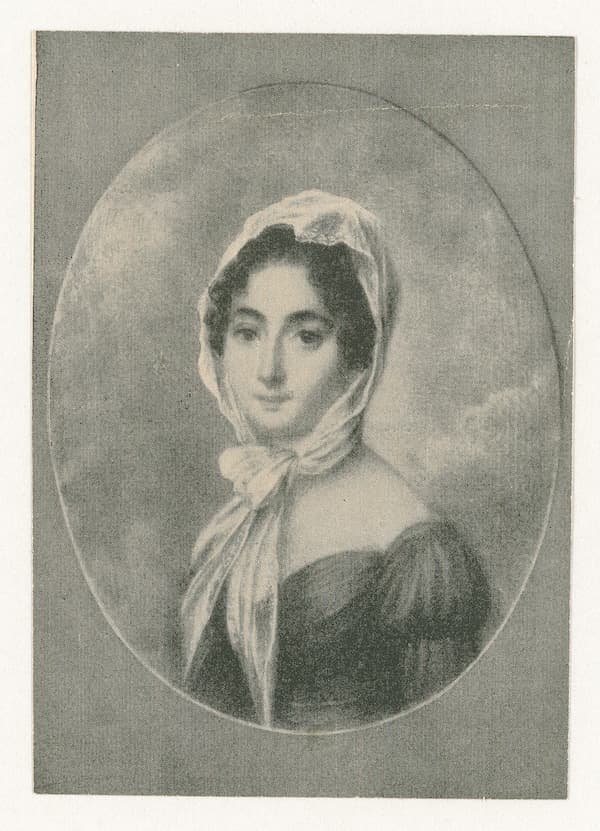
Josephine Brunsvik
- Josephine Brunsvik. She was a noblewoman who had begun studying piano with Beethoven in 1799 at the age of twenty. She married a much older and wealthier man and had three children with him, but he died in 1804, when she was pregnant with her fourth. She and Beethoven gravitated toward each other during her widowhood, but family pressure led her to pull back from him. She embarked on a second marriage in 1810 that was unhappy from the start, and had collapsed completely by 1811. The timeline for a tryst with Beethoven lines up. (Intriguingly, she also had a daughter named Minona nine months later.)
- Antonie Brentano. She was a philanthropist and art collector who’d married a wealthy merchant in 1797. She met Beethoven in 1810, and he became a family friend, dedicating his Diabelli Variations to her. In his 1977 biography, musicologist Maynard Solomon suggested she was an Immortal Beloved candidate, although she was pregnant at the time the letter was written and apparently happily married.
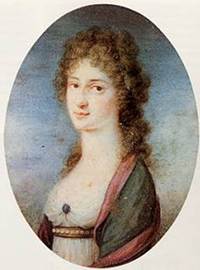
Antonie Brentano
Why did Beethoven hate Napoleon?
A miniature documentary about Beethoven and Napoleon
In 1802, Beethoven counted himself as an admirer of Napoleon. He was irresistibly drawn to the idea of a self-made man who didn’t rely on his royal background to make his mark on the world.
Beethoven even wrote “Sinfonia intitolata Bonaparte” on the manuscript of his third symphony, and pointedly left the manuscript out for visitors to notice.
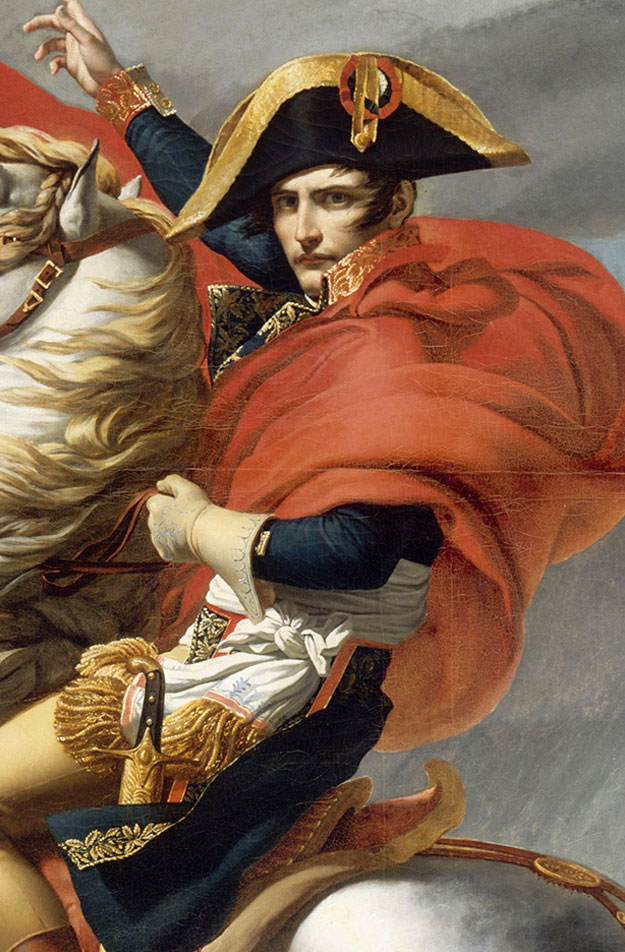
Napoleon Bonaparte
But when Napoleon crowned himself Emperor of France in the spring of 1804, Beethoven was disgusted at the power grab. According to legend, he shouted:
“So he is no more than a common mortal! Now he, too, will tread underfoot all the rights of man [and] indulge only his ambition; now he will think himself superior to all men [and] become a tyrant!”
He crossed out Bonaparte’s name with such intensity that his pen tore through the paper.
The symphony went out into the world with the new subtitle Eroica: “Heroic.”
Beethoven’s Symphony No. 3, “Eroica”
What did Beethoven die of?
We don’t know for sure.
Sadly, he was not well for a long time before his death. In December 1826, he had a case of pneumonia that weakened him badly, as well as spells of vomiting and intestinal distress.
Those issues may not have dealt the final blow directly, but they certainly contributed to his final illness.
His autopsy revealed that his liver was shrunken and severely cirrhotic. We can’t know exactly what caused this; it could have been his heavy drinking, some kind of hepatitis, or even heavy metal contamination. (It was much easier to consume dangerous amounts of lead in the nineteenth century than it is today, and various nineteenth century medical treatments for other problems often included lead.)
In any case, Beethoven’s liver was severely damaged, and the other organs in this abdomen were affected accordingly.
Learn more about the final illness and death of Beethoven.
Who did Beethoven inspire?
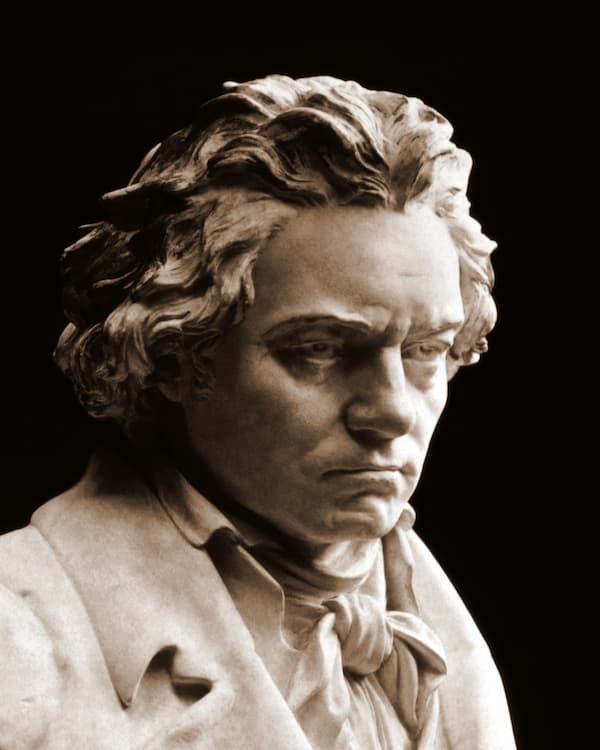
Photograph of bust statue of Ludwig van Beethoven by Hugo Hagen
In one way or another, Beethoven has inspired every composer who came after him…whether they know it or not!
- Franz Schubert asked, “Who would dare to do anything after Beethoven?” He served as a pallbearer at Beethoven’s funeral.
- Robert Schumann revered Beethoven’s ability to combine emotional expression and structural rigour. You can see his influence in Schumann’s four symphonies.
- Hector Berlioz was inspired by Beethoven’s programmatic works like the Pastorale Symphony, and took Beethoven’s ideas even farther in a number of his works.
- Richard Wagner became obsessed with Beethoven’s output, especially the chorus embedded in the Ninth Symphony. As a young man, he had dreams in which he communicated with Beethoven.
- Johannes Brahms was so intimidated by Beethoven’s symphonic output that he took over two decades to write his own first symphony…which a conductor then nicknamed Beethoven’s Tenth.
- Gustav Mahler carried on Beethoven’s idea of the symphony being a grand philosophical statement with cosmic implications.
In short, Beethoven’s influence became inescapable.
And this isn’t even counting all of the visual artists, writers, philosophers, scientists, and others whom Beethoven influenced.
In the words of conductor Marin Alsop, when it comes to Beethoven’s influence on the nineteenth century, there was “before Beethoven” and “after Beethoven.”
It seems likely that we will never again see a single individual change an art form the way that Beethoven did.
For more of the best in classical music, sign up for our E-Newsletter