William Byrd is one of the most remarkable figures in music history. He lived through a period of intense religious and political turmoil in Tudor England. As a devout Catholic working in the court of Protestant Queen Elizabeth I, Byrd walked a dangerous political tightrope. This listening guide explores ten of Byrd’s essential works in cohesive narrative sections. Each part connects his artistic versatility directly to the political pressures, secret faiths, and social shifts of his time.
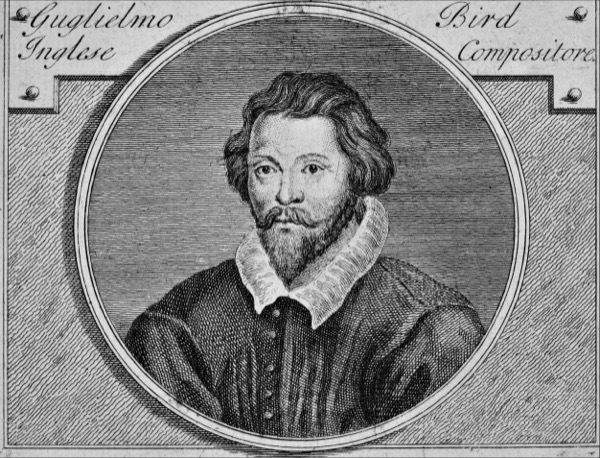
An undated etching of Byrd by Gerard Vandergucht (after Nicola Francesco Haym)
Music in the Service of the Crown
During the reign of Queen Elizabeth I, the English government demanded strict obedience to the Protestant Church of England. As a gentleman of the Chapel Royal, Byrd had to write official music for the state, even while remaining a secret Catholic. His public anthem Sing joyfully unto God our strength (c. 1580s) represents this official court identity. The piece is a bright and energetic work designed for major public services. Its soaring vocal lines projected state power and religious authority.
William Byrd: Sing Joyfully unto God Our Strength (Steven Devine, organ; Musica Contexta; Simon Ravens, cond.)
To secure royal favour and protection against persecution, Byrd composed O Lord, make thy servant Elizabeth (c. 1570s). This royal anthem praised the Queen directly in six grand vocal parts. Its majestic harmony reflected the official cult of Elizabeth. Here, Byrd crafts a magnificent six-part royal anthem that begins with simple homophony before unfolding into rich counterpoint, offering public praise to the Virgin Queen.
William Byrd: O Lord, make thy servant Elizabeth the Queen (ORA Singers; Suzi Digby, cond.)
Expressing Faith in Secret
Beneath his public life as a royal servant, Byrd risked heavy fines and imprisonment by practising Catholic rites in secret. For underground worship in private country houses, he wrote deeply emotional Latin church music. The Mass for Four Voices (c. 1592–1593) was published covertly in small books without title pages for underground Catholic worship. Facing constant risk of house searches and crippling recusancy fines, Byrd crafted an intensely compact masterpiece. Driven by relentless English counterpoint and an austere tone, the introverted music moves from dark intimacy in the Agnus Dei to fierce defiance. Its closely argued vocal lines avoid flashy display, providing small secret choirs with a deeply expressive prayer born of a believer fighting with his back to the wall.
William Byrd: Mass for 4 Voices: Kyrie (Tallis Scholars)
William Byrd: Mass for 4 Voices: Agnus Dei (Tallis Scholars)
Byrd also composed short Latin motets for private devotional circles. Ave verum corpus (1605) comes from his Gradualia, published boldly when political tensions briefly eased after Elizabeth I’s death. Following the 1605 Gunpowder Plot, Byrd was forced to withdraw and hide the collection until 1610. The motet’s gentle harmonies create an aura of quiet comfort. It shows extraordinary strength of character and unyielding Catholic faith.
William Byrd: Ave verum corpus (Tallis Scholars)
For larger private gatherings, Byrd wrote dramatic Latin works like Infelix ego (1591). Based on the text of a desperate sinner awaiting judgment, this extensive piece reflected the intense psychological distress of English Catholics. The eight-part vocal counterpoint builds immense tension across its grand structure.
William Byrd: Liber secundus sacrarum cantionum (Cantiones sacrae): Infelix ego (Marian Consort; Rory McCleery, cond.)
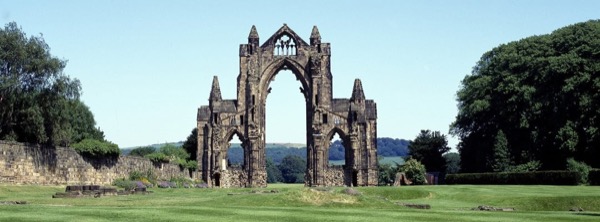
The stark ruins of Gisborough Priory, North Yorkshire, suppressed in 1540 (Credit: English Heritage)
Private Sorrow and Hidden Messages
Beyond public anthems and secret masses, Byrd also wrote secular vocal music for home entertainment. However, scholars believe many of these songs carried hidden political meanings. A prime example is Lulla, Lullaby (My sweet little baby) (1588). On the surface, the piece is a gentle mother singing her child to sleep. In reality, it expresses the constant fear of Catholic families living under government surveillance. The sweet melody carries a heavy, lingering sorrow.
William Byrd: Lullaby my sweet little baby (Ensemble Pro Victoria; Toby Ward, cond.)
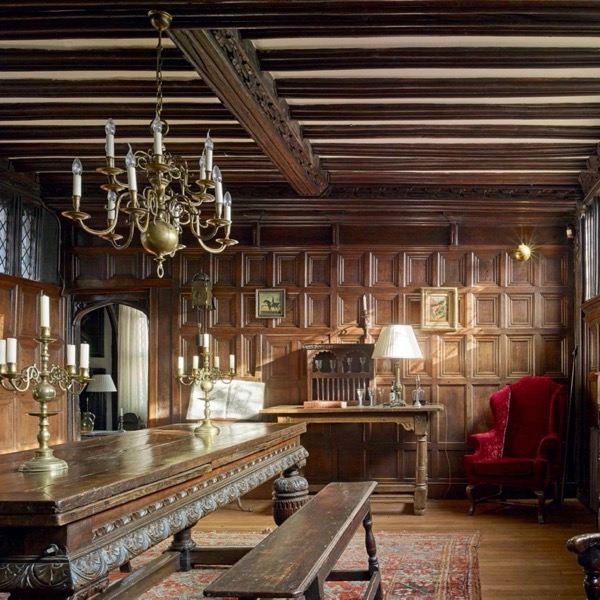
The panelled parlour of Alston Court, Suffolk, dated to about 1520 (Credit: Country Life Picture Library)
Instrumental Art and Chamber Music
Obviously, instrumental chamber music offered Byrd a safer space for creative experimentation. Free from state-censored texts, he could explore pure musical form with friends and colleagues. His viol consort piece Browning (The Leaves Bee Greene) (c. 1580s) shows how Tudor musicians gathered in private homes to play chamber music. Byrd took a popular folk song and repeated it in the lower voices while five instruments played creative variations above it.
William Inglott: The Leaves bee greene (Charivari Agréable)
Byrd was also a pioneer of European keyboard music. His works preserved in the famous Fitzwilliam Virginal Book show his incredible rhythmic energy and variation techniques. Church bells were a central part of Tudor life, marking work hours, royal events, and religious holidays. In The Bells (c. 1590s), Byrd mimicked the sound of ringing bells using only two alternating bass notes. Over this simple pattern, he built complex variations that sound surprisingly modern.
William Byrd: The Bells (Pieter-Jan Belder, harpsichord)
Byrd also used popular tunes to send quiet political messages through keyboard music. Our Lady of Walsingham was England’s most famous Catholic shrine before Henry VIII destroyed it. By writing eighteen brilliant variations on the banned folk tune Walsingham (c. 1590s), Byrd paid subtle tribute to England’s lost medieval past.
William Byrd: Walsingham (from The Fitzwilliam Virginal Book, Vol. 1, No. 68) (Pieter-Jan Belder, harpsichord)
Finally, Byrd adapted famous popular songs by his contemporaries into keyboard masterpieces. In Pavana Lachrymae (c. 1600), he took John Dowland’s famous lute song Flow My Tears and transformed it for the virginal. The piece reflected the fashionable melancholy of late Elizabethan culture. Its slow harmonic shifts create a dark, thoughtful, and noble atmosphere.
John Dowland, arr. William Byrd: Pavana Lachrymae (Aapo Häkkinen, harpsichord)
Conclusion
William Byrd was far more than a court musician. He was a political realist and a man of deep personal faith. By exploring these ten works within their narrative groups, listeners can hear the real heart of Tudor England.
For more of the best in classical music, sign up for our E-Newsletter