
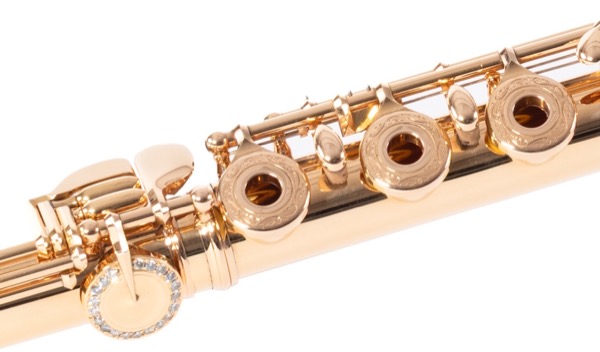
Sir James Galway’s gold and diamond-encrusted flute, Osamu Muramatsu, Tokorozawa, Japan, 2001. MIM Collection,
Courtesy of the Musical Instrument Museum, Phoenix, Arizona
The oldest wind instrument is also the world’s most universal. A special exhibition at the Musical Instrument Museum (MIM) in Phoenix, Arizona—The Magical Flute: Beauty, Enchantment and Power—traces the flute‘s extraordinary role in society and its evolution over the millennia. Visitors can see a bone flute from 38000 BCE (discovered in Germany’s Hohle Fels Cave) alongside another from China, between 6300 and 5400 BCE. MIM calls itself “the world’s only global musical instrument museum,” and the exhibition spans a staggering variety of European flutes, ocarinas, pan pipes, end-blown flutes, whistles and ceramic vessel-flutes from every continent except Antarctica.
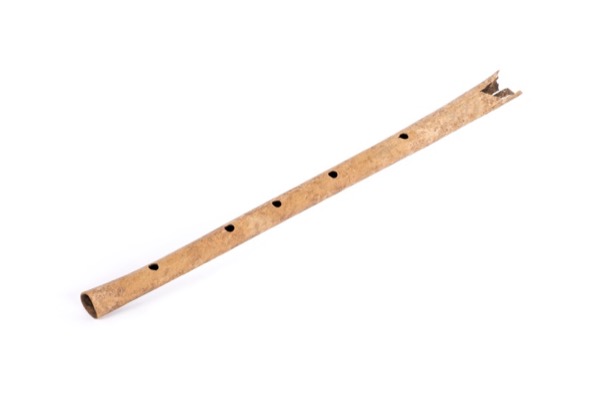
Yue (bone flute), Xinglongwa culture, China, c. 6300-5400 BCE. Anonymous Loan
What makes a flute? As the exhibition puts it: “All flutes share fundamental characteristics: they are open tubes—the hole the player blows across or a window beneath it is always open, even if one end of the tube is closed—and they produce sound when an airstream is split by an edge or oscillates inside a chamber, causing the air to vibrate. The principles of the flute can be observed in nature—imagine wind blowing across the opening of a cave or across the mouth of a glass bottle.”

Jasmine Choi. Photo provided by Jasmine Choi
Listen: Jasmine Choi, flute, plays the first of Georg Philipp Telemann’s 12 Fantasies.
Georg Philipp Telemann: 12 Fantaisies, TWV 40:2-13: No. 1 in A Major, TWV 40:2 (Jasmine Choi, flute)
Through the flute, human breath is transformed into music. Perhaps because of this, from earliest times the flute has been identified with transcendence, ceremony and status. In the exhibition, an 18th-century walking-stick flute testifies to the Enlightenment’s fascination with nature and intellectual pursuits—though exclusively for gentlemen of means. A crystal flute made by Claude Laurent for Napoleon Bonaparte in the early 19th century speaks of wealth and power. Napoleon’s brother Louis, not to be outdone, commissioned a cobalt blue flute from Laurent—the only one of its kind.
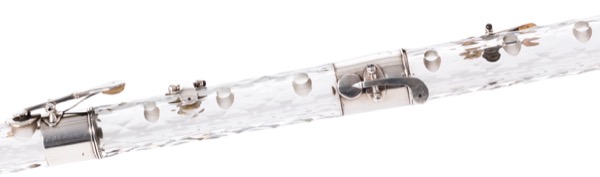
Leaded glass flute formerly owned by Napoleon Bonaparte, Claude Laurent, Paris, France, 1813. Loan Courtesy of Mark Leone
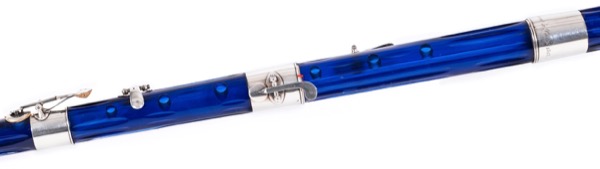
Cobalt glass flute formerly owned by Louis Bonaparte, Claude Laurent, Paris, France, 1813. Loan Courtesy of Mark Leone

Listen: James Galway, flute, with Charles Gerhardt conducting the National Philharmonic Orchestra, in Christoph Willibald Gluck’s Orfeo ed Euridice, Act II: Dance of the Blessed Spirits.
Christoph Willibald Gluck: Orfeo ed Euridice, Act II: Dance of the Blessed Spirits (James Galway, flute; National Philharmonic Orchestra; Charles Gerhardt, cond.)
Two exquisite end-blown flutes in the exhibition date from 14th-century Japan. A hitoyogiri of bamboo, finished with seven layers of lacquer and pigment and decorated with dragon and cloud motifs, was made for the 96th Emperor of Japan, Go-Daigo, the last emperor to wield real power until the Meiji Restoration of 1868.
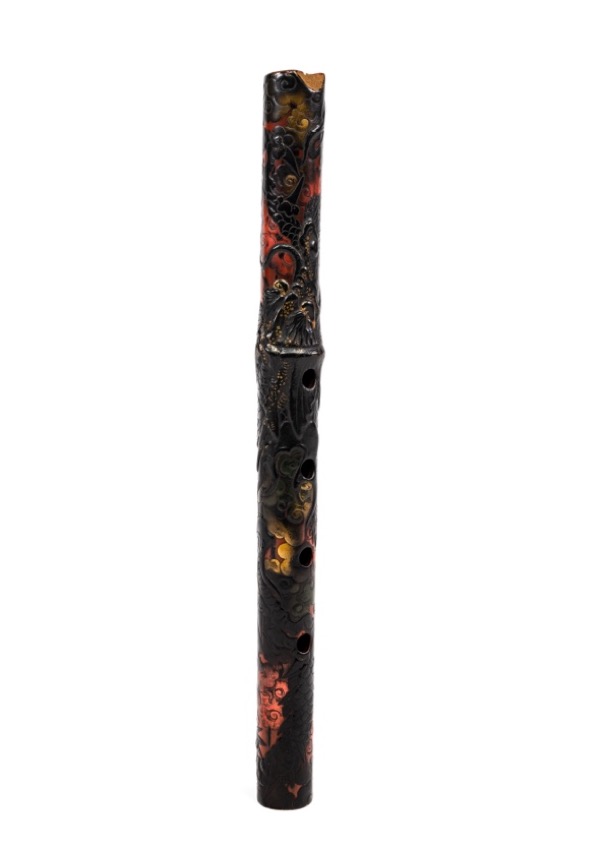
Emperor Go-Daigo’s hitoyogiri, early 14th century. Loan courtesy of the Takao Oikawa Family
Stepping away from MIM’s exhibition, scholars tell us that while the oldest known flutes come from Europe, both end-blown and side-blown (transverse or “German”) instruments had to be reintroduced there during the Middle Ages, via Byzantium and North Africa. End-blown recorders were more common at that time, and our knowledge of the flute from the period has significant gaps. Nevertheless, troubadour Adenet le Roi claimed that he played the transverse flute in 1285, and the composer-poet Guillaume de Machaut mentioned transverse flutes in his La Prise d’Alexandrie (circa 1370-72).
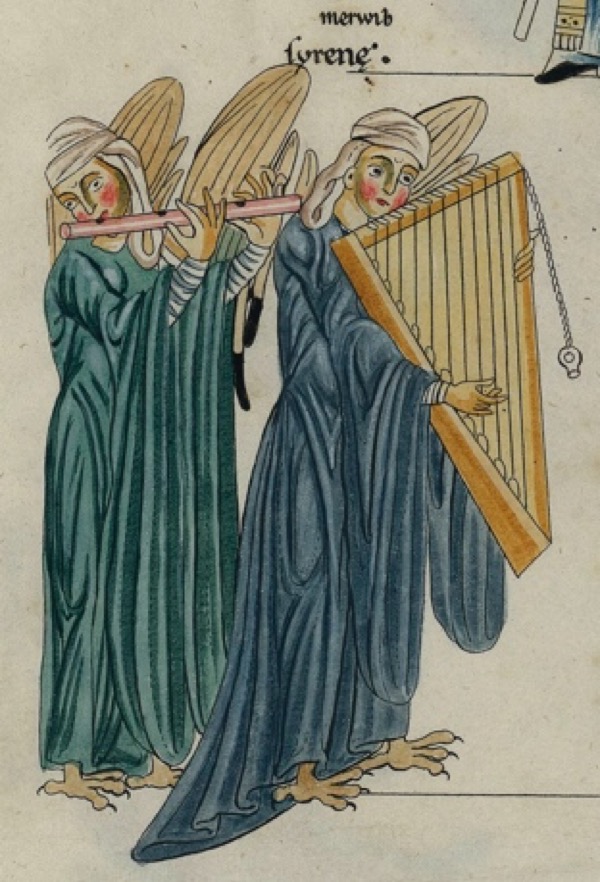
An early European depiction of the transverse flute with Rotte (Germanic lyre), in Hortus Deliciarum (circa 1180). Image via Wikimedia Commons
The Renaissance flute (c. 1500-1670) was distinguished by a narrower bore, which had a profound influence on its sound and range. The instrument expanded into a full consort of voices. The Hotteterre family of makers, among others, developed the Baroque traverso (c. 1670-1760) with a conical bore, first with three sections, then four. Makers introduced interchangeable upper center sections, known as corps de rechange, allowing flutists to play in a variety of keys.
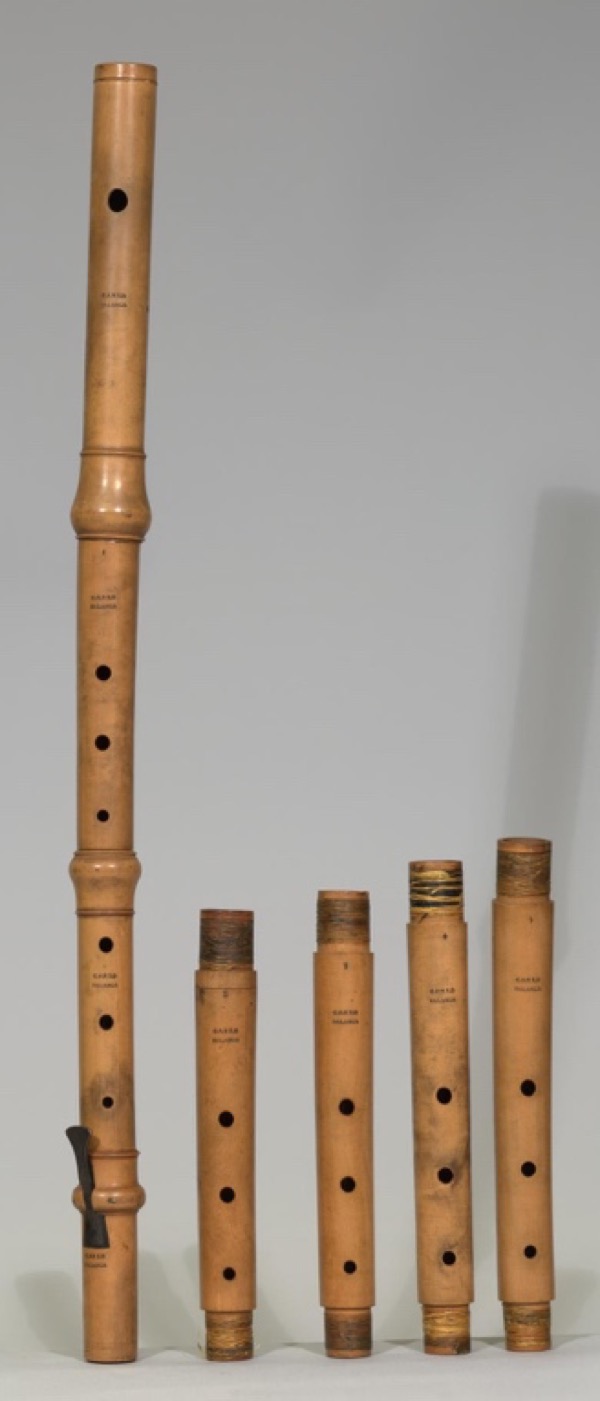
Baroque traverso flute in C with corps de rechange, boxwood and silver, Carlo Palanca, Torino 1719. Library of Congress Dayton C. Miller Collection
During the Classical Era, the Simple System Flute continued as a variant of the Baroque Flute’s basic structure. The modern flute’s primary development came not through gradual evolution but through two jolts, both administered by German flutist and composer Theobald Boehm (1794–1881). The MIM exhibition catalogue tells the story:
In 1832, he invented a system of keys with rings and placed it on a traditional wooden body with enlarged tone holes. Fifteen years later, Boehm radically redesigned the flute using the principles of mathematics and acoustics. Boehm abandoned the traditional wooden body and conical bore in favour of a metal body with a cylindrical bore and parabolic head. He made the tone holes as large as physically possible and placed them in mathematically ideal locations. Boehm also designed a system of padded keys interlinked with axles and clutches to let the player cover and uncover tone holes. The key systems he designed became the foundation of modern keyed woodwinds.

Flute in C, made personally by Theobald Boehm, Munich 1850. Library of Congress Dayton C. Miller Collection. Probably the first Boehm flute brought to America, it was played by Martin Heindl in the Boston Symphony Orchestra
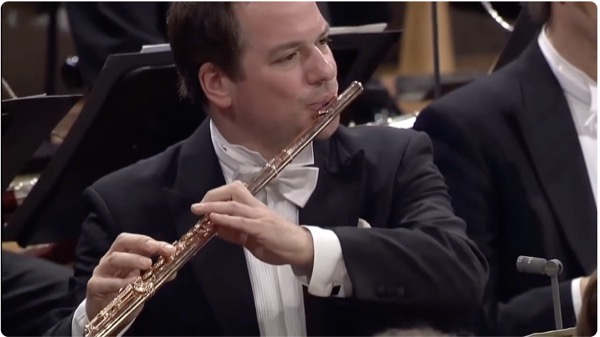
Emmanuel Pahud
Listen: Emmanuel Pahud, flute, plays the Intermezzo from Georges Bizet‘s Carmen with the Berlin Philharmonic Orchestra conducted by Gustavo Dudamel.
BIZET – Carmen (Intermezzo) – Flute Solo (Pahud)
Where will today’s golden age of flutes take us? Anyone who claims to know is destined to be wrong, of course. Makers will continue to innovate, and the MIM exhibition includes an example already a quarter-century old: a super-light carbon fiber flute with elastomer gaskets and magnets instead of springs.
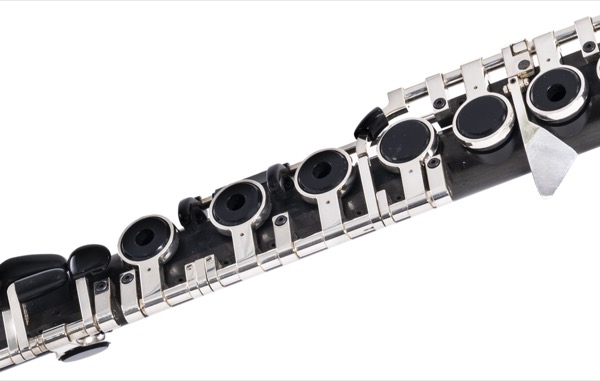
Carbon fiber flute, Helsinki, Finland, c. 1999. Loan Courtesy of Peter Spohr
The writer thanks Musical Instrument Museum’s staff for its assistance with this article.
For more of the best in classical music, sign up for our E-Newsletter






And we must not forget the Japanese end blown flute. the Shakuhachi and it’s place in the music of Japan.
Thank you for your note. MIM’s exhibition touched on this, and its permanent collection includes several examples. Indeed, I now plan to explore the history and sound of early Japanese music.