
The 2026 edition of the Z+ Festival—now in its third year as part of the Shanghai Symphony Orchestra’s 25/26 season—continued its chamber music projects. Led by pianist Zee Zee, this seven-concert series brought together a mix of international soloists, leading Chinese musicians, and players from the Shanghai Symphony Orchestra. Chamber music festival is still something of a rarity in China’s market; it is perhaps natural that the Shanghai Symphony Hall—run by the Shanghai Symphony Orchestra and established as one of China’s most forward-looking chamber music venues—should serve as its home.
The festival has, by now, cultivated a reputation for programming that seeks out the less obvious corners. Unusual instrumental combinations and non-standard repertoire abound, though, as Zee Zee herself insists, never at the expense of listenability. “Ear-pleasing” was the guiding principle—and, for the most part, the ears were indeed pleased.
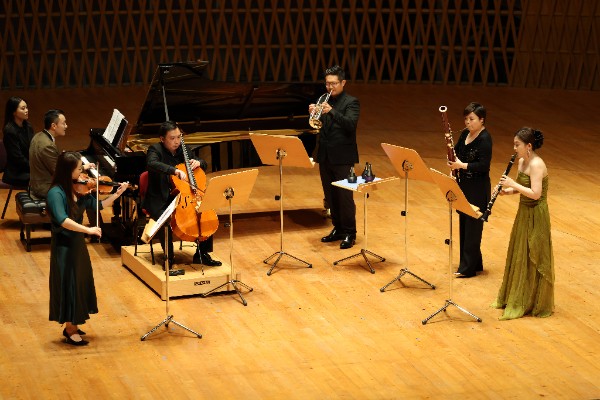
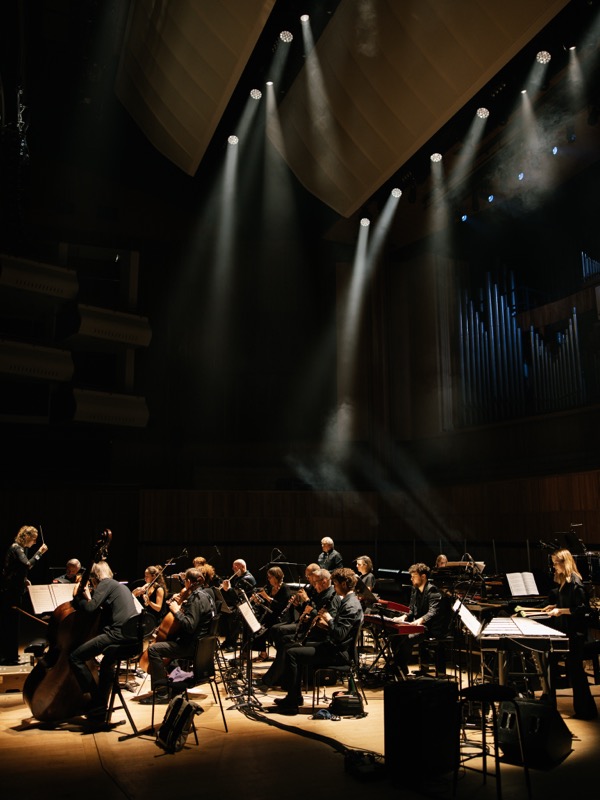
Performance of Martinů’s La revue de cuisine © Cai Leilei
Martinů’s La revue de cuisine, a delightful sextet for clarinet, bassoon, trumpet, violin, cello, and piano, was introduced with witty sparkle. Eight of Beethoven’s Scottish Songs offered a glimpse of the giant in genial mood, while Lili Boulanger’s choral miniatures—if not strictly “chamber” in scale—revealed the sparkling imagination of the short-lived prodigy. In such company, Messiaen’s Quatuor pour la fin du temps and Ravel’s Introduction and Allegro almost felt “familiar.” There was also some new music to entertain by Elliott Leung, the Shanghai Symphony Orchestra’s favoured voice.
Messiaen: Quatuor pour la fin du temps – Ⅲ, Clarinet solo: Julian Bliss
Arrangements, too, formed a recurring thread. Gershwin’s songs, recast for clarinet, were fittingly Jazzy, and the ensemble of twelve cellos, led by Jian Wang, brought charm to the transcriptions of “hot tracks.” Less convincing was the Rückert-Lieder in a piano quartet arrangement, which felt like an arrangement for arrangement’s sake—stripped of Mahler’s orchestral subtlety, and unable to rival even his own youthful Piano Quartet, heard earlier in the same programme.
Elgar: “Nimrod”, from Enigma Variations (arr. Sungmin Ahn) – Jian Wang Cello ensemble
Like the renowned Verbier Festival, Z+ assembles soloists into ad hoc ensembles. The results were, predictably, mixed. One is guaranteed a high level of individual playing, though not always the seamless unanimity of long-standing chamber groups. Whether this occasional lack of coordination proves a drawback or part of the charm is, perhaps, a matter for debate: Zee Zee has openly called for diversity, and the potential chemistry that follows, and a certain degree of disparity may indeed be part of the point.
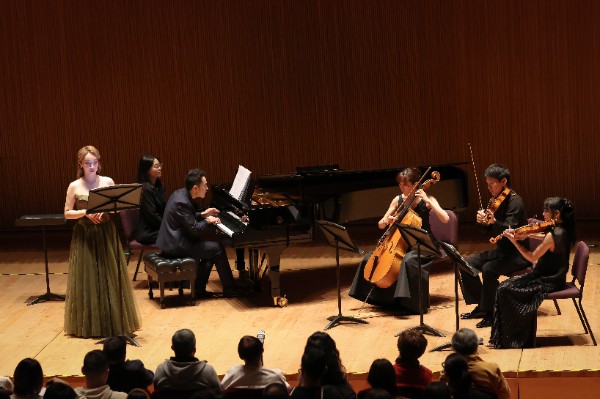
Mahler’s Rückert-Lieder performance © Zhang Tianyu
Among the highlights was violinist Paul Huang, whose performance in Messiaen’s Quartet—particularly the final movement, Louange à l’Immortalité de Jésus—combined exquisitely sensual beauty with emotional intensity. He knew exactly how to make use of the creamily rich tone of his “ex-Wieniawski” Guarneri del Gesù, but never to excess. Across Mozart, Messiaen, and Schumann alike, his phrasing remained poised, luminous, and unfailingly musical.
Equally compelling was clarinettist Julian Bliss, especially in Messiaen’s “Abîme des oiseaux”, the solo clarinet movement, where he sustained extraordinary tension across the work’s slow tempo and extreme dynamic contrasts; the same virtuosity lent refinement to the cantabile lines of Mozart’s Clarinet Quintet. The 2001-born cellist Yibai Chen, stepping in for the Messiaen, brought a depth of insight one would hardly expect from a player of his age. Violist Adrien La Marca, performing in Mozart and Schumann, combined a warm, rounded tone with a keen feel for ensemble.
Cellist Jing Zhao, another late addition to the festival, proved a most welcome surprise – with nuanced vibrato and bowing, the plaintively expressive tone she drew in the Andante cantabile of Schumann’s Piano Quartet remained one of the festival’s most memorable moments. Her playing was the kind that truly speaks—the subtlety of the Schubertian inflections was finely conveyed in the Piano Trio.
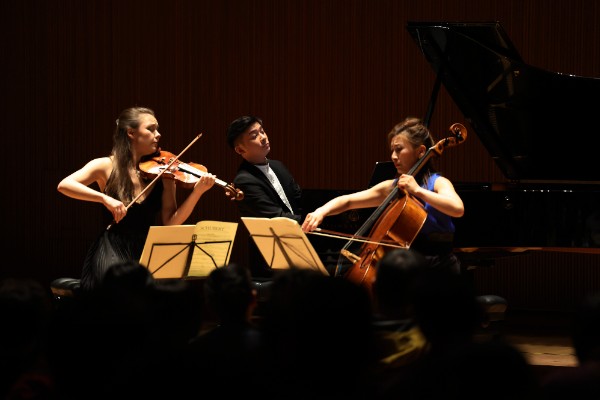
Schubert’s Piano Trio No. 2 performance © Cai Leilei
Another surprise was pianist KaJeng Wong, whose instinctive grasp of Schubert’s rhetoric brought both the music’s bitter humour and its lyrical melancholy vividly to life in the Piano Trio. The Andante con moto unfolded on an almost Brucknerian symphonic scale, its sudden turns to the minor and restless harmonic tensions dramatically conceived yet rendered with a compelling delicacy of finger touches. Wong drew a grand yet nuanced sound from the instrument—at times making it seem almost a different piano from that heard in the first half—though occasionally the musical argument felt slightly pressed, particularly in the final movement.
Not all performances convinced—an inevitable reminder of the cruelty of live performance, all the more so in a festival such as Z+. Violinist Alexandra Conunova struggled with intonation in the Schubert, her tone at times unyieldingly dry. She fared much better in Mahler’s Piano Quartet on another evening, where her sound regained its expressive breadth—perhaps a reminder that soloists cannot always be at their peak.
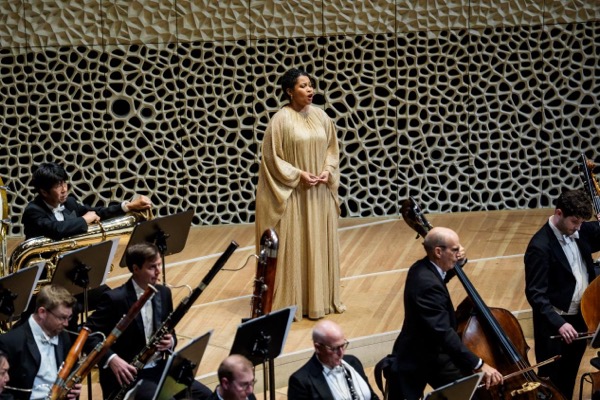
Mezzo-soprano Hongni Wu’s return to the Shanghai Symphony Hall, after her successful concert in July 2024, was much anticipated. In the Mahler songs, she responded with renewed maturity, negotiating most of the technical demands with assurance. Compared to her performance in Mahler’s Third Symphony with the Philharmonia Orchestra in 2024, her interpretation has clearly deepened, her phrasing more naturally shaped; her well-inflected lines conveyed Mahler’s shifting palette of colours with conviction.
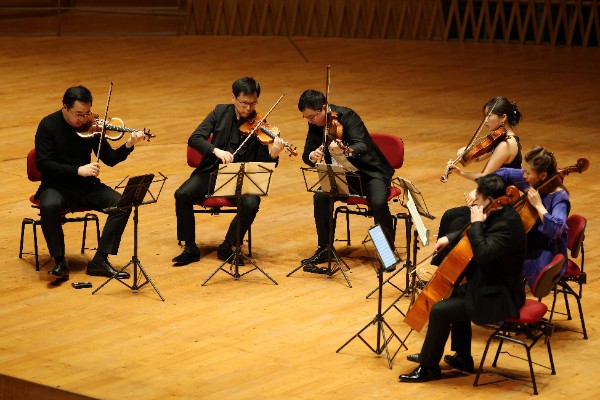
Tchaikovsky’s Souvenir de Florence performance © Cai Leilei
The festival concluded with Tchaikovsky’s Souvenir de Florence, featuring a star-studded string ensemble including Ning Feng and Diyang Mei. It was a performance of considerable electricity and brilliance, the solo lines dispatched with flair. Yet once again, moments of slight lack of ensemble cohesion—inevitable in such gatherings—were audible, but those of chemistry were surely there. Still, one suspects that Z+ would not wish it otherwise: perfection, perhaps, is not its aim.
For more of the best in classical music, sign up for our E-Newsletter





Will there be any chamber music July 26, 2026?