The exceptional and legendary Alicia de Larrocha, born on 23 May 1923 in Barcelona, Catalonia, Spain, won four Grammy Awards after being nominated fourteen times, along with a Prince of Asturias Award for the Arts and other prizes and various national medals.
In 1995, she became the first Spanish artist to win the UNESCO Prize for Music, and as an extraordinary ambassador for Spain, she championed the Spanish repertoire, particularly the piano works of Isaac Albéniz and Enrique Granados.
She once explained that “Spanish music is very, very, very, hard. Young people come to me and think they can play it right away. But Spanish music must have the right rhythm.” To celebrate her birthday, let us highlight some of her best recordings of Spanish piano music.
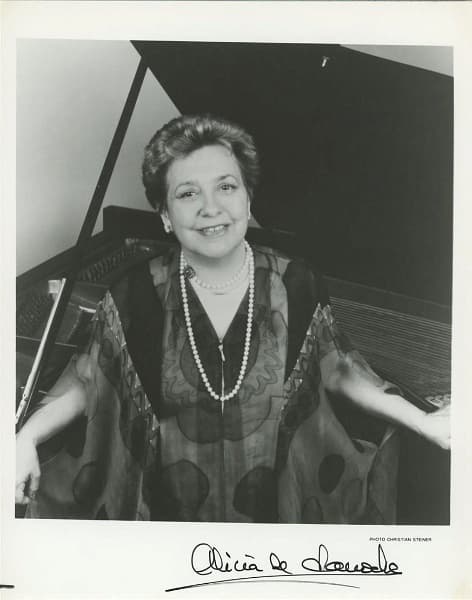
Alicia de Larrocha
Alicia de Larrocha performs Granados: 12 Danzas españolas, Op. 5, No. 5 “Andaluza”
Her Deepest Passion
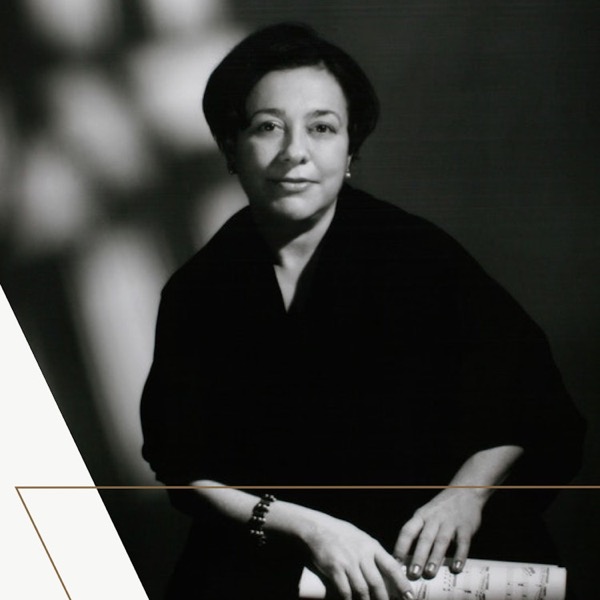
Alicia de Larrocha
Alicia de Larrocha held Enrique Granados in particularly high regard among Spanish composers. Both her mother and aunt had studied with Granados, and she had trained under Frank Marshall, Granados’s successor at the academy.
In a well-known 1978 interview, she explained that “Granados was one of the great Spanish composers, and that, in my opinion, he was the only one to capture the real Romantic flavour. His style was aristocratic, elegant, and poetic.”
Her Granados recordings are often called benchmarks or definitive as they draw directly from her documented pedagogical lineage. What is particularly stunning is her natural command of rubato and the way she keeps the tempo flexible. Everything sounds organic and never mannered.
Alicia de Larrocha plays Albéniz – Iberia: Triana (1969 TV)
Iberia Through Her Eyes
Alicia de Larrocha considered Granados a true Romantic, and she believed that Isaac Albéniz was “a more international composer. Even though his music is Spanish in flavour, his style is completely Impressionistic.”
Specifically in Iberia, Larrocha found a sophisticated French-influenced pianistic language that blended with Spanish colour. In masterclasses, she emphasised fidelity to the Albéniz scores, the precise placement of exact accents, and a pianistic rather than percussive execution.
Larrocha recorded Iberia multiple times and performed the complete suite in notable recitals. Reviewers frequently described her playing as having a “special empathy” with her native Spanish repertoire, music she played with authority that came from deep tradition.
Alicia de Larrocha plays Federico Mompou (LIVE – 1970)
Lifelong Friendship
Alicia de Larrocha enjoyed a lifelong personal and professional friendship with Federico Mompou. They collaborated musically for decades, including joint performances and recitals.
Mompou dedicated multiple works to her, including Música Callada and “Canción y Danza No. 14.” In turn, she became one of the foremost interpreters of his piano music, recording his works across several decades.
Alicia de Larrocha had a special affinity for the intimacy, subtlety, and poetic restraint of Mompou’s music. Having direct insight into the composer’s intentions, she brought out the almost secretive character of his music through her nuanced dynamic shading and voicing.
Alicia de Larrocha plays Turina: Zapateado, Op. 8, No. 3
A Lifetime with Spanish Masters
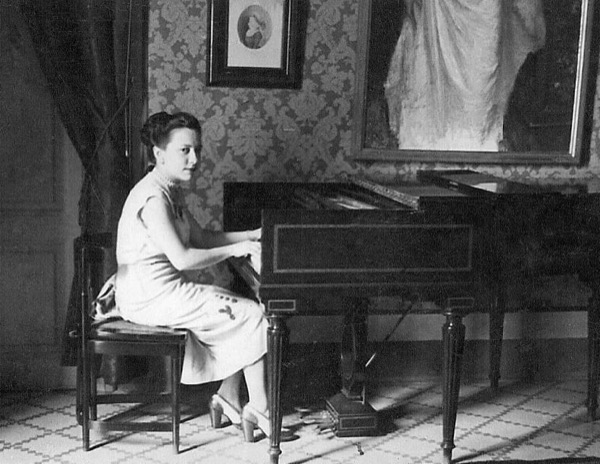
Alicia de Larrocha at the Marshall Academy, 16 June 1948 (courtesy of the Alicia de Larrocha Archive)
The composer and critic Joaquín Turina described his surprise and admiration upon hearing Alicia perform works by Bach, Mozart, and Granados on 14 May 1929, at her first public appearance at the Marshall Academy.
In time, she became a leading advocate for Turina’s music, recording and performing his major piano works. In fact, critics noted that she made a “powerful case” for his piano music, which was less known compared to his guitar works written for Segovia.
Alicia de Larrocha positioned Manuel de Falla as a composer who most authentically captured “the spirit of the Gypsy music.” She recorded Nights in the Gardens of Spain at least twice in the studio, and later added live performances and video recordings.
Her interpretation accentuates the rhythmic vitality and idiomatic Spanish flair of the music by combining a poetic atmosphere with evocative colouring. Here and elsewhere, Alicia de Larrocha remains the defining voice of Spanish piano music.
For more of the best in classical music, sign up for our E-Newsletter