Every Wagner production falls into two categories: “traditional” and “modern.” The latter, in turn, can be divided into two further kinds: controversial and extremely controversial—sometimes, controversy itself seems to be the point. Since the 1976 Jahrhundertring, conducted by Pierre Boulez and directed by Patrice Chéreau, modern Regietheater productions have gradually become the mainstream at the Bayreuth Festival, amid the constant tension between resistance and innovation.
New version of Wagner’s “The Valkyrie”(Die Walküre) premieres in Shanghai
The current artistic director of the Bayreuth Festival, Katharina Wagner—great-granddaughter of Richard Wagner—has consistently pursued her own Regie will throughout her career. On 24 and 26 April 2026, in the second year of the “Bayreuth in Shanghai” project, her production of Die Walküre received its world premiere at the Shanghai Grand Theatre, provoking considerable controversy. As waves of boos rang out through the theatre, one wonders whether Katharina, stepping onto the stage for her curtain call, might briefly have felt herself back in Bayreuth. In the Festspielhaus built for her great-grandfather, few productions have escaped the long-standing tradition of booing—and since her own directorial debut in 2007’s Bayreuth, Katharina’s work has often been accompanied by such jeers.
Of course, booing in China differs from booing in Bayreuth. In China, Regietheater remains relatively new to most audiences, and many still struggle to accept the sense of disjunction when “what is sung” and “what is acted” seem to belong to different worlds. In Europe, however, where these canonical works are staged year after year, audiences already know the original plots by heart; directorial deconstruction therefore allows for a fresh theatrical experience, and controversy itself effectively generates attention. Katharina herself appears neither resistant to nor particularly troubled by such controversy—in fact, she may rather enjoy it.
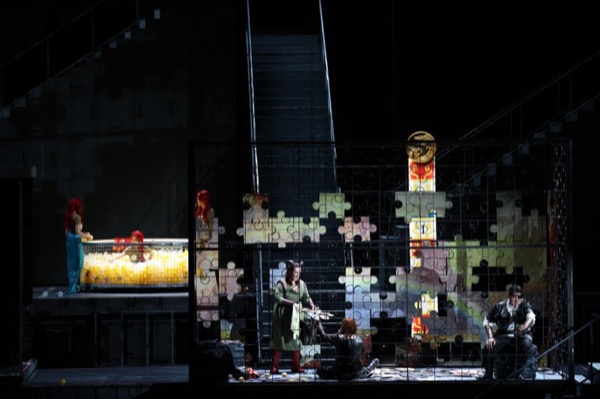
Wotan, Fricka, and Brünnhilde solving puzzles © Qi Qi / Shanghai Grand Theatre
Her Die Walküre certainly contains interesting ideas. Katharina places the story of the Ring within the framework of a video game: all the principal characters appeared as players in “The Ring Game,” and the conflict between fate and free will was materialised as a struggle between game setting and player choices. This proved a highly apt stage allegory. In this production, characters must solve locks, puzzles, and mazes, eventually collecting enough golden apples to reach the next level—the dragon-form Fafner in Siegfried. These golden apples, symbolising life, wealth, or power, became the essential key to progression, and also served as the food Siegmund first used to restore his “health points.” Golden apples seemed a rather clever device: In Das Rheingold, Freia, the goddess of love and beauty, grows golden apples that keep the gods unageing; in Greek mythology, the eleventh of Hercules’ twelve labours was to obtain the golden apples guarded by a dragon, after which he would conquer Cerberus and attain immortality. At the end, as Brünnhilde, having gathered the apples, slowly rose toward the dragon guarding the Ring above, Katharina concluded her Regie narrative with a suspenseful full stop.
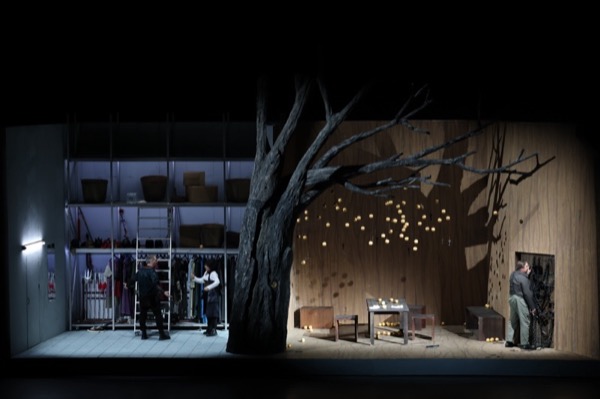
Siegmund attempting to unlock © Qi Qi / Shanghai Grand Theatre
The stage design by Karlheinz Beer also offered notable highlights. In Act I, the shifting scenes created a rich visual experience akin to an electronic display screen; the opening game start page, as well as the rising underground passage at the end, effectively established the spatial logic of a video game world. By contrast, Acts II and III, lacking such transitions, felt visually less driven in their stage storytelling, though touches such as the Rhinemaidens bathing in bubble-ball tubs in the background of Act II, or the Valkyries clearing away the corpses of failed players at the “Exit” in Act III, added welcome visual texture.
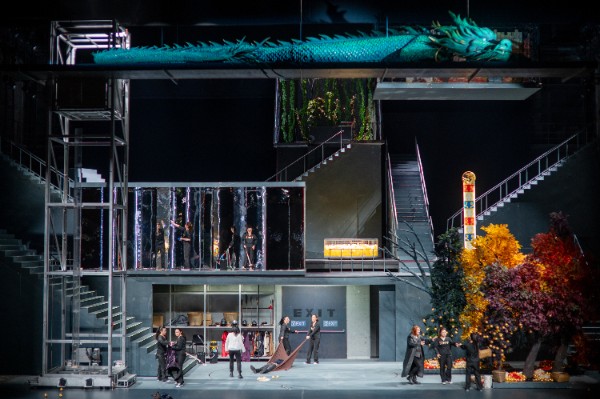
The Ride of the Valkyries © Dong Tianye
One major frustration, however, lay in the neglect of the sonic dimension of Wagner’s Gesamtkunstwerk. Obstructive set pieces and awkward stage positioning frequently disrupted the already fragile balance between singers and orchestra, leaving the texts (which Wagner highly emphasises) rather inaudible. More damaging still was the constant noise generated by the machinery itself: most notably, the persistent mechanical humming of the elevator in Act III seriously compromised the auditory experience and weakened the dramatic impact.
LOHENGRIN – Gran Teatre del Liceu – 2025
In past productions, Katharina has often asserted her Regie will by radically altering the plot itself. In her 2025 Barcelona production of Lohengrin, for instance, she shocked audiences already during the Prelude: the heroic Lohengrin appeared as the murderer who drowned Gottfried, the Swan Knight transformed into a “black swan.” By the end, rather than returning to the Holy Grail, Lohengrin—unable to bear his guilt—committed suicide.
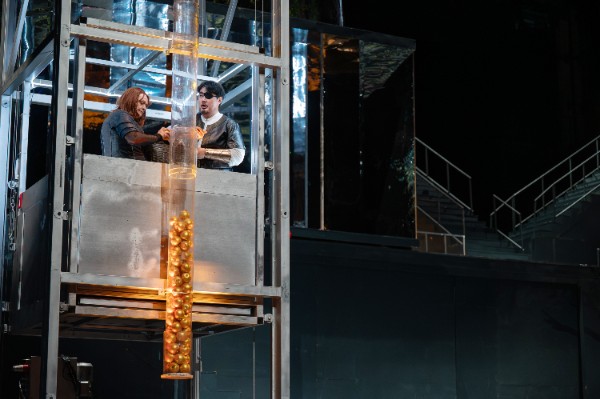
Collecting Golden Apples © Dong Tianye
This strategy seemed pushed even further in Die Walküre. In Act II, Fricka killed Hunding herself, riding on top of him; Wotan, who should have killed Hunding, sat passively beside Sieglinde, who had just seen her lover murdered. In Act III, Brünnhilde—who in the original should lie sleeping within the ring of fire—killed Fricka when she attempted to steal the golden apples, repeatedly provoked Wotan, imprisoned him within the fire circle, and then proceeded alone upward by elevator while Wotan sang his moving “Magic Fire Music.” Compared with such revisions, the strangely cold lack of physical intimacy between Siegmund and Sieglinde, or the Valkyries sitting on the stairs taking cheerful selfies after clearing away corpses, seemed almost unsurprising.
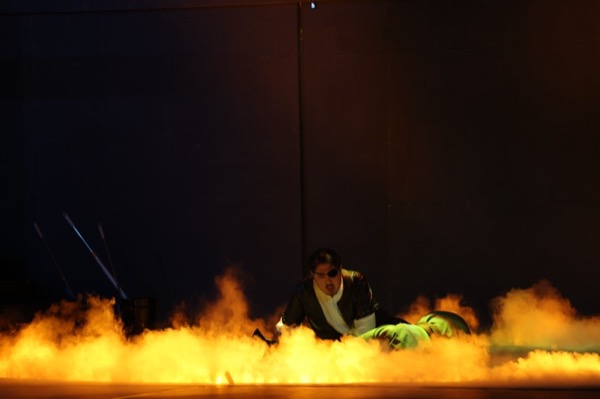
Wotan imprisoned in the fire © Qi Qi / Shanghai Grand Theatre
Yes, Katharina achieved precisely the effect she sought, and her concept seemed largely coherent. Throughout the game, each character displayed a stronger—perhaps more distorted—individual will than in the original script, and nowhere was this more evident than in Brünnhilde, whose portrayal was arguably the most successful in the production. Her rebelliousness was greatly amplified: from her quarrels with Wotan and Fricka during the puzzle sequences, to her repeatedly throwing golden apples at Wotan, to finally killing Fricka and imprisoning Wotan, a clear line of dramatic development emerged.
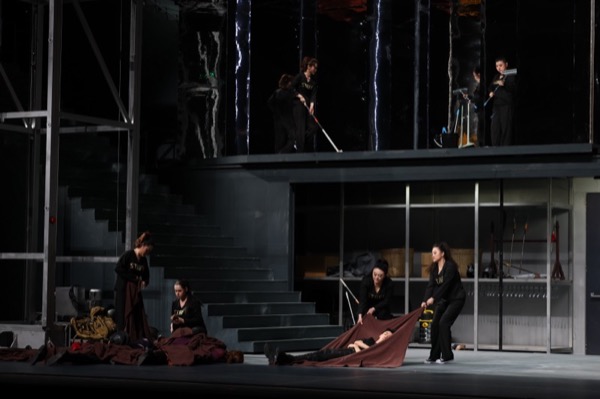
Valkyries collecting corpses © Qi Qi / Shanghai Grand Theatre
Yet if Brünnhilde’s rebellion is reduced merely to the overthrow of “patriarchy,” the idea becomes somewhat clichéd and shallow. Beyond her startling Regie interventions, Katharina seemed not to have uncovered sufficient depth within the dramatic space of Die Walküre, especially since many of Brünnhilde’s original emotional complexities were almost entirely stripped away. Brünnhilde imprisoning Wotan within the ring of fire symbolised the overthrow of paternal authority—but was Katharina’s reimagining of her great-grandfather’s drama not itself another form of that same rebellion?
Musically, however, this Walküre rarely disappointed, even if one could not expect overwhelming musical magic. Catherine Foster as Brünnhilde was beyond doubt. Sixteen years ago, she had already come to Shanghai with the Cologne Opera to perform this very work. Once again, I was reminded that she remained one of the finest Wagnerian sopranos of our time. Stage limitations inevitably affect performance, and her voice now bears some traces of time, but her broad yet finely nuanced singing remains remarkable. She shaped phrases almost instinctively, finding expressive inflection in every line; her Brünnhilde combined brilliance with innocence.
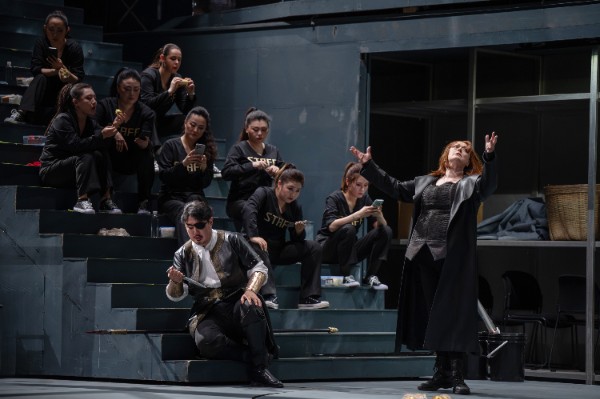
Wotan and the Valkyries © Dong Tianye
Shen Yang’s Wotan was similarly impressive. His warm, grounded timbre, clear diction, and perfect control across registers gave his singing almost the quality of Lieder; his Wotan possessed more warmth than authority. In contrast, Anna Maria Chiuri sang Fricka with fiery sharpness and volatility, in keeping with the production’s characterisation.
Vincent Wolfsteiner’s Siegmund offered a bright and attractive Heldentenor sound. Though his voice did not always project through with absolute force, he clearly understood how to shape the role, and in the touching monologues of Acts I and II, he captured the character’s emotional shifts with sensitivity, if not quite perfection. His rival, Wilhelm Schwinghammer, by comparison, possessed a more focused and powerful sound; his Hunding was suitably cold and menacing, and “Hunding’s Oath” carried real oppressive force—a genuinely terrifying antagonist. Manuela Uhl, with her sweet and clear voice, was a gentle Sieglinde.
With nine musicians from the Bayreuth Festival Orchestra joining them, the Suzhou Symphony Orchestra performed at their highest level under Xu Zhong. The orchestra’s own principal wind players also produced sounds of admirable quality, and the balance between sections, as well as rhythmic precision during tempo changes in crucial passages, revealed the results of careful rehearsal. Xu Zhong continued the same meticulous musical discipline he had shown last year while conducting another orchestra for “Bayreuth in Shanghai.”
For more of the best in classical music, sign up for our E-Newsletter