In his latest recording, pianist and composer Emanuele Delucchi turns to the late piano works of Ferruccio Busoni, bringing together the Elegien, Sonatina IV, and Toccata. Developed in collaboration with Breitkopf & Härtel, the project offers a compelling perspective on Busoni’s evolving musical language and invites renewed attention to a composer whose work continues to challenge and captivate.

Emanuele Delucchi
Delucchi’s extensive artistic background provides a strong basis for the project. He has performed widely across Europe and beyond, including Italy, Germany, France, the UK, Greece, Slovenia, Croatia, and Mexico. His recordings for Toccata Classics, Dynamic, and Piano Classics span from the Renaissance to contemporary music, often highlighting lesser-known works. Notably, he performed Carl Czerny’s Pianist im klassischen Style Op. 856 live for the first time and gave the first Italian performance of Charles-Valentin Alkan’s Concerto Op. 39. He is also recognised for his interpretations of Leopold Godowsky, including performing and recording his works critically acclaimed, such as the complete Studies on Chopin Op. 10. In addition to his solo performances, Delucchi has worked with conductors like Gustav Kuhn and composers like Fabio Vacchi and Carlo Boccadoro. His compositions, published internationally, include the orchestral piece Ricercare II, which opened the VI Festival Primavera di Baggio in 2017. A passionate reader interested in classical culture, Delucchi brings an intellectual depth to his music, particularly evident in this Busoni project.
The program itself is carefully conceived as a survey of contrasting compositional approaches. “The program aims to offer a sampling of various compositional styles,” Delucchi explains. “It includes a collection of short, deeply philosophical pieces, a single, strictly structured piece, and a complex, large-scale work.” The idea for the album originated in 2024, during a concert marking the centenary of Busoni’s death, and grew from there into a broader exploration of the composer’s late piano output. As Delucchi points out, “Busoni’s entire piano oeuvre is interconnected,” with the Elegien functioning as a kind of nexus. These pieces draw on material from operas such as Turandot and Die Brautwahl, as well as instrumental works including the Piano Concerto Op. 39, and the Berceuse élégiaque. “From the Elegies onwards, Busoni’s style becomes distinctive and instantly recognisable,” he notes.
Delucchi’s approach to interpretation reflects a shift in his artistic experience. After years of engaging with the meticulously detailed music of Leopold Godowsky, Busoni presented a very different kind of challenge. “Finding the right interpretation for these pieces has been thrilling,” he says. “With Godowsky, everything is scientific and precise. With Busoni, I discovered the thrill of interpretative metaphysics.” Busoni’s scores, with markings such as ängstlich (fearful) and flehend (imploring), open a space for the performer’s imagination while demanding a deep understanding of context. For the Elegien, this meant going beyond the piano repertoire itself. “It was essential to listen to the works connected to them and to seek inspiration in the way Busoni orchestrated passages that exist in both piano and orchestral versions,” Delucchi explains.
In the Toccata, Delucchi finds a particularly vivid expression of Busoni’s aesthetic, one that bridges historical reference and modern innovation. He describes it as “a genuine 20th-century piano masterpiece,” noting how it resonates with parallel developments in the music of composers such as Ottorino Respighi and Alfredo Casella, as well as the neoclassical works of Igor Stravinsky. Yet Busoni’s voice remains distinct. While the work gestures toward Renaissance models that explicitly invoke Girolamo Frescobaldi, it also incorporates Romantic elements and a sense of pianistic grandeur rooted in Franz Liszt. Delucchi responds with an interpretation that emphasises clarity and restraint: “I have sought to make my interpretation as clean and classical as possible, limiting the use of the sustain pedal and striving for a sound that is consistently expressive and well-defined.”
The contrasts within the program are deliberate, offering a broad view of Busoni’s pianistic imagination. “The choice of program is deliberate and calculated,” Delucchi observes, “and serves as a broad-scale illustration of Busoni’s style, which seeks the greatest possible variety of timbres and colours.” In the Sonatina IV, written during Busoni’s Zurich exile, he identifies multiple layers within a single work: rigorous counterpoint in the manner of Johann Sebastian Bach, a more rhythmic and pastoral dimension, and passages of sonic experimentation achieved through sustained pedal effects. Recordings of Busoni himself further illuminate this diversity. “His pianistic style is extremely varied, colourful, and never banal,” Delucchi remarks.
The collaboration with Breitkopf & Härtel also plays an important role in the project’s development. Closely associated with Busoni’s music, the publisher provided both historical continuity and practical support. “Our collaboration began in 2024, for the concert marking the centenary of his death,” Delucchi says. “I am grateful to Irina Eppel and Breitkopf & Härtel for the trust and esteem they have placed in my work.”
At the heart of the recording lies a desire to reconnect audiences with Busoni’s unique musical voice. “Busoni’s music needs to be rediscovered and listened to,” Delucchi reflects. “It is unique music, unlike anything else written during that period.” While Busoni admired Arnold Schoenberg, he maintained a distance from strict atonality, drawing instead on a wide range of influences, including Italian folk traditions, Romantic expression, and the enduring legacies of Johann Sebastian Bach and Franz Liszt. “All these influences contribute to forming a unique style that I would describe as almost ‘magical’,” Delucchi says.
For listeners, the invitation is both simple and profound. “I think it is very easy to be captivated by Busoni’s music, even without any technical or philosophical background,” he concludes. “After a first listen, the desire to explore this composer further will soon arise.”
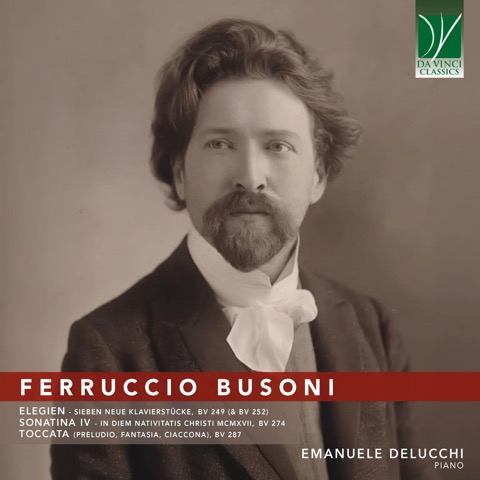
Ferruccio Busoni: Elegien, Sonatina IV, Toccata
Emanuele Delucchi, piano
Da Vinci Classics
Release date: 27 March 2026
For more of the best in classical music, sign up for our E-Newsletter