As soon as Richard Wagner had put the finishing touches on Lohengrin on 28 April 1848, he became embroiled in the stirrings of the 1848 Revolutions. He delivered a fiery speech, denouncing the evils of money and speculation, which he considered immoralities that were barriers to the emancipation of the human race.
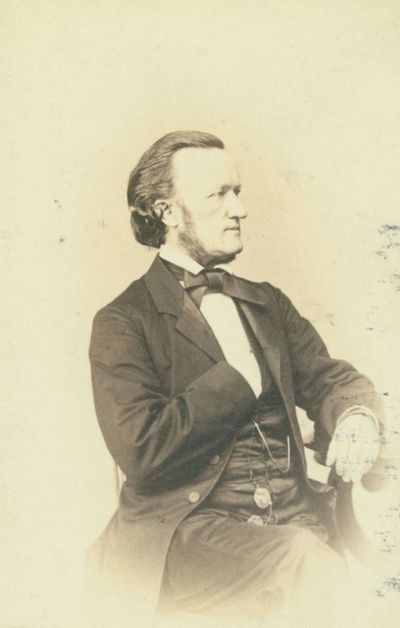
Richard Wagner in 1860
When Prussian troops started to assert control over the city in May 1849, Wagner first fled to Liszt in Weimar, and subsequently made his way to Switzerland on a false passport.
Coincidentally, the year 1849 also saw the marriage of the silk merchant Otto Wesendonck to the poet and playwright Agnes Mathilde Luckemeyer. The couple moved to Zurich, and their abundant wealth allowed them to support various artists and causes.
A Chance Encounter
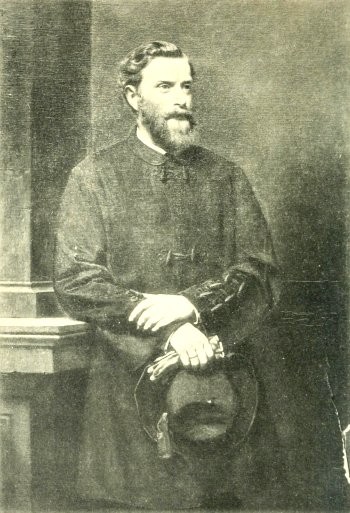
Otto Wesendonck
On 25 April 1853, the Wesendoncks went to a concert at the Aktien-Theater and heard music composed and conducted by Richard Wagner. Otto was immediately fascinated by Wagner’s music, and Richard initially fancied Otto’s money, and a little later became fascinated by Mathilde as well.
To celebrate Wagner’s birthday on 22 May, let us take a closer look at the fruits of this chance encounter, the five so-called Wesendonck Lieder, with poems by Mathilde and music by Richard.
Richard Wagner: Wesendonck Lieder, “Der Engel”
A Woman of Poetry and Intelligence
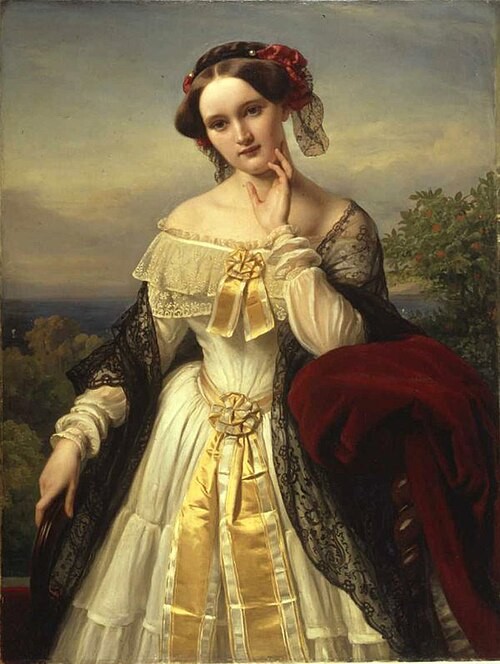
Agnes Mathilde Wesendonck
Agnes Mathilde Wesendonck hailed from Elberfeld, and her father ran a freight forwarding company. He also founded a steam shipping company that operated on the Middle and Lower Rhine. Mathilde was one of four children and was highly educated, attending a boarding school in Dunkirk with her sister Marie.
She met Otto Wesendonck in late 1847, and the wedding took place in May of 1849. The couple were interested in politics and the arts and held gatherings that included very distinguished attendees.
Mathilde Wesendonck was also a writer and poet, and she published two books of poems, folk songs, and legends in 1862 and 1874, respectively. She also wrote children’s stories and plays, and “her fascination with Wagner was likely propelled by the fact that he took her seriously and spoke to her as a person of intelligence.” (Baldwin, Wesendonck Lieder, 2018)
The Angel
In the early days of childhood
I often heard tell of angels
Who exchange heaven’s pure bliss
For the sun of earth,
So that, when a sorrowful heart
Hides its yearning from the world
And would silently bleed away
And dissolve in streams of tears,
And when its fervent prayer
Begs only for deliverance,
That angel will fly down
And gently raise the heart to heaven.
And to me too an angel descended,
And now on shining wings
Bears my spirit, free from all pain,
Towards heaven!
English translation © Richard Stokes
Richard Wagner: Wesendonck Lieder, “Stehe still”
Silk Money and Wagnerian Dreams
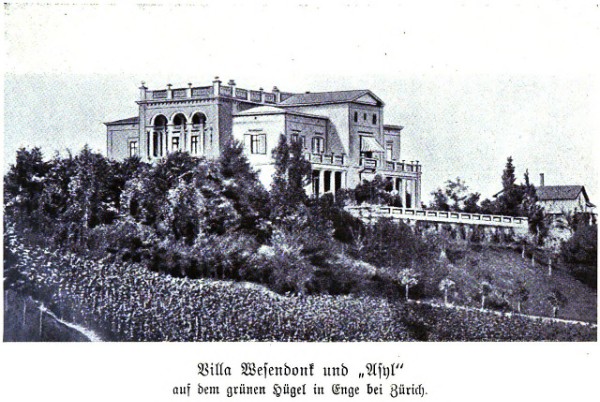
Villa Wesendonck
Otto represented the import silk firm Loeschigk, Wesendonck & Company until the mid-1860s. Since he had done extremely well in his profession, he ordered the construction of a lavish villa, harmoniously situated in a sprawling park in the centre of the city of Zurich.
Otto spared no expense in furnishing his new home, providing a lush marble interior, plush carpets, exotic tapestries, luxurious curtains and delectable furniture. The Wesendonck mansion was completed by 1857, and Otto placed the two-story cottage adjacent to the villa on the estate, at Richard’s disposal.
When Otto went on frequent and extended business travels, Richard took over the villa.
He hosted lavish parties and invited friends from near and far to stay for indefinite periods of time. Even the newlyweds Cosima Liszt and Hans von Bülow visited the self-anointed lord of the manor.
Stand still!
Rushing, roaring wheel of time,
You that measure eternity;
Gleaming spheres in the vast universe,
You that surround our earthly sphere;
Eternal creation – cease:
Enough of becoming, let me be!
Hold yourselves back, generative powers,
Primal Thought that always creates!
Stop your breath, still your urge,
Be silent for a single moment!
Swelling pulses, restrain your beating;
Eternal day of the Will – end!
That in blessed, sweet oblivion
I might measure all my bliss!
When eye gazes blissfully into eye,
When soul drowns utterly in soul;
When being finds itself in being,
And the goal of every hope is near,
When lips are mute in silent wonder,
When the soul wishes for nothing more:
Then man perceives Eternity’s footprint,
And solves your riddle, holy Nature!
English translation © Richard Stokes
Richard Wagner: Wesendonck Lieder, “Träume”
The Secret Romance
Mathilde and Richard developed very strong feelings for each other, and it remains a matter of debate whether, and to what extent, they crossed the line of decorum and consummated the relationship. We do know, however, that she became his “Isolde,” and that she showered him with perfume and with all the silk undergarments a real man could ever want.
In 1853, after several years largely devoted to prose writings and opera projects, Wagner presented Mathilde with a piano sonata that he had composed specifically for her. The friendship blossomed, and increasingly, Wagner would leave little clues in his work on Die Walküre.
According to Baldwin, we find annotations like “if it were not for you, my Beloved!!, “I love you infinitely,” and “Do you love me, Mathilde?” “These little notes, like those of a young lover writing in the margin of a textbook, show that he was constantly thinking of the young wife of his benefactor.” (Baldwin, Wesendonck Lieder, 2018)
Dreams
Say, what wondrous dreams are these
Embracing all my senses,
That they have not, like bubbles,
Vanished to a barren void?
Dreams, that with every hour
Bloom more lovely every day,
And with their heavenly tidings
Float blissfully through the mind!
Dreams, that with glorious rays
Penetrate the soul,
There to paint an eternal picture:
Forgetting all, remembering one!
Dreams, as when the Spring sun
Kisses blossoms from the snow,
So the new day might welcome them
In unimagined bliss,
So that they grow and flower,
Bestow their scent as in a dream,
Fade softly away on your breast
And sink into their grave.
English translation © Richard Stokes
Richard Wagner: Piano Sonata in A-flat (1853)
The Seeds for Tristan
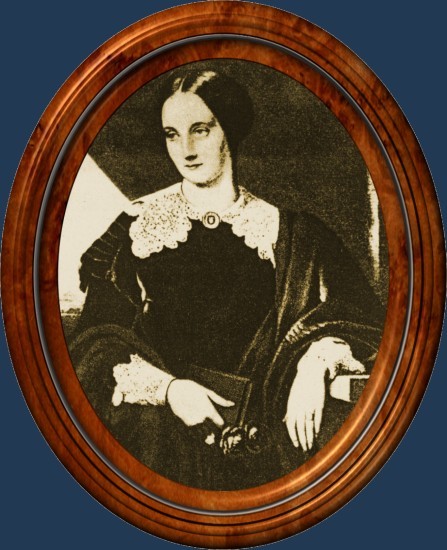
Mathilde Wesendonck
Mathilde presented Wagner with a poem in November 1857, a couple of months after an emotional reading of Tristan and Isolde. According to literary critics, “The Angel” carries spiritual salvation and the longing for a peaceful death as its primary themes.
Scholars have noted that the setting carries similarities to the beginning of the prelude to Das Rheingold. By December 1857, Wagner had also received the poem “Dreams,” which unfolds in a structure similar to “The Angel.” Nature and spiritual salvation are once again referenced, and we find the wish for a peaceful death at the end.
This Lied, specifically, contains a multitude of references to motives found in Tristan and Isolde, and in her dissertation on this topic, Baldwin points out specific connections to the opera score. The poem for “Agonies,” presented in the same month, draws a connection between a glorious hero and the sun, as the sun itself must die and each day begin again.
Agonies
Every evening, sun, you redden
Your lovely eyes with weeping,
When, bathing in the sea,
You die an early death;
Yet you rise in your old splendour,
The glory of the dark world,
When you wake in the morning
As a proud and conquering hero!
Ah, why should I complain,
Why should I see you, my heart, so depressed,
If the sun itself must despair,
If the sun itself must set?
If only death gives birth to life,
If only agony brings bliss:
O how I give thanks to Nature
For giving me such agony!
English translation © Richard Stokes
Richard Wagner: Wesendonck Lieder, “Schmerzen”
The Breaking Point
“Stand Still” reached Wagner on 6 February 1858, but things were getting complicated as Otto was becoming more and more aware of Mathilde’s feelings for Richard. This might well account for the dramatic nature of the setting.
Things got really complicated, however, when Minna Wagner intercepted a letter from Richard to Mathilde in April 1858. “The day before yesterday, an angel came to me at noon, blessed and comforted me,” he wrote. “Now I am able to pray to my angel with heartfelt emotion. This prayer is a prayer of love. Love!
Profound joy in this love, it is the source of my salvation. When I look into your eyes, there is nothing more to say. I feel so sure of myself when this wonderful, sacred gaze falls upon me and envelops me…” Minna was devastated and furious, and showed the letter to Mathilde, and subsequently to Otto as well.
Mathilde presented the final poem, “In the Greenhouse,” to Wagner at the end of April. Baldwin suggests that Mathilde was suffering and grieving. “She is using the trees, canopies of emerald, their arms stretched wide, as a metaphor for her realization that her connection with Wagner must come to an end.” (Baldwin, Wesendonck Lieder, 2018)
In the Greenhouse
High-arching leafy crowns,
Canopies of emerald,
You children who dwell in distant climes,
Tell me, why do you lament?
Silently you bend your branches,
Inscribe your symbols on the air,
And a sweet fragrance rises,
As silent witness to your sorrows.
With longing and desire
You open wide your arms,
And embrace in your delusion
Desolation’s awful void.
I am well aware, poor plant;
We both share a single fate,
Though bathed in gleaming light,
Our homeland is not here!
And just as the sun is glad to leave
The empty gleam of day,
The true sufferer veils himself
In the darkness of silence.
It grows quiet, a whirring whisper
Fills the dark room uneasily:
I see heavy droplets hanging
From the green edge of the leaves.
English translation © Richard Stokes
From Scandal to Immortality
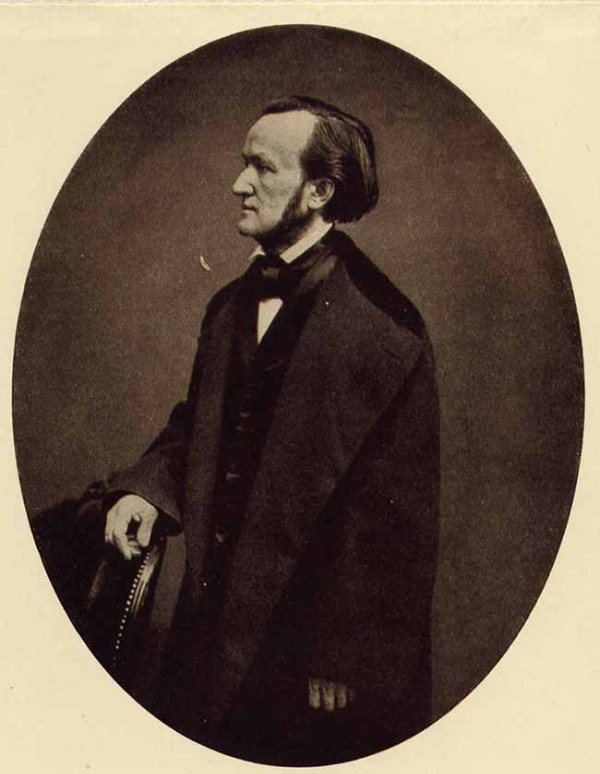
Richard Wagner in 1860
Richard always claimed that Minna had put a vulgar interpretation on his letter, and it is debatable if Otto told him to leave immediately or whether Wagner left on his own accord.
Minna continued to take the view that Mathilde had seduced her Richard, and he apparently continued to write lavish “fantasy love letters” to Mathilde.
The connection between Richard and Mathilde came to an end, but their story survived through the poetry of these five Lieder and the tale of Tristan and Isolde. Wagner referred to the opera as a child of their suffering, and six years later Richard asked Otto once again to be allowed to live in the Wesendonck cottage.
Otto declined and Richard was highly offended. “All my suffering should have earned your forgiveness, and it would have been beautiful and noble to have forgiven me, but it is useless to demand the impossible.”
Richard would later describe his relationship with Mathilde as “something of a mystery,” and the Wesendoncks continued to support the arts and various artists. When Johannes Brahms visited Zurich for a number of performances between 1865 and 1866, he lodged in the Wesendonck cottage, but he politely refused the invitation to move in.
For more of the best in classical music, sign up for our E-Newsletter