The new book Bach: The Cello Suites by Edward Klorman features exhaustive research into the six Bach Cello Suites and is available as a new Cambridge Music Handbook through Cambridge University Press. This handbook is not to be underestimated, despite being under 200 pages. It includes multiple pages of musical examples and tables, an index, a bibliography, and extensive notes after each chapter.
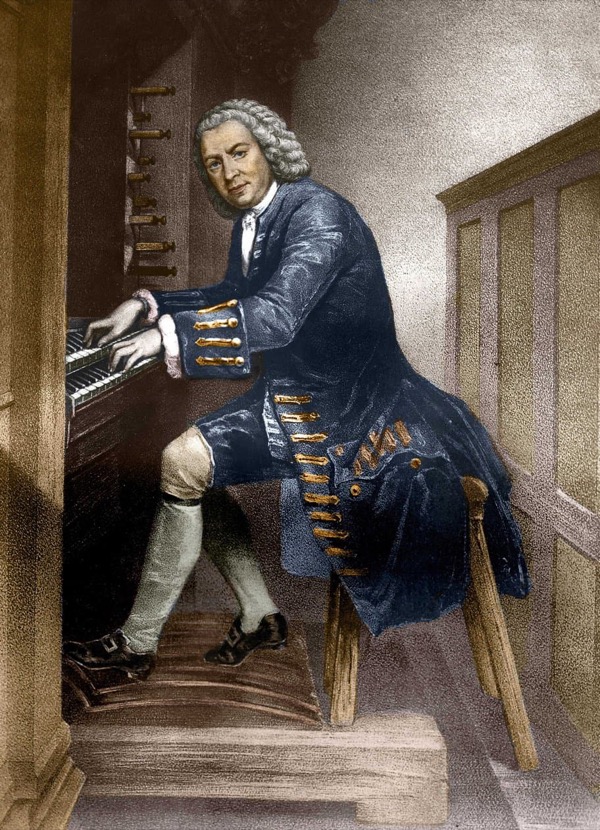
Johann Sebastian Bach playing the organ (c. 1881)
The first chapter delves into the context, citing Bach’s environs during the time he wrote the suites, as well as the instrument he might have intended. It was a time when the bass viol was beginning to decline in popularity, but there was little tradition of unaccompanied music. The cello, a comparatively newer instrument, was still more known “as an instrument suitable for bass lines in ensemble music” but was soon to gain popularity over the viol.
Around the middle of Bach’s tenure from 1717-1723 as “Capellmeister and director of chamber music for Prince Leopold of Anhalt-Cöthen, Bach was asked to compose instrumental music, secular cantatas, and divertissements, as Leopold was an avid musician who sang, and who played harpsichord, violin and viol. This was a new focus for Bach, and a break from church music composition and organ playing.”
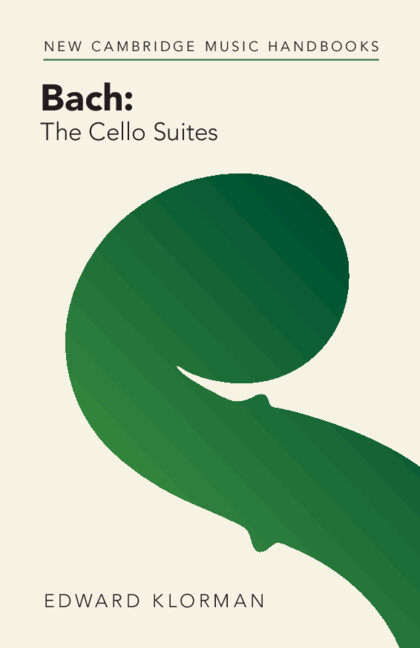
Bach: The Cello Suites by Edward Klorman
The author explains, and it is fascinating to know, that Bach likely intended the Six Violin Partitas as part one and the Six Cello Suites as part two of a two-part set and that they were conceived together. The violin pieces were composed first, likely in Weimar. Completed in 1720, they were copied out, “in an extraordinarily neat, calligraphic manuscript. Containing virtually no errors, corrections, or signs of creative deliberation…” Bach copied the work “while visiting the Carlsbad spa in May-June 1720 as a member of Leopold’s entourage.”
We are not so fortunate with the Cello Suites. The chapter outlines the research regarding what the author believes are the reasons we are missing the definitive autograph copy. As a professional cellist, I found these two chapters especially intriguing.
The author surmises that although the Cello Suites may have been well underway when Bach returned to Cöthen, he received the devastating news that Maria Barbara Bach, “his wife of almost thirteen years, and mother to his first seven children, had died and been buried during his extended absence.” The time required to handwrite a copy of the music was further complicated by Bach’s extended trip to Hamburg to perform and apply for a new position. A manuscript copy by Anna Magdalena Bach and a copy in C.P.E. Bach’s library are based on the original draft, and possibly at the behest of students of the elder Bach.
The author goes on to explain the virtues of the four versions that form the basis for editions and performances today.
He emphasises that the rhythmic integrity and style of each of the movements should take precedence over following indications such as slurs, bowings, articulations, and fingerings, which not only were unlikely to be Bach’s markings, but in his day, these works were performed on a variety of instruments, including the viola da spalla. Here’s a virtuosic performance of the Suite No. 6 on the Viola da Spalla.
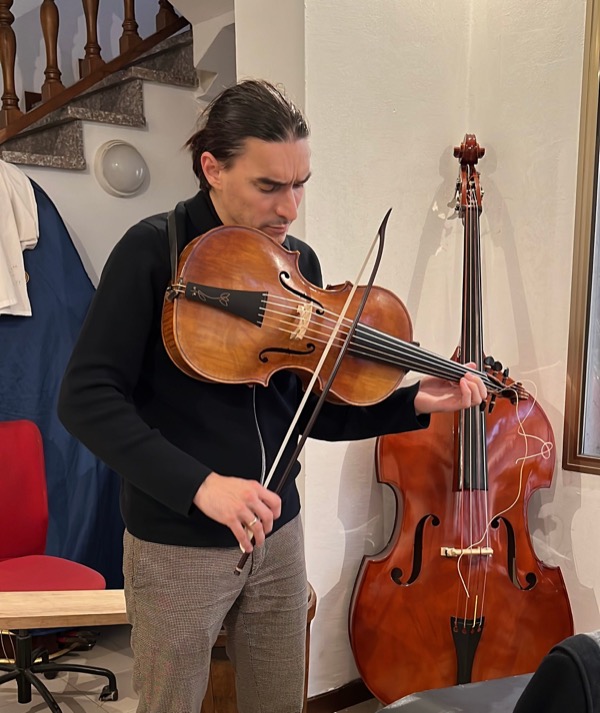
The viola da Spalla small five-string cello by Christian Gottlieb Klinger, now in the Leipzig Grassi Museum
Bach: Suite nº 6 BWV 1012 para viola da spalla | Sergey Malov
Nonetheless, Bach “was apparently the earliest German composer to explore the solo cello as a polyphonic instrument, [while] in composing for solo violin he was following a well-trodden path.”
There’s a very interesting chart that compares the movements of the Partitas to the Suites—the violin works are eclectic and vary regarding the number, types, and length of movements, whereas the cello suites all open with preludes followed by five dance movements and all follow the same order.
The analysis of each suite follows with impeccable detail.
Another fascinating chapter concerns performances and performance practices prior to Casals’ popularising the unaccompanied suites for the public. While still admiring the suites as Bach’s explorations of instrumental facility, prowess, and mastery of playing in different keys, artists of the day regarded the suites as exercises.
In fact, several composers, including Robert Schumann, wrote piano accompaniments to make them more “palatable” to audiences in public performances. These early concerts often entailed merely individual movements of the suites. The first known performance of all six suites, with piano accompaniments, occurred over two days, New Year’s Eve of 1853-54, for a private performance with pianists Robert and Clara Schumann, and cellist Christina Reimers. Schumann’s accompaniments are sadly lost.
The author goes on to describe the performances and attitudes of cellists of the day, whom we cellists know intimately through their etudes—the studies every cellist works on at one time or another. These cellists include Klengel, Gruetzmacher, Popper, Piatti, Hausmann, and Dotzauer.
David Popper is noted to have performed a Bach saraband with piano as early as 1864. Alfred Piatti performed several movements of Bach in his concerts from 1859 to 1873, sometimes combining movements from different suites.
A later chapter is dedicated to Pablo Casals and his “transformative impact on the way Bach’s Cello Suites are played in concerts and more broadly on the space they occupy in the cultural imagination.” It was Casals who established norms for performance, including standards for playing all the movements of a suite in order, with repeats, and without accompaniment. The first to record the six suites, his tempo choices are considered the definitive interpretation, and his influence has led cellists to value mastering the suites as a lifelong exploration and quest.
Musicians spend decades perfecting and revisiting these works over their lifetime. Here is a sample of Yehudi Menuhin’s sheet music.
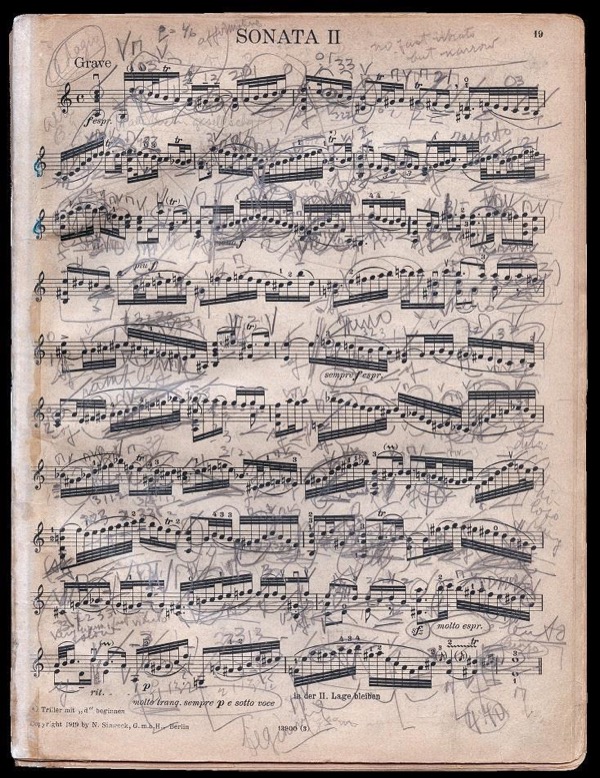
A marked-up first page of Bach’s Sonata no. 2, from the Sonatas and Partitas, ed. Adolf Busch (1919).
The Menuhin Bach manuscript was on display in 2016 at the Royal Academy of Music in London as part of its
‘Yehudi Menuhin: Journey with a Violin‘ exhibition, drawn from the Foyle Menuhin Archive.
Listen to Casals performing two movements from the Suite No.1.
Johann Sebastian Bach: Cello Suite No. 1 in G Major, BWV 1007 – I. Prelude (Pablo Casals, cello)
Johann Sebastian Bach: Cello Suite No. 1 in G Major, BWV 1007 – III. Courante (Pablo Casals, cello)
It’s almost compulsory for prominent cellists to record the suites, and a few of them have more than once. The listings read like a who’s who of cellists. Today it has become fashionable for cellists to perform the complete cycle, and they have been widely performing on concert tours—a breathtaking feat of stamina and memory.
Italian composer and cellist Giovanni Sollima’s version of the Prelude of Suite No.1, as you can hear, is with an entirely different articulation than Casals, and the tempo is quite different in the courante. Sollima also adds several ornamental flourishes.
Johann Sebastian Bach: Suite for Solo Cello No. 1 in G Major, BWV 1007 – I. Prélude (Giovanni Sollima, cello)
Johann Sebastian Bach: Suite for Solo Cello No. 1 in G Major, BWV 1007 – III. Courante (Giovanni Sollima, cello)
A young Spanish cellist, Pablo Ferrández, takes some liberties and plays the prelude more rhythmically free and quite a bit faster.
Johann Sebastian Bach: Cello Suite No. 1 in G Major, BWV 1007: I. Prelude (Pablo Ferrández, cello)
Let’s also compare the Allemande to the second suite. Casals performs it in a rhythmic and stylised fashion while Rostropovich plays the movement more lyrically.
Johann Sebastian Bach: Cello Suite No. 2 in D Minor, BWV 1008 – II. Allemande (Pablo Casals, cello)
Johann Sebastian Bach: Cello Suite No. 2 in D Minor, BWV 1008 – II. Allemande (Mstislav Rostropovich, cello)
As you can hear, there is a wide variety of interpretations. The suites become progressively more difficult from No. 1 to No. 6. Here are two dance movements from Suite No. 4 in E-flat major, the Bourree I and II, played by German cellist Maria Kliegel.
Johann Sebastian Bach: Cello Suite No. 4 in E-Flat Major, BWV 1010 – V. Bourree I and II (Maria Kliegel, cello)
Other noteworthy performances of the suites include Rostropovich’s performance of Bach at Checkpoint Charlie in Berlin upon the fall of the Berlin Wall in 1989. Yo Yo Ma performed the complete cycle at the BBC Proms in the Royal Albert Hall in 2015, and then embarked on his groundbreaking Bach Project, during which he performed the six suites on six continents, comprising 36 days of action, collaborating with local communities and artists. The suites have become synonymous with advocating for peace and universal understanding.
The author highlights several other performers of the Bach Suites and includes the cultural significance of the music in film, dance, and television, as well as the variety of other instrumentalists who play the suites.
There are rather a large number of musical examples that the music-lover may feel daunted by, and the analyses are quite in-depth, but I think even if you are not a cellist, if you are enamoured of the Bach Cello Suites, consider this volume for your library and for in-depth study.
For more of the best in classical music, sign up for our E-Newsletter