Perhaps you have never heard the music of Sophia Maria Westenholz (née Elenore Sophia Maria Fritscher, 1759–1838) — neither had I until listening to this new duo recording by Wu Qian and Juho Pohjonen, which includes the first commercial recording of Westenholz’s Sonata for Piano Four Hands.
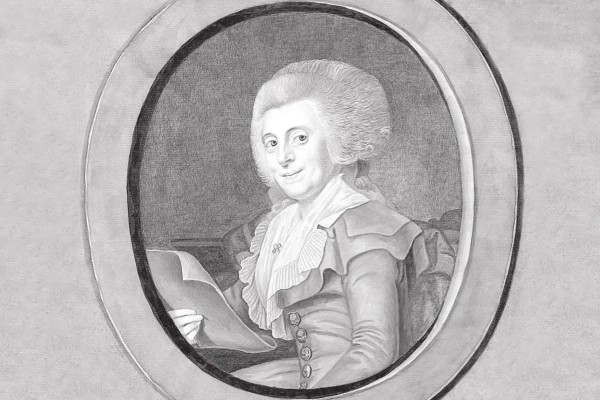
Sophia Maria Westenholz © Landeshauptarchiv Schwerin
A contemporary of Mozart, Clementi, Beethoven, and Hummel — the former two, like Westenholz, born in the 1750s — Westenholz has largely faded from modern musical consciousness. Yet she was one of the very few female musicians to achieve remarkable professional success during the Classical era, despite the severe social discrimination women faced at the time. Praised by Johann Friedrich Reichardt as “one of the leading musicians in Europe,” Westenholz served as Kapellmeisterin at the court of Ludwigslust and established herself as a renowned pianist, singer, conductor, and glass harmonica player.
It is not difficult to understand why Westenholz enjoyed such esteem during her lifetime once one hears her Sonata. The boldly vague beginning — striding octaves, shifting harmonies, and then the dramatic eventual arrival in a firm F major — immediately asserts the composer’s ambition: this is far removed from the genteel courtly music one might stereotypically expect from a “lady composer.” Westenholz’s astonishing writing reaches its height in the development section of the first movement, where the music, previously in a C major cadence, suddenly appears in the remote key of D-flat major — perhaps an early exploration of chromaticism, or an effect recalling the transposing keyboards of the period? The harmonic palette undergoes further turbulence as Westenholz navigates a succession of remote key changes, sometimes twice within a single phrase!
Considering its near-symphonic texture, one might even argue that this music follows Beethoven or even anticipates Schubert. It is worth remembering that the sonata was written around 1806, when Beethoven himself was composing the Razumovsky Quartets and the Appassionata Sonata. Westenholz truly was, as Reichardt suggested, a “leading musician” of her age. The following two movements are less radical but no less accomplished: a songful slow movement with an unexpectedly intense central section, and a delightful rondo that further explores keyboard brilliance and harmonic colour.

Wu Qian © wuqianpiano.com
Wu and Pohjonen offer an account fully worthy of Westenholz’s invention. Their sensitive articulation and nuanced touch capture the music’s fleeting sparkle, while clearly delineating the striking harmonic tensions that underpin the first movement’s structure. The Classical rhetoric — often almost Mozartian in its cantabile grace — is equally well judged in its phrasing. One is reminded that Westenholz remained an active singer until the end of her career and composed extensively for the voice.
Alongside Westenholz, the programme presents works connected to three other female composers. Felix Mendelssohn’s Andante and Variations and Andante and Allegro brillante were originally written for performance with his sister Fanny Mendelssohn and Clara Schumann respectively; and two sets of miniatures — Cécile Chaminade’s Pièces Romantiques and Amy Beach’s Summer Dreams — offer glimpses into later generations of female compositional voices now, deservedly, receiving renewed attention.
The two four-hand works by Mendelssohn remain the best-known pieces on the recording, and Wu and Pohjonen’s finely coordinated playing proves as compelling as any on record. Such coordination is essential in Mendelssohn’s conversational duet writing. The Andante and Variations abounds in abrupt contrasts and sudden shifts of character: the way they shape Variations 4 and 5 into an accelerating climax before the music plunges into the stark G minor of Variation 6 is especially striking; equally compelling is the sweeping “con forza” energy of the eighth variation in B-flat minor. Virtuosity comes even more to the fore in the Andante and Allegro brillante, a magnificent concert piece performed here with breathtaking bravura.
Cécile Chaminade: La Chaise à Porteurs
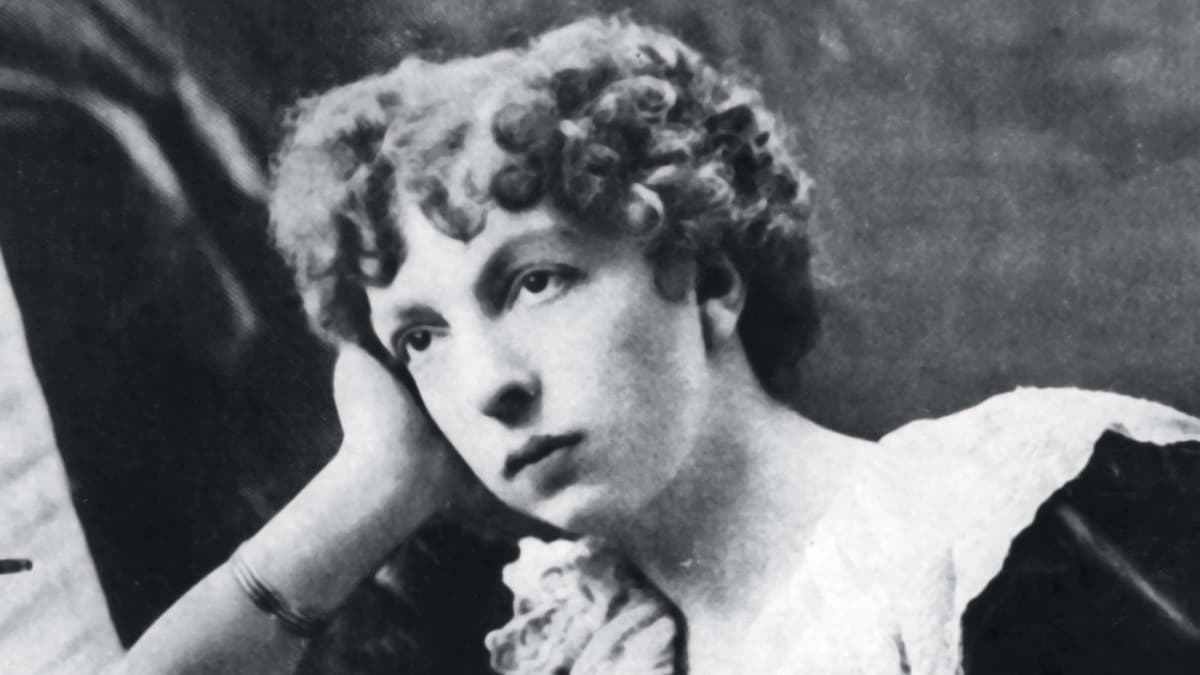
Cécile Chaminade
Despite her considerable financial success during her lifetime, Chaminade’s music has long suffered from dismissive labels such as “salon music” or “light music.” Yet, structurally simple though these pieces may be, the Pièces Romantiques contain remarkable colour and imagination. Wu and Pohjonen bring a freshness and playfulness to these character pieces, with delightfully flexible rhythms, varied articulation, and light, lyrical phrasing. Beach’s Summer Dreams is equally concise and poetic — a set of childhood tableaux (Märchenbilder?), each accompanied by evocative poetic epigraphs that invite programmatic imagination. These miniatures are played with the same dexterity and sensitivity that distinguish each piece with individual character.
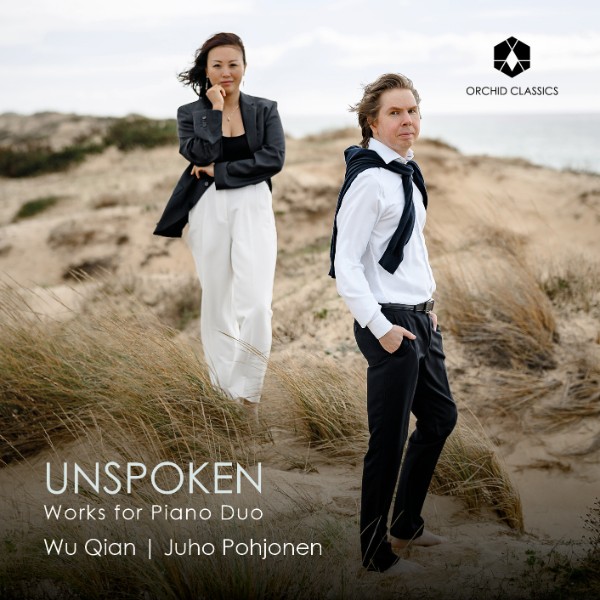
Beyond its imaginative programming and revival of neglected repertoire, the recording is further enriched by the substantial and insightful liner notes by Wu and Pohjonen, which illuminate both the works and the broader curatorial ideas behind the album. An intriguing release, thoughtfully conceived and compellingly performed.
https://www.orchidclassics.com/releases/orc100452-unspoken/
For more of the best in classical music, sign up for our E-Newsletter