Few pianists in history have embodied artistic courage quite like Maria Yudina.
A deeply religious musician living in the Soviet Union during the twentieth century, Yudina was both revered – and feared – for her uncompromising moral and musical vision.
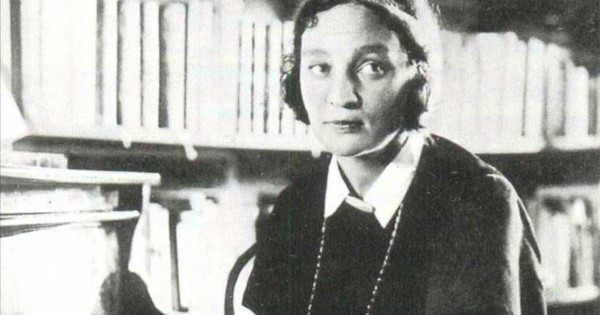
Maria Yudina
Born in the provincial town of Nevel, she rose from humble beginnings to become one of the Soviet Union’s most formidable pianists and teachers.
She also became a celebrated interpreter of Bach, Mozart, and Beethoven…as well as modern composers like Stravinsky, Hindemith, and Bartók.
Today, we’re looking at the extraordinary life and times of pianist Maria Yudina.
Maria Yudina’s Childhood
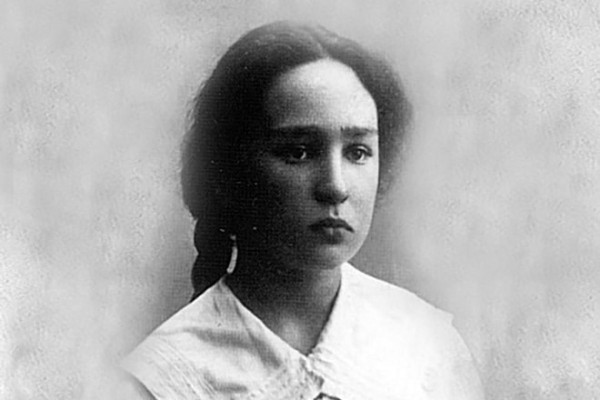
Maria Yudina
Maria Yudina was born on 9 September 1899 in the Russian town of Nevel, 500 kilometers south of St. Petersburg, on the present-day border between Russia and Belarus.
She was the fourth of five children of physician and physiologist Veniamin Yudin and his wife Raisa Yudina.
Her father had come from grinding poverty and had worked his way up to becoming a well-trained doctor. He suffered no fools when it came to securing resources for his impoverished community. In the words of Maria’s half-sister, “Family legend has it that Father shouted at the Governor and threw some visiting dignitary down the stairs. That was in his style.” Maria would inherit his pluck.
Her mother was a kind woman who came from a musical family. Her cousin Ilya Slatin founded the Kharkov Symphony Orchestra.
The Yudins were secular, culturally Jewish, and big believers in education. All of the children went on to have impressive careers in medicine, science, and filmmaking.
Maria Yudina’s Early Piano Studies
Maria began playing piano at the age of seven.
Her first important teacher was Frieda Teitelbaum-Levinson, a former winner of the gold medal at the St. Petersburg Conservatory.
Sensing her daughter’s talent, Maria’s devoted mother took her on the hundred-kilometer-long journey to take piano lessons a few times a month.
At 13, she went to St. Petersburg to study with Anna Yesipova, a teacher who taught some of the greatest pianists in Russia at the time, including Sergei Prokofiev, Leo Ornstein, and Isabelle Vengerova.
After Yesipova’s sudden death in 1914, a year after Maria began working with her, she was transferred to the class of Vladimir Drozdov.
She also – likely on the sly – took supplementary lessons with Felix Blumenfeld, who was Vladimir Horowitz’s teacher.
Importantly, she also began training as a preschool teacher. She cared deeply about the piano, but was not preparing for the life of a globetrotting virtuoso.
Johann Sebastian Bach: Chromatic Fantasia and Fugue in D Minor, BWV 903 (Maria Yudina, piano)
Maria Yudina’s Revolutionary Days
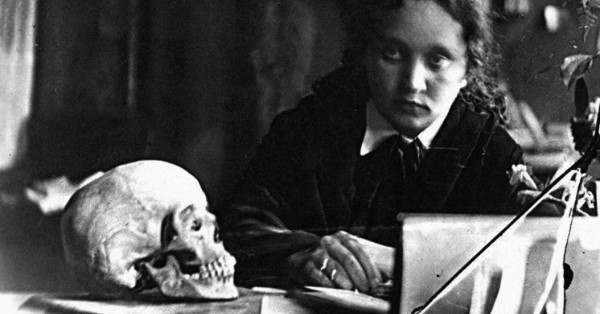
Maria Yudina
When the Russian Revolution began in 1917, she was swept up in it. When firearms were distributed to the throng of citizens, Maria took a rifle.
Things didn’t go as planned. “But the wretched thing went off by itself!” she later wrote. “The bullet went through the ceilings of four storeys, and I was very lucky that I didn’t wound anybody on the fifth!”
Despite her flirtation with revolutionary activity and politics, she returned to the Conservatory in 1917.
That summer, she moved back closer to home and taught local children. She also continued her study of philosophy that she had begun in St. Petersburg. By her late teens, philosophy and theology had become a kind of obsession with her.
In 1918, she found herself torn when she fell in love with her friend, literary critic and philosopher Lev Pumpyansky.
However, she wasn’t ready to marry, and she decided to distract herself by studying conducting…an unusual pursuit for a woman in 1918.
“I have one aim in front of me. Conducting! This will cure me, and help me find my way back to reality,” she wrote in her diary.
Her Conversion and Return to Petrograd
In 1919, she moved back to Petrograd, where she resumed her music studies at the Conservatory and also took formative courses in philology and philosophy at Petrograd University.
In May of that year, although they were no longer an item, she followed the example of Pumpyansky and joined the Russian Orthodox faith.
Her atheist father struggled deeply with his daughter’s conversion, but she never wavered, even after he physically abused her for believing.
Her religion would serve as a foundation for her artistic and moral convictions over the years to come.
Ludwig van Beethoven: Piano Sonata No. 28 in A Major, Op. 101 (Maria Yudina, piano)
A Rocky Start to a Celebrated Career
Yudina graduated from the conservatory in the early 1920s and was asked to join the faculty there.
She taught at the Petrograd Conservatory (later the Leningrad Conservatory) between 1921 and 1930.
Even after she secured the job, she refused to hide her faith, conspicuously wearing a large cross around her neck even when she was on stage.
Not surprisingly, her beliefs repeatedly put her at odds with authorities.
Once, the director of the Leningrad Conservatory led a surprise “raid” on Yudina’s class, demanding to know if she believed in God. Yudina answered yes, citing her constitutional right to do so. Days later, a state newspaper denounced her with a mocking cartoon of “the preacher at the Conservatory.”
In 1930, she was dismissed from her job for her religious beliefs. This led to a period of transience during which she was unemployed and homeless.
Johannes Brahms: 25 Variations and Fugue on a Theme by Handel, Op. 24 (Maria Yudina, piano)
Moving to Moscow
Thankfully, in the mid-1930s, pianist Heinrich Neuhaus vouched for her, and she was hired at the Moscow Conservatory. She taught there between 1936 and 1951.
In 1944, in the middle of her Moscow Conservatory tenure, she also joined the Gnessin Institute, the second-most prestigious music school in town after the Moscow Conservatory. She taught ensemble and vocal classes there until 1960.
Once again, she was fired there because of her religion, as well as her embrace of challenging, intellectual modern music abhorred by Soviet authorities.
Maria Yudina, the Performing Pianist
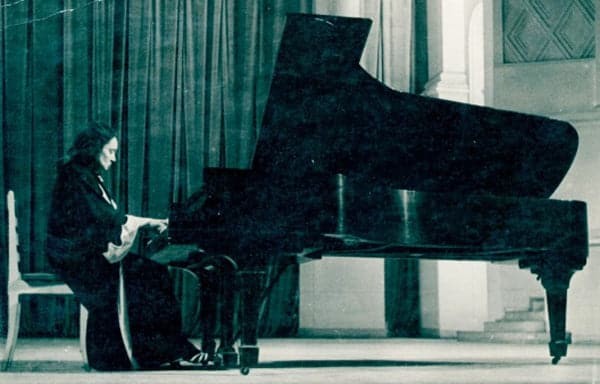
Maria Yudina
In addition to her teaching career, Yudina also worked as a pianist and kept up an ambitious performing schedule across the Soviet Union.
She boasted a striking stage presence. She was a large woman; she didn’t follow fashion trends and always wore a long black dress, looking somewhat like a nun. (Her colleague Dmitri Shostakovich once joked that she wore the same dress her entire life.) She was also known to give concerts barefoot.
She became especially popular in the Soviet Union during World War II. She played on the radio, played for soldiers at the front, played for patients in hospitals, and played in Leningrad during the siege of that city.
She cheerfully programmed all kinds of composers, from Bach to Beethoven to cutting-edge avant-garde modern-day masters like Stravinsky, Hindemith, and Bartók.
In fact, she was one of the only virtuosos of her generation in the Soviet Union to approach programming in such an adventurous way.
Hindemith Piano Sonata No. 3
Unfortunately, because of Soviet travel restrictions, she was allowed to travel abroad only twice (once to Poland and once to East Germany).
So, despite her genius, she was never appreciated by audiences in the West until after the fall of the Iron Curtain, which only happened after her death.
Running Into Trouble With the Authorities – And Always Escaping
All that said, she was even occasionally banned from public performances within the Soviet Union.
In the early 1960s, she read her friend Boris Pasternak’s censored poetry onstage as an encore. That act of defiance led to a five-year ban from Soviet concert halls.
She also thumbed her nose at authority by visiting various prisons and gulags, where she would exchange messages with arrested compatriots who were artists, writers, clergymen, and the like.
Despite this constant rebellion, she was never arrested or imprisoned.
In the end, it seems she slipped through the cracks because she was viewed as relatively harmless. She was a woman; she was unmarried; she gave away her money and lived a life of poverty, even eschewing owning her own piano. She could, in short, be dismissed as an eccentric. (She had also likely earned a certain amount of goodwill for her devotion to performance and uplifting national morale during World War II.)
Shostakovich once said of her, “I accused her of behaving like a yurodivy (holy fool)…but I can say this – she never lied.”
Shostakovich’s Piano Sonata No. 2
Maria Yudina’s Recordings
Yudina’s artistry was preserved in a number of notable recordings and remembered in a few memorable legends.
She was especially celebrated for her interpretations of the core classical repertoire.
Her Bach playing had an especially rousing rigor to it (later commentators noted she anticipated some of Glenn Gould’s approach to the composer).
Her transcendent performances of Mozart and Beethoven were revered for their spiritual depth and intensity.
Yudina, Stalin, and the Legendary Mozart Piano Concerto Recording
One of Yudina’s most famous recordings is of Mozart’s Piano Concerto No. 23 in A-major, made in 1948 with conductor Alexander Gauk.
This recording is tied to the most famous legend of her life.
Mozart: Piano Concerto No. 23, Movement 2
According to a story found in the controversial book Testimony, supposedly originating from Shostakovich’s recollections, Joseph Stalin heard Yudina play this Mozart concerto on a live radio broadcast around 1944, and was so moved that he demanded a copy of the performance.
Afraid to tell the dictator that no copies existed, officials scrambled to summon Yudina and an orchestra in the middle of the night to record the piece. A single acetate record was pressed and delivered to Stalin by morning.
In gratitude, Stalin sent Yudina 20,000 rubles as a reward. She wrote him a reply thanking him for the money, and informing him that she’d donated it to the church to help atone for his sins.
There’s no documentary evidence that this wild story actually occurred. But it certainly captures the emotional truth about her lifelong bravery, indifference to authority, and devotion to her art and her church.
The story was dramatized in the 2017 film The Death of Stalin, introducing her to wider modern audiences who may never have heard of her.
The Legacy of Maria Yudina
Maria Yudina died in Moscow in 1970. She was 71 years old.
Although she was never able to pursue a truly international career, she worked as hard as she could to bolster music inside the Soviet Union, even during its darkest days.
She also made her mark on music in a way that impacted and influenced generations to come.
In the exasperated but adoring words of pianist Sviatoslav Richter:
She was immensely talented and a keen advocate of the music of her own time: she played Stravinsky, whom she adored, Hindemith, Krenek and Bartók at a time when these composers were not only unknown in the Soviet Union but effectively banned. And when she played Romantic music, it was impressive—except that she didn’t play what was written. Liszt‘s Weinen und Klagen was phenomenal, but Schubert‘s B-flat major Sonata, while arresting as an interpretation, was the exact opposite of what it should have been, and I remember a performance of the Second Chopin Nocturne that was so heroic that it no longer sounded like a piano but a trumpet. It was no longer Schubert or Chopin, but Yudina.
For more of the best in classical music, sign up for our E-Newsletter