Few Romantic Era love stories are as passionate – or as tumultuous – as the relationship between Franz Liszt and Marie d’Agoult.
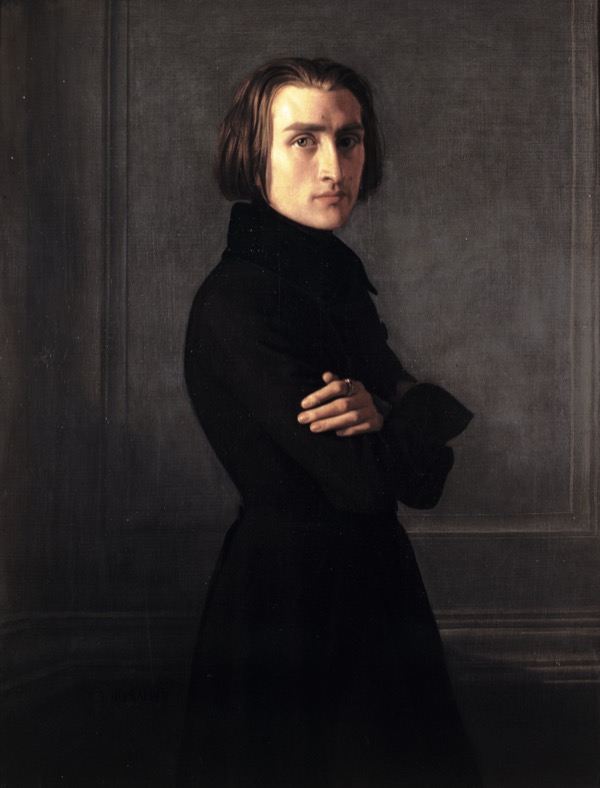
Franz Liszt
What began as an unexpected meeting in a Parisian salon in the early 1830s blossomed into an intense intellectual, emotional, and artistic partnership: one that openly defied the rigid social codes of the time.
Their years together spanned scandal, travel, artistic triumphs, and the birth of three children. At the same time, their relationship was darkened by grief, jealousy, and competing ambitions. It became one of the most consequential relationships in music history.
Today, we’re looking at the remarkable love story of Franz Liszt and Marie d’Agoult.
Marie d’Agoult’s Early Life
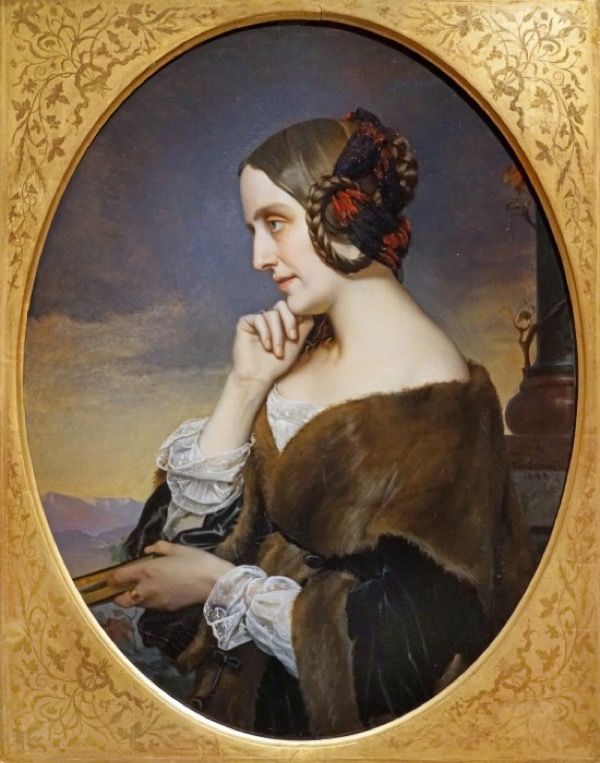
Marie d’Agoult
Marie d’Agoult was born in December 1805 in Frankfurt, Germany, to a wealthy family. Her mother was German, and her father was French; they moved to France when she was a child.
She was a very musical child, even studying piano with composer Johann Nepomuk Hummel as a girl.
Hummel’s Piano Concerto No. 2
However, at the time, women who were both talented and wealthy found it extremely difficult to make a musical career. By and large, women of her class were expected to embrace marriage and motherhood.
So in 1827, at the age of 18, she entered into an arranged marriage with a socially prominent nobleman named Charles Louis Constant d’Agoult, the Comte d’Agoult. He was 37.
She had little sense of what such a marriage would actually entail, and found herself unable to connect with her kind but conventional new husband.
She had two daughters – Louise in 1828 and Claire in 1830 – but their marriage deteriorated quickly.
Liszt and Marie d’Agoult Meet
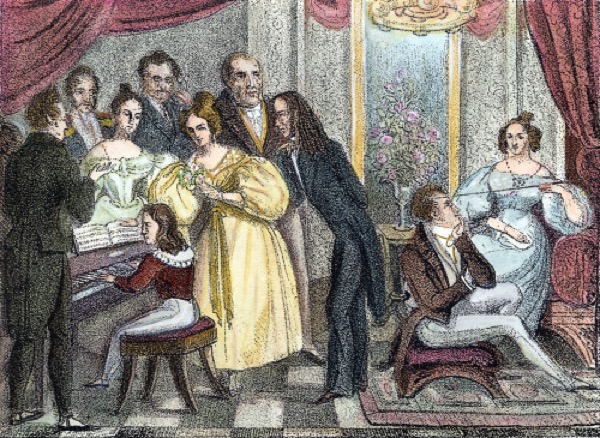
A 1830s Parisian salon
In late 1832 or early 1833, Franz Liszt and Marie d’Agoult crossed paths for the first time at a gathering thrown by a marquise.
d’Agoult later recalled the meeting:
“I would say an apparition, lacking another word to describe the extraordinary sensation he gave me, altogether the most extraordinary person I had ever seen…like that of a phantom about to be summoned back to the shades, this is how I saw the young genius before me.”
At the time, he was 21, and she was 27.
She couldn’t stop thinking about him and discreetly inquired after his address. They began meeting in d’Agoult’s home, enjoying the types of intellectual conversations her husband was unwilling to partake in.
We still don’t know exactly when the relationship turned romantic – only that it did. At one point, she invited him to their country home, where, after a tiff, Liszt knelt and comforted her. From that point forward, they considered themselves a couple.
In 1833, Liszt sent her a note mentioning that he was looking for a private apartment in Paris that they could escape to. They would nickname it “the rathole.”
We wrote in more detail about this stage of their relationship.
Shortly after meeting Marie, in 1834, Liszt composed his piano work Apparitions – a piece inspired by the poetry of Alphonse de Lamartine. The music’s introspective, rhapsodic character reflected the new emotional terrain he was exploring.
It’s important to acknowledge that Marie was not merely Liszt’s muse. Biographers note that the lyrical style and soul-searching tone of Liszt’s music in the mid-1830s owed much to the study of Romantic literature that the couple embarked on together.
Liszt’s Apparitions
Despite its scandalous beginnings, the relationship seemed like it was charmed – until an embarrassing accident occurred.
Liszt sent d’Agoult some love letters that a former flame had recently returned to him. They were scattered in the bottom of a box of music that he’d given d’Agoult.
Although they eventually patched things up, d’Agoult remained wounded by the incident, wondering about Liszt’s ability – and willingness – to remain faithful to her long-term.
It was a quiet foreshadowing of how things would ultimately end between them.
Tragedy, Trauma, and a Pregnancy
A year later, in 1834, d’Agoult’s eldest daughter, Louise, fell gravely ill. She died that December at the age of six.
Marie was devastated. Compounding her grief was her younger daughter’s inability to understand what had happened. Marie ultimately decided to send her away to school, hoping to shield both of them from the constant reminders of the loss.
She and Liszt bonded intensely in the aftermath of the loss, and in May 1835, she realised she was pregnant with his child.
Liszt’s Réminiscences de ‘Lucia di Lammermoor’
Rumours of their relationship were rampant, though they had somehow not reached her husband.
Faced with a monumental choice, she decided to walk out on her marriage and live openly – unmarried – with Liszt.
On 26 May, she wrote her husband a letter:
“I am going to leave, after eight years of marriage, we are going to separate forever. Whatever you may think, it was not without cruel anguish and bitter tears that I have been able to make a decision like this. I have no reproach to make you, you have always been full of affection and loyalty, you have always thought of me, never yourself, and despite this, I was very unhappy.”
She asked for “forgiveness of the grave of Louise” and signed the missive “M.”
It was unclear how such a drastic move would impact her reputation – or whether she’d ever be allowed to see her surviving daughter again.
It was one of the boldest decisions any woman of her social class could make, and one that would define the rest of her life.
Idyll in Switzerland
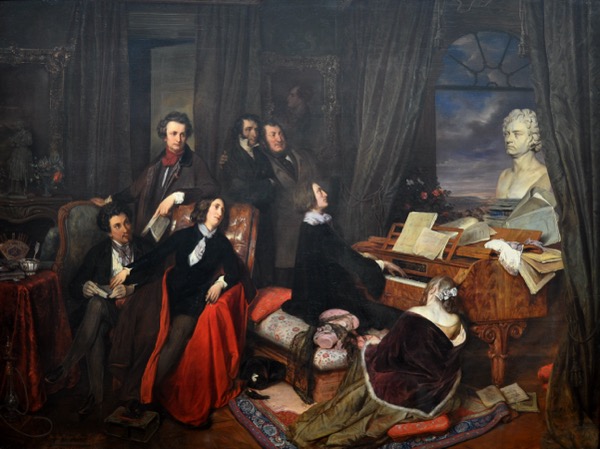
Liszt at the piano, d’Agoult sitting on the ground
From there, she and Liszt traveled to Switzerland. In the countryside, nobody knew who they were. In fact, the pair were often mistaken for brother and sister. For two people fleeing scandal and scrutiny, the anonymity was intoxicating.
They eventually settled in Geneva. Although they had imagined leading a quiet life together, far from the glare of society, Liszt soon found himself drawn into the social world of wealthy and well-connected Genevans. Marie, by contrast, had hoped their retreat would solidify their emotional bond, not open a new front of social obligations.
Liszt immortalised their Swiss (and later Italian) travels in the first two volumes of his piano suite Années de pèlerinage, composed between 1837 and 1841.
These pieces – inspired by tranquil Swiss valley scenes and passionate Italian sonnets – are poetic evocations of landscapes and art they admired together.
Liszt’s Années de pèlerinage, 2nd Year “Italie”
However, as the honeymoon phase cooled, pressures began to mount.
Liszt struggled to resist the pull of becoming a celebrated public artist, while d’Agoult struggled with the role such a man’s partner was expected to play, especially since she couldn’t get a divorce and they couldn’t marry. She began to feel the quiet life she’d envisioned slipping away.
Seven months into their life together, Marie’s fateful pregnancy resulted in the birth of their first child, Blandine, in December 1835.
Motherhood transformed Marie’s circumstances yet again, adding both joy and strain to an already fragile time of her life.
A Daughter and Discontent
In the summer of 1837, the little family moved to Italy. That December, their second child, Cosima, was born.
However, once the family settled in Milan, Liszt found himself increasingly drawn to the city’s social whirl: its salons, late nights, and intoxicating attention.
Marie found it difficult – if not impossible – to feel connected to him when he entered these restless, performative phases. She began to wonder if she was cut out for a life with Liszt after all.
In the spring of 1838, she wrote in her diary:
“Passion elevated me for a moment, but I feel that the principle of life is lacking in me. I feel that I am a shackle on him; I do not benefit him; I cast sadness and discouragement on his days.”
The words reveal a woman wrestling not only with loneliness, but with a fear that her great upheaval hadn’t led to the emotional renewal she’d so desperately hoped for.
Mounting Suspicions and a Son
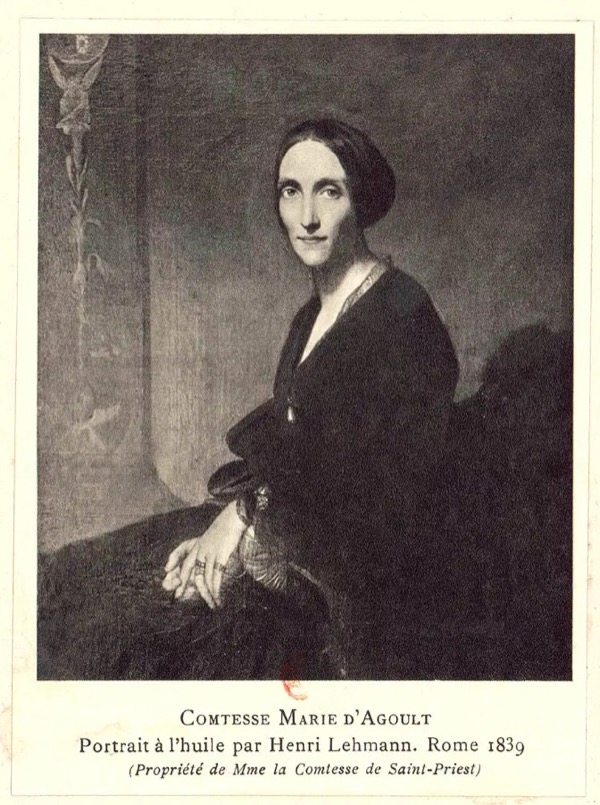
Marie d’Agoult, 1839
In March 1838, a devastating flood struck Budapest, Hungary. Liszt, with his Hungarian roots and political sympathies for the poor and downtrodden, found himself stirred to go on tour to raise money for the victims.
The following month, he embarked on a trip to Vienna for his charity tour. He said he’d be gone for eight days; the visit stretched into two months.
Schubert/Liszt’s Liebesbotschaft from Schwanengesang, 1838
Marie, always suspicious of what was really motivating his actions, came to believe that he was interested less in fundraising and more in gallivanting amongst adoring aristocrats in Vienna.
After he finally returned, he had earned a considerable sum – all of which he kept for himself. Liszt’s finances during these years were chaotic: he was generous to strangers and impulsive with donations, yet strangely haphazard when it came to obligations at home.
She began to believe that he was having affairs with other women. Given all she had sacrificed – her reputation, her financial security, her daughter – her anguish makes sense. Even the mere idea of suspected emotional infidelities cut deeply.
It seemed the relationship was heading toward an inevitable split. But in August 1838, she became pregnant again, and their plans to separate were abruptly suspended.
Their only son, Daniel, was born in Rome in May 1839.
Late Struggles and Separation
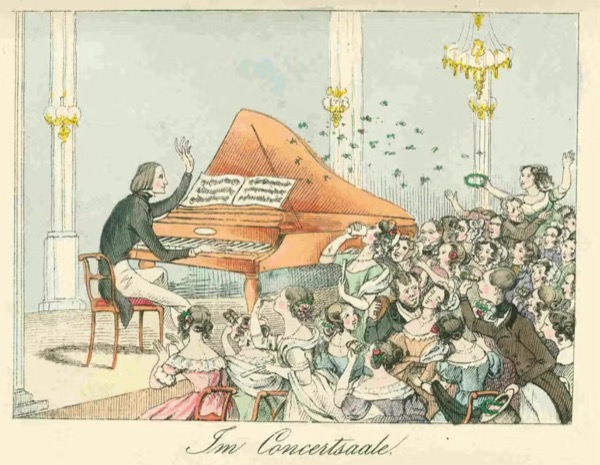
Liszt concert cartoon
After Daniel’s birth, d’Agoult returned to France with the children in tow, longing to rejoin the intellectual atmosphere of Parisian salon life.
But instead of formally ending the relationship, Liszt hit the road. He was gone for most of the following year.
They traveled together to Britain in April 1840, but the trip was marked by constant arguments.
Liszt’s Valse melancolique, 1839
Liszt continued having relationships with other women. One of the more humiliating rumours involved novelist and composer Bettina von Arnim. The idea that Liszt might be linked – however implausibly – to an older, famously eccentric intellectual was mortifying to Marie, who already felt publicly displaced.
The fact that she didn’t have concrete proof didn’t stop d’Agoult from publishing a sharply critical article on von Arnim’s music, under her pseudonym Daniel Stern.
d’Agoult also began pursuing affairs of her own. She also began focusing more intently on her writing, which increasingly became the anchor missing from her personal life.
The Final Breakup
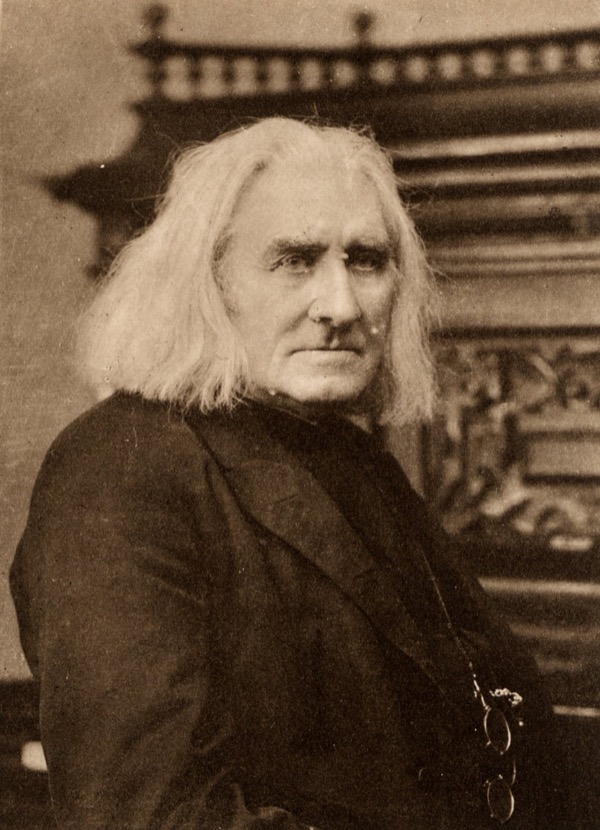
Liszt later in life
The relationship continued in fits and starts until the mid-1840s, when Liszt began an affair with the celebrated courtesan Marie Duplessis – the woman who inspired Dumas’s The Lady of the Camellias, later adapted into Verdi’s La Traviata.
According to d’Agoult, she “had no objection to being his mistress, but would not be one of his mistresses.”
On 8 April 1844, Liszt came to d’Agoult’s lodgings for dinner, only to find her latest lover – the poet Georg Herwegh – present. It is unclear exactly what transpired, but the encounter affected Liszt deeply. Some biographers have suggested that seeing Marie openly in another man’s company forced him to confront, perhaps for the first time, the finality of their separation.
He wrote in a letter to her a few days later:
“I am mortally sad and profoundly afflicted. I count one by one the sorrows I have put in your heart and nothing and nobody can save me from myself.”
By the end of their romance, what remained for Marie was not love for Liszt so much as a resolve to reclaim her own life on her own terms – again.
Impacts of Their Relationship
They may have broken up, but the echoes of their relationship lingered for decades.
Like many separated couples, d’Agoult and Liszt started clashing over how their children should be raised and educated.
The legal situation was especially complicated because the couple had never married. This left Marie with weak legal standing regarding questions of custody or guardianship.
Liszt did not want d’Agoult to raise the children, fearing she would turn them against him – a fear heightened by his constant travels and long absences.
He wrote to her:
“…I can not ignore your telling all comers the wildest and most abusive things about me… [Can] you really think it would suit me to have Blandine brought up by you so long as you keep us on a footing of armed warfare?”
Their correspondence from this period is full of recriminations, defensiveness, and pain: a stark contrast to the loving and passionate letters of their early years.
The children were ultimately shuttled between the care of Liszt’s mother and strict Catholic institutions. Liszt, increasingly consumed by his career and later relationships, was largely absent from their lives. He became especially negligent after 1847, when he fell in love with another noblewoman: Princess Carolyne zu Sayn-Wittgenstein.
Blandine and Daniel would both die young. Cosima, however, lived a long life and eventually married Richard Wagner, whose vast musical legacy she would shape and oversee for decades.
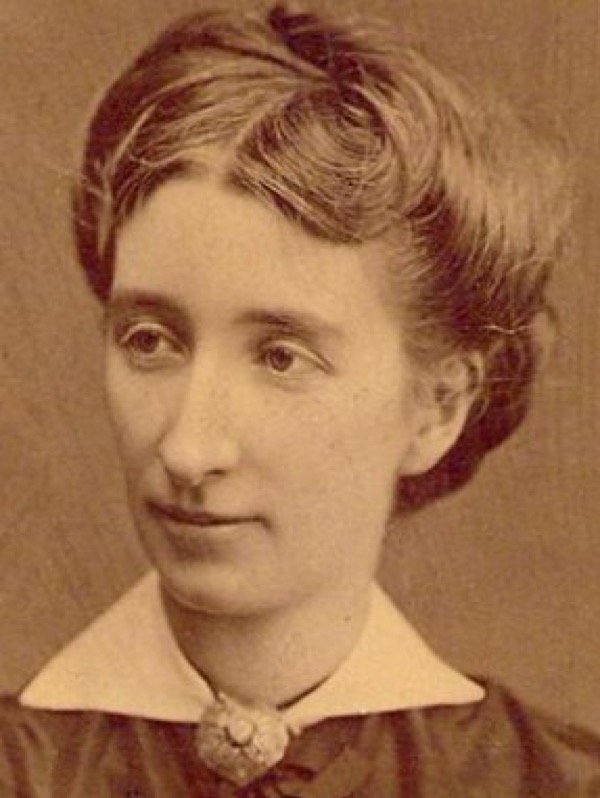
Cosima Liszt Wagner
Liszt’s transcription of Wagner’s Overture from Tannhauser
And this doesn’t even touch on d’Agoult’s later life, which she devoted to writing.
Her most famous novel, 1846’s Nelida, written under the pseudonym Daniel Stern, drew heavily from her own life – especially her years with Liszt.
Franz and Marie met again in 1861, when both were in their fifties. She wrote in her diary afterwards:
“The great passions, the great sorrows, the great ambitions that rend and tear – they all come down to a chicken à la portugaise.”
Their relationship burned fiercely and ended painfully. Despite that – or maybe because of that – its imprint on Romantic music, literature, and cultural history endures.
For more of the best in classical music, sign up for our E-Newsletter