RWV BAMBERG Richard-Wagner-Verband Bamberg e. V.
The internationally renowned Chinese conductor Xu Zhong is, among other things, Artistic Director of the Shanghai Opera House and Chief Conductor of the Suzhou Symphony Orchestra. Marko Cirkovic interviewed him about the new production of “Die Walküre” in Shanghai (premiere on April 24, 2026).
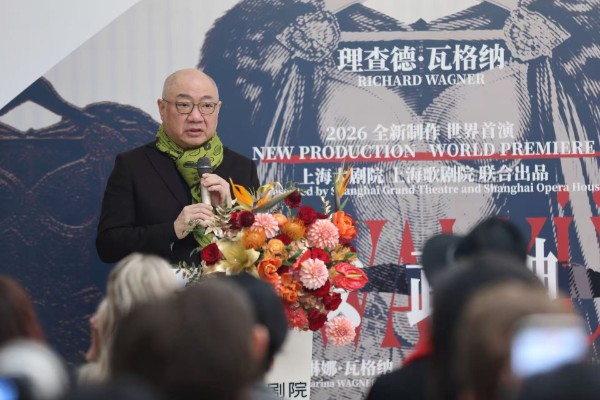
Maestro Xu Zhong
Shanghai, April 22, 2026. During the first interval of the dress rehearsal, before the air in the hall has completely released Wagner’s electric tension, a rare form of silence arises in the Shanghai Grand Theatre – not a silence of emptiness, but a pause under high pressure. Behind the stage, the performance continues, even when the curtain rests for a few minutes: in corridors, in glances, in the concentrated gestures of a house that knows it is approaching a premiere. It is here that I meet conductor Xu Zhong, who is leading this new Shanghai “Walküre” staged by Katharina Wagner. In the pit is the Suzhou Symphony Orchestra, augmented by guests from the Bayreuth Festival Orchestra. What just moments ago flowed through the space as an orchestral current must now be transformed into words, without losing its inner fire.
Xu Zhong does not speak like someone who wants to comment on music, but like someone who thinks it from within: from the singers’ breath, from the weight of the words, from the tensions between line and architecture, between expression and style. Especially in an opera like “Die Walküre”, whose world is at once mythical and human, eruptive and constructed, it quickly becomes clear that he does not treat Wagner as a monument, but as living dramatic substance. The following conversation took place in that very state of suspension: between rehearsal and performance, between control and risk, between what has already been achieved and what will only be completed at the moment of the premiere. The interview was conducted in English and translated into German for this publication.
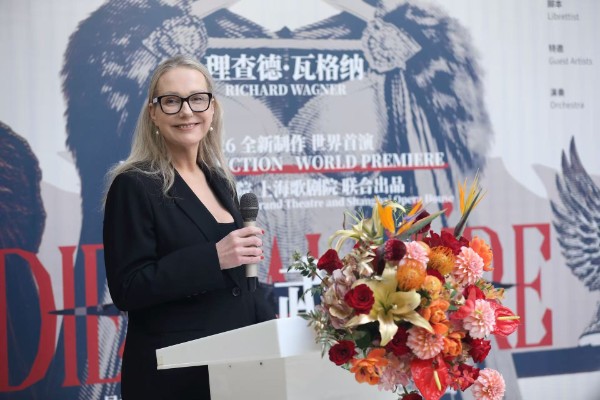
Katharina Wagner
Marko Cirkovic: Mr. Xu, first of all, many thanks for your time and your flexibility. How do you feel today, during this dress rehearsal?
Xu Zhong: It is better today. The singers have become more secure, and the orchestra plays better as well. Of course, there are still small mistakes, but with a work like this, that is hardly surprising. For a Chinese orchestra, this is an extraordinarily demanding piece. Precisely for that reason, I am very pleased with the level we have already achieved, especially with the support of the principal players from Bayreuth and the great dedication of everyone involved.
Marko Cirkovic: You first gained prominence as a pianist in your career. What did the piano teach you about conducting?
Xu Zhong: Piano and conducting are basically two different professions for me. The piano gave me, above all, a sense of time, of tempo, of inner proportions. At the same time, it sharpened my sensitivity for timbre. But the decisive difference is, of course, that at the piano you produce the tone directly yourself; as a conductor, you shape it in a different way – through mediation, through imagination, through communication. I have always kept these two activities separate, and yet they are internally connected. Especially with Wagner, construction is of enormous importance. You have to build this music step by step, almost like a great architectural structure.
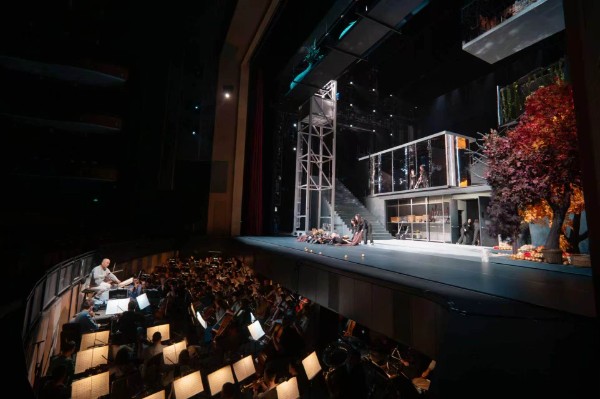
Wagner’s Die Walküre at the Shanghai Grand Theatre
Marko Cirkovic: Speaking of “Die Walküre” itself: what was your first approach to this work? The score, the drama, the colours, the hidden lines?
Xu Zhong: I believe my approach was initially a musical-theatrical one. I am not unfamiliar with Wagner; I have already conducted “The Flying Dutchman“, and therefore I did not feel unprepared for this language. What fascinates me especially about the “Walküre” is the magic of the leitmotifs, that thematic world in which love, curse, power, pain and fate take shape in musical signs. But Wagner is not only an orchestra. Wagner is theatre in the deepest sense. You have to know very precisely what you want, where the limits are, and how far you can go. And above all: the voice, the word, the German language are of the greatest importance. Every word carries weight, direction, and intention. You have to give it its pressure, its colour and its moment.
Marko Cirkovic: Is there a moment in this opera that is particularly close to you personally?
Xu Zhong: Yes, indeed. I am especially moved by the third act, and there above all, Wotan in his suffering. Not just the actual ending, but that whole zone in which he carries so much pain within him – from love, from loss, from inner contradiction. That is of great beauty, musically as well as humanly. And then there is also, at the end of the first act, that moment of departure, of light, of inner opening. That attracts me very much. In general, Wagner’s long recitatives are of immense importance. They are difficult precisely because they must be so organic. For singers who have not grown up with this linguistic culture, that is a special challenge. What matters to me is that the words remain clear, but never seem mechanical. Everything must flow, organic, breathing.
Marko Cirkovic: Do you remember your first encounter with Wagner? Was it early in your life?
Xu Zhong: Yes, quite early. My first encounter with Wagner was the Siegfried Idyll. That was a very special entry for me, because this work already contains so much of Wagner’s sound world, his intimacy and his orchestral imagination in concentrated form. Later, I approached other works, such as “The Flying Dutchman”, which is, in a way, more immediately accessible. But excerpts from the “Meistersinger” and other Wagner passages have also occupied me again and again. This music possesses such power that, when well prepared, it speaks for itself. Some in Europe may think that Wagner is difficult to access for Chinese musicians or for a Chinese audience. But my experience is: if you work seriously on it, the music itself unfolds its persuasive power.
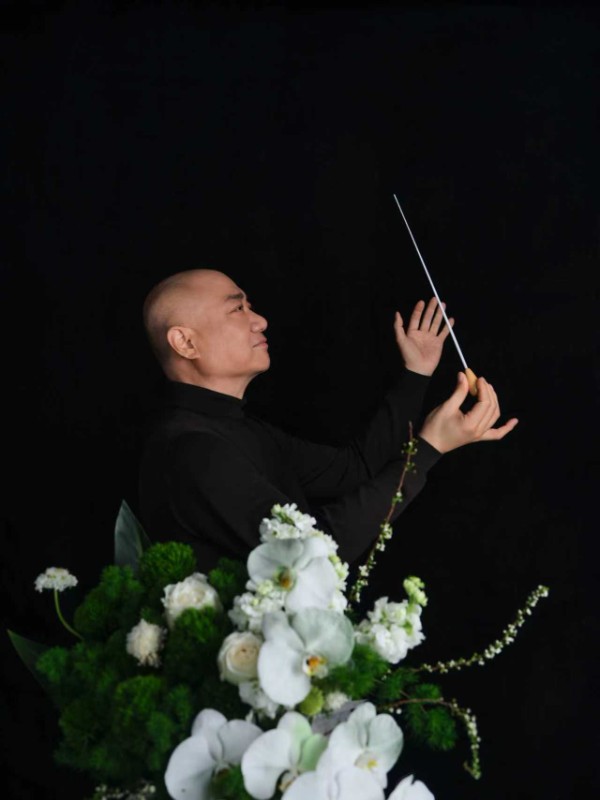
Maestro Xu Zhong
Marko Cirkovic: Do you sometimes think that the Chinese audience might not yet be quite ready for Wagner?
Xu Zhong: Whether it is ready or not is ultimately not my first question. My task is the music. If we present it convincingly, if we take it seriously and prepare it at a high level, then a connection arises. Art must not wait for permission first. It must come with truthfulness; then it will find its way.
Marko Cirkovic: We are now experiencing three major productions with “Bayreuth in Shanghai”. Do you wish that more would come out of it?
Xu Zhong: Of course, I wish that. But first, we live in this moment, in this concrete artistic situation. Everything else will show itself. I believe Katharina Wagner has a genuine interest in Chinese culture, especially in Peking opera. It is precisely from that that new ideas could develop in the future. Such encounters are artistically very fruitful.
Marko Cirkovic: Who is your personal Wagner hero? A conductor, a singer, perhaps a character?
Xu Zhong: I would not want to focus that on a single person. As an opera conductor, you must be in a certain sense hear in all directions, three hundred and sixty degrees, so to speak. You have to give the people around you space, open up possibilities, and lead and inspire them simultaneously. For me, the heroic lies in the collective achievement. Not one person alone carries this world, but everyone together.
Marko Cirkovic: So the heroic here is the whole?
Xu Zhong: Yes, absolutely. Everyone contributes at the highest level. That is precisely what makes opera.
Marko Cirkovic: What has changed between your first image of Wagner – perhaps still around the time of “The Flying Dutchman” – and your understanding today?
Xu Zhong: A great deal, because I have continued to learn. To this day, I try to penetrate deeper into this world, especially through language. I keep working on the words, on understanding German diction, also with the help of a German teacher. The more you understand the language, the deeper the musical comprehension becomes.
Marko Cirkovic: What for you is the truly unique thing about the “Walküre”?
Xu Zhong: For me, it is above all the relationships between the characters. I don’t mean something superficial, but the way people shape, hurt, bind, and change each other. These relationships change over time, and with them change the colours, the expressive values, the musical faces. There is a great deal of truth in that. Wagner does not only compose action, but also states of relationship.
Marko Cirkovic: When I heard you in the rehearsal yesterday and today, I noticed how strongly you emphasise vitality and at the same time contrasts, tensions, expansions, and strong inner movements. How do you see yourself?
Xu Zhong: The contrasts are already in the score. They are not something you would have to add artificially. The decisive thing is to do justice to them within the stylistic framework. Of course, at the same time, you have to pay attention to the voice, to the singers’ breathing, to the balance. But my starting point remains always respect for the music, for what is actually written.
Marko Cirkovic: You already hinted at it in the press conference, but I would like to put it more pointedly: if Wagner were sitting in the hall today, what do you think he would say about this performance?
Xu Zhong: Perhaps he would criticise some things, who knows. But I hope that in the end he would say: It has turned out well.
Marko Cirkovic: Mr. Xu, many thanks for this conversation. I am very glad we were able to have it during this short break.
Xu Zhong: It was a pleasure. Thank you very much.
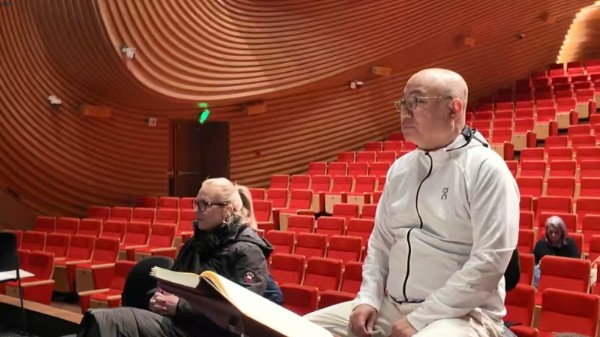
Maestro Xu Zhong and Katharina Wagner at the rehearsal
As Xu Zhong returns to the stage operation, this brief conversation also ends in that state of suspension known only to a dress rehearsal: nothing is final yet, and yet everything is already set for decision. Soon Wagner’s music will take possession of the space again, with its power, its precision, its inner fire. The fact that Richard Wagner‘s “Walküre” appears in Shanghai not as a distant monument but as a present, seriously worked-out music theatre is also thanks to a conductor who does not administer this score but lets it breathe. The premiere will show how far this tension carries.
- “Die Walküre” in Shanghai (https://rwv-bamberg.de/2026/04/die-walkuere-in-shanghai/) April 30, 2026
- “Everyone wants this ring” (https://rwv-bamberg.de/2026/04/jeder-will-diesen-ring-haben/) April 30, 2026
- Wagner in cinema and streaming (https://rwv-bamberg.de/2026/03/wagner-im-kino-und-zum-streamen/) March 25, 2026
- “Parsifal” dress rehearsal & premiere (https://rwv-bamberg.de/2017/03/parsifal-generalprobe-premiere/) March 27, 2017
- Wagner in streams and on the radio (https://rwv-bamberg.de/2026/04/rheingold-im-radio/) April 10, 2026
- Our next event (https://rwv-bamberg.de/2026/04/unsere-naechste-veranstaltung-14/) April 10, 2026
For more of the best in classical music, sign up for our E-Newsletter