Queer love has always existed in classical music.
Sometimes it was hidden in plain sight; sometimes it was expressed through music itself; other times, LGBTQ+ composers were remarkably frank and open about it.
Stretching from the salons of fin-de-siècle Paris to the rehearsal rooms of mid-century America, these relationships didn’t just define the artists’ personal lives; they shaped the repertoire that we know and cherish today.
Today, we’re looking at six important queer relationships in classical music history and the music directly inspired by them.
Ethel Smyth & Elisabeth von Herzogenberg
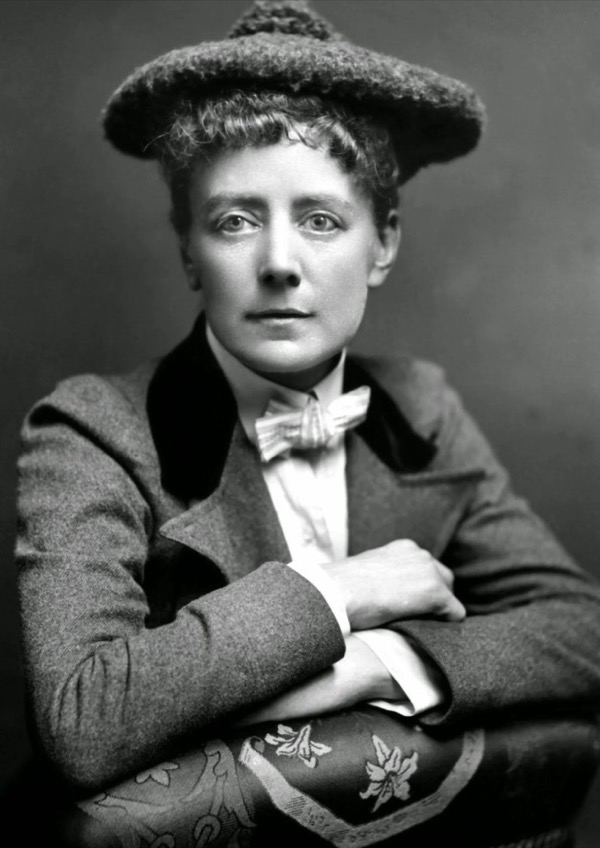
Ethel Smyth
In 1877, nineteen-year-old British musician Ethel Smyth moved to Leipzig to study composition.
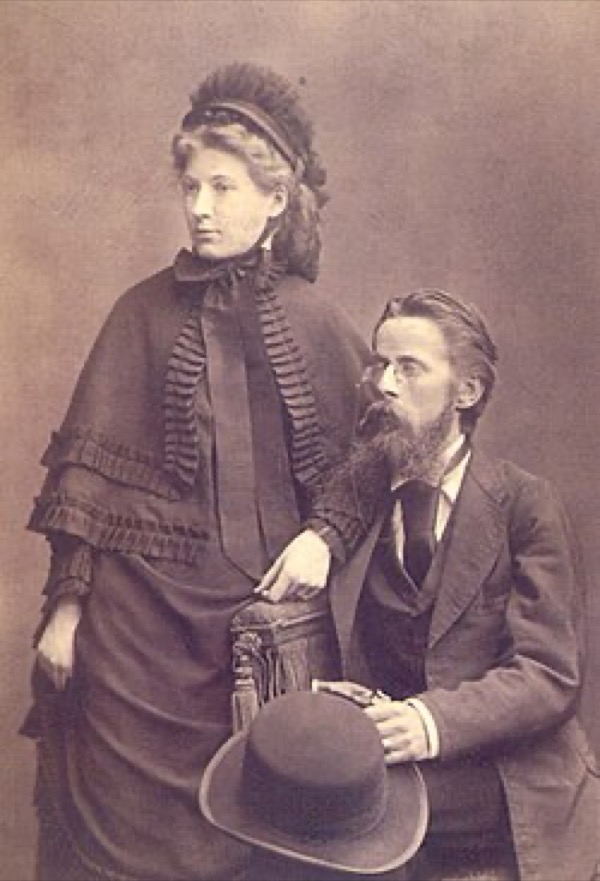
Heinrich and Elisabeth von Herzogenberg
The following year, she left the Leipzig Conservatory and moved in with her mentors Heinrich von Herzogenberg and his wife, the composer Elisabeth von Herzogenberg.
Elisabeth was eleven years Ethel’s senior. She initially treated Ethel almost like an adopted daughter. But as Smyth gained confidence and independence, their bond deepened and shifted.
After Smyth suffered a nervous breakdown in 1878, Elisabeth took her under her wing, and the two soon developed an intense emotional and romantic attachment.
Smyth later wrote admiringly of Elisabeth’s beauty and kindness, while Elisabeth confessed in a letter: “In our case something has grown between us that tells me we belong together, inseparably!”
During these years, Smyth began writing a set of songs that would later be published as her “Lieder & Balladen,” Op. 3.
Ethel Smyth: Lieder und balladen, Op. 3 (Lucy Stevens, contralto; Elizabeth Marcus, piano)
Her String Quintet in E major, Op. 1, also showed traces of Elisabeth’s tastes, with its Bohemian character that called to mind one of Elisabeth’s favourite composers, Antonín Dvořák.
Ethel Smyth: String Quintet in E Major, Op. 1 (Joachim Griesheimer, cello; Mannheim String Quartet)
Together, these pieces form one of the clearest musical records of Smyth’s feelings for Elisabeth.
In 1881, Smyth travelled to Italy in search of artistic renewal and befriended Elisabeth’s sister Julia and her husband Henry, who were in an open marriage.
Smyth, who had never previously shown interest in men, grew unexpectedly close to Henry, and this entanglement placed strain on her relationship with Elisabeth.
By the summer of 1885, the emotional tension had become too great. Elisabeth wrote Smyth a final letter declaring that their relationship was over. Smyth was devastated.
Elisabeth died in 1892 before they could reconcile, and Smyth never forgot her.
Pyotr Ilyich Tchaikovsky & Yosif Kotek
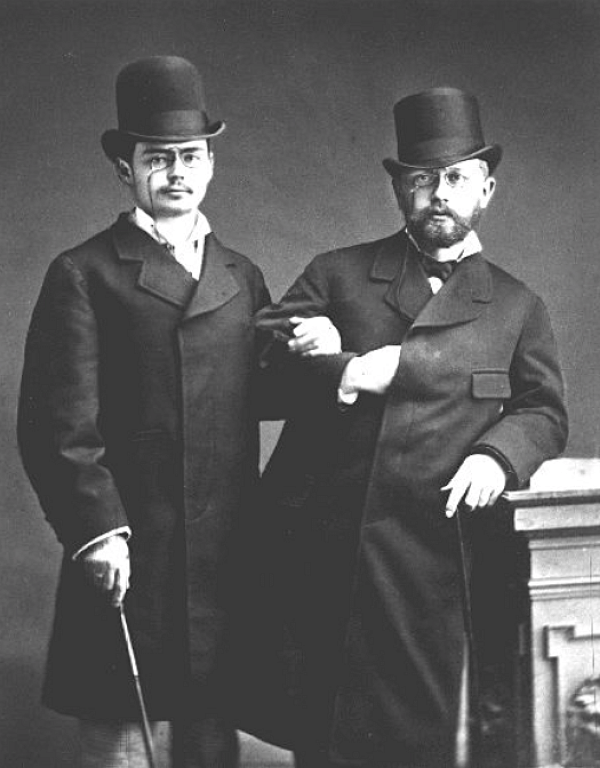
Pyotr Ilyich Tchaikovsky and Yosif Kotek
In the early 1870s, while teaching at the Moscow Conservatory, Pyotr Ilyich Tchaikovsky (1840–1893) formed a close – and likely romantic – relationship with his gifted violin student Yosif Kotek (1855–1885).
Tchaikovsky later admitted to his brother Modest, “I have known him for six years already… I have felt a little bit in love with him.”
In 1877, partly to quell rumours about his sexuality, Tchaikovsky entered a disastrous marriage with another former student, Antonina Miliukova. Kotek served as a witness.
Within weeks, Tchaikovsky suffered a breakdown and ultimately fled to Switzerland, where he reunited with Kotek.
There, the young violinist introduced him to Lalo’s Symphonie Espagnole: a spark that ignited Tchaikovsky’s own Violin Concerto, which was written in just a month. Kotek offered encouragement and technical insights during the creative process.
Tchaikovsky’s violin concerto
Although Tchaikovsky briefly considered dedicating the concerto to Kotek, he feared the gossip it might inspire. He ultimately dedicated it to Leopold Auer, who had no role in its creation.
Their relationship began to fade after Kotek declined to premiere the concerto, anxious about the reception and the impact on his career. Their differences in age, career plans, and diverging romantic interests also widened the distance between them.
Kotek eventually left to pursue further study in Berlin, and Tchaikovsky returned to Russia.
But when Kotek fell ill with tuberculosis in 1885, Tchaikovsky made a special effort to travel to visit him before his death.
Today, Tchaikovsky’s violin concerto remains the greatest musical testament to their connection.
Reynaldo Hahn & Guy Ferrant
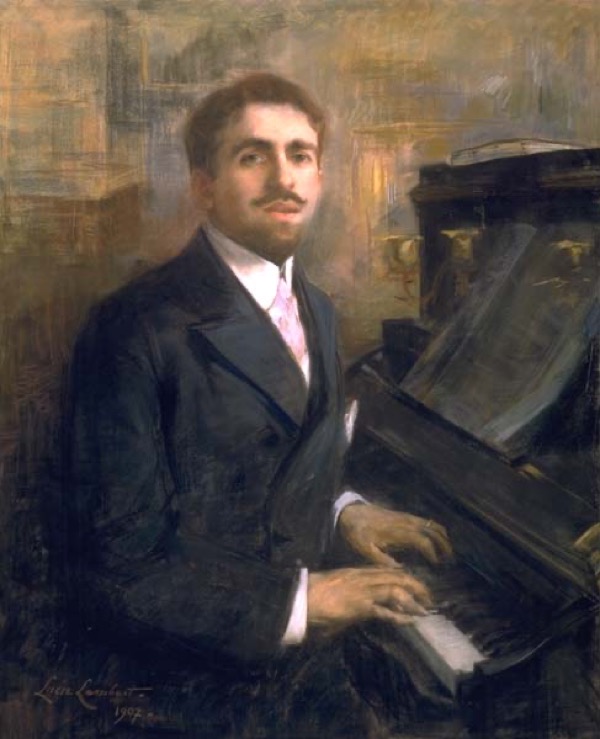
Reynaldo Hahn
Reynaldo Hahn (1874–1947) was a prodigy who became a central figure in the salons of fin-de-siècle Paris.
In 1894, at nineteen, he met and fell in love with writer Marcel Proust. It was a brief but intense romance that blossomed into a lifelong friendship.
Decades later, in 1919, Hahn met the great love of his life: Guy Ferrant, a 21-year-old actor and singer.
Ferrant became Hahn’s partner both personally and professionally, working as his secretary, occasional interpreter, and constant companion.
Far less survives about Ferrant than about Proust, which has sometimes obscured his importance in Hahn’s life – but contemporary accounts and Hahn’s later works make his influence undeniable.
Guy Ferrant singing Hahn’s song “Paysage triste”
One of the clearest reflections of this relationship can be found in Hahn’s Violin Concerto (1927).
Reynaldo Hahn: II. Chant d’Amour (Denis Clavier, violin; Lorraine Philharmonic Orchestra; Fernand Quattrocchi, cond.)
The slow movement of the concerto – titled Chant d’Amour (“Love Song”) – portrays the mixture of wistfulness and late-life happiness that Hahn found in his relationship with Ferrant.
Henriëtte Bosmans & Frieda Belinfante
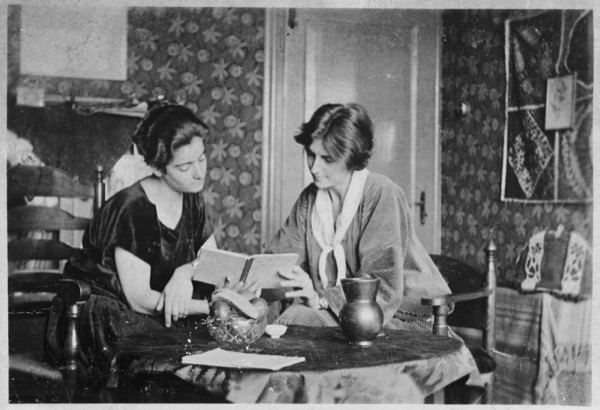
Frieda Belinfante and Henriëtte Bosmans
Henriëtte Bosmans (1895–1952) was a Dutch pianist-composer who shared a passionate partnership with the cellist Frieda Belinfante (1904–1995) throughout the 1920s.
They met in 1920, when Belinfante was a 17-year-old prodigy and Bosmans, eight years older, was already emerging as one of the Netherlands’ leading musicians.
Belinfante soon moved into Bosmans’s home, where she managed the household – with Bosmans nicknaming her “Mommy and Pops” – while Bosmans composed and performed.
Over their years together, Belinfante became Bosmans’ muse. The pieces Bosmans wrote for her are among the most expressive works in her catalogue.
They include the Poème for cello and orchestra, the Second Cello Concerto, and the Impressions for cello and piano.
Belinfante premiered several of these works, shaping their interpretations and ensuring their place in Dutch musical life.
Henriëtte Bosmans: Poème (Dmitri Ferschtman, cello; Netherlands Radio Chamber Orchestra; Ed Spanjaard, cond.)
In 1927, their relationship fell apart after Belinfante felt emotionally pressured into marrying a male musician friend, who threatened suicide if she didn’t accept his proposal. (The marriage was, predictably, short-lived.)
During the rise of the Nazis, Belinfante stepped back for a time from her musical career to focus on working for the Dutch Resistance. Meanwhile, Bosmans became engaged to a violinist who died of a brain tumour before their wedding.
Although they drifted apart, the music Bosmans wrote for Belinfante in the 1920s endures as a legacy of their love for each other.
Bosmans’s Impressions, Movement 2
Samuel Barber & Gian Carlo Menotti
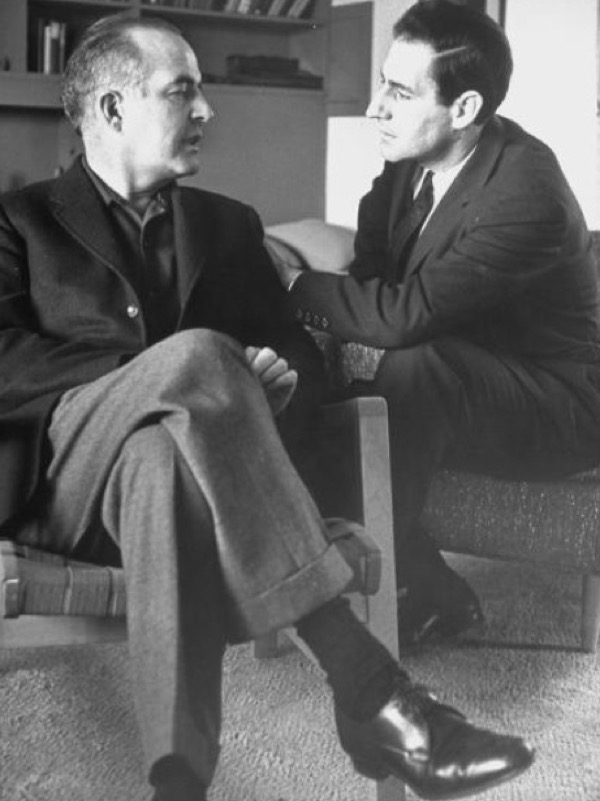
Samuel Barber and Gian Carlo Menotti
Samuel Barber (1910–1981) and Gian Carlo Menotti (1911–2007) formed one of the most influential artistic partnerships of the twentieth century.
They met as teenagers in 1928 at the Curtis Institute in Philadelphia, where Barber, an American who spoke some Italian, quickly bonded with Menotti, who was still learning English.
Together, they settled just north of New York City in a house they named Capricorn, which became their home and a lively creative hub for mid-century American music.
They collaborated with striking ease: Menotti wrote the libretti for Barber’s operas A Hand of Bridge and Vanessa, and both composers worked side by side during their early successes.
Throughout Barber’s major creative periods – including the years he wrote his most enduring works, such as the Adagio for Strings, his Violin Concerto, and Knoxville: Summer of 1915 – Menotti was a constant source of support.
Barber’s A Hand of Bridge
But the intimacy that sustained their partnership also made its eventual fracture deeply painful.
Barber struggled in the 1960s as his career faltered and he battled alcoholism. By 1970, the strain between them had grown too great, and Menotti ended the relationship, relocating to Europe.
However, when Barber became terminally ill with cancer, Menotti returned to New York to care for him. Barber died in his arms: a final gesture that underscored the depth of a bond that had shaped both of their lives and decades of American classical music.
Benjamin Britten & Peter Pears
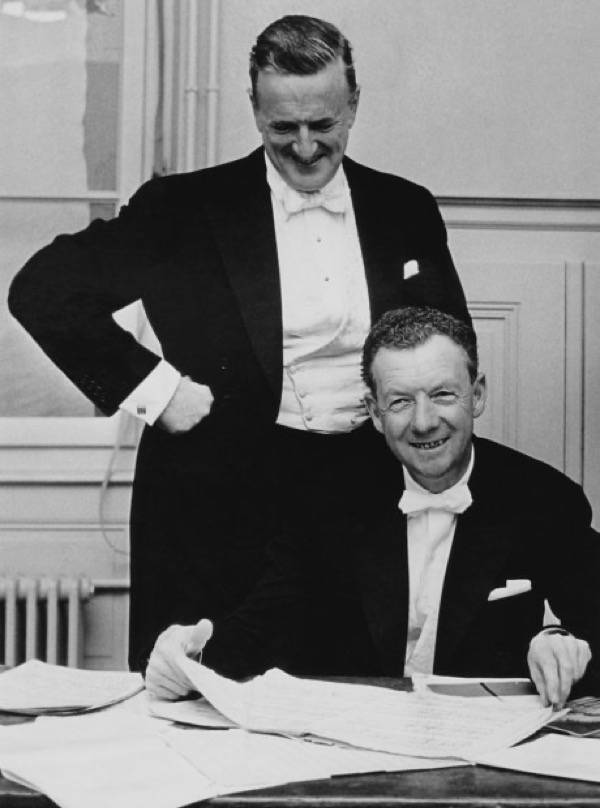
Peter Pears and Benjamin Britten
Benjamin Britten (1913–1976) showed early brilliance as a composer, but his creative world was transformed completely in 1937 when he met tenor Peter Pears.
The two were brought together while sorting through the belongings of a mutual friend, writer Peter Burra, who had died in a plane crash.
Pears’s distinctive voice – bright, penetrating, and unmistakably his – immediately sparked Britten’s imagination. Within weeks, Britten composed the aria “A thousand gleaming fires” from the radio cantata The Company of Heaven for him.
Benjamin Britten: No. 7. A thousand gleaming fires, from The Company of Heaven (Dan Dressen, tenor; London Philharmonic Choir; Christopher Herrick, organ; Philip Brunelle, cond.)
Their relationship remained platonic until the spring of 1939, when a tour of America brought them closer, and they became lovers. From that moment on, their personal and artistic lives were inseparable.
Returning to Britain in 1942, at the height of World War II, they embraced their identities as English artists and built a shared musical world together.
Two years later, Britten composed Peter Grimes, an opera exploring themes of isolation, desire, and societal judgment — all especially resonant with queer experience. He wrote the title role for Pears, whose interpretation helped define postwar British opera.
Pears would go on to inspire much of Britten’s most important music. Roles written expressly for him include Captain Vere in Billy Budd (1951), Quint in The Turn of the Screw (1954), and Aschenbach in Death in Venice (1973). His voice became Britten’s most treasured instrument.
One of the most intimate works Britten ever wrote for Pears came early: the Seven Sonnets of Michelangelo (1940), set to poems written for Michelangelo’s male lover. Britten dedicated the cycle simply “To Peter” – an astonishingly bold declaration of queer love for its time.
Watch Britten and Pears performing Britten’s Seven Sonnets of Michelangelo.
Conclusion
Each of these queer relationships had a direct influence on classical music history, inspiring masterpieces such as Tchaikovsky’s violin concerto, Britten’s Peter Grimes, Bosmans’s Poème, and Hahn’s “Chant d’Amour.”
Listening to these works with their little-known histories in mind enriches them. The music becomes fuller, more human, and more deeply connected to the lives that brought it into being.
These love stories also reveal a larger truth: LGBTQ+ musicians were never peripheral to classical music. They were central to it.
For more of the best in classical music, sign up for our E-Newsletter