1200 seats sold out within seconds. That was how the audience responded to Augustin Hadelich’s only solo recital in mainland China this September. Last year, he closed off the Shanghai Symphony Orchestra’s season with Beethoven’s Violin Concerto. Across concert halls and digital platforms worldwide, he has generously shared his musical musings. Long captivated by his precision and passion, I asked Hadelich about his upcoming program that brings together Telemann, Perkinson, Ysaÿe, Paganini, and Bach.
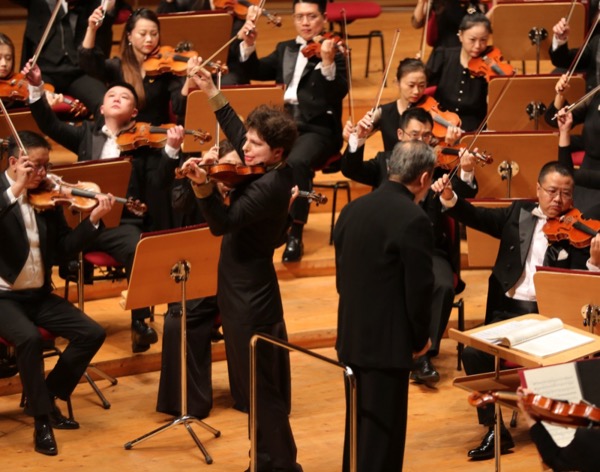
Augustin Hadelich at Shanghai Symphony Orchestra in June 2025
Telemann’s Fantasia with Baroque Bow
Hadelich recorded Georg Philipp Telemann’s Twelve Fantasies for Solo Violin in 2009 and has continued to champion such underrated pieces. “My program’s first half is lighthearted and extroverted,” Hadelich commented, “Telemann’s Fantasie No. 8 provides a fresh, playful beginning.”
Georg Philipp Telemann: Fantasie No. 8 in E Major, TWV 40:21 (Augustin Hadelich, violin)
Hadelich described Telemann’s composition as “inventive and surprising, even flamboyant and virtuosic, and full of thorny counterpoint.” During Telemann’s lifetime, he was actually more celebrated than Bach. However, the sheer number of his output, with works of varying quality, greatly affected how later generations viewed him.
As Telemann constantly moved on to the next composition, that improvisatory quality fascinated Hadelich: “he has great ideas, but they are spontaneous and unexpected, and not necessarily part of some ambitious architecture. For this reason, I would only program Telemann before Bach, not after!”
”I use my baroque-style bow for the Telemann and Bach works on the program and play the rest with a modern bow.” Hadelich credited the violinist Julia Fischer for introducing him to baroque bows. Almost immediately, he found the natural, intuitive, and bouncy qualities of the 1730s-style bow perfect for the repertoire.
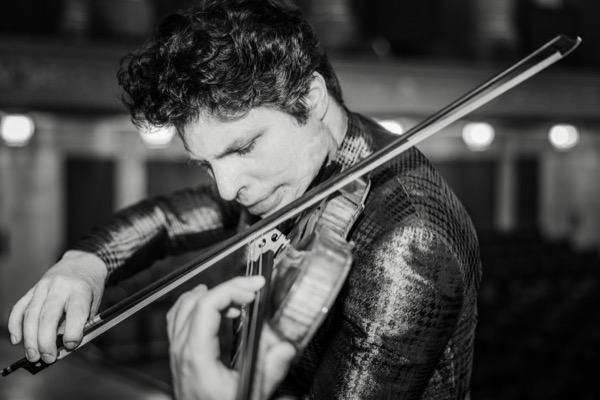
Augustin Hadelich
Coleridge-Taylor Perkinson’s Blue Note
Hadelich’s latest album, American Road Trip, featured Coleridge-Taylor Perkinson’s Louisiana Blues Strut, and his solo recital also included Perkinson’s Blue/s Forms. 2024 marked 20 years since Hadelich came to America: “so it is the perfect time to release an American album.”
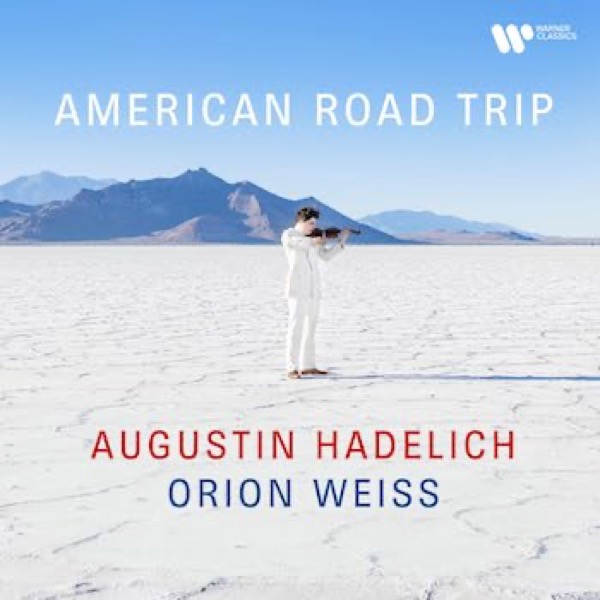
Through this collection, Hadelich introduced more listeners to the lesser-known works of African American composers such as Coleridge-Taylor Perkinson. “I find Perkinson’s music very well composed for the violin.” Hadelich reflected, “The Blues references are recognisable, but they are more complex, with harmonically and rhythmically surprising elements around every corner.”
Plus, Perkinson and Bach have both used the dance forms and folk music for inspiration, Hadelich pointed out. But as a classical violinist, he said he had to “switch off certain left-hand habits” to play Perkinson’s blues style. Unlike a clean slide between two notes of perfect pitches, Hadelich embraced the “blue note” that ended up “slightly flat.” The third movement of Blue/s Forms makes extensive use of this technique.
Augustin Hadelich plays Coleridge-Taylor Perkinson’s “Blue/s Forms”
Capturing Ysaÿe’s Sunrise
Carrying the imaginations of Telemann and Perkinson forward, Hadelich chose Eugène Ysaÿe’s Sonata No. 5 in G major for Solo Violin as the next piece. “The first movement, L’Aurore, depicts a dawn and sunrise—a very ambitious idea for a solo violin piece!” Hadelich said, “The sounds and textures are colourful and powerful, almost orchestral.” As to the second movement, Danse Rustique, “it is a folk dance in quintuple meter, and travels along all kinds of unexpected musical paths, sounding almost like an improvisation, until the dance returns and accelerates towards the end.”
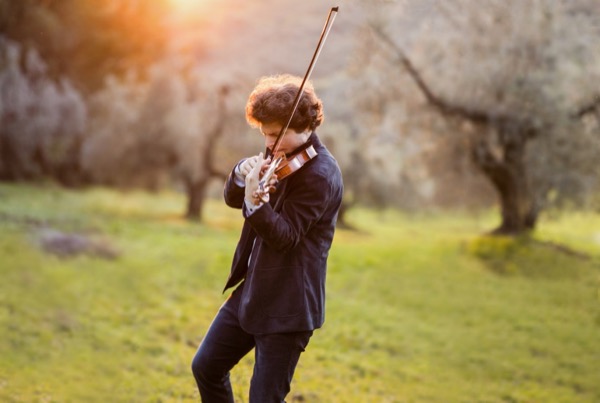
Augustin Hadelich (Photo Credit: Suxiao Yang)
Interestingly, in late 2009, Hadelich filmed a performance video of L’Aurore. His original plan was to begin shooting at 5 a.m.: starting in “the darkness and stillness of the night”, then the music would accompany “the world waking up” and culminate with “a beautiful sunrise”. Hadelich specifically located a venue with east-facing floor-to-ceiling windows, only to discover that snow began falling at 6 a.m.! Yet even as heavy snow obscured the winter sunrise, the radiance of Ysaÿe’s L’Aurore continued to shine through Hadelich’s violin playing.
Augustin Hadelich plays Ysaÿe’s Sonata No. 5 “Dawn”
Paganini: Capriccio literally means prank!
Why choose Niccolò Paganini to conclude the first half? Hadelich explained: “In a solo violin program, stylistic variety is particularly important. The pieces are so different and contrasting, yet one can find unexpected connections. It was my goal to showcase many approaches to writing for unaccompanied violin.”
Hadelich decided upon two Paganini caprices for this recital, No. 19 and No. 16, “not played all that often but showing his humour and eccentricity as a composer.” According to Hadelich, “No. 19 is downright funny at times, while the off-kilter accents of No. 16 remind me of Perkinson’s Blues ideas.”
Augustin Hadelich plays Paganini Caprice No. 19
In his live performance videos, Hadelich often walked the listeners through noteworthy details. “No. 19 Caprice opens with majestic octaves…(the main theme) is cheerful and playful, interrupted by strongly barking double-stops…” Hadelich shared that “the funniest moment of the piece (for me at least) is at the very end, when the upper voice goes into the stratosphere (around 2:30 in the video)!”
Hadelich added in his description: “We should never forget how funny some of Paganini’s music is. Capriccio literally means prank, and a caprice like this is intended to surprise, thrill and delight the listener at every turn!”
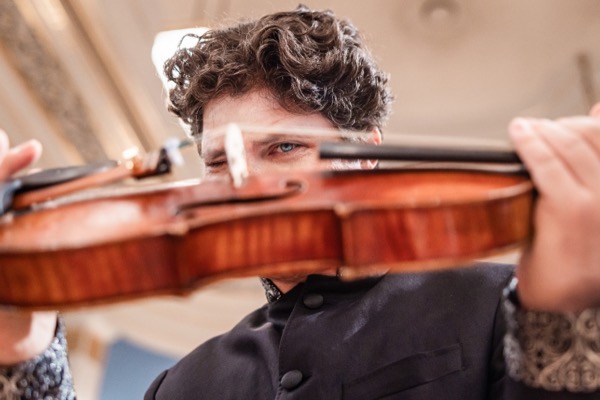
Augustin Hadelich
Bach: Res severa verum gaudium
“True joy is a serious matter” is the motto of the Gewandhaus Orchestra in Bach’s city, Leipzig. Like many violin players, Hadelich’s first exposure to Bach seemed all too serious, lacking enough joy, until the historically informed approach revolutionised our collective perception.
“I had first encountered Bach when I was 7,” Hadelich recounted in his carefully written CD liner notes. “I remember wondering why he didn’t make all our lives easier by just writing for violin with accompaniment, so violinists wouldn’t have to play all those double-stops!” In fact, many 19th-century violinists performed these works with piano accompaniment.
In the early 20th century, Bach often sounded solemn and slow. Hadelich credited the rise of historically informed interpretations in rediscovering “the playfulness, lightness and eccentricity of baroque music.” He pointed out that the Italian word barocco means “bizarre” or “irregular,” which reflected its adventurous departure from the earlier Renaissance ideals.
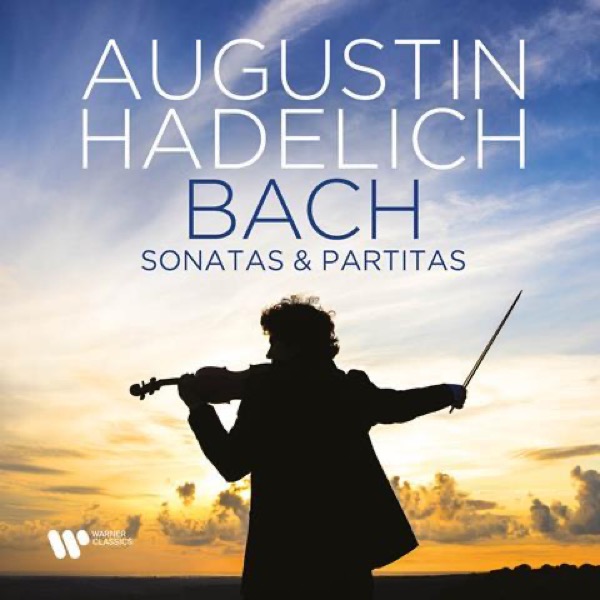
In his acclaimed Bach Sonatas & Partitas recording, Hadelich used vibrato discreetly and only added ornaments when necessary. “It felt liberating to play Bach with a baroque bow…passages of three- and four-note chords felt more fluid. The dance movements danced more, and the slow movements sang more,” he wrote.
For the second half of his recital, Hadelich programmed Bach’s Violin Partita No. 2 in D minor ending with the great Ciaccona. “Bach’s voice leading is perfect, and he always thinks polyphonically,” Hadelich told me, “one has to study this a bit, away from the violin, to understand the voices.” For example, he added: “even in movements like the first and third (Allemanda and Sarabanda), which initially sound homophonic, there are in fact always three voices implied, with the violin line tracing all three!”
Augustin Hadelich plays Bach Allemanda from Partita No. 2
As always, Hadelich meticulously revealed hidden details in his words and in his performance. He saw the Allemanda as “a microcosm of all the dramatic, tender, and playful moods of the partita.” For the Courante, he discovered from the printed facsimile of Bach’s manuscript a more natural way of bowing around the dotted rhythms. During the Giga’s main theme, he relished the baroque bow’s lively bounce on the string.
Johann Sebastian Bach: Violin Partita No. 2 in D Minor, BWV 1004: V. Ciaccona (Augustin Hadelich, violin)
Finally, Hadelich said: “The pinnacle of Bach’s Partita No. 2 is the Ciaccona (Chaconne): on top of a descending bassline, repeated 64 times, Bach erects towering structures, creates moments of anguish and sorrow, and leads us to moments of introspection and bliss. It feels like a journey through life itself. It is not hyperbolic to say that the Chaconne might be the greatest piece ever written for the violin.” Meditative, focused, and solitary, the solo violinist reached the end: “it feels like the final note could continue forever.”
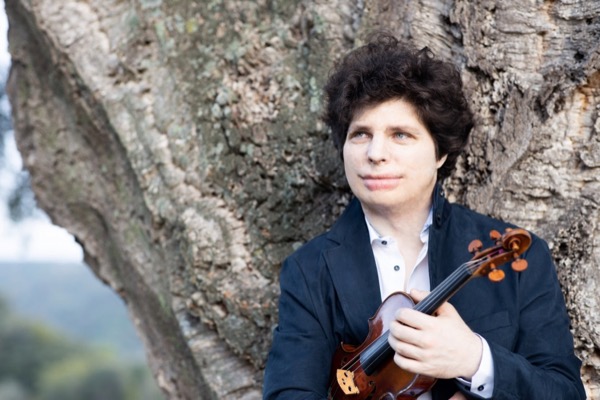
Augustin Hadelich (Photo Credit: Suxiao Yang)
For more of the best in classical music, sign up for our E-Newsletter