In a career lasting the better part of forty years, Claude Debussy composed nearly ninety art songs, also known as mélodies. He was not especially well educated in literature, but his mélodies became a vehicle for the development of a new musical language.
Always guided by the particular requirements of the French language, Debussy abandoned the expressive conventions of the nineteenth century and attempted to capture ambiguity and fleeting emotional impressions.
As we celebrate Debussy’s birthday on 22 August, let us explore his remarkable mélodies through the poetry of three writers who profoundly shaped his imagination: Paul Verlaine, Charles Baudelaire and Stéphane Mallarmé.
Claude Debussy: Fêtes galantes, “Mandoline”
Between Speech and Song
If you are listening to the Debussy melodies for the first time, it’s important to understand that the requirements of the French language always guided Debussy. Stressed syllables are never strongly accentuated, but treated with suitable discretion in order not to betray the spirit of the text.
The vocal lines are full of rhythmical innovations that free them from symmetrical regularity. Essentially, we hear melodic recitatives created in a flexible framework that generally avoids large intervals. This flexibility gives rise to the wonderful nuances so highly valued in French art.
His piano accompaniments, which probably shouldn’t be called accompaniments at all, are basically self-sufficient compositions. Actually, we can follow the harmonic development in Debussy’s musical language all the way to the most daring refinements in his last years.
Claude Debussy: Fêtes galantes, “Pantomime”
Music Melting into Air
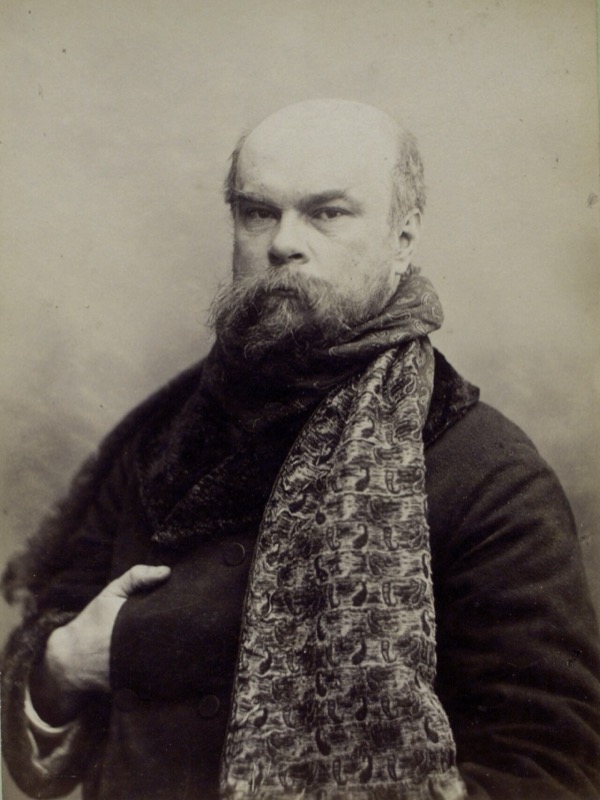
Paul Verlaine
Without doubt, Paul Verlaine was Debussy’s favourite poet. His statement that “music comes before all else, and for that chose the irregular, vague, and melting better into the air,” also became Debussy’s focal point.
Paul Verlaine published his Fêtes galantes in 1869, and it was immediately compared to the enchanted world of the divine master of amorous plays, the great and sublime painter Watteau.
Claude Debussy set “Mandoline” from the Fêtes galantes collection in 1882. It is one of the first Verlaine texts he set to music. It is a work of juvenilia, but Verlaine’s text is precisely what would have appealed to him at this time in his life. Debussy’s amorous ventures were well known, and the light-hearted text pokes fun at wild exchanges of vows and luxuriates in a good lifestyle.
The idea of using the piano as a mandolin substitute is not new, but Debussy introduces a new realism in the opening call to attention. The opening fifths allow for limitless possible continuations, and the initial vocal line sets out wonderfully floating chromatic phrases that won’t be repeated until the final verse. In this early mélodie, we get a sense of what Debussy’s piano part would later become.
Claude Debussy: Fêtes galantes, “Clair de lune”
When Love Became Music
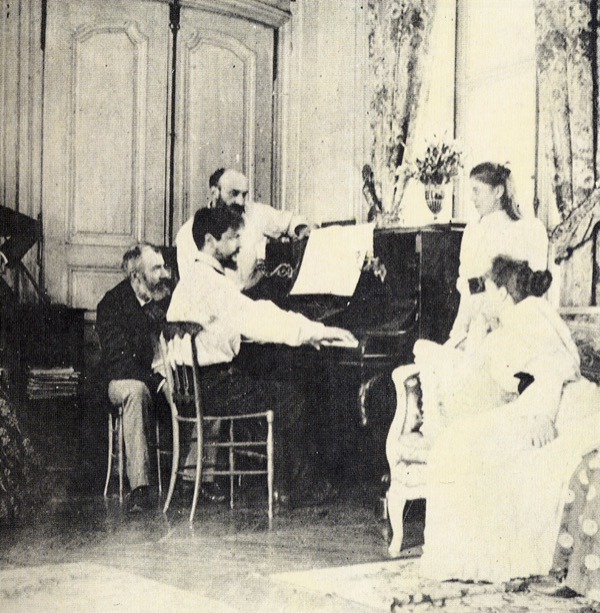
Claude Debussy, 1893
The aesthetic kinship between Verlaine and Debussy has been amply discussed, and Debussy took two stabs at Clair de Lune, with the first setting dating from 1882. It conjures up a magical moonlit world in which commedia dell’arte figures linger without a clear purpose.
It is a dream world in which sense is abandoned before the senses, and no story is told. However, there is a clear subtext to this particular setting. The 18-year-old Debussy was an accompanist for Mme Moreau-Sainti, a professional singer who operated a singing school for the ladies of Parisian high society.
And thus, Debussy’s gaze fell upon a red-haired beauty with green eyes, blessed with a beautiful high soprano voice. As his passion grew, he wrote songs that resembled an amorous diary of dreams and desires of infinite sweetness. In all, Debussy composed around forty songs for Madame Vasnier.
Before he left for Rome, he assembled thirteen in a bound album and added the following dedication. “To Mme Vasnier, these songs which have lived only through her, and whose enchanting grace would be lost if they no longer passed through her fairylike melodious lips.”
Claude Debussy: Ariettes oubliées
A New Language of Song
Debussy composed his next set of mélodies to Verlaine’s texts in Rome and Paris between 1886 and 1887. These settings were re-published in 1903 under the official title Ariettes oubliées. Inspired by subtlety and nuance, Debussy began to move in a new direction, towards a recitative-like style that would become a trademark of his vocal writing.
His earlier lover and muse, Marie-Blanche Vasnier, was still in his mind, and it is certainly possible to see the entire set as a declaration of love. However, both Verlaine and Debussy sought to innovate song by using rhythm and tone colour as the basis for a new form of art.
For Debussy, this set established the tone for his future vocal compositions in terms of musical and attention to poetic detail. In Ariettes oubliées, he found a new and heightened level of understanding of Verlaine’s poetry. He composed in a highly chromatic, tonally ambiguous language, which he would make his own over the next couple of years.
Both artists essentially freed language and music from conventional restrictions. Verlaine employed uneven rhythm and rhymes, and Debussy was breaking away from traditional tonal concepts. Both were reaching out in new directions by seeking guidance from the other arts.
Claude Debussy: Trois mélodies de Verlaine, “Le son du cor s’afflige vers les bois”
The Poetry of Inner Exile
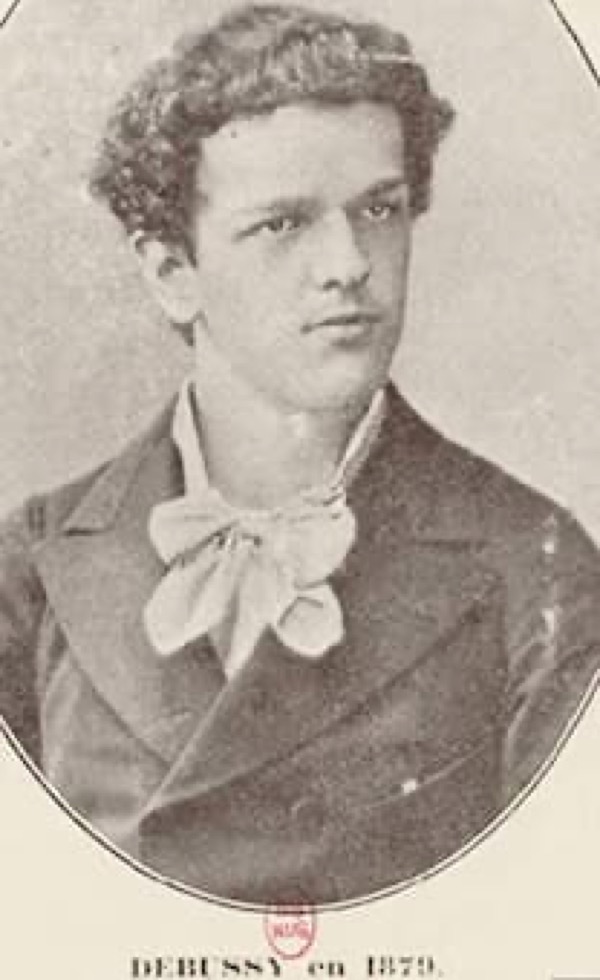
Claude Debussy, 1879
Paul Verlaine certainly lived an extremely troubled life. He lived as a closeted gay man and was suffering from wild swings of emotions and possibly bipolar disorder. Drug dependence and alcoholism took a horrific toll on his life, and he died in Paris at the age of 51.
Incarcerated for shooting his fellow poet and lover Arthur Rimbaud, Verlaine composed what many literary critics consider to be his finest poetry. He was aware that his time away from the Parisian cafes probably saved his life, and he converted to Roman Catholicism in the summer of 1874.
It was during this period in his life that Verlaine penned most of the poems in Sagesse, poetical expressions of simple Catholic Christianity as well as of his emotional odyssey. Debussy’s setting of three poems from this collection dates from 1891, but they were not published together until 1901.
Dedicated to Ernest Chausson, the “Trois mélodies” find Debussy moving away from the intimate and psychologically charged aspects of his earlier Verlaine settings towards something more purely atmospheric. The music dissolves the distinction between foreground and background, with the piano creating the environment in which the voice exists.
Claude Debussy: Fêtes galantes II, “Colloque Sentimental”
Echoes of Lost Loves
In June 1904, Claude Debussy said goodbye to Verlaine by composing three additional songs from the Fêtes galantes. This set is dedicated to Emma Bardac, his future second wife, and he summons once more the familiar spirits of Verlaine from the commedia dell’arte.
Composed two years after he had completed Pelléas et Mélisande, Debussy reached a new height of daring and innovation in his musical language. “Les ingénus” presents an example of purely French atonality, expressing the poem’s veiled irony.
“Le faune” makes use of courante and saraband rhythms, yet the piano does not provide the customary rich background of colour. Instead, the right hand imitates the arabesques of a flute in free counterpoint with the voice. Meanwhile, the left hand, in the lowest register, beats out the accompaniment like a tambouring.
The cycle reaches its climax with “Colloque sentimental,” a rather nostalgic goodbye to his old loves. A searing sadness fills the conversation as Debussy gives “the poem the dimensions of an inner dialogue, remembrances of the kind one murmurs privately to oneself. It is a supreme example of the perfect freedom of recitative alternation with arioso.”
Claude Debussy: Cinq Poèmes de Baudelaire, “Harmonie du soir”
Beauty in the Darkness
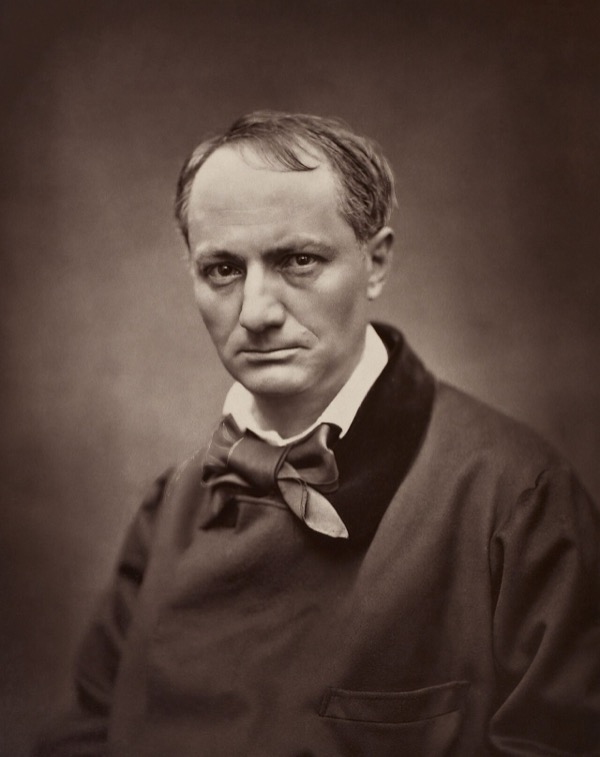
Étienne Carjat, Portrait of Charles Baudelaire, circa 1862
Charles Baudelaire (1821-1867), according to TS Eliot, was the first modern poet, “the greatest exemplar in modern poetry in any language.” He produced unprecedented expressions of a complex sensibility and modern themes within the structures of classical rigour and technical artistry.
He wrote his best poetry against a backdrop of financial constraint, alienation, and legal strife. And let’s not forget exceedingly complicated personal and family relationships. He set himself apart from other writers by cultivating an eccentric image.
He lived an unconventional life by writing poetry in verse that used romantic topoi to upset them, and by launching a new form. While he did seek recognition, “Their distinct individuality defines Baudelaire and his poetry.”
His Les Fleurs du mal (The Flowers of Evil) was considered the most important and influential poetry collection published in all of Europe in the 19th century. As a critic wrote, “Into his poetry he poured all the dark pessimism of his own soul, all the bitterness and agony of his despair.” Composers loved Baudelaire’s poetry, as it so closely resembled music.
Claude Debussy: Cinq Poèmes de Baudelaire, “Recueillement”
The Shadow of Bayreuth
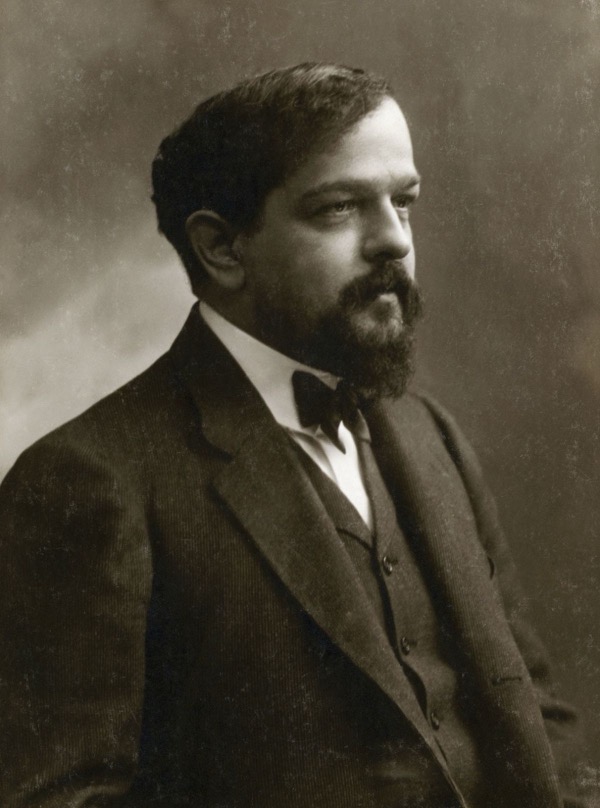
Claude Debussy, ca. 1908, photo by Félix Nadar
Composed between 1887 and 1889, Debussy’s Cinq poèmes de Charles Baudelaire hurls us into the sensual worlds of Baudelaire’s words and Richard Wagner’s harmonies. In fact, Debussy made two pilgrimages to Bayreuth, and he responded positively to Wagner’s sensuousness, mastery of form, and striking harmonies.
It has been suggested that while Debussy was no traditional heir to Wagner in Pelleas and Melisande, “his possession and transformation of Wagner give him substantiality, signification, and depth.”
These were Debussy’s only settings of Baudelaire, and despite his ambivalent view of Wagner, the shadow of Bayreuth is not far away. “Le Balcon” is conceived on an unusually large scale, and it is the longest of Debussy’s songs.
As Roger Nichols wrote, it “shows how sensitive Debussy was to the double need of recapitulation, confirmation, and forward movement.” “Harmonie du soir” is probably the most popular song in the set, as Debussy closely mirrors Baudelaire’s poetic structure. It opens with a brief prelude and then develops into an evolving structure. Maybe you also recognise it from his fourth Prélude for piano, which is titled “Les sons et les parfums tournent dans l’air du soir,” after a quote from “Harmonie du soir.”
Claude Debussy: Cinq Poèmes de Baudelaire, “Le Balcon”
Music of the Unspoken
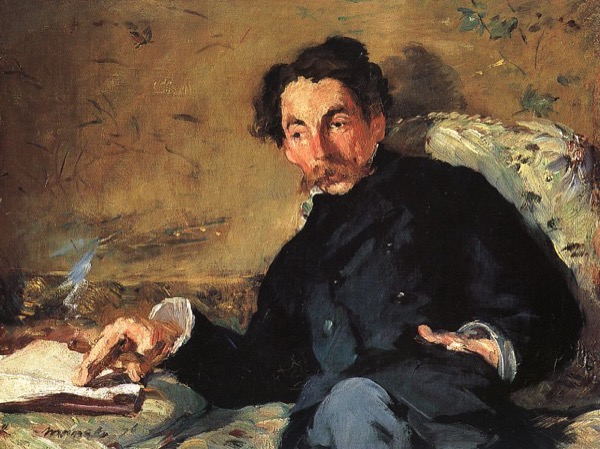
Portrait of Stéphane Mallarmé (Manet)
Debussy had set verse by the French Symbolist poet Stéphane Mallarmé in 1884. Still, when the first complete volume of his poetry was published in 1913, both Debussy and Ravel quickly began independently setting several verses.
Debussy was annoyed that Ravel had chosen two of the same poems, and Ravel was annoyed that the poet’s heir did not refuse Debussy’s request. In the event, to render the poet’s dense symbolism into a compelling musical language, Debussy created an unprecedented degree of boldness and refinement.
As Roger Nichols writes, “To be sure, the air one breathes here is dangerously rarefied, and, matching the world of the poetry, of all the songs Debussy wrote, these are the most difficult to approach.”
How does one musically convey a desire for longing, which cannot be fulfilled for lack of an object to focus on? Debussy forged an ingenious atonal language with an unreal weightlessness, all remaining suspended in mid-air. These three songs are a great achievement, but an exception among Debussy’s mélodies.
Debussy’s mélodies never attempted to illustrate poetry in music. Verlaine gave him atmosphere and ambiguity; Baudelaire opened the door to a darker, more sensual musical world; and Mallarmé pushed him towards an almost weightless language. Yet, Debussy’s greatest achievement is probably the fact that it hovers between what is said and what is suggested.
For more of the best in classical music, sign up for our E-Newsletter