Founded in 1979, the Festival International de Colmar became an international festival in 1989 under the artistic direction of Vladimir Spivakov. Alain Altinoglu took over as artistic director in 2023, continuing the festival’s long tradition and its place as a fixture in the European classical-music calendar.
Held annually in early July, the 2024 edition opened at Saint-Matthieu Church. It featured the Orchestre Symphonique du Théâtre Royal de la Monnaie de Bruxelles, conducted by Alain Altinoglu, with French baritone Stéphane Degout as soloist.
The programme opens with Wagner’s Prelude to Lohengrin and closes with César Franck’s powerful Symphony in D minor. The emotional heart of the evening is Mahler’s deeply expressive song cycle Lieder eines fahrenden Gesellen.
A Royal Overture: Festival International de Colmar
From French Mélodie to Mahler

Stéphane Degout
Born on 9 June 1975 in Bourg-en-Bresse, France, the exceptional French baritone Stéphane Degout has built a remarkable career. Trained at the Lyon Conservatoire and the prestigious Atelier Lyrique of the Opéra de Lyon, he found early success at major opera houses, including the Opéra National de Paris, the Royal Opera House in London, and the Metropolitan Opera in New York.
While he celebrated triumphs on the world’s great opera stages, Degout also became one of the foremost interpreters of French song. French mélodie, with its fundamental emphasis on poetry and language, has always been a central pillar of his artistry.
Collaborating with leading pianists and orchestras, Degout has also ventured into the unique world of Gustav Mahler. As he suggested in a 2022 interview with Première Loge, “Mahler is a world apart in the Lied repertoire… You can sense how vital composing was for him and how it reflected his life.”
With Des Knaben Wunderhorn, Kindertotenlieder, and Lieder eines fahrenden Gesellen in his repertoire, Degout relates how this music impacts him emotionally. “It is striking how much his melancholy can amplify my own… I know that when I sing Mahler, I will vibrate differently, before, during and after the concert.”
The Music of Heartbreak
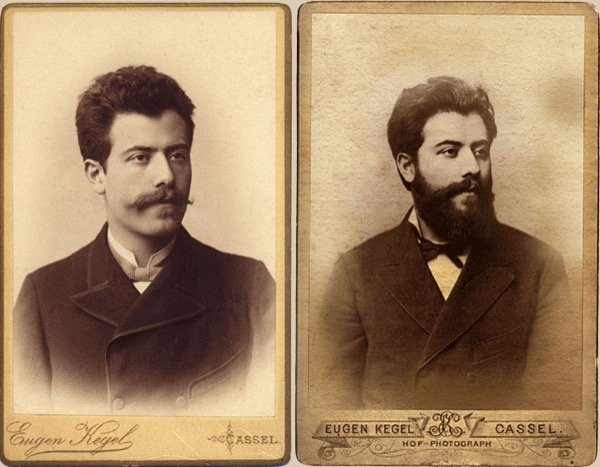
Gustav Mahler in Kassel
Of course, Mahler himself vibrated differently. During his time as a conductor in Kassel, he fell deeply in love with the soprano Johanna Richter. It was the first genuinely intense experience of love Mahler had known, yet the liaison brought him more pain than pleasure.
Richter was decidedly non-committal, which exposed Mahler to a whirlwind of emotions in which fear prevailed over hope. As he wrote to a friend, “I am torn apart, my heart is bleeding, all is lost.” Mahler addressed several poems to Richter and set four of them to music for voice and piano. In the resulting Songs of a Wayfarer, Mahler sees himself as a travelling journeyman who has faced adversity, set out into the world, and wandered on in solitude.
The Songs of a Wayfarer represent Mahler’s first mature composition, and they speak to us with great emotional force. “When my sweetheart is getting married” expresses the grief at losing his love to another, and even the beauty of the surrounding world cannot keep him from having bad dreams.
“I went this morning over the field” sounds like the happiest music in the work, as the wayfarer can finally revel in nature’s beauty. A deep sense of despair is expressed in “I have a gleaming knife,” as the wayfarer likens his agony of lost love to an actual blade piercing his heart. The concluding “The two blue eyes of my beloved” offers a subdued, gentle resolution, and the music would later resurface in the opening movement of his First Symphony.
A Mahlerian Tribute to Alsace

Alain Altinoglu and Stéphane Degout in Colmar
Stéphane Degout’s performance of Mahler at Colmar was clearly a highlight of the evening. Critics praised his expressive German diction and remarkable vocal control. The concluding song was singled out for its tenderness and sense of pain.
The audience agreed, and their applause brought Altinoglu and Degout back for an encore, specifically, a Mahlerian tribute to Alsace. “At the Ramparts of Strasbourg” is one of Mahler’s early settings of texts from Des Knaben Wunderhorn, and it belongs to a group of nine songs for voice and piano composed between 1887 and 1890.
For more of the best in classical music, sign up for our E-Newsletter