The death of Swedish-American conductor Herbert Blomstedt, at the age of 99, marks the passing of one of the last great conductors whose careers reached back to the musical world of the mid-20th century. For more than seven decades, Blomstedt stood before some of the world’s finest orchestras, offering interpretations of extraordinary integrity and conviction. The sheer longevity of his career remains one of the most remarkable phenomena in contemporary musical life, while the uncompromising musicality that Blomstedt brought to his performances is yet another part of his legend.
Blomstedt died on 4 November at his home in Gothenburg, just eight months short of his hundredth birthday. Until his final months, he remained an active presence on the international concert platform. On 15 May 2026, Blomstedt conducted his final concert in San Francisco with the San Francisco Symphony, coincidentally performing Mahler’s Ninth Symphony, a work about farewell in the face of death. The concert was interrupted by Blomstedt’s frail health: during the third movement, Blomstedt slumped farther and farther to his right, prompting his attendants to rush onto the stage. Blomstedt, however, insisted on resuming and completing the performance despite his serious health difficulties, and he subsequently cancelled the remaining two performances in the series.
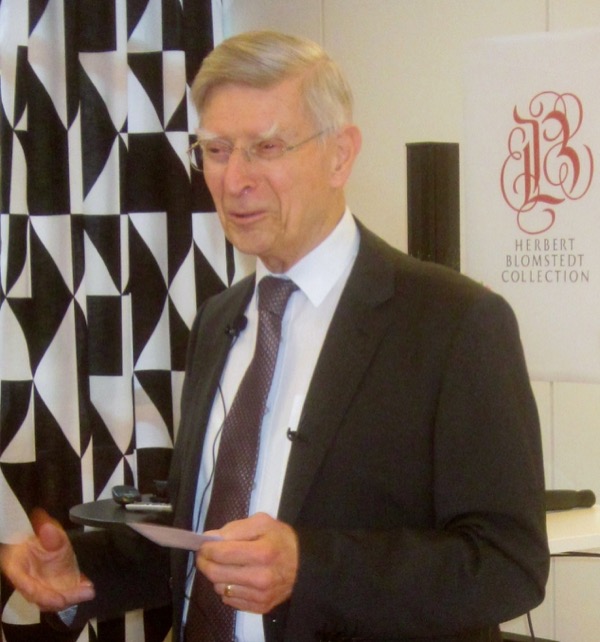
Herbert Blomstedt in Gothenburg, May 2015 © Eskil Malmberg / Wikimedia Commons, CC BY-SA 4.0
Blomstedt’s last appearance in London, on 21 November 2024, was also a performance of Mahler’s Ninth, this time with the Philharmonia, which I had the honour of attending. By then, Blomstedt had already suffered serious falls in 2022 and 2023, and had to conduct from a piano bench. It was, nevertheless, a performance of incredible magic and musicality. There were undoubtedly compromises imposed by age, but the expressive power was never diminished; on the contrary, it seemed honed to its most vivid form (with no dragging of tempi at all!), culminating in a most nobly Olympian final movement. At the general rehearsal, Blomstedt concluded by saying something to the effect that the body will age and die, but the “spirit” lives on. The performance that very evening was indeed a perfect reflection of his words.
Herbert Blomstedt conducts Mahler’s Symphony No. 9
Daniel Barenboim once said that Wilhelm Furtwängler was a philosopher in rehearsal and a poet in performance. I believe the same applies to Blomstedt, who, well into his tenth decade, continued to discover and refine his musical understanding, remaining an ageless poet. Furtwängler himself was, indeed, an idol of Blomstedt’s, from whom the latter drew inspiration by listening to his rehearsals and concerts. He even obtained Furtwängler’s autograph when the conductor performed in Gothenburg while he was still a boy. Of course, it is difficult to discern obvious links between the conducting styles of the two, but what they perhaps shared was the magical musicality they were able to draw from their orchestras, something that belongs only to great conductors.
Born Herbert Thorson Blomstedt on 11 July 1927 in Springfield, Massachusetts, to Swedish parents, he spent his childhood in Sweden and Finland. His parents were Seventh-day Adventists, and their religious convictions profoundly shaped the young Herbert’s upbringing. Music was central to family life, and he learned the piano, violin and organ before developing an increasingly powerful attraction to orchestral music. The values of discipline, modesty and service, instilled in him from childhood, would remain inseparable from his musical outlook.
In 1945, Blomstedt entered the Royal College of Music in Stockholm, where he began studying conducting. His education continued under a broad range of influential figures, including periods of study with John Cage at Darmstadt, Igor Markevitch in Salzburg, Jean Morel at Juilliard and Leonard Bernstein at Tanglewood in 1953, the year in which Blomstedt won the Koussevitzky Conducting Prize. His formal conducting debut came in 1954 with the Stockholm Philharmonic, leading directly to his first professional appointment with the Norrköping Symphony Orchestra in Sweden.
After eight years in Norrköping, Blomstedt’s career grew steadily, and he subsequently served as chief conductor or music director of the Oslo Philharmonic Orchestra (1962–1968), the Danish Radio Symphony Orchestra (1967–1977) and the Swedish Radio Symphony Orchestra (1977–1982), with most of which he maintained lifelong associations as conductor laureate. His Nordic years established him as one of the most notable interpreters of Nielsen and Sibelius, while his interests also extended to the neglected Swedish symphonist Franz Berwald.
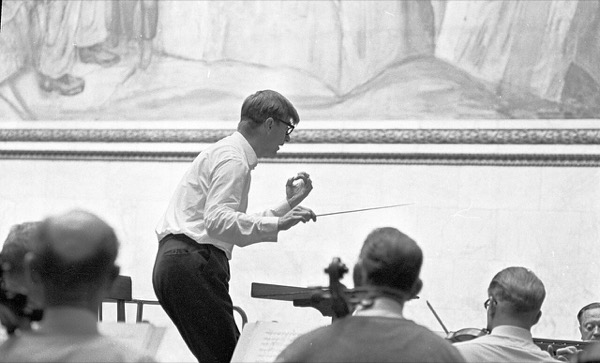
Herbert Blomstedt in 1967 © Johan Brun / Wikimedia Commons, CC BY-SA 4.0
A major turning point in his career came in 1975, when the Staatskapelle Dresden, the oldest surviving orchestra in the world, and the Saxon State Opera invited him to become their new chief conductor, following several years during which the orchestra had been without a chief conductor. Blomstedt’s affinity for Austro-German music was further deepened during this period. Over his ten-year tenure, Blomstedt recorded complete cycles of Beethoven’s and Schubert’s symphonies with the orchestra, and helped lift it out of the low ebb that had followed Kurt Sanderling’s departure.
Blomstedt displayed a different side of his artistry during his subsequent tenure with the San Francisco Symphony, where his career reached new heights of international recognition. Having signed with Decca Classics in the late 1980s, Blomstedt and the SFSO recorded a wide range of repertoire for the label, becoming benchmark artists of the digital era and winning three Grammy Awards, a Gramophone Award and a Grand Prix du Disque. There are admirable recordings of Austro-German composers such as Brahms, Mendelssohn and Bruckner, as well as Nordic composers including Berwald, Sibelius and Nielsen, whose works Blomstedt retained at the core of his repertoire in later years. But perhaps most astonishing are the spectacular performances of Hindemith and Bartók, which reveal Blomstedt in his prime, bringing out extraordinary balance and colour. Some of these recordings remain reference recordings for collectors today.
After leaving San Francisco in 1995, Blomstedt returned to Germany as chief conductor of the NDR Symphony Orchestra in Hamburg, before assuming one of the most historically significant positions in European musical life: Gewandhauskapellmeister of the Leipzig Gewandhaus Orchestra, the world’s oldest civic orchestra, a post he held from 1998 until 2005. Perhaps there was a certain quality in Blomstedt that fostered his affinity with eastern Germany. During his seven-year tenure, Blomstedt expanded the orchestra’s repertoire and refined its unique sound: his love of Hindemith and Nordic repertoire continued here. But, of course, the traditions of Leipzig were not forgotten, particularly his admiration for Bach and Mendelssohn, and the significance of conducting the orchestra with which Mendelssohn himself had once worked. It was under Blomstedt that the Mendelssohn-Festtage became established as a regular fixture in Leipzig’s musical calendar.
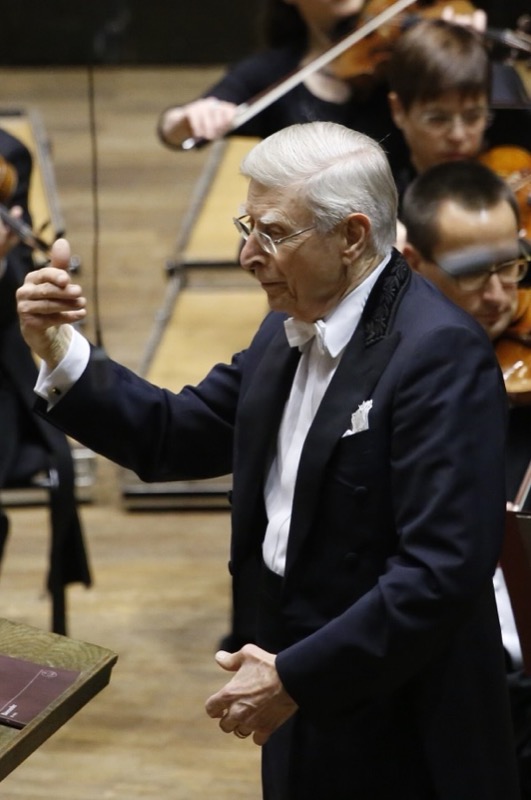
Herbert Blomstedt at the Leipzig Gewandhaus, December 2015 © Alexander Böhm / Wikimedia Commons, CC BY-SA 4.0
After 2005, at the age of 78, Blomstedt decided not to take on any further chief conductorships. The Bamberg Symphony, an orchestra with which he had worked frequently, appointed him honorary conductor in 2006. Perhaps Blomstedt himself would not have imagined that his career would continue for another twenty years. He first conducted the Vienna Philharmonic on 26 January 2011, aged 83, during Salzburg’s Mozartwoche festival, stepping in at short notice to replace Nikolaus Harnoncourt, who was actually two years his junior, and becoming the oldest debutant in the orchestra’s history at the time. What began as a last-minute substitution developed into a celebrated artistic partnership, culminating in his appointment as an honorary member in 2019.
Why was Blomstedt loved by so many orchestras? Authority, of course, comes from age and experience, but it was his unique humility and wealth of knowledge that made Blomstedt such an adored figure. Conducting mostly without a baton in his later years, Blomstedt was not a conductor who marked every beat clearly; rather, his magical hands shaped poetry with wonderful directness and genuineness. By contrast, films of his earlier, baton-wielding years reveal a certain sharpness and power. Particularly in his later years, Blomstedt’s conducting technique was economical but effective, and, of course, worked best with orchestras that knew him well. Yet there was never any wallowing, despite his frail health in the final years. Blomstedt knew too well how to shape phrases according to the natural flow of breath, and his musical pulse retained an inner vigour.
There was much modesty in Blomstedt’s character, but also a determination born of his firm beliefs. A devout Seventh-day Adventist, Blomstedt always refused to rehearse on Friday evenings or Saturdays, the Sabbath in Seventh-day Adventism, while remaining open to concert performances on those days. And Blomstedt only conducted works that he absolutely loved, which, according to Esa-Pekka Salonen, was the secret that kept him vigorous.
Bruckner, in particular, occupied a special place in Blomstedt’s artistic life. A natural Brucknerian, Blomstedt devoted a large proportion of his career to conducting Bruckner, which was not unusual for conductors of his generation. His interpretations of Bruckner continued to evolve over time, but always possessed a wisdom, patience, command and spiritual conviction rarely encountered among conductors, as well as an inner vitality that made even the most expansive passages purposeful.
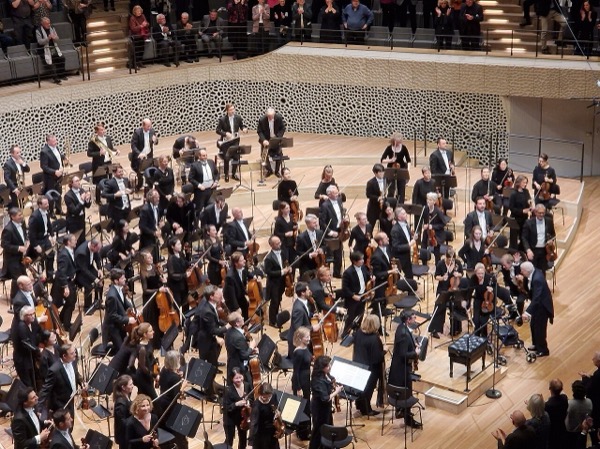
Herbert Blomstedt, Bruckner’s Ninth, Elbphilharmonie © Gerda Arendt / Wikimedia Commons, CC0
In his later years, Blomstedt generally focused on the works that interested him most, particularly Bruckner and, of course, Beethoven, Brahms, Mendelssohn, Sibelius and others. What made his interpretations so admirable—and probably why Blomstedt remained a figure beloved by orchestras and audiences alike—was that they always offered new discoveries and insights that could scarcely be found elsewhere. But there was new repertoire, too. Blomstedt came rather late to the Second Symphony of his fellow Swede Wilhelm Stenhammar, taking it up in his late eighties, around 2013, and subsequently making a recording of the Symphony No. 2 and the Serenade for Orchestra, Op. 31, with the Gothenburg Symphony Orchestra.
Vigour lay at the very heart of Blomstedt’s artistry and, indeed, his personality. I once heard someone close to him say that “music kept him alive”, and perhaps it is most fitting to conclude with Blomstedt’s own words to CBS News Sunday Morning in 2025: “Without work, I don’t live. If I just twiddle my thumbs, that is not living.” May he live forever through the music he leaves behind.
Conductor Herbert Blomstedt, a man who has cheated time
For more of the best in classical music, sign up for our E-Newsletter