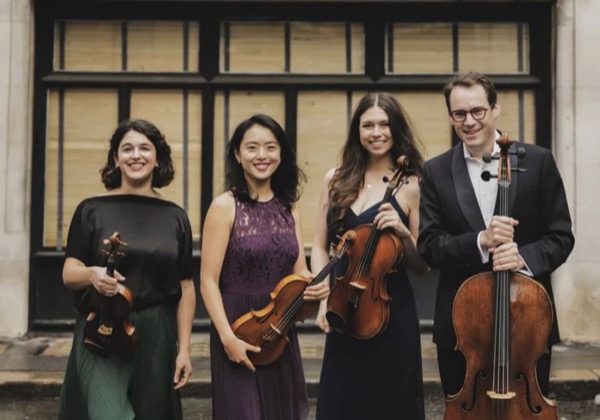
Matthew Hunter, who majored in philosophy as an undergraduate and did not take up the viola until he was 27, grew up near Boston and learned to speak fluent German. “The viola teacher who had the greatest influence on me was from Berlin.” During his three decades as a musician with the Berlin Philharmonic, Hunter has worked with distinguished conductors such as Claudio Abbado, Bernard Haitink, Zubin Mehta, Simon Rattle, and Kirill Petrenko.
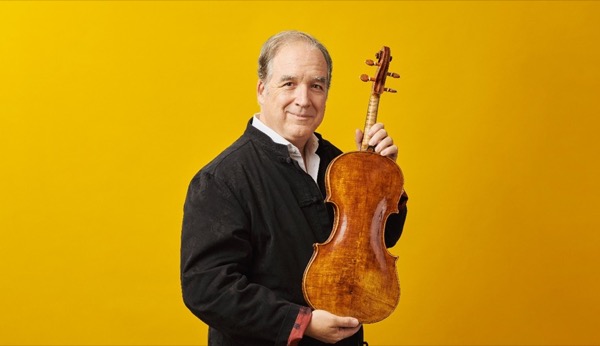
Matthew Hunter (Photo from the Berlin Philharmonic)
Being a senior colleague of the first Chinese principal violist, Diyang Mei, Hunter visited China this May, performing in Shanghai, Beijing, Shenzhen, and Guangzhou with the Berlin Philharmonic Piano Quartet. The group presented all three of Brahms’ piano quartets in one night. If you count the intermission, that was almost a three-hour marathon!
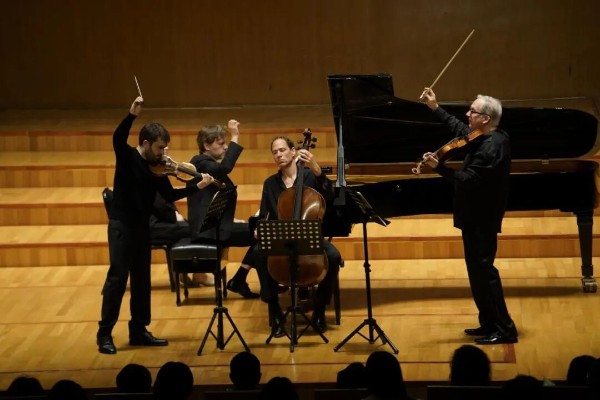
Berlin Philharmonic Piano Quartet (Photo from Shanghai Oriental Art Centre)
While Brahms’s textures were rich, the viola is still an underappreciated instrument everywhere else you look. So before the quartet’s performance, I asked Hunter to share his passion for the viola, his understanding of Brahms, and the fascinating experience of playing guitar in Mahler’s Symphony No. 7.
From a violist’s perspective, can you share with us how Brahms advocated for the viola in chamber music?
It’s a nice expression to say that Brahms was an advocate for the viola, and not just in his chamber music. Compared with the Mozart Piano Quartets, where the viola is essentially a rhythm and harmony box, Brahms treats the viola as an equal of the cello and the violin. The viola performs solos and melodies, and bears responsibility for many key transitions. Of all composers, Brahms expressed a depth of feeling and appreciation for the autumnal sounds of the viola.
Johannes Brahms: Viola Sonata No. 1 in F Minor, Op. 120, No. 1: I. Allegro appassionato (Lionel Tertis, viola)
Brahms’ two viola sonatas were originally written for clarinet. What do the different versions tell you about Brahms’ musical mind?
Brahms also had a commercial motivation for creating different versions. He composed the clarinet sonatas after being inspired by the playing of Richard Mühlfeld, solo clarinettist of the orchestra in Meiningen, which was the original orchestra of Hans von Bülow. There were very few clarinettists of Mühlfeld’s quality, so the audience for the printed music would have been very meagre. And Brahms also played the viola fairly well, so he certainly knew of the inner voice of the instrument. He transposed octaves, and added double stops to adapt his sonatas. He saw the viola and clarinet as having tonal relationships, and paired the two in his symphonies.
Johannes Brahms: Clarinet Quintet in B Minor, Op. 115: I. Allegro (Andreas Ottensamer, clarinet; Leonidas Kavakos, violin; Christoph Koncz, violin; Antoine Tamestit, viola; Stephan Koncz, cello)
You must also have played the viola in Brahms’ great symphonic works. Do you have a memorable occasion you can share that shows your experience of being inside the music?
One of my first performances on tour with the orchestra was in the Musikverein in Vienna, with Claudio Abbado. This must have been around 1996/97. In the final movement of the Fourth Symphony, at some point after getting us worked up, he raised both hands high, fingers outstretched, like a wizard summoning lightning. The orchestra went berserk.
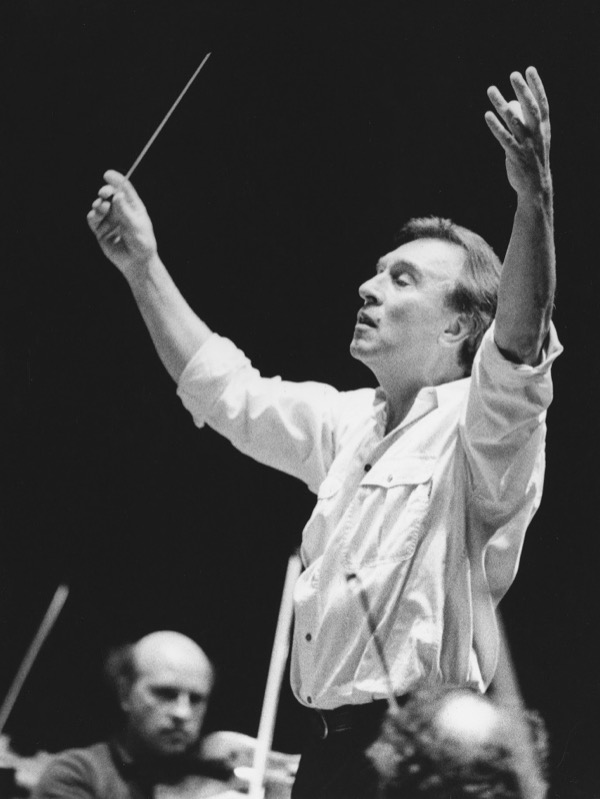
Claudio Abbado (Photo by Cordula Groth)
You have worked with hundreds of conductors, including Abbado (1989–2002), Rattle (2002–2018), and Petrenko (2019–present) with the Berlin Philharmonic. Can you name a few interactions or performances that illustrate their different styles?
The story mentioned above is a good illustration of Claudio’s trust in his orchestra. He gave over the direction and control to fate and the musicianship of his rowers.
Matthew Hunter interviews Bernard Haitink
Sir Simon felt that the orchestra’s present and future included the introduction of new works. So, he added so many pieces by new composers, some of which we took on tour. We took an untested work by Magnus Lindberg, “Untested Work on Tour,” to Sapporo, which was far outside expectations. I can’t say that this experiment was positive. We learned that, just as there are limits to old, there are limits to new. On the other hand, Simon’s staged version of Bach’s St. Matthew Passion was among the most inspiring things I’ve ever done.
Sir Simon Rattle directs Bach’s St. Matthew Passion
We just performed an exemplary Rheingold with Kirill Petrenko in Salzburg. His choice of vocal soloists was inspired, and his attention to detail and precision, while very difficult work for us, bore results. The texture of the sound was transparent, which, for the music of Wagner, seems an impossible task.
Berlin Philharmonic: Inside “Das Rheingold” at Salzburg
Can you tell us about the history of the Berlin Philharmonic Piano Quartet?
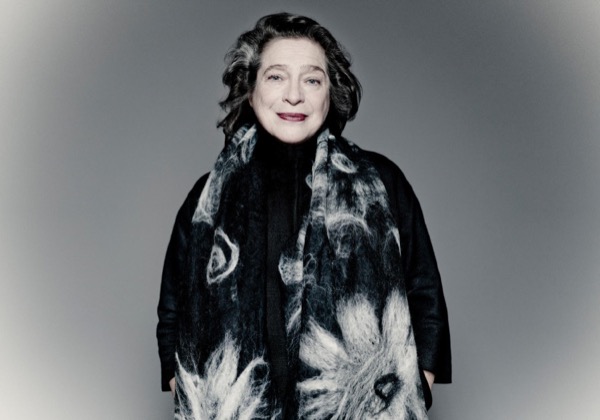
As you can see from our website, the Piano Quartet was established in 1985 as a chamber music ensemble. Today the Piano Quartet consists of three members of the orchestra – violinist Luis Esnaola, violist Matthew Hunter and cellist Knut Weber – as well as the pianist Markus Groh. Our China tour in May 2026 featured all three of Brahms’s piano quartets, played in the order of No. 2 in A Major, Op. 26, then No. 3 in C Minor, Op. 60, and lastly No. 1 in G Minor, Op. 25. We played in four cities and held open rehearsals for audiences at several venues. In addition to these more familiar quartet pieces, our repertoire also includes unknown compositions and rediscovered works.
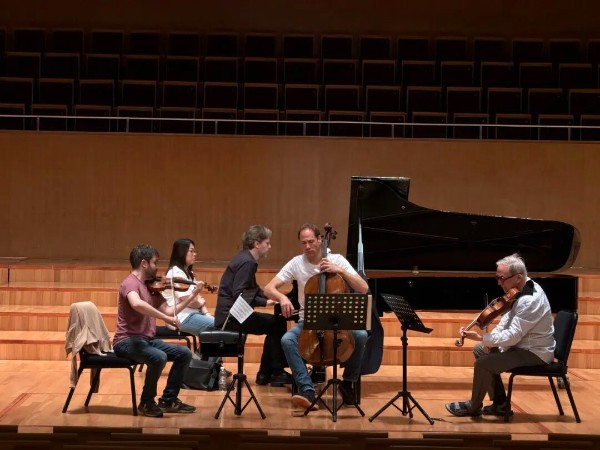
Berlin Philharmonic Piano Quartet’s open rehearsal in Shanghai
Since 1999, you have also directed the Philharmonic Stradivari Soloists and participated in the Berlin Philharmonic Virtuosi. As a chamber musician and an orchestral player, can you compare the differences between the two roles, if any?
In the case of the ensembles that you mention, those are for doubled viola voices. The piano quartet has one single, solo voice. The orchestra section has as many as twelve voices. Each of these situations presents its own unique challenges; for example, the ability to play and remain together is a fundamental discipline when performing in a large section.
In the piano quartet, the emphasis is on tonal quality and colour, dynamics, and the creation of the musical frame in the absence of a conductor. As we understand the style of playing as a “chamber musician”, which has something to do with having contact, playing with initiative and projection, and leading while following, it is a style that applies to all playing in all ensemble sizes.
Matthew Hunter on playing a Viola by Stradivari
Besides Berlin, Boston is another city full of musical memories for you. Can you share your listening and performing experiences at Boston Symphony Hall with us?
The thing to keep in mind about Boston Symphony Hall is that it was an interpreted 1900 version of the European ideal “shoebox” shaped hall, like the Musikverein or the Concertgebouw. This might explain the hall’s incredible sound and aura.
My latest experience performing Mahler Symphony No. 7, as a guitarist in the fourth movement, will remain one of my most exciting musical moments. When I was a child, my father took us to Boston Symphony Hall to hear great touring artists such as Arthur Rubinstein. I remember how Rubinstein walked, held his head, and the 10 minutes of applause before he played his first notes.
Matthew Hunter with the Berliner Philharmonic’s 2022 US tour
During your student years and early career, who had the greatest influence on you in developing your sound and musical identity?
My sound was influenced from an early age. My late teacher, Julian Olevsky, was a Berliner whose cousin was a Berlin Philharmonic concertmaster. So I learned the “Berlin School” of violin from age 8. And Julian had two violins: one Stradivarius, and one Guarneri del Gesù known as the “Emperor”. So he had an enviable choice—each morning at breakfast he could ask himself, today, am I a Strad man, or a Guarneri man?
Julian Olevsky plays Kreisler’s Chanson Louis XIII and Pavane
Jaime Laredo is one of the most elegant violinists I have ever known. He performed the Grieg Third Violin Sonata just meters in front of me, and I am still in thrall to the beauty of his sound. A similar experience was hearing Emmanuel Pahud perform the Prokofiev Sonata in Berlin.
Johannes Brahms: Piano Quartet No. 1 in G Minor, Op. 25: I. Allegro (Isaac Stern, violin; Jaime Laredo, viola; Yo-Yo Ma, cello; Emanuel Ax, piano)
Why did you study philosophy in the first place? What are you reading now?
My study of philosophy grew out of probing more deeply into the Russian novel and wanting to understand the movements of nihilism, Nietzsche, and Schopenhauer, for example. I am currently reading Essays After Eighty by Donald Hall, a book of poetry by Wendell Berry, and a book about the art of raising chickens.
I assume you must have acquired the German language to advance musically and philosophically?
Music is language. Language is identity and history as deep as the rocks and the hills. To approach the composers of the German Romantic period, I feel it essential to understand their spoken and written identity. Maybe it’s time for me to start learning Chinese, so that I could better represent the music of Chinese composers.
I enjoy reading your quote about five-year plans on the Berlin Philharmonic website. Are you practising guitar right-hand technique as your current five-year plan?
I was studying Soviet Russian economic plans, which usually had five-year goals. For some reason, this became a standard of measurement for me, and I developed life goals to be achieved within five years. It worked for me, as I seem to need that framework. The right-hand technique of the guitar is a very good suggestion!!
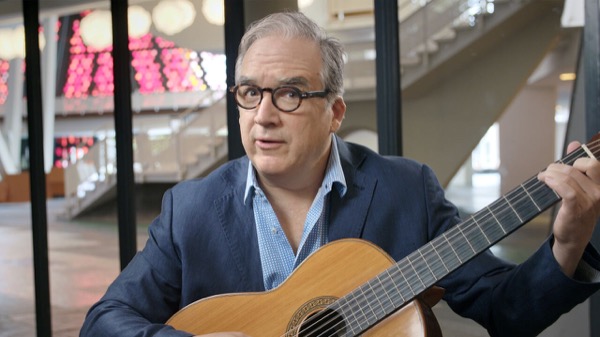
Matthew Hunter demonstrates Mahler’s guitar parts on Digital Concert Hall.
Can you recommend some viola pieces for those less familiar with the instrument?
A viola recital is a very rare occasion, so there isn’t much exposure. So we have to rely mostly on recordings. Rather than list individual works, it might be easier to point the listener towards some great soloists of the instrument.
For Historical recordings: Lionel Tertis, Lillian Fuchs, Ernst Wallfisch, William Primrose.
For current top recordings: Nobuko Imai, Kim Kashkashian, Yuri Bashmet, Antoine Tamestit. The recordings of Kim Kashkashian for ECM Records are especially satisfying for the exploration of sound.
For more of the best in classical music, sign up for our E-Newsletter
Johannes Brahms: Viola Sonata No. 2 in E-Flat Major, Op. 120, No. 2: I. Allegro amabile (Kim Kashkashian, viola; Robert Levin, piano)