Franz Liszt is often remembered as the quintessential Romantic era piano virtuoso and composer.
Less often discussed, however, is the remarkable group of women composers and pianists who studied with him, admired him, challenged him, or were otherwise inspired by him.
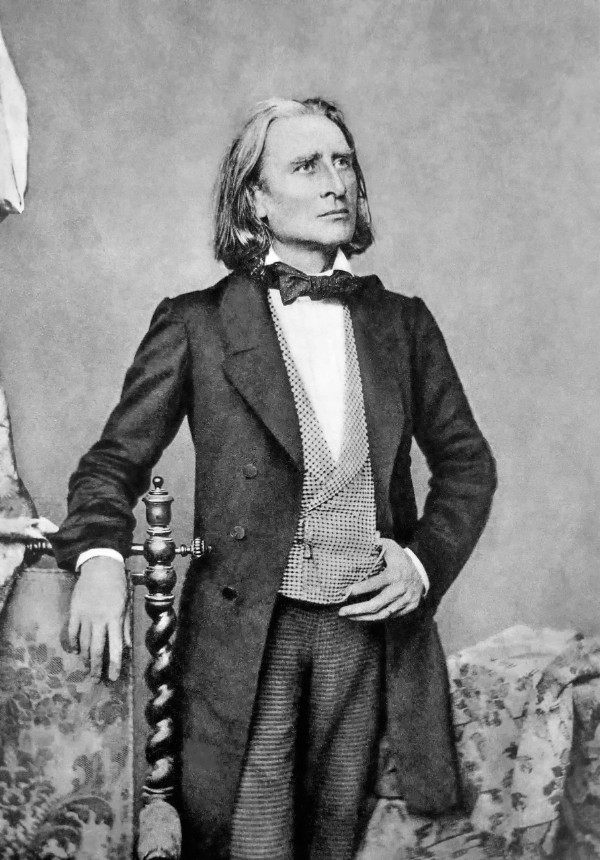
Franz Liszt
Some studied with Liszt in Weimar; others collaborated with him or moved in the same musical circles; and still others developed Liszt-like techniques independently before forging their own paths.
Their stories paint a picture of a vibrant, interconnected musical world: one in which women were far more active and influential than music history has ever acknowledged.
Today, we’re looking at six women whose creative relationships with Liszt illuminate a fascinating chapter of Romantic music history.
Clara Schumann (1819–1896)
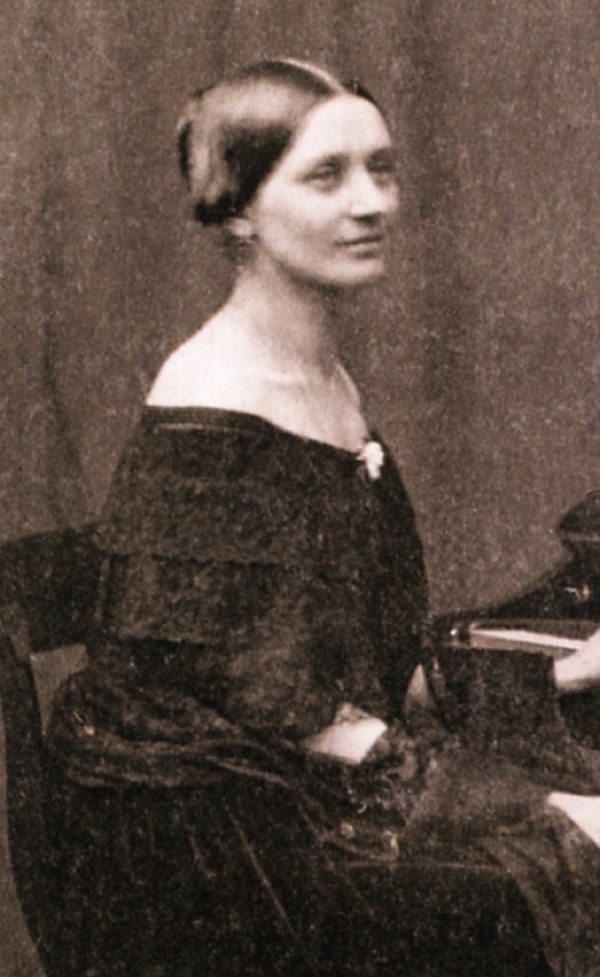
Clara Schumann
Clara Wieck Schumann had a complicated relationship with Liszt.
They met for the first time in 1838, when she was 18 and he was 26.
For ten days, they stayed at the same Vienna hotel and played for each other after dinner.
Liszt wrote to his partner Countess Marie d’Agoult, “Her compositions are really very remarkable, especially for a woman.”
He was so impressed by her playing that he dedicated his Paganini Etudes to her, despite her young age.
Meanwhile, Clara wrote to her future husband, Robert Schumann, “He is an artist whom one must hear and see for oneself.”
Clara married Robert in 1840. Over the next couple of years, both she and Robert began feeling increasingly leery about Liszt’s compositions and penchant for showmanship.
But early in her career, in 1837, she wrote a set of virtuosic variations on a theme from Vincenzo Bellini’s 1827 opera Il pirata.
Clara Schumann: Variations de concert sur la cavatine du Pirate de Bellini, Op. 8 (Jozef de Beenhouwer, piano)
That same year, Liszt contributed to the 1837 multi-composer project Hexaméron, which consists of virtuosic variations on a theme from Bellini’s 1835 opera I puritani. Liszt contributed to and assembled this work.
It’s fascinating to note how each embarked on such similar projects at the same time before eventually pursuing their own very different creative paths.
Franz Liszt: Hexameron – Grandes variations de bravoure sur le marche des Puritains, S392/R131 (Evelyne Dubourg, piano)
As Clara Schumann matured, her music became less and less outwardly virtuosic. Eventually, she came to loathe Liszt’s compositions, even as she had a grudging admiration for his virtuosity.
We wrote about the rocky relationship between Clara and Liszt.
Marie Jaëll (1846–1925)
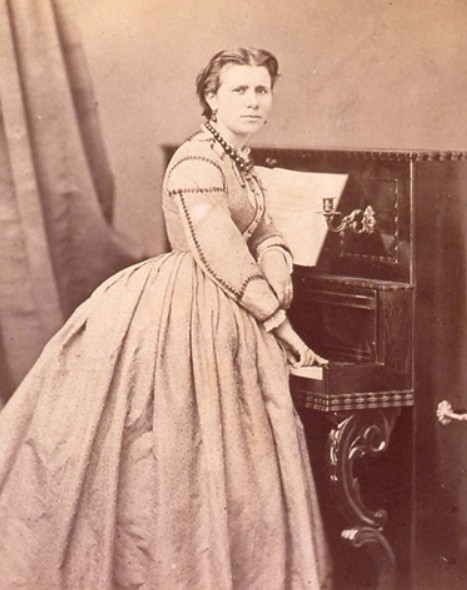
Marie Jaëll
Marie Trautmann Jaëll was born in France in 1846. She was an impressive child prodigy and studied at the Paris Conservatory.
In 1866, at the age of twenty, she married fellow virtuoso pianist Alfred Jaëll, who was almost twice her age.
They concertized throughout Europe together, and Marie began specialising in the music of Liszt.
Alfred had connections throughout the music world, and he helped to arrange a meeting with Liszt himself in 1868.
Once they met, Liszt wrote generously of her, “[Marie Jaëll] has the brains of a philosopher and the fingers of an artist.”
In 1872, at the age of 26, she wrote a piano sonata that she dedicated to him.
Although it is written in a language that is clearly her own, the sonata takes inspiration from his work. There are a number of Liszt-style modulations, and the massive finale demands Liszt-style virtuosity to pull off.
Marie Jaëll – Sonate pour piano (1872)
After her husband died in 1884, leaving her a young widow, she decided to devote herself even more intensely to her art.
She ended up travelling to Weimar to study with Liszt during the last couple of years of the master’s life: a formative experience.
Sophie Menter (1846–1918)
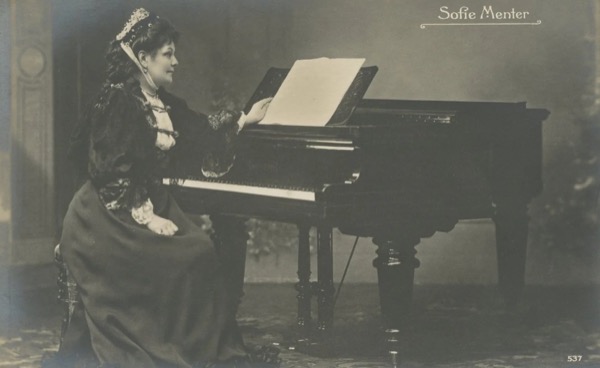
Sophie Menter
Sophie Menter was one of the more colourful characters in late nineteenth-century music.
She was born in Munich to a musical family in 1846, the same year as Marie Jaëll.
She was a child prodigy and studied with Carl Tausig (a famous Liszt student whose career was cut short by his early death) and Hans von Bülow (another Liszt student who ended up marrying Liszt’s illegitimate daughter Cosima).
Menter met Liszt for the first time in Vienna in 1869. She was 23, and he was 58.
She became his protege, and he called her “my only piano daughter.”
He also named one of her cats. (She was famous for her love of felines, to the point where pictures of her and her cats were sold in local shops when she’d play in a city.)
Spending time with Liszt rubbed off on her. When she appeared in Paris, she was nicknamed “l’incarnation de Liszt.”
The two remained friends for the rest of Liszt’s life. In 1886, she visited him on his deathbed in Weimar.
The biggest work attributed to her is her work for piano and orchestra, Ungarische Zigeunerweisen (Hungarian Gypsy Melodies).
Music historians aren’t sure how much of it was written by Liszt and how much by Menter, although today it is usually credited to Menter.
To add to the confusion, her friend Tchaikovsky orchestrated it, and he and Menter performed it together with Tchaikovsky on the podium in 1893, the year of his death. If he’d lived longer, they might have teamed up again.
Sophie Menter: Ungarische Zigeunerweisen (Hungarian Gypsy Melodies) (arr. P. I. Tchaikovsky for piano and orchestra) (Andrei Hoteev, piano; Tchaikovsky Symphony Orchestra; Vladimir Fedoseyev, cond.)
Of course, Menter’s embrace of Hungarian music in this showpiece immediately calls to mind Liszt’s lifelong love of the style, as exemplified by works like his Hungarian Rhapsodies.
Agathe Backer Grøndahl (1847–1907)
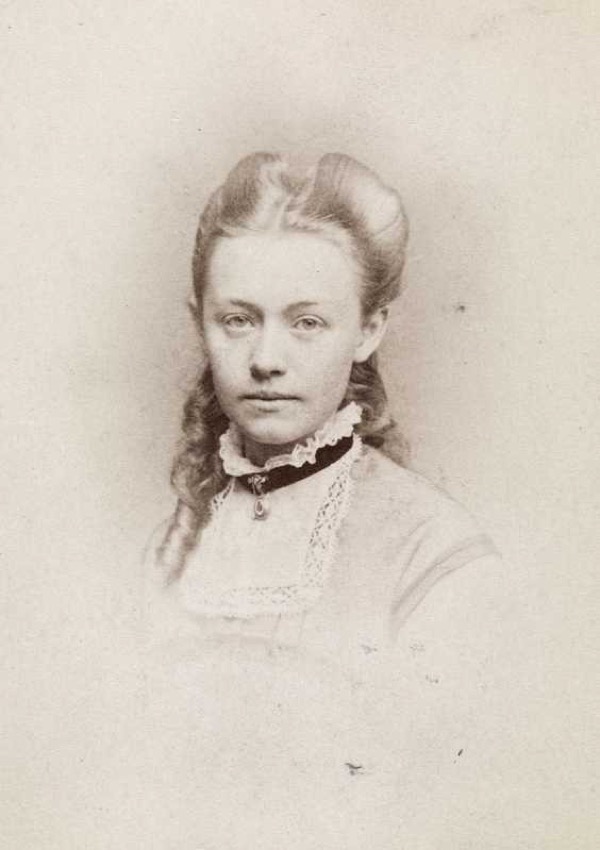
Agathe Backer Grøndahl
Agathe Backer Grøndahl was born in Holmestrand, Norway, in 1847. When she was ten, she and her family moved to present-day Oslo.
In 1868, at 21, she made her debut in the city under the baton of Edvard Grieg in Beethoven’s Emperor Concerto.
In 1871, she began studying with Hans von Bülow. Two years later, she moved to Weimar to study with Liszt himself.
Agathe Backer-Grøndahl: 3 Ungarske studier (3 Hungarian Studies), Op. 38: No. 2. Intermezzo (Sara Aimée Smiseth, piano)
Agathe Backer-Grøndahl: 6 Concert Etudes, Op. 11 (Geir Henning Braaten, piano)
She became a staggeringly prolific composer, writing over 400 works spread across 70-plus opus numbers.
The two pieces above – an excerpt from her 3 Hungarian Studies and her 6 Concert Etudes – demonstrate Liszt’s influence in their bravura virtuosity and Hungarian subject matter.
Augusta Holmès (1847–1903)
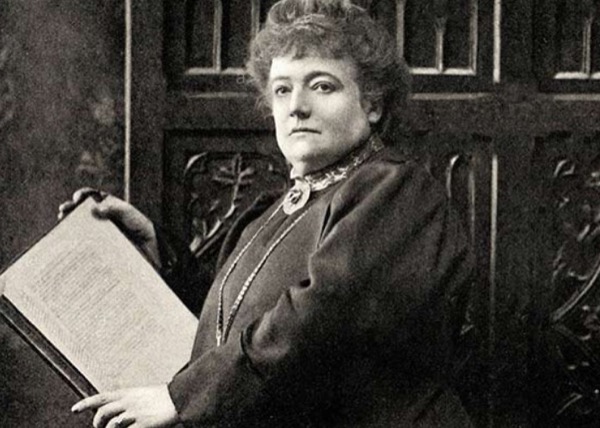
Augusta Holmes
Augusta Holmès was born to an Irish father in Paris in 1847.
Between her gender and nationality, she wasn’t able to study at the Paris Conservatory, but she did study privately with teachers who taught there.
When she was a young woman, Liszt’s son-in-law Émile Ollivier, a French statesman, showed him some of Holmès’s compositions. Liszt was impressed, saying their harmonies reminded him of Schubert’s.
Holmès met Liszt for the first and only time in Munich in 1869, during rehearsals for the world premiere of Wagner’s Das Rheingold. (She was a devoted Wagner acolyte.)
Although they only met that one time, they continued corresponding. He invited her to come to Weimar, but she was unable to accept the invitation due to the death of her father and the Franco-Prussian War.
Like Liszt, Holmès wrote large symphonic poems on national themes.
Her tone poems about Irish and Polish identity, Irlande (1882) and Pologne (1883), are patriotic works about oppressed populations in Ireland and Poland, respectively – a political passion that Liszt shared.
Augusta Holmès: Irlande (Rheinland-Pfalz State Philharmonic Orchestra; Samuel Friedmann, cond.)
Teresa Carreño (1853–1917)
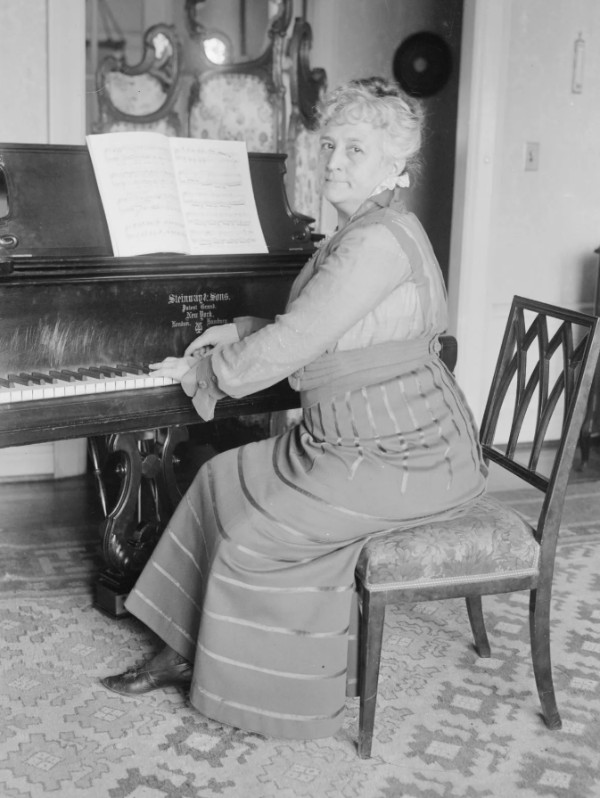
Teresa Carreño
Teresa Carreño: Caprice-Etude No. 1, Op. 4 (Alexandra Oehler, piano)
Teresa Carreño was born in Venezuela in 1853. It became very clear very quickly that she was a child prodigy.
The family emigrated to New York City in 1862. After touring America, the Carreños travelled to Paris, where she met Liszt, as well as other giants of the music world like Rossini and Gounod. According to legend, Liszt offered her piano lessons, but she declined.
She went on to become one of the most celebrated pianists, male or female, of her generation.
Although today she is more often linked with the music of Chopin, she did share one trait with Liszt: a love of falling in love. Liszt was famous for his relationships with women, and Carreño’s love life rivalled his in drama. She ended up marrying four husbands.
Her first husband, violin virtuoso Émile Sauret, was Liszt’s recital partner, while her third husband, pianist Eugen d’Albert, was a Liszt pupil.
She was also influenced by Liszt in that she loved to write virtuoso repertoire inspired by Venezuela, just as he loved to write virtuoso repertoire inspired by his Hungarian homeland.
Carreño may never have formally studied with him, but his presence certainly loomed large in the repertoire she wrote, the social circle she frequented, and the bravura pianism she championed throughout her career.
Conclusion
The six women highlighted here – Clara Schumann, Marie Jaëll, Sophie Menter, Agathe Backer Grøndahl, Augusta Holmès, and Teresa Carreño – were far more than footnotes in the story of Liszt’s life.
They were virtuosos and innovators in their own right who absorbed elements of Liszt’s style while also developing their own multi-faceted musical identities.
Some shared close personal and professional ties with him; others paralleled his artistic trajectory on their own.
Yet all of them participated with Liszt in the same vibrant Romantic era culture of daring virtuosity and freedom of emotional expression.
For more of the best in classical music, sign up for our E-Newsletter