A popular trombone saying goes like this: Marriage is like playing the trombone. It looks easy until you try it! The trombone is widely recognised as a challenging brass instrument, particularly due to its slide mechanism, which requires precise muscle memory and a good ear for pitch and accuracy, demanding quite a bit of physical effort.
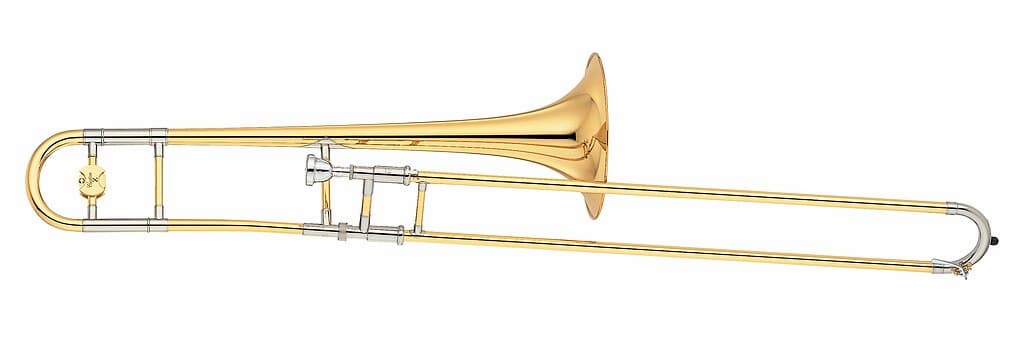
A modern trombone (Yamaha)
But they are sometimes the brunt of musical humour:
What do you call a documentary about trombone players? A slide show.
The trombone players I know are grounded, reliable, and social, sometimes prone to playing jokes back there in the last row of the orchestra, and they possess a unique, “super-nerd” dedication to their craft. The trombone may be called upon to render gorgeous, mellow chorales, as well as sometimes portray the raucous, rowdy braggart we might be familiar with.
Let me illustrate what I mean. The English composer Benjamin Britten (1913-1976) began writing The Young Person’s Guide to the Orchestra in 1946. The piece opens with Henry Purcell’s theme, a rondeau from Abdelazar Suite, a work from 1695. After the entire orchestra plays the theme, each instrument takes a turn within the four sections of the orchestra: the woodwinds, brass, strings, and percussion, until the full orchestra plays the theme once again. Then Britten highlights each instrument within these four sections.
Britten captures the essence and character of each instrument. This is a wonderful, inventive piece I loved to play. The performance with San Francisco Symphony and the late Michael Tilson Thomas (MTT we call him) is full of humour and flair, and his tempos are great, as is the filming. (RIP, Maestro) Britten captures the noble quality of the trombone section with tuba. Listen to this section from 10:29. (Better yet, listen to the entire piece.)
#MTT25 | SF Symphony Centennial Gala: Britten’s The Young Person’s Guide to the Orchestra
Johannes Brahms (1833-1897) waited many years before he wrote his magnificent Symphony No.1. The composer’s instrumentation includes three trombones but reserves them for the drama of the introduction to the 4th movement and final section. Talk about suspense.
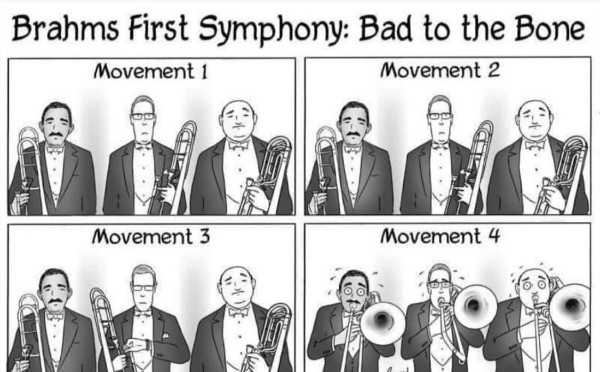
When the trombones enter after the hesitating pizzicato in the strings, the dramatic horn solo, and the flute solo, they enter alone. It’s a stunning moment. Brahms emphasises the regal, singing character of the three trombones.
As in our previous articles featuring the trumpet and the French horn, certain passages are on every trombone audition. In the case of Anton Bruckner (1824-1896), his Symphony No. 4 in E-flat major “The Romantic” (or any Bruckner symphony) features the trombone. Arguably the most famous of his nine symphonies, the fourth utilises only four horns rather than eight in the later symphonies, so it is a bit smaller orchestra. Written in 1874, the symphony was drastically revised in 1877, and then in 1880, Bruckner substituted a new Finale, and this is the version that we typically play. Here are the three trombones playing the famous dialogues from that symphony.
Low Brass Excerpts from Bruckner Symphony No. 4
Now listen to the powerful and dramatic first movement in its entirety, with the trombones in context.
Anton Bruckner: Symphony No. 4 in E-Flat Major, WAB 104, “Romantic” (1881 version, ed. R. Haas) – I. Bewegt, nicht zu schnell (Royal Scottish National Orchestra; Georg Tintner, cond.)
After almost an hour of music, the Finale is worth waiting for. It is full of suspense and builds relentlessly to its triumphant climax. The last movement is thrilling for the brass to play and for the audience to hear.
Anton Bruckner: Symphony No. 4 in E-Flat Major, WAB 104, “Romantic” (1881 version, ed. R. Haas) – IV. Finale: Bewegt, doch nicht zu schnell (Royal Scottish National Orchestra; Georg Tintner, cond.)
Austrian composer and conductor Gustav Mahler (1860-1911) served as the director of the Vienna Court Opera and conducted at New York’s Metropolitan Opera and the New York Philharmonic. His ten symphonies, although not widely performed during his lifetime, or in fact for decades after his death, are very much beloved today.
Mahler Symphony No. 3 opens with one of the most famous trombone calls—an exposed solo in the first movement.
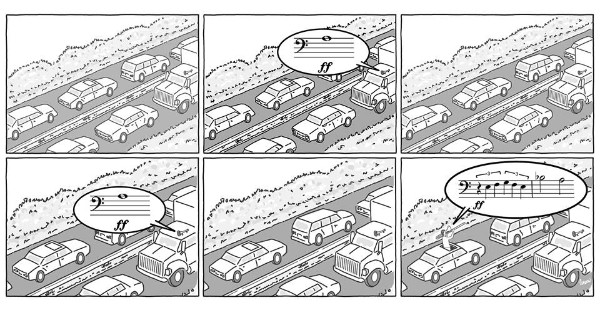
Jokes aside, this opening heralds the tragic ambience of the movement and takes the utmost focus and concentration to play.
This excerpt then skips to the contrasting lyrical and sensitive solo later in the piece. What tenderness, and it illustrates the range of tonal colours available to the trombone.
Jeffrey Kant – Mahler Symphony No.3
What could be better than a choir of twelve trombone players playing this opening and solo! Here’s a wonderful arrangement performed by the Southeast Trombone Symposium.
Mahler 3 Trombone Solo – Nathan Zgonc – ITF 2018
Continuing with Gustav Mahler, the following is an excerpt from Mahler Symphony No. 2 last movement, movement five, for four trombones and tuba. It is one of the most gorgeous brass passages ever written, I think. The trombones simply shimmer and then while the flutes and oboes play trills, and the violins play tremolo, they grow into the heroic.
Mahler 2nd symphony brass choral Royal Concertgebouw Orchestra, D. Gatti
Within the context of the entire movement, this section solo occurs about six and a half minutes in.
Gustav Mahler: Symphony No. 2 in C Minor, “Resurrection” – V. Im Tempo des Scherzos. Wild herausfahrend (Hanna Lisowska, soprano; Jadwiga Rappé, alto; Cracow Radio and Television Choir; Polish National Radio Symphony Orchestra; Antoni Wit, cond.)
Another favourite orchestral work of mine is Pulcinella Suite by Igor Stravinsky from the ballet of the same name. The principal trombone has a charismatic solo in this piece.
My friend Gordon Cherry, who was principal trombone of the Vancouver Symphony for thirty-five seasons, told me this story:
“In the spring of 1967, Igor Stravinsky came to Toronto to conduct the Toronto Symphony. The special concert was during his 85th birthday celebration tour of North America. I was a student in Toronto at the time. The concert took place at the old Massey Hall, and I purchased tickets to hear the concert. I made sure to get a special set of seats in the second balcony right above the trombone section where I could watch every move they made.
The hall was packed in anticipation of Stravinsky’s entrance. When he did come on stage with his assistant, Robert Craft, he was walking very slowly and with a cane. The audience immediately leapt to their feet, shouting bravos. He kept bowing to the audience as the ovation continued for what seemed like quite a long time. The first piece on the program was the suite to his ballet Pulcinella. Just as the applause died down, Stravinsky quickly pivoted to face the orchestra and gave the downbeat so quickly that most of the orchestra was unprepared. Only a handful of players came in on the upbeat to that famous piece – and it seemed others inhaled the first note!
From my vantage point in the second balcony, I could see everyone clearly. Stravinsky was grinning mischievously at the red-faced musicians, who couldn’t hide their surprise and embarrassment. The rest of the concert went off without a hitch. As it turns out, it was the last concert that the composer ever conducted, and it’s one of my favourite musical memories.”
Here is that opening.
Igor Stravinsky: Le sacre du printemps (The Rite of Spring) – Part II: The Sacrifice: Mystic Circles of the Young Girls (Columbia Symphony Orchestra; Igor Stravinsky, cond.)
The movement showcasing the solo trombone, as well as a solo double bass, movement VII Vivo, is spirited and proud, perhaps even a bit cocky?
Igor Stravinsky: The Firebird (original version) – Scene 1: Infernal Dance of Kastchei and his subjects under the Firebird’s magic spell (Columbia Symphony Orchestra; Igor Stravinsky, cond.)
To conclude, I’d like you to hear the charming Shostakovich Waltz No. 2. The trombone takes the charming and wistful melody about halfway in!
Dmitri Shostakovich – Waltz No. 2 – Klassik Open Air 2015 Nuremberg (TV)
This has been just a taste of the characteristics of the trombone. It seems many composers enjoy writing for the vast variety of sounds the trombone can produce.
For more of the best in classical music, sign up for our E-Newsletter