Felix Mendelssohn (1809–1847) is often celebrated for his orchestral masterpieces like the Italian Symphony or the incidental music to A Midsummer Night’s Dream. However, Mendelssohn was not only a prodigious composer but also one of the finest pianists of his era.
By his early teens, he was performing Bach, Beethoven, and his own works in private salons. And by twenty, he was dazzling European audiences on concert tours. His playing blended Classical precision with Romantic expressiveness, and Robert Schumann praised his “delicate, spiritual style, entirely free of empty bravura.”
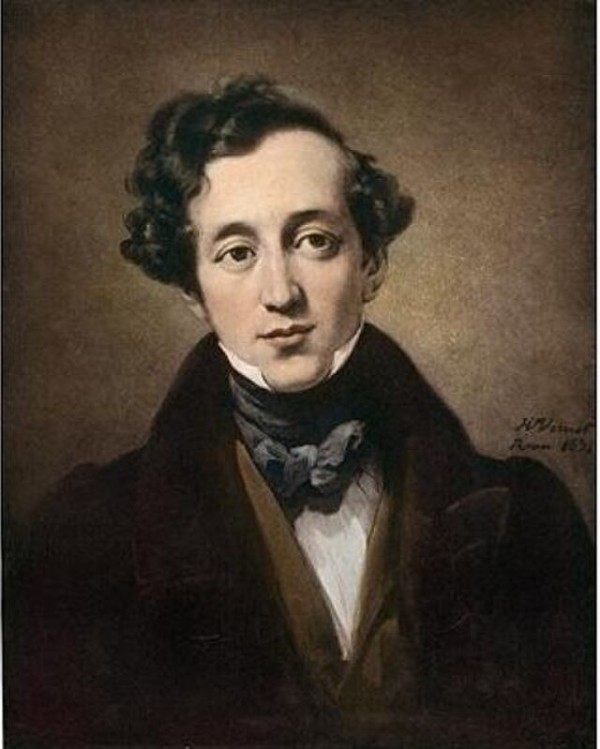
Horace Vernet: Felix Mendelssohn, 1831
His most popular piano compositions are surely the forty-eight lyrical miniatures titled Song Without Words. However, among his output, we also find three published sonatas. To commemorate his death on 4 November 1847, let’s feature these delightful sonatas that bridge the musical worlds of Beethoven and Schumann.
Felix Mendelssohn: Piano Sonata in E Major, Op. 6, MWV U54 – I. Allegretto con espressione (Murray Perahia, piano)
A Formative Youth
The piano sonatas by Felix Mendelssohn emerged during a formative period in his career, composed when he was between the ages of twelve and eighteen. Born into a cultured and affluent Jewish family in Hamburg, Mendelssohn received an exceptional education that included rigorous musical training.
By his early teens, he was already composing with astonishing fluency, producing symphonies, concertos, and chamber works that rivalled the maturity of established composers.
The piano sonatas reflect this precocity. The earliest, Op. 105 in G minor was written in 1821 when Mendelssohn was just twelve, though it remained unpublished until 1868, well after his death. Op. 6 followed in 1826, revised from an earlier version and dedicated to his sister Fanny. The final published sonata, Op. 106 in B-flat major, appeared in 1827 and was dedicated to Karl Friedrich Zelter.
Felix Mendelssohn: Piano Sonata in E Major, Op. 6, MWV U54 – II. Tempo di Menuetto (Murray Perahia, piano)
In the Shadow of Giants
These works were composed in the shadow of Beethoven, whose late sonatas were pushing the boundaries of form and expression, and Mozart, whose elegance Mendelssohn admired deeply.
Yet Mendelssohn was no mere imitator. His sonatas synthesise Classical architecture with a distinctly Romantic sensibility, including lyrical melodies, harmonic richness, and a penchant for programmatic suggestion.
At their core, the Mendelssohn sonatas adhere to the traditional four-movement structure inherited from Haydn, Mozart, and Beethoven. A sonata-form first movement, a slow movement, a scherzo or minuet, and a finale.
Felix Mendelssohn: Piano Sonata in E Major, Op. 6, MWV U54 – III. Recitativo: Adagio e senza tempo – IV. Molto allegro e vivace (Murray Perahia, piano)
From Arpeggio to Intensity
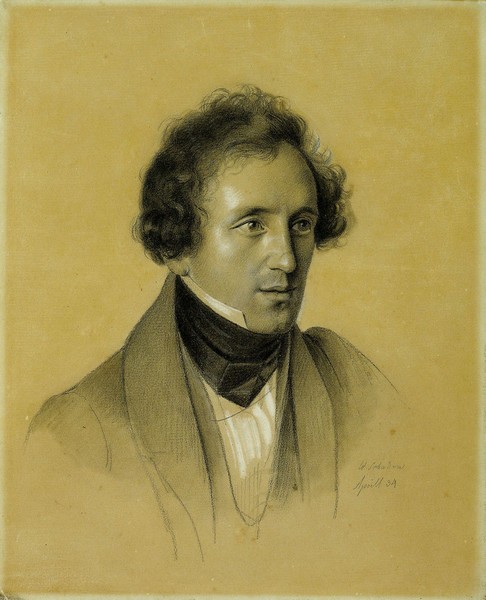
Felix Mendelssohn
This fidelity to form might suggest conservatism, but Mendelssohn’s handling of these conventions reveals subtle innovations that anticipate the Romantic era. Take the Sonata in E major, Op. 6, composed in 1826. The first movement, marked Allegro con fuoco, opens with a bold, Beethovenian gesture.
A descending arpeggio immediately establishes tonal clarity and rhythmic vitality. The exposition introduces two contrasting themes, a fiery and virtuosic subject in E major and a lyrical, song-like second theme in B major.
Mendelssohn’s development section is compact yet ingenious, weaving fragments of both themes into a web of contrapuntal interplay. The recapitulation, rather than merely restating the material, introduces subtle variations, like shifting harmonies and embellished melodies to heighten emotional intensity.
Felix Mendelssohn: Sonata in G Minor, Op. 105 – I. Allegro (Benjamin Frith, piano)
Tender Lieder
The “Andante sostenuto,” is a tender romance in A major, its melody unfolding like one of Mendelssohn’s later Songs Without Words. Here, Mendelssohn’s gift for cantabile writing shines. The right hand sings above a gently undulating accompaniment, evoking the intimacy of a lieder.
The third movement, a minuet and trio, nods to Mozart with its graceful 3/4 meter and elegant phrasing, while the finale erupts with youthful exuberance. The rondo theme
drives the movement forward with relentless energy, culminating in a brilliant coda.
Similarly, the Sonata in B-flat major, Op. 106 demonstrates Mendelssohn’s structural sophistication. The opening “Allegro vivace” features a theme that alternates between buoyant optimism and shadowy introspection, a duality that permeates the entire work.
Felix Mendelssohn: Sonata in G Minor, Op. 105 – II. Adagio (Benjamin Frith, piano)
Unpolished Genius
The posthumously published Sonata in G minor, Op. 105, though less polished, reveals Mendelssohn’s early experimentation. Composed at age twelve, it already displays a keen sense of drama.
The first movement’s stormy opening in G minor gives way to a consoling second theme in B-flat major, a classic Mendelssohnian contrast of turmoil and serenity. The slow movement, an Andante in E-flat major, is a simple yet affecting aria, while the finale races to a triumphant conclusion.
Though the work lacks the refinement of the later sonatas, its raw energy and melodic fecundity mark it as a prodigious achievement.
Felix Mendelssohn: Sonata in G Minor, Op. 105 – III. Presto (Benjamin Frith, piano)
Beyond Exercises
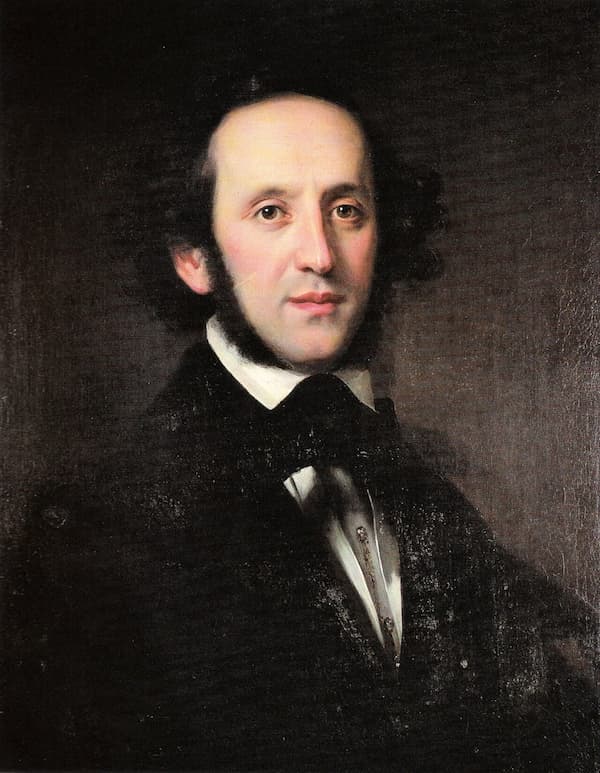
Felix Mendelssohn
What elevates Mendelssohn’s sonatas beyond mere academic exercises is their emotional richness and imaginative detail. Unlike Beethoven, whose sonatas often grapple with existential struggle, or Chopin, whose works revel in poetic introspection, Mendelssohn’s piano writing is characterised by clarity, balance, and an almost Mozartian grace.
Yet within this framework, he infuses a Romantic warmth that is uniquely his own. One of the most striking features of the sonatas is Mendelssohn’s use of cyclic form, which recalls themes or motifs across movements to create unity.
In Op. 6, the finale quotes the second movement’s melody in a transformed, exuberant guise, a technique that anticipates Schumann and Brahms. In Op. 106, the slow movement’s hymn-like theme subtly informs the finale’s contrapuntal texture, lending the work a cohesive narrative arc.
Felix Mendelssohn: Piano Sonata in B-Flat Major, Op. 106, MWV U64 – I. Allegro vivace (Daniel Hoxter, piano)
Enharmonic Magic
Mendelssohn’s harmonic language, while rooted in Classical tonality, ventures into chromaticism and unexpected modulations that hint at the Romantic future. In the development section of Op. 6’s first movement, a sudden shift to C major disrupts the expected tonal trajectory, creating a moment of luminous surprise.
Similarly, the slow movement of Op. 106 features daring enharmonic pivots that blur the boundaries between keys, evoking a sense of otherworldly transcendence.
The sonatas also showcase Mendelssohn’s idiomatic piano writing. His textures are transparent yet richly layered, with arpeggiated accompaniments that shimmer like harp strings and melodic lines that soar with vocal freedom.
Felix Mendelssohn: Piano Sonata in B-Flat Major, Op. 106, MWV U64 – II. Scherzo: Allegro non troppo (Daniel Hoxter, piano)
Bravura with Soul
Passages of bravura, including double octaves, rapid scales, and wide leaps, demand virtuosity without sacrificing musicality. This balance of technical brilliance and expressive depth makes the sonatas rewarding for both performer and listener.
Moreover, the sonatas reflect Mendelssohn’s programmatic imagination, even if he rarely provided explicit narratives. The stormy opening of Op. 105 suggests a Romantic tempest, while the ethereal slow movement of Op. 106 evokes a moonlit reverie.
These suggestive qualities align the sonatas with the emerging Romantic trend of music as emotional storytelling, a path later explored by Liszt and Wagner.
From Salon to Sideline
Despite their merits, Mendelssohn’s piano sonatas have languished in relative obscurity compared to his more popular works. Several factors contribute to this neglect. First, the shadow of Beethoven loomed large in the 19th century, and Mendelssohn’s sonatas were often dismissed as lightweight in comparison.
Second, the posthumous publication of Op. 105, and the limited dissemination of the others meant they never entered the standard repertoire.
Finally, Mendelssohn’s early death at 38 curtailed his output, leaving the sonatas as youthful works rather than mature statements.
Felix Mendelssohn: Piano Sonata in B-Flat Major, Op. 106, MWV U64 – III. Andante quasi alegretto (Daniel Hoxter, piano)
Revival by Masters
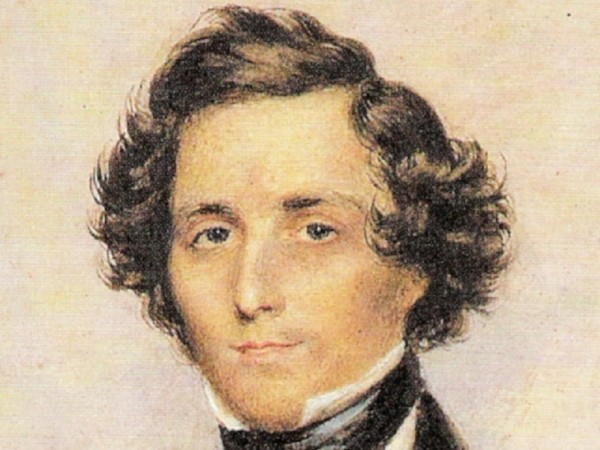
Felix Mendelssohn
Yet in recent decades, pianists like Murray Perahia, András Schiff, and Benjamin Grosvenor have championed these pieces, revealing their depth and charm. Recordings and performances highlight their technical demands and emotional range, positioning them alongside the sonatas of Schubert and early Brahms.
Scholars, too, have reevaluated Mendelssohn’s contributions, recognising his role as a bridge between Classicism and Romanticism. To be sure, the sonatas hold historical significance as products of Mendelssohn’s dual identity as performer and composer.
Felix Mendelssohn’s piano sonatas are more than historical curiosities. They are vibrant, multifaceted works that encapsulate the composer’s genius. Through their masterful structures, lyrical melodies, and innovative harmonies, they reveal a young artist grappling with tradition while forging a distinctly personal voice.
Balancing Past and Future
In an era dominated by titans like Beethoven and Chopin, Mendelssohn carved out a space for elegance, clarity, and emotional sincerity, qualities that remain entirely refreshing today. Mendelssohn balanced the discipline of the past with the passion of the future.
The Mendelssohn sonatas are ideal vehicles for exploring the early Romantic piano idiom and certainly deserve much greater recognition.
Mendelssohn was not just a musical conservative but a visionary whose contributions to the piano sonata genre are both enduring and undervalued. In the words of Robert Schumann, who admired Mendelssohn deeply, “He is the Mozart of the nineteenth century.”
For more of the best in classical music, sign up for our E-Newsletter
Felix Mendelssohn: Piano Sonata in B-Flat Major, Op. 106, MWV U64 – IV. Allegro molto (Daniel Hoxter, piano)