In her latest release, British pianist Sarah Beth Briggs celebrates the notion that “small is beautiful”, including two of the greatest sets of miniatures ever written – Robert Schumann’s Waldszenen (Forest Scenes) and Brahms’s 4 Klavierstucke op. 119. These are interspersed with less familiar works by Clara Schumann and Germaine Tailleferre, together with the evocative Trois Novellettes by Francis Poulenc. As an encore, Sarah – a former International Mozart Competition winner – ends with a tiny gem by Mozart, his Gigue in G Major, K.574.

Sarah Beth Briggs
Battling against cycles of depression, Schumann completed his Waldszenen (Forest Scenes), his last major suite for solo piano, in December 1848 and early 1849. The forest was a subject close to the heart of any Romantic writer, artist or composer, with its contrasts – beautiful, unknownable, sometimes menacing.
Sarah Beth Briggs plays Small Treasures – A Preview
The rather innocent title of the suite as a whole and the individual pieces belies the emotional depth of these miniature miracles (Clara chose not to play some of the pieces because she found them too unsettling). With their contrasting characters, these forest scenes become metaphors for explorations of the internal, the self. Sarah Beth Briggs perfectly captures the shifting moods and images with sensitivity and nuance, creating a powerful sense of intimacy even in the more jaunty pieces. The Prophet Bird, perhaps the strangest of the suite, calls plaintively in the forest, with delicate, impressionistic figures in the treble.
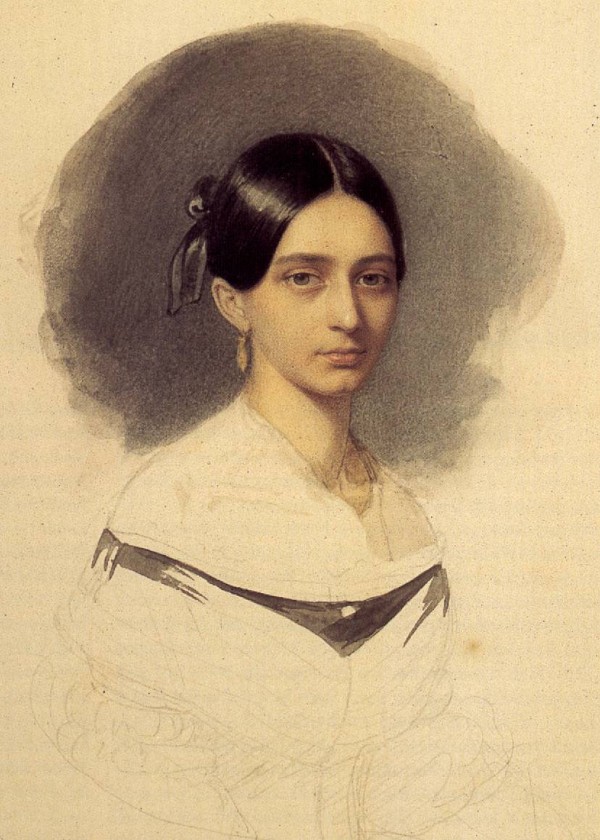
Clara Wieck Schumann
An elegant and supple Impromptu by Clara Schumann follows, a prelude to her Four Fugitive Pieces, written after her 1840 marriage to Robert Schumann and published in 1845. The title “fugitive” suggests music that is freer, with fewer structural conventions. Fleeting and contrasting, each piece has a distinct character, and the entire set is wistful, romantic and introspective. Sarah brings a delightful spontaneity to these short pieces, highlighting their individual moods with supple phrasing, subtle dynamics and a warm tone.
Robert Schumann’s evergreen Arabeske in C is played with a delicate tenderness which is then reflected in the first of Poulenc’s Trois Novelettes. These miniatures were written over a long period and, like the preceding works by Robert and Clara Schumann, each has a distinct character, elegantly highlighted by Sarah Beth Briggs. The second is a bouncy scherzo, and the third, completed some 30 years later, is reflective and nostalgic.
The only female member of Le Six, of which Poulenc was also a member, Germaine Tailleferre wrote piano music which combines classical elegance with tonal ambiguity, rhythmic complexity, and wit similar to Poulenc’s. This rather nostalgic little Sicilienne from 1928 begins innocently enough, with a charming lilting rhythm and gently arching melody, before moving into more agitated territory in its central section, before the return of the opening motif.
Composed in 1893, the 4 Klavierstücke, Op.119, were Brahms’s final statement for solo piano. Tinged with melancholy, these pieces move from the poignancy of the Adagio into more animated territory, with the final Rhapsody sounding a note of defiance rather than transcendence.
The closing Gigue by Mozart is a little sparkle of joy. Playful and witty, its chromaticism looks forward to the harmonies and colours of the preceding pieces.
This really is a recording of small treasures by Sarah Beth Briggs, who finds common threads between the pieces being played, which demonstrates warmth, affection, sensitivity, simplicity, intimacy and thought.
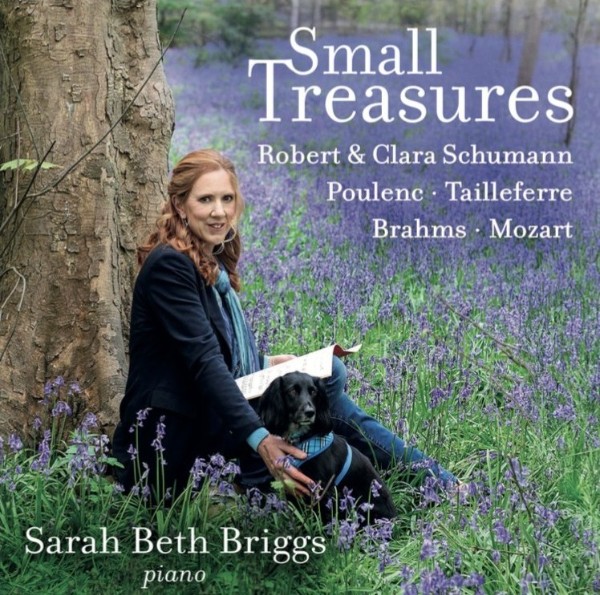
Small Treasures is released on the Avie label.
For more of the best in classical music, sign up for our E-Newsletter