Wilhelmine Clauss, later Wilhelmine Clauss-Szarvady, is one of the most successful pianists you’ve never heard of.
Although almost entirely forgotten today, she would become one of the greatest pianists of the Romantic Era, beloved by Berlioz, Liszt, the Schumanns, and countless critics.
Today, we’re looking at the incredible story of her life and career.
Early Years
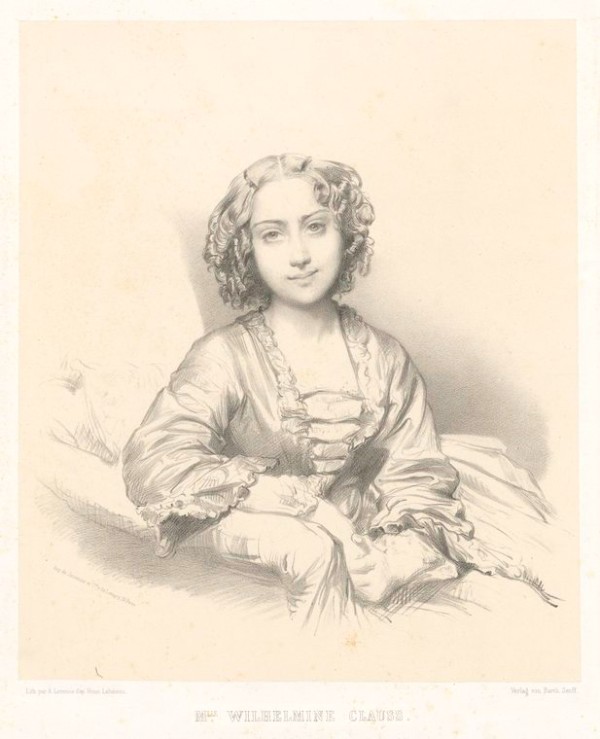
Wilhelmine Clauss-Szarvady
Wilhelmine Clauss, later Wilhelmine Clauss-Szarvady, was born on 12 December 1832 in Prague.
She was musical from an early age and began her music studies at home.
Just two years after she started playing, she became a student of Joseph Proksch, a blind pianist and pedagogue. (Interestingly, Joseph taught his daughter Marie Proksch, who, like Wilhelmine, also became a piano soloist.)
Her First Tour – and Impressing Liszt and the Schumanns
Wilhelmine’s father died when she was a preteen. In 1849, when she was sixteen, her mother spearheaded a European concert tour for her daughter. It’s possible that she embarked on this tour to help support her family.
One of the highlights of the tour was performing at the court of Dresden.
Another was performing at the storied Gewandhaus concert hall in Leipzig, where she met two of the greatest piano celebrities of the day: Franz Liszt and Clara Schumann.
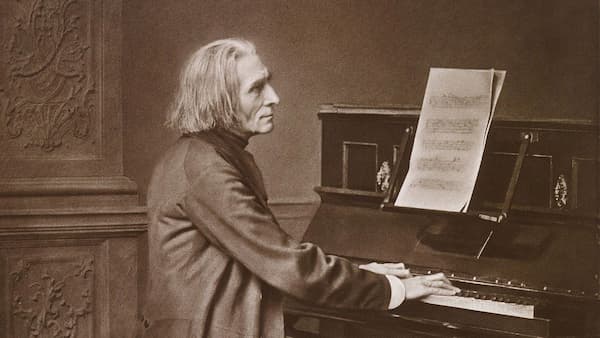
Carbon print circa 1869 by photographer Franz Hanfstaengl
Liszt was very impressed by her playing. She also played for Clara, as Robert Schumann noted in his journal: “The little Clauss studying with Clara – very talented.”
Clara even sacrificed a performing date at the Gewandhaus so that the public could hear Wilhelmine instead, and the two performed Robert’s piano duet Andante and Variations, Op. 46 together at a private event.
Robert Schumann’s Andante and Variations, Op. 46
In Kassel, the renowned violinist Louis Spohr (inventor of the chin rest) was so impressed by Wilhelmine’s playing that he offered to turn pages for her.
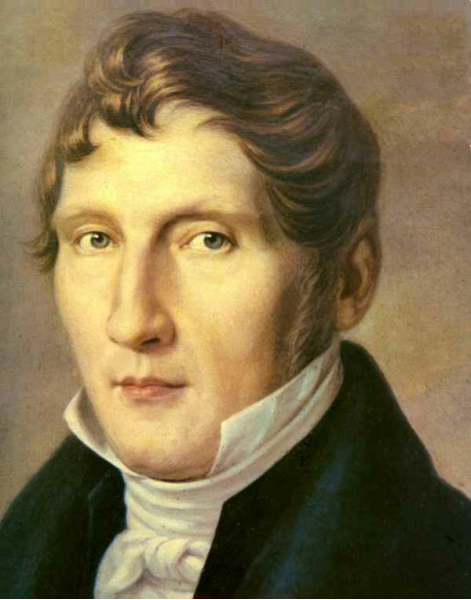
Louis Spohr
One review mentioned, “Spohr was delighted by the artist’s achievements, and it was delightful to see the great master busy turning the music sheets over for the young lady in the concert.”
Conquering Paris
In 1851, the year she turned nineteen, she traveled to Paris and played for piano maker Sébastien Érard and composer Hector Berlioz. They were both hugely impressed by her artistry.
While in Paris, she chose to tackle Beethoven’s “Appassionata” piano sonata.
It was a daring choice. At the time, it was relatively unusual for women pianists to play Beethoven’s works in concert. It was believed that these pieces required a physical stamina and intellectual rigour that women lacked.
It was especially striking for Wilhelmine, a physically small teenager, to do so, as the press often described her as “childlike”, “childish”, “girlish”, and “delicate.”
However, audiences responded to Wilhelmine’s interpretation.
Ludwig van Beethoven’s Appassionata Sonata<
One review wrote that “the applause…grew to such enthusiasm as had not been seen since Liszt’s appearance.”
The journal Signale reported:
Mrs. Szarvady has devoted her beautiful talent entirely to serious, classical music, which she performs with consummate artistry. This artistry is particularly evident in the clear and simple naturalness with which Mrs. Szarvady is able to convey the character of the work she performs and the master’s intentions down to their finest consequences.
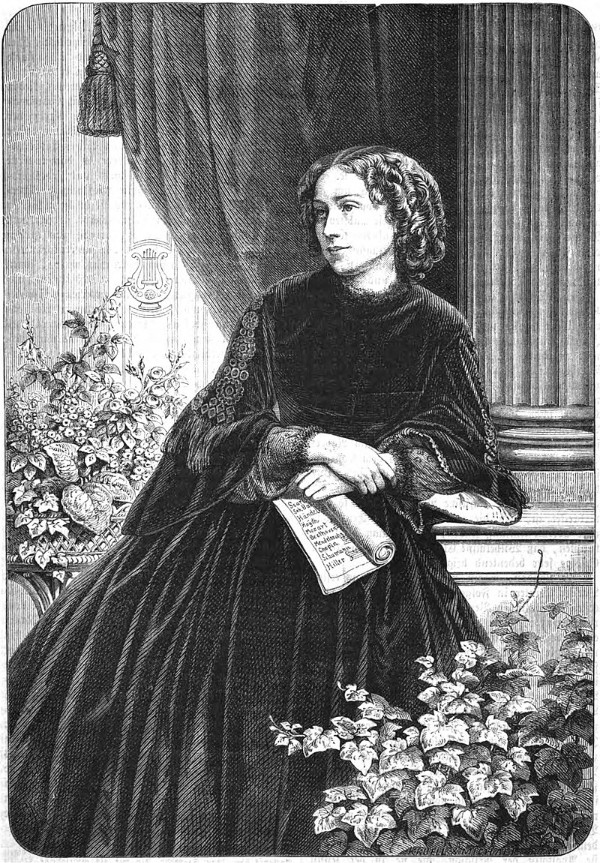
Wilhelmine Clauss-Szarvady
Tragedy Strikes – and Famous Friends Help Out
Wilhelmine did not have long to enjoy her triumph. While in Paris, her mother died suddenly. She was eighteen years old, and both of her parents were dead.
Luckily, contralto Caroline Ungher, remembered today for having sung at the premiere of Beethoven’s Ninth Symphony, stepped in to help her. (Ungher was the woman who had famously turned the deaf Beethoven around on the conductor’s podium so that he could witness the work’s extraordinary reception.)
For a period of months, Wilhelmine withdrew to Montpellier and mourned in the company of Caroline and her husband.
Another musical celebrity who helped get her back on her feet and provide for her was Franz Liszt, who sent money, along with his partner Princess Carolyne von Sayn-Wittgenstein.
It would have been easy to retire then and there, but performing clearly meant too much to her. She returned to Paris to give a comeback concert on 2 February 1852.
Conquering London
That spring, she traveled to London and stayed over the summer, ending her visit by performing for Queen Victoria.
The following year, she was labeled “the darling of the London public.”
Ludwig van Beethoven’s Waldstein Sonata
During that tour, she would also perform Beethoven’s Waldstein sonata for the queen on the Isle of Wight, the palace that Victoria and her husband built for themselves as a retreat. Victoria was so delighted that she asked for an encore.
Wilhelmine’s Friendship with the Schumanns
Robert Schumann’s Piano Quintet
Wilhelmine returned to Paris in the fall of 1852, where she began advocating for the work of Robert Schumann, playing his Piano Quintet, Op. 44, which was just ten years old at the time.
We know that Robert and Wilhelmine corresponded, but unfortunately, none of the letters have survived.
Clara Schumann, Robert’s wife and his primary interpreter and advocate, wrote in her diary on 9 April 1853 that she was upset at Wilhelmine’s choice of repertoire:
Robert wrote a lovely letter to Wilhelmine Clauss in Paris today. But I was sad that she had to be the first to perform Robert’s works in Paris and London, when I should have been the first to do so.
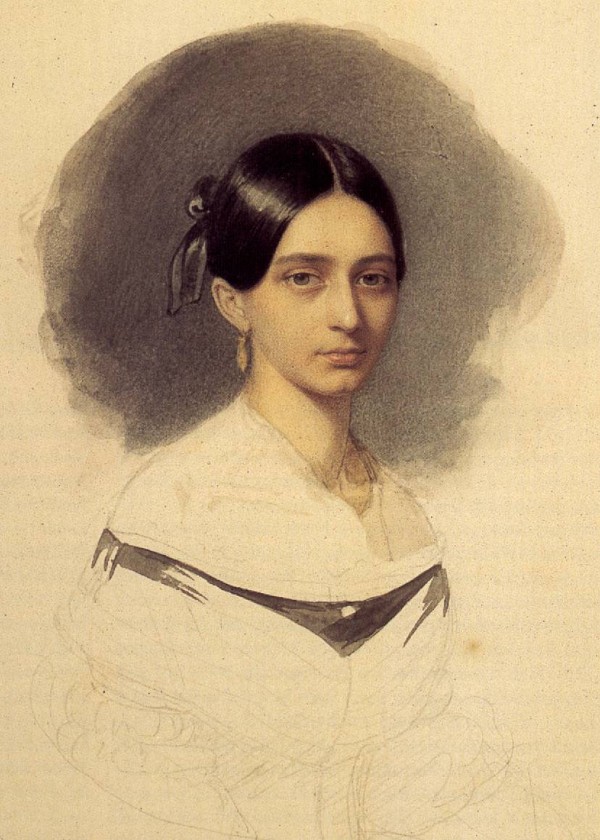
Clara Wieck Schumann
For understandable reasons, Clara often felt possessive of her husband’s works and preferred to be the artist to introduce them to new audiences. But whatever grudge she held against Wilhelmine didn’t last long.
Introducing Paris to Bach
Wilhelmine’s advocacy didn’t stop at new music.
She also had a passion for Baroque music and especially Johann Sebastian Bach, in an era when Bach was still extremely underrated.
In fact, according to one review, she can be credited for introducing many Parisians to his work:
Miss Clauss has thereby become a trendsetter in musical fashion. For it is suddenly fashionable for concert organisers, and especially for the most shallow virtuosos, to play at least one piece by the old Sebastian Bach in their concerts.
In the 1860s, she published collections of music by Baroque masters like Bach, Rameau, and Scarlatti.
Marriage, Motherhood, and a Return to the Stage
In 1855, she married a Hungarian writer and diplomat named Friedrich Szarvady. They made their home in Paris and had children.
After becoming a mother, she temporarily withdrew from the concert platform. When she announced her comeback concert in Paris in February 1858, tickets sold out quickly.
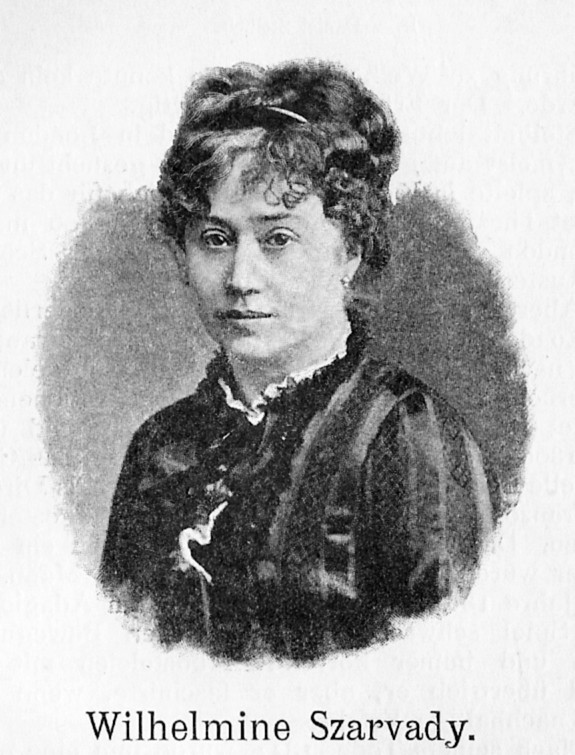
Wilhelmine Clauss-Szarvady
Franz Liszt’s mother wrote to her son that “It is only Clauss, now Madame Szarvady, who is doing good business. She gave four concerts in four weeks with many successes….”
Wilhelmine embarked on a tour of German cities in 1860, but it seems that she didn’t pursue the same breakneck international schedule that she had in earlier years.
Triumphs of the 1860s
Wilhelmine made a series of important appearances in the 1860s.
She gave another Paris concert in 1862.
In March 1863, she buried the hatchet (if indeed there was any hatchet to be buried) with the widowed Clara Schumann and performed a Mozart sonata for two pianos with her. It must have been a rewarding appearance, because the two women would perform together again in 1865.
Then, in 1867, she learned and performed Brahms’s first piano concerto and played it in Paris. This was yet another big work that had gained a reputation as a concerto for men, which Wilhelmine mastered.
Despite her marriage and motherhood, she made other trips throughout Germany in the 1860s.
A Professional Change of Course, and a Legendary Concert Series
In 1867, tragedy struck again when her young son died. Her grief was compounded when the Franco-Prussian War began in 1870.
After the war ended in 1871, as she neared forty years old, she began to reassess the contours of her career.
She decided she wanted to play less in public and more for influential guests in private settings.
During the 1871-72 season, she began curating a series of chamber music concerts that became legendary.
The Neue Zeitschrift für Musik reported:
The artist did not send out invitations, but waited for applications for admission. This made her all the more independent in putting together the repertoire.
With the most eminent quartet players, she played a trio by Beethoven, a quartet by Schumann, and a sonata by Raff in the first session. In a second session, she added Bach and Mendelssohn.
The demand grew ever greater, the applications for admission ever more irresistible. Mrs. Szarvady was thus pushed to a fourteenth session, and the classical concert season in her hotel could not end until June…
Since she played at the express request of an audience that was as brilliant as it was non-paying and uninvited, she could certainly expect them to perform to a higher standard in terms of art history than perhaps a paying and less select audience.
The critic also reported that she approached programming in a strikingly modern way:
Mrs. Szarvady had arranged her repertoire in such a way that the history of classical music was methodically presented to her audience in the selected pieces.
It was said that her concert series was more influential in Paris than the Paris Opera.
Her Final Years
She gave a handful of public concerts in the 1870s. Notably, in 1877, she performed with Camille Saint-Saëns (they played a four-hand arrangement of his Danse Macabre).
Danse Macabre arranged for piano four-hands
Her husband Friedrich Szarvady died in 1882, when she was forty-nine.
Perhaps as a result of his death and needing to make money to support herself, she announced in 1886 that she was opening a piano school, “even going back to elementary instruction,” according to the journal Signale. Historians have yet to unearth much about the fate of this project.
We know that she continued performing in intimate settings until at least 1895. But all we know about what followed is that she died on 1 September 1907 in Paris.
Wilhelmine’s Reputation
In 1862, Hector Berlioz wrote an effusive testimony to her playing:
I consider this young lady, who is gifted with the deepest musical feeling and a completely pure taste, who displays a wonderful mechanism, an encyclopedic memory, and a style of incomparable elegance, to be the first among female pianists.
Maybe a day is coming when historians and music history lovers feel the same way.
Here’s Joachim Raff’s 1870 Trio No. 3, Op. 155, which was dedicated to her.
For more of the best in classical music, sign up for our E-Newsletter