
Ludwig van Beethoven may be one of the most famous composers in Western music history, but he’s also one of the most misunderstood.
Over the past two centuries, a powerful mythology has grown around Beethoven: the image of a lonely, friendless genius, raging against the world in total deafness as music poured effortlessly from him.
These stories are compelling, but they flatten the more complex and human reality.
In fact, many of the most common myths about Beethoven don’t hold up under historical scrutiny. He had friends, students, and devoted patrons; his hearing loss unfolded gradually over decades; and his revolutionary music was the product of relentless labour rather than sudden inspiration. Even his relationship to Classical tradition is often mischaracterised as outright rejection, when in reality it was one of deep respect and transformation.
Today, we’re looking at five of the most persistent myths about Beethoven and uncovering what music history actually tells us about his life, his music, and his legacy.
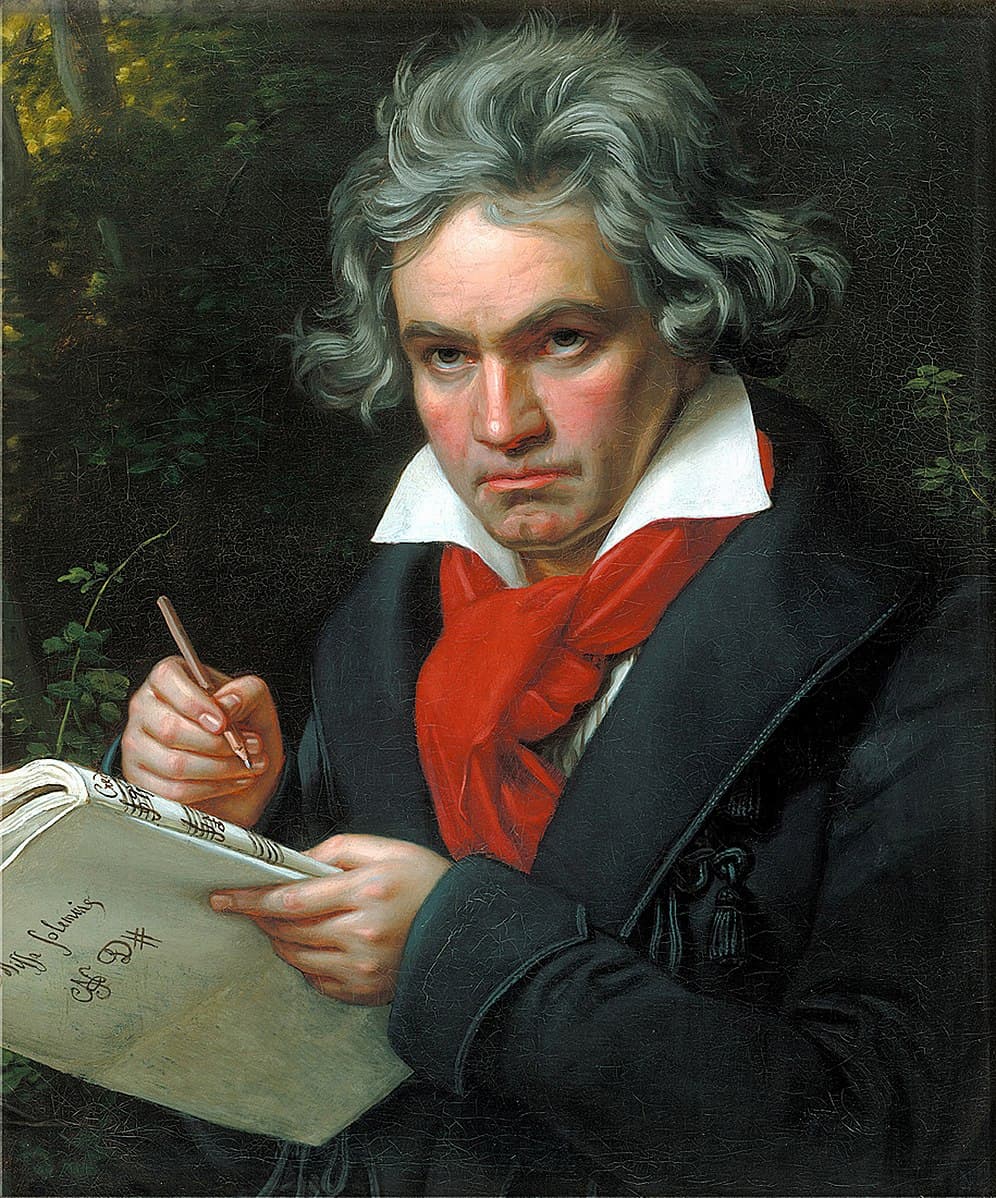
Portrait of Ludwig van Beethoven
Myth #1: Beethoven was a lonely, isolated genius with no friends.
Beethoven’s popular image as a friendless, misanthropic hermit is exaggerated.
In reality, although many of his relationships could be tumultuous, he maintained an active social circle of friends, patrons, students, and family throughout his life.
In his hometown of Bonn, he was welcomed into the cultured von Breuning family as a child, became close to fellow young people like future physician Franz Wegeler (who remained a lifelong friend), and began teaching piano students.
Later, after he relocated to Vienna at 22, Beethoven mingled with the musical and noble elite.
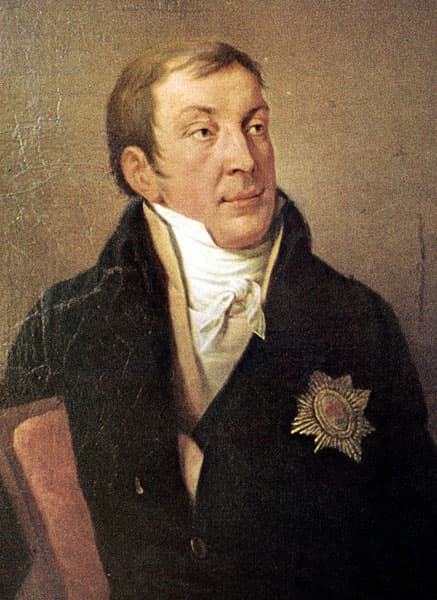
Prince Karl Lichnowsky, 1800
He had loyal patrons who befriended him. Prince Lichnowsky gave him lodging and financial support; Count Razumovsky hosted him; and most famously, Archduke Rudolf (the youngest son of the Emperor) studied piano and composition with Beethoven. Archduke Rudolf became Beethoven’s devoted friend and benefactor – their meetings continued regularly for about two decades (c. 1804–1824), and Beethoven dedicated fourteen major works to Rudolf.
Beethoven, Piano Trio in B-Flat Major, Op. 97, “Archduke” — Camerata Pacifica
When Beethoven lay on his deathbed in 1827, a large number of friends flocked to see him: the violinist Ignaz Schuppanzigh (leader of the ensemble that premiered many of his string quartets), composer Johann Nepomuk Hummel, publisher Anton Diabelli, young musician Ferdinand Hiller, and others all came to pay respects.
Many even sent tokens of esteem. The London Philharmonic Society even sent £100, and others sent wine – a poignant irony, given his struggles with alcohol.
These gestures show Beethoven was far from forgotten or friendless.
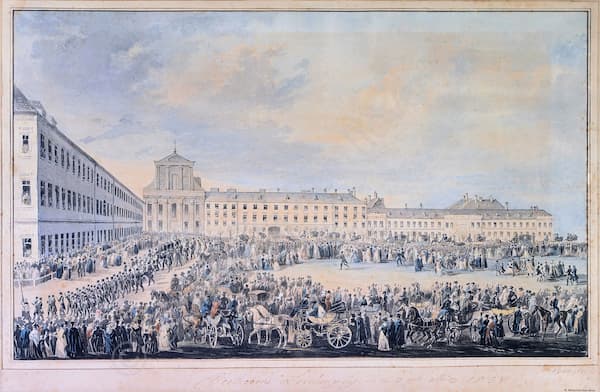
Beethoven’s funeral as depicted by Franz Xaver Stöber
Beethoven’s funeral was attended by an enormous crowd (contemporary estimates ranged between 10,000 and 20,000). That attendance stands as a final testament to how deeply he was respected.
It’s true that as his deafness worsened, he grew more socially withdrawn, and his prickly personality did strain some relationships. But to characterise him as an “isolated genius with no friends” is inaccurate.
Myth #2: He was completely deaf for most of his career.
Beethoven’s hearing loss was gradual, and he was not totally deaf for the bulk of his working life.
Importantly, many of Beethoven’s greatest works were written before his hearing totally vanished. His first eight of nine symphonies, his piano concertos, and many of his quartets and piano sonatas were all composed while he still could hear some things.
He began noticing hearing problems in the late 1790s, when he was in his late twenties. But for many years after that, he continued to compose, perform, teach, and socialise, still relying on his deteriorating hearing.
In fact, pianist Carl Czerny later remarked that Beethoven could still hear conversation and music reasonably well until about 1812.
Beethoven: Overture to Egmont | Kurt Masur and the Gewandhaus Orchestra
Over the following decade, Beethoven’s hearing did worsen, and by his last years he was almost entirely – but not quite completely – deaf. Reportedly, he could still perceive some low tones and loud sounds, even near the end of his life.
Only in the final few years (by the time of the Ninth Symphony’s premiere in 1824) was he effectively unable to hear speech or performance.
As one scholar notes, popular belief overstates Beethoven’s deafness. It was a long, uneven, heartbreaking decline – not a sudden, abrupt silence.
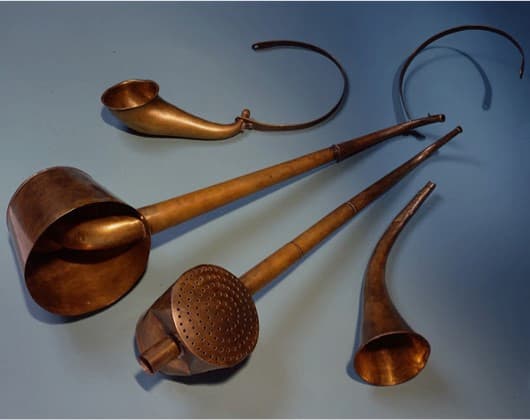
Beethoven’s ear trumpets
Myth #3: His music poured out effortlessly.
Contrary to the mental image that many people have, Beethoven was a meticulous, hard-working craftsman who agonised over his compositions.
Beethoven sketched out his compositions more systematically than most other major composers, sometimes working through a dozen different versions of a musical passage before settling on the final one we know today.
Surviving sketchbooks containing over 8,000 pages of musical drafts reveal his obsessive process of revision, trial and error, and self-critique.
The famous four-note motive of the Fifth Symphony and the Ode to Joy theme in the Ninth – as simple or inevitable as they seem to us today – went through numerous drafts and transformations in his sketchbooks.
His work was the result of relentless revision, not effortless inspiration.
Beethoven: Symphony No. 5 Fate Symphony | Christian Thielemann & Vienna Philharmonic
Myth #4: He only wrote loud, heroic, revolutionary music.
It’s true that Beethoven’s music can be bold and stormy, but he also composed some of the softest, most intimate music in the repertoire.
Alongside the powerful extroverted Fifth Symphony and the “Eroica,” we also have works of profound introversion and fragile beauty.
In Beethoven’s late period, especially, his music often became tender or even spiritual. The late string quartets (dating between 1825–26) are a prime example of this. These quartets contain whispering, ethereal, slow movements that are deeply personal.
The “Holy Song of Thanksgiving” from his String Quartet No. 15, Op. 132 is serene and reverent, written after Beethoven recovered from illness.
Danish String Quartet plays Beethoven quartet no. 15 in A minor, op. 132, 3rd mov. (Molto adagio)
And the “Cavatina” movement of the String Quartet No. 13, Op. 130 is so heartfelt that Beethoven confessed it moved him to tears whenever he thought of it.
Danish String Quartet plays Beethoven op. 130, 5th mov. “Cavatina”
But this introversion wasn’t confined to his late works. Even in earlier ones, Beethoven often reveals a poetic, hushed side: the tranquil slow movement of the “Emperor” Concerto, the scene by the brook in the Pastoral Symphony, and the aria-like slow movements of many piano sonatas (Moonlight, Pathétique, etc.) are all delicate and expressive.
All of these works helped to redefine what instrumental intimacy could sound like.
So while Beethoven can absolutely be martial and forceful, that is only one part of his vast output.
Myth #5: Beethoven rejected classical tradition entirely.
Despite his reputation as a revolutionary, Beethoven didn’t discard Classical forms; he expanded and elevated them.
Far from tearing up the rulebook, Beethoven’s innovations grew from the foundation laid by Haydn and Mozart. He was educated in the Classical tradition and mastered Classical era forms (sonata-allegro, string quartet, theme and variations, etc.).
Even Beethoven’s revolutionary Eroica Symphony, dating from 1803, still follows a four-movement design with sonata form, a funeral march, a scherzo, and a set of variations as a finale – all classical structures, just magnified.
Beethoven’s Symphony No. 3, “Eroica” ∙ hr-Sinfonieorchester ∙ Andrés Orozco-Estrada
Likewise, Beethoven’s late works (like the monumental Hammerklavier Piano Sonata, Op. 106, or his String Quartet No. 14, Op. 131) often use fugues, canons, and theme-and-variation techniques that harken back to Baroque and Classical practices, even as they sound avant-garde and cutting-edge.
In fact, Beethoven’s achievement was to expand the limits of Classical era forms, making sonata movements bigger, codas more dramatic, and developments more adventurous – not to reject the form altogether.
This is how Beethoven is the bridge between Classical and Romantic eras: he took the forms he inherited, then reconsidered every element of them – melody, harmony, structure – to realise new expressive possibilities. Nevertheless, the classical framework remains unmistakable: expanded, interrogated, but never totally abandoned.
Conclusion
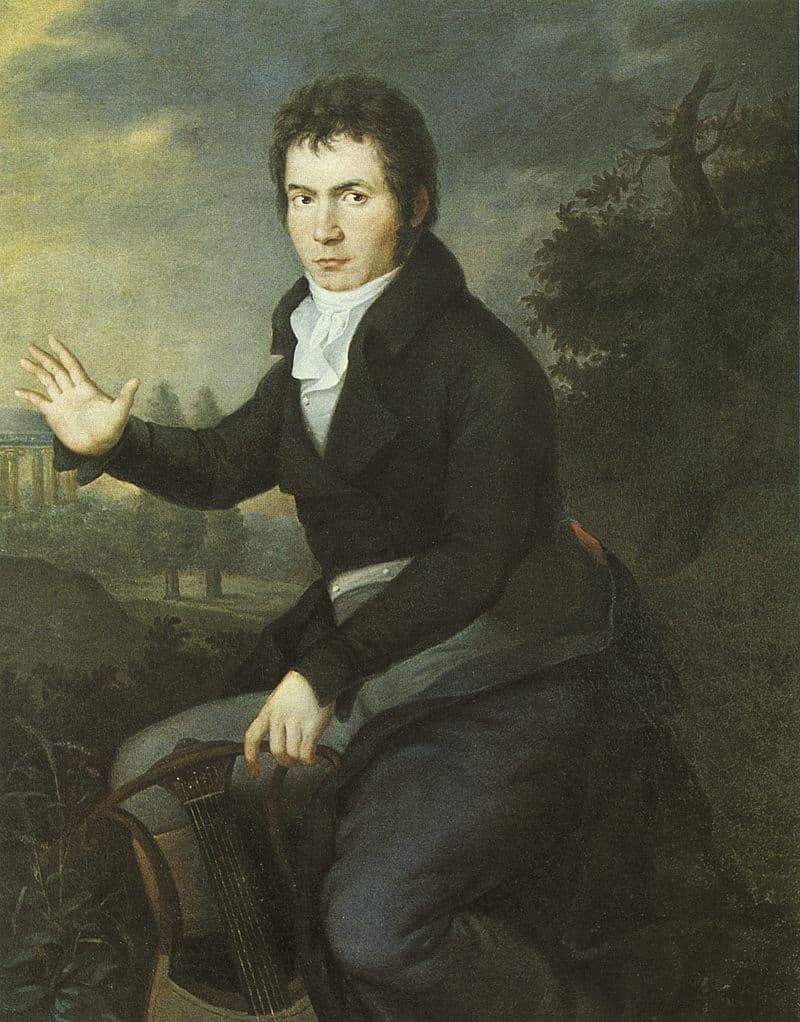
Joseph Willibrord Mähler: Beethoven, 1804–1905 (Gesellschaft der Musikfreunde in Wien)
Seen clearly, Ludwig van Beethoven emerges not as a solitary, superhuman figure cut off from the world, but as a deeply engaged artist shaped by friendships, patronage, health issues, self-discipline, and tradition.
Understanding the real Beethoven allows us to hear his music differently, as the work of a fiercely intelligent, emotionally complex human being who pushed the traditions he inherited to their limits.
By separating myth from history, we don’t diminish Beethoven’s stature. We gain a richer, more accurate picture of why his music continues to speak so powerfully to listeners more than two centuries after his death.
For more of the best in classical music, sign up for our E-Newsletter





Deafness:
A moving story is that the soprano had to touch him so that he turned round to see the standing ovation that the Ninth aroused.
Friends:
Schubert was one of the torch bearers in his funeral march, among thousands of people.
Tenderness in his music:
What do you think of “an Elise”?
It was the first Beethoven piece I heard as a kid: it was played by a neighbour of the floor over ours.
I forgot to say that I find it excellent as all articles in Interlude.