The first opera I ever saw live on stage was Carl Maria von Weber’s masterpiece Euryanthe. It was all a bit confusing at first, because there was just so much going on. I tried to follow everything, including the story, the singers, and the orchestra.
But after a while, the music became overwhelmingly beautiful and connected with me on an emotional level. I have never forgotten the moment when my mind stopped trying to analyse everything and I simply entered a fantasy world with the most vivid storytelling I had ever experienced.
Carl Maria von Weber died on 5 June 1826, exactly 200 years ago. To commemorate this wonderful composer, I decided to revisit my impressions of Euryanthe.
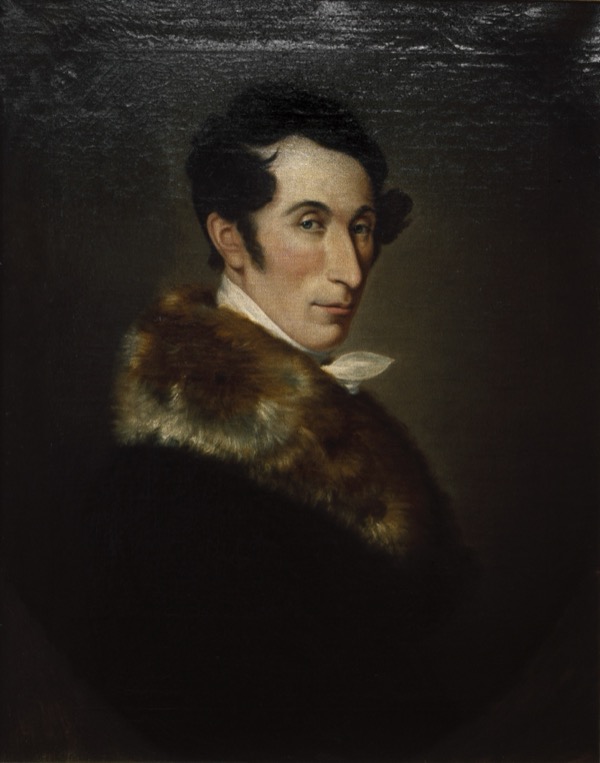
Carl Maria von Weber, portrait by Ferdinand Schimon
Weber: Overture ‘Euryanthe’ // Sir John Eliot Gardiner & London Symphony Orchestra
The Road to Euryanthe
Many years have passed, and I now understand that my innocent reaction to Euryanthe was special indeed. However, I have also realised that by knowing more of the context, the background, and intricacies of the libretto and music, I could hear the work in different ways.
So, let’s get started with some background. Carl Maria von Weber had scored a huge international success with his opera Der Freischütz (The Marksman) in Berlin in 1821. Only a couple of months later, Weber received a letter from the impresario Domenico Barbaja in Vienna, asking him to compose an opera in the style of Der Freischütz.
Weber was enthusiastic indeed, but from the start, he was looking to write a different kind of opera. You see, Der Freischütz contained a good bit of spoken dialogue, while his new opera was to feature continuous music.
Carl Maria von Weber: Euryanthe, J. 291: Act I Scene 1: Unter blüh’nden Mandelbäumen (Adolar) (Vienna Radio Symphony Orchestra; Constantin Trinks, cond.)
The Seeds of Confusion
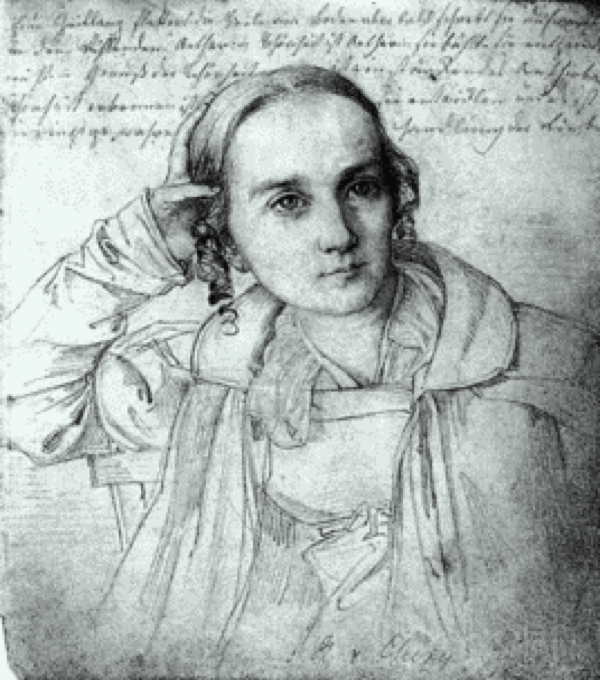
Helmina von Chézy, librettist of Euryanthe
The very first stage in composing an opera is to find a suitable libretto, and that turned out to be a little bit of a problem. He considered a number of possibilities, and then persuaded Helmina von Chézy, who was part of his literary circle in Dresden, to come up with the text.
Weber appreciated her writing but disliked her unbridled ambition, once calling her a “suave poetess but an unbearable woman.” However, you might recognise the name Helmina von Chézy from a different context as well. Her play Rosamunde, with incidental music by Franz Schubert, premiered in 1823 in Vienna.
In the event, Helmina von Chézy initially protested that she lacked experience with libretti, but in the end, she went to work on a 13th-century French romance. Set in the world of medieval chivalry, Euryanthe had ground-breaking ideas, but the plot mechanics have been described as rather crude. I read that it took many modifications and rewritings before Weber started work on the music.
Carl Maria von Weber: Euryanthe, J. 291: Act I Scene 2: O mein Leid ist unermessen (Eglantine) (Vienna Radio Symphony Orchestra; Constantin Trinks, cond.)
Untangling the Plot
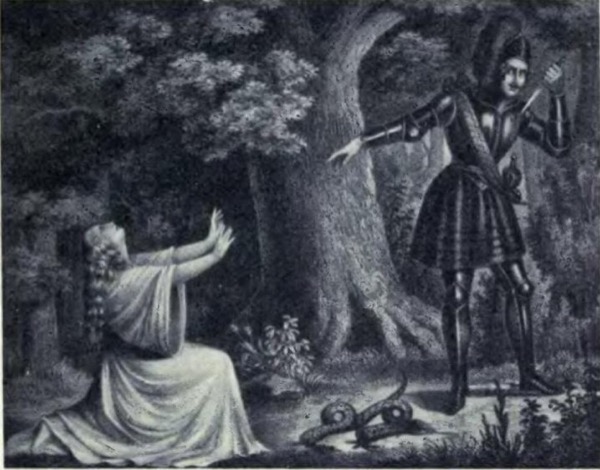
Forest scene from Euryanthe, Svenska Teatern
Let me see if I can communicate the story, which puts the fidelity of Euryanthe to the test, in a way that makes it less confusing. The noble Count Adolar is engaged to the sensitive Euryanthe, who had already rejected Count Lysiart.
Enraged by jealousy, Lysiart now intends to destroy the couple’s happiness. He provokes Adolar, who never tires of extolling the purity and fidelity of his betrothed, to accept a risky wager to produce proof of Euryanthe’s infidelity.
When Lysiart fails in his attempt to seduce Euryanthe, he forms an alliance with the equally jealous Eglantine, who is also in love with Adolar and secretly determined to effect Euryanthe’s downfall.
Carl Maria von Weber: Euryanthe, J. 291: Act II Scene 1: Wo berg’ ich mich? Wo fänd’ ich Fassung wieder? (Lysiart) (Vienna Radio Symphony Orchestra; Constantin Trinks, cond.)
The Curse of Emma’s Ring
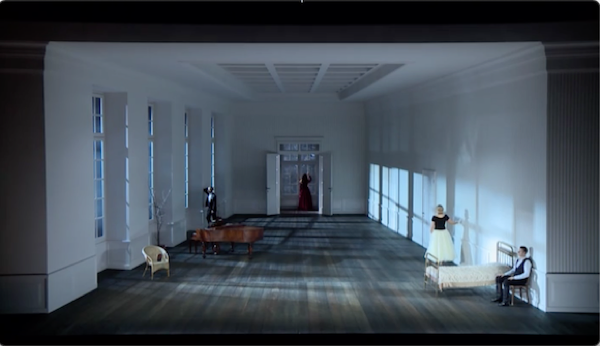
Euryanthe, Vienna production
Eglantine succeeds in drawing an embarrassing family secret from Euryanthe that she had been made to swear never to reveal. Adolar’s lovesick sister Emma committed suicide with poison from a ring, and now her ghost restlessly roams the grounds.
Her soul will find no peace until the ring from which she took the drink of death is moistened by the tears of innocence and utmost sorrow. This ring, taken from Emma’s tomb, becomes the corpus delicti and causes Adolar to believe that Euryanthe had entrusted it to Lysiart, along with his secret, on a night of passion.
In the presence of the unsuspecting Euryanthe, the wager is ended before the entire court. Adolar loses his lands, his fortune, and his bride. He publicly disowns Euryanthe, who is speechless with horror and bewilderment.
Carl Maria von Weber: Euryanthe, J. 291: Act I Scene 2: Unter ist mein Stern gegangen (Euryanthe, Eglantine) (Vienna Radio Symphony Orchestra; Constantin Trinks, cond.)
The Tears of Innocence
Her inability to defend herself is taken as proof of her guilt, and Adolar banishes her to the wilderness. At the last moment, the king discovers her there and saves her from starvation. Euryanthe regains the power of speech and now reveals the full extent of the conspiracy, which she had seen through after much reflection in the forest.
Just as Eglantine and Lysiart are about to marry, the wicked couple is visited by fate’s vengeance. Under the weight of her guilt, Eglantine loses her mind and reveals all. Adolar is now gripped by deep remorse.
The king then summons Euryanthe, whom Adolar believes to be dead, to appear before him. The kind-hearted lover forgives Adolar for the idiotic wager and his false accusations. The lovers are reunited, and Emma’s soul also finds peace, as the tears of the innocent Euryanthe have moistened her ring.
Carl Maria von Weber: Euryanthe, J. 291: Act II Scene 1: Komm denn unser Leid zu rächen! (Eglantine, Lysiart) (Vienna Radio Symphony Orchestra; Constantin Trinks, cond.)
Plot Problems and Musical Magic
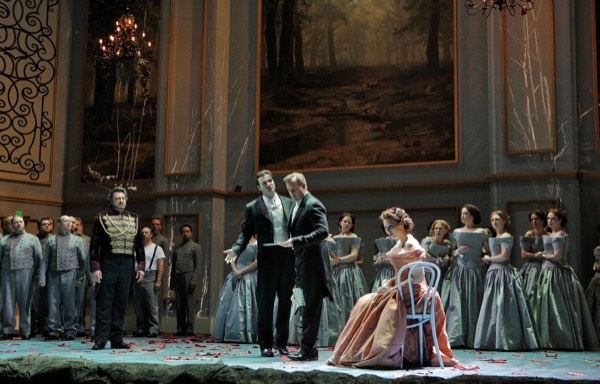
Euryanthe at Bard SummerScape, 2014
That’s a seriously convoluted story, and nobody could decide how to end the opera. I guess several versions of the final act were discussed and discarded. But in the end, the sinners are punished, and the true lovers are united.
Yet, from a purely musical point of view, Euryanthe is considered by many to be Weber’s masterpiece. He beautifully blends set pieces with freer sections of recitative and arioso, and his chromatic portrayal of evil, especially in the person of Lysiart, is most effective.
Musical motifs are employed with greater subtlety than in Der Freischütz, and the orchestration contributes significantly to the opera’s overall atmosphere. Even if the overall drama is deficient, the work greatly influenced Meyerbeer, Schumann, Liszt, and Wagner.
Carl Maria von Weber: Euryanthe, J. 291: Act III Scene 1: Die Thale dampfen, die Höhen glühn! (Chorus of Hunters) (Vienna Radio Symphony Orchestra; Arnold Schoenberg Choir; Constantin Trinks, cond.)
Learning to Hear Euryanthe
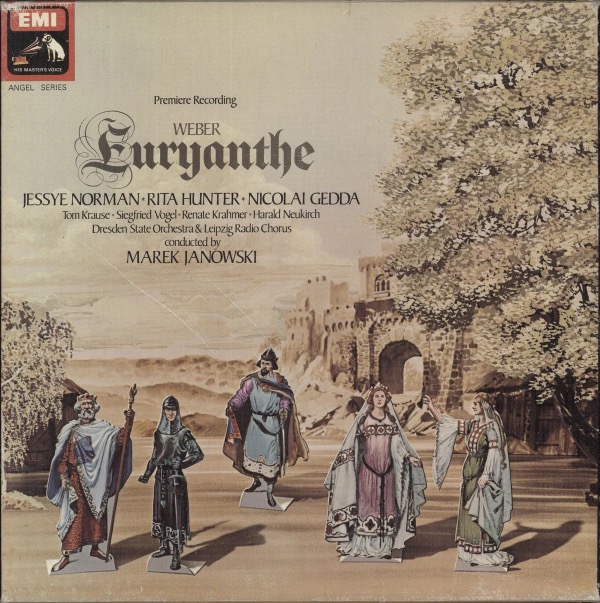
Weber: Euryanthe, UK vinyl box set
Euryanthe was first performed, with Weber conducting, on 25 October 1823 at the Theater am Kärntnertor in Vienna. The reception was initially enthusiastic, but Schubert complained that “whenever a scrap of tune appears, it is crushed like a mouse in a trap by the weighty orchestration.”
The opera was too long, the plot too confusing, and Weber made some cuts to make the opera more effective. Nothing helped, and Euryanthe closed after twenty performances. The failure to capture the public’s imagination was a source of bitterness and puzzlement for Weber.
In an age when opera was dominated by Gioachino Rossini, Weber’s attempt to express every nuance of feeling through details of melodic shape did not engage many listeners. Franz Grillparzer became Weber’s harshest critic, arguing that “the music ceased to be music because it did not allow melody to grow out of itself in an organic way.”
Just maybe, my initial sense of confusion that everything went too fast and did not hold together mirrors some of these criticisms. Only much later, and after repeated hearings, did I begin to sense the composer’s intentions and how Weber tried to hold it all together beneath the surface.
For more of the best in classical music, sign up for our E-Newsletter