No matter what weather you’re experiencing right now, we can practically guarantee that a composer has written some classical music about it.

Storm over Needles Canyon, Colorado (National Park Service) (Photo by Emily Ogden)
Today we’re looking at fifteen weather conditions…and fifteen pieces of classical music about that weather!
Windy Weather
Jean-Baptiste Lully: Les vents from Alceste (1674)
In 1674, Versailles-based composer Jean-Baptiste Lully wrote the opera Alceste to celebrate a military victory by Louis XIV.
In the opera, Princess Alceste is kidnapped by a handful of gods and other supernatural creatures. One of the abductors is Aeolus, the god of the winds.
In this excerpt from the opera, Lully uses a wind machine to imitate a gale.
Freezing Weather
Henry Purcell: Chorus of Cold People from King Arthur (1691)
In 1691, English composer Henry Purcell wrote a work called a semi-opera, King Arthur, in which only certain characters sing.
In the third act, there’s a famous excerpt called the Frost Scene, in which a Saxon magician conjures up a vision of a freezing mythical Iceland.
In this vision, the people sing while Cupid describes how love has warmed them.
Rainy Weather
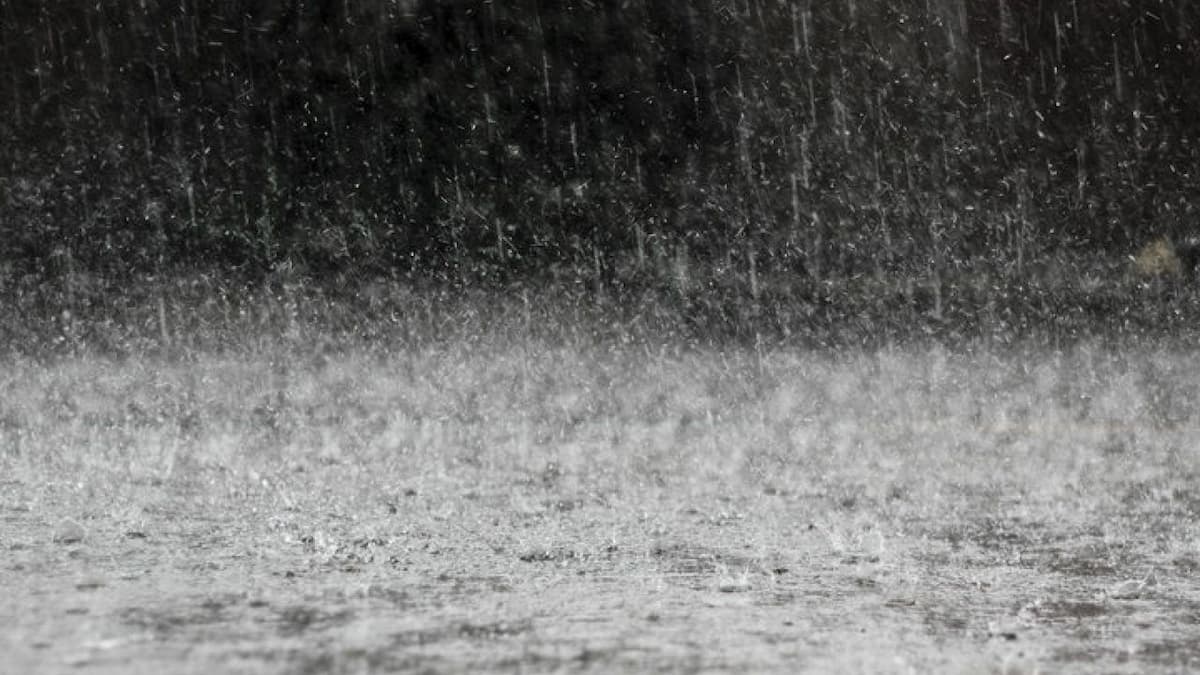
Frédéric Chopin: Raindrop Prelude (1838)
In 1838, Chopin and his lover, authoress George Sand, traveled to the island of Mallorca.
One night, while playing piano in a rainstorm, Chopin imagined himself floating dead in a lake, with raindrops falling on his body…or so George Sand’s autobiography later claimed!
It seems likely that Chopin wrote this prelude at the time. A recurring A-flat in the prelude’s first theme calls to mind rain dripping off the eaves.
Rain
Gale
Richard Wagner: Overture from Der fliegende Holländer (1843)
“Der fliegende Holländer” translated means “The Flying Dutchman.” It’s the title of an important early Wagner opera.
In the first act, a ship sails off the coast of Norway in the middle of the night during a storm. Unfortunately, the helmsman falls asleep and the ship crashes into The Flying Dutchman, a ghost ship.
In the overture, one can hear the fierce storm and crashing waves that trigger the plot of Wagner’s opera.
Read more about the stormy voyage that inspired The Flying Dutchman.
Thunder
Franz Liszt: Orage from Années de pèlerinage (1855)
Orage (“Storm”) is from Liszt’s demanding work Années de pèlerinage (“Years of Pilgrimage”).
It’s a staggering depiction of a roaring thunderstorm brought to life by a single pianist.
Somehow, using nothing but a pianist’s ten fingers, Liszt creates an aural portrait of driving rain (and maybe even hail!), bright flashes of lightning, branches being tossed in the wind, and the perpetual grumble of thunder.
Lightning
Johann Strauss II: Thunder and Lightning Polka (1868)
Technically speaking, we might be cheating a bit with this one. Its first title was actually Shooting Stars, which suggests that composer Johann Strauss II wasn’t even thinking of thunder and lightning when he wrote it.
However, the percussion in this piece sounds just like wind and thunder, and the roar in the lower strings like gusts of wind, so we had to include it.
Cloudy Weather
Claude Debussy: Nuages from Three Nocturnes (1892–1899)
Nuages in English means “clouds.”
In this work, Debussy was experimenting with orchestral colour. He’d recently seen the work of artist James Whistler and was fascinated by the way that Whistler used different shades of grey to create different moods in his work. Those ideas would come in handy when he created this musical landscape of clouds.
A Debussy biographer named Léon Vallas reported on the origins of Nuages:
One day, in stormy weather, as Debussy was crossing the Pont de la Concorde in Paris with his friend Paul Poujaud, he told him that on a similar kind of day the idea of the symphonic work “Clouds” had occurred to him: he had visualized those very thunderclouds swept along by a stormy wind; a boat passing, with its horn sounding. These two impressions are recalled in the languorous succession of chords and by the short chromatic theme on the English horn.
Hot Weather
Alexander Glazunov: Summer from The Seasons (1899)
In 1899, Alexander Glazunov wrote a ballet that portrayed each of the four seasons.
In the summer, flowers dance in the sun, then rest. They’re dehydrated from being in the sun! Luckily, water nymphs are nearby to provide water. The Spirit of the Corn does a dance of gratitude.
Eventually, more mythological creatures – including satyrs and fauns – join the celebration. They try to abduct the Spirit of the Corn, but luckily, she is saved by the wind.
Sunny Weather
Carl Nielsen: Helios Overture (1903)
In 1902, Danish composer Carl Nielsen and his wife, Anne Marie, went on a joint business trip to Greece.
Anne Marie was an accomplished sculptress who wanted to study Greek art. Meanwhile, Nielsen was hoping to be inspired by the Mediterranean landscape.
Happily for listeners, Nielsen was indeed inspired by his trip. He wrote the Helios Overture in 1903, portraying the dramatic rising and setting of the sun over the Aegean Sea.
Foggy Weather
Richard Strauss: Nebel steigen auf from Alpine Symphony (1915)
Strauss’s Alpine Symphony is massive. It requires 125 musicians, lasts for nearly an hour, and tells the story of eleven hours in a mountain climber’s day.
Strauss writes magical music about all kinds of mountaintop scenes: sunrise, the ascent, a waterfall, a pasture, an overgrown path, a glacier, mists, a massive thunderstorm and tempest, and finally, a descent.
He even wrote about mountain fog in a brief section he labeled Nebel steigen auf, or “Mists rise.”
If you want to hear a full version of Strauss’s vision, here’s a performance of the entire thing:
An Alpine Symphony / Richard Strauss / Vasily Petrenko / Oslo Philharmonic
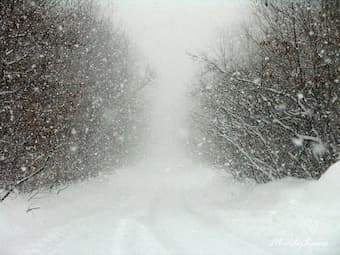
Blizzard
Ralph Vaughan Williams: Sinfonia antarctica (1953)
In 1948 composer Ralph Vaughan Williams wrote the soundtrack to a British action film called Scott of the Antarctic, which followed the ill-fated expedition of explorer Robert Falcon Scott. (That particular outing ended in the explorer’s death in a tent.)
Vaughan Williams was so inspired by just the subject matter that he composed most of the score before even seeing the film!
He later took some of the material from the movie and reworked it into his seventh symphony, which would be subtitled Sinfonia antarctica, or Antarctic Symphony.
One can hear the winds of blizzards throughout the work.
Sandstorm
David Amram: Dust Bowl Dirge from Variations on a Song by Woody Guthrie (2007)
In 2007, composer David Amram turned to songs by American folk singer Woody Guthrie when looking for music to orchestrate.
Amram wrote about the fifth variation:
Dust Bowl Dirge, for strings alone, honours the brave people who survived the national nightmare of losing everything during this ecological catastrophe and still found a way to survive. One of Woody’s greatest songs, “So Long, It’s Been Good to Know ‘Ya” was reportedly written as a farewell note during one of the terrible storms when it was feared that everyone present with him would suffocate. This minor variation of the theme is played by the violas and then restated by the whole string family.
You can hear Guthrie sing the original song here:
Woody Guthrie – So long it’s been good to know you
Tornado
Joshua Roman: Tornado (2017)
Composer Joshua Roman was born in Oklahoma, in the middle of the region nicknamed Tornado Alley.
In this area, it’s a regular occurrence in the summertime for severe thunderstorms to spawn tornadoes. These terrifying natural phenomena can be dangerous or even deadly, destroying homes, businesses, and livelihoods in a matter of seconds.
Roman’s Tornado for string quintet conjures the thrill, danger, and unpredictability of these storms through its use of dissonant textures and parts that are, at times, left up to chance…much as the path of a tornado is never predictable.
Conclusion
Come rain or shine, there’s always a piece of classical music about the weather to enjoy! Which one of these is your favourite? Are there any you’d add?
For more of the best in classical music, sign up for our E-Newsletter