In the world of classical music, atonal music often receives a cool reception. Listeners who love listening to Schubert or Schumann often tap out when Schoenberg is on the program.
It makes a certain amount of sense. The dissonances common in this style can be grating, even eliciting genuine physical discomfort at times.
In addition, atonal music employs complicated compositional techniques that can isolate listeners who have not studied music theory for many years.
So why did composers bother writing atonal music at all?
To find the answer, we have to look at some music history.
Here are five reasons why composers started writing atonal music:
1. Most composers have always preferred doing new things over rehashing their predecessors’ ideas. In the early twentieth century, writing atonal music scratched that itch.
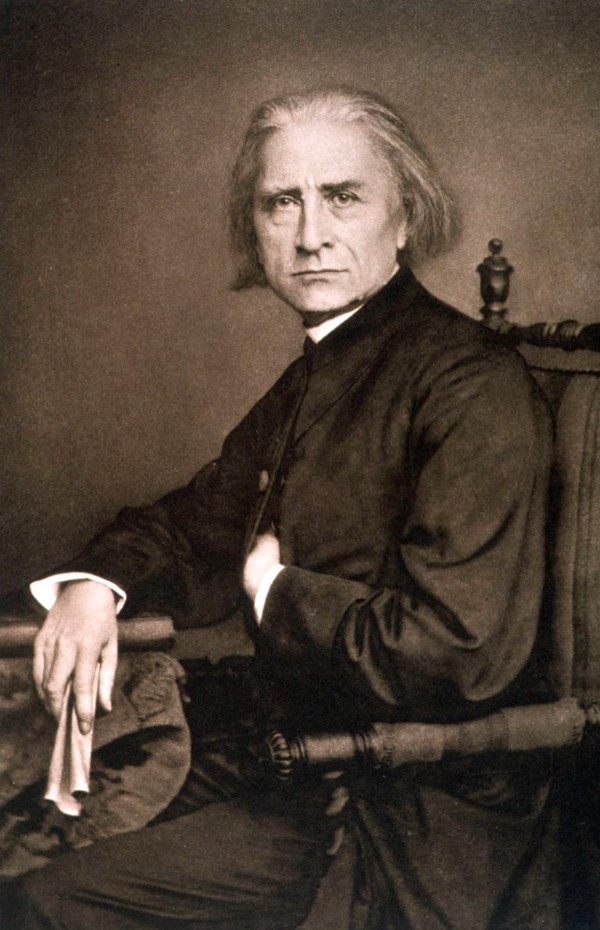
Franz Liszt
During the late 1800s and early 1900s, composers like Franz Liszt, Richard Wagner, and Gustav Mahler spent their careers pushing traditional harmony to its limits.
Sometimes a piece of music they wrote employed so many accidentals, or went through so many modulations, that the stated key of a piece became less and less important.
Every year, the temptation was growing stronger to discard traditional ideas about harmony altogether.
Liszt’s Nuages gris is often cited as a proto-atonal work. Listen to how the harmony drifts, refusing to settle, three decades before Schoenberg’s revolution.
Liszt’s Nuages gris (“Grey Clouds”), 1881
Past a certain point, indulging in that kind of experimentation was a bit like letting toothpaste out of the tube: there was no mechanism to let it back in.
By the turn of the century, tonal music was simply running out of runway.
Plus, a certain subset of musicians has always enjoyed innovating and surprising listeners. And many have ultimately been feted for it. Think of how Beethoven was canonised for the innovations he introduced to the symphony.
2. When the first works of atonal music were being developed, composers were living through a period of destabilizing social, political, and technological change. It was natural for music to reflect those broader societal trends.
Remember everything that was happening as atonal music came into vogue in the 1910s, 1920s, and 1930s.
There was a senseless, devastating war in Europe that killed twenty million people over a period of four years.
A worldwide influenza pandemic in 1918-19 killed tens of millions of people more.
Women were seeking suffrage, and in many cases, achieved it. In fact, gender roles more broadly were being questioned, leading many people to fear that previously foundational ideas about family and society would no longer be taken for granted.
Movements like nationalism, socialism, communism, anarchism, totalitarianism, and more were all battling for supremacy in the political sphere. These movements were accompanied by huge amounts of labour unrest.
Then, in the 1930s, the world plunged into a decade-long global depression.
Taken as a whole, this was not a generation that could tell its story with simple, pleasant, surface-level music. For many, the rigour and structure of twelve-tone composition offered a sense of order amid cultural and societal upheaval.
Listen to Schoenberg’s Five Pieces for Orchestra from 1909: a snapshot of early atonal language. You can see why composers might be attracted to such a style within the context of their tumultuous era.
Schoenberg’s Five Pieces for Orchestra, 1909
3. Atonal music is an intellectual challenge to write.
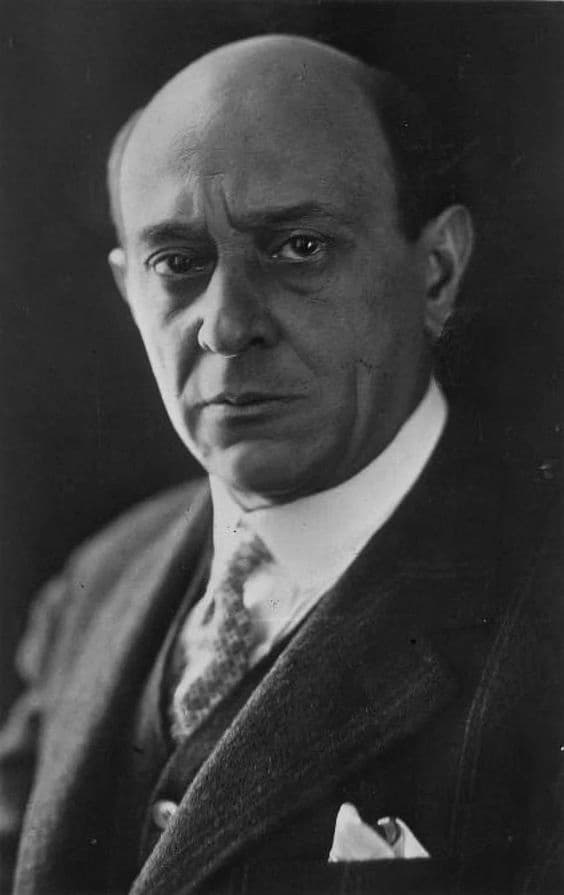
Arnold Schoenberg
The term “atonal music” was disliked by Arnold Schoenberg, the composer most closely associated with it.
He employed a technique called the “twelve-tone technique.” As Wikipedia defines it:
The technique is a means of ensuring that all 12 notes of the chromatic scale are sounded as often as one another in a piece of music while preventing the emphasis of any one note through the use of tone rows, orderings of the 12 pitch classes. All 12 notes are thus given more or less equal importance, and the music avoids being in a key.
Not all atonal music is twelve-tone…and not all twelve-tone music is necessarily atonal.
Writing this kind of music is like assembling a giant puzzle. Many composers simply loved the intellectual challenge of it, similar to the way that many great composers of the past loved working within the confines of form (like the sonata form, for instance, which was developed to its height in the eighteenth century by composers like Haydn and Mozart).
A brief documentary on how twelve-tone music is constructed
4. There were compelling, influential composers who made interesting cases in favour of the value of developing atonal music.
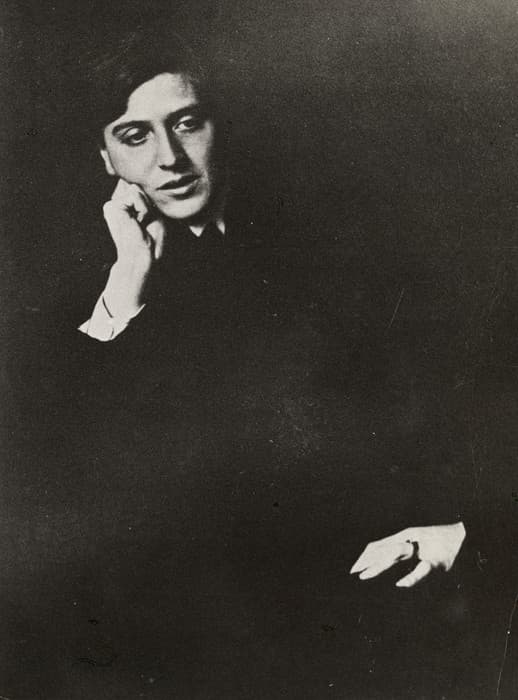
Alban Berg, 1920s
The Second Viennese School consisted of composer Arnold Schoenberg and his pupils Berg, Webern, and others.
Schoenberg’s students were deeply affected by him and his teachings. In fact, his ideas became so potent and influential that Berg and Webern carried them into their own creative lives, even though they both composed in very different styles.
Alban Berg: Lyric Suite (New Zealand String Quartet, Ensemble)
Anton Webern: 6 Bagatelles, Op. 9 (Artis Quartet, Ensemble)
But Schoenberg’s influence didn’t stop at Berg and Webern. In the 1930s, in response to the rise of the Nazis, he moved to California, where he continued teaching and sharing his ideas.
He spent significant periods teaching on two continents, a résumé few earlier composition teachers could match.
In short, Schoenberg’s reach and influence required a kind of creative reckoning, and composers of all stripes had to mount a response to the revolution.
For some composers, that meant embracing his ideas; for others, rejecting them; for still others, finding some kind of synthesis.
5. Composers writing in an atonal style were influenced by artistic and literary trends of the time, which had similar traits to atonal music.
Historically, music, art, and literature have always been in conversation with each other.
Visual abstraction and musical abstraction moved in tandem.
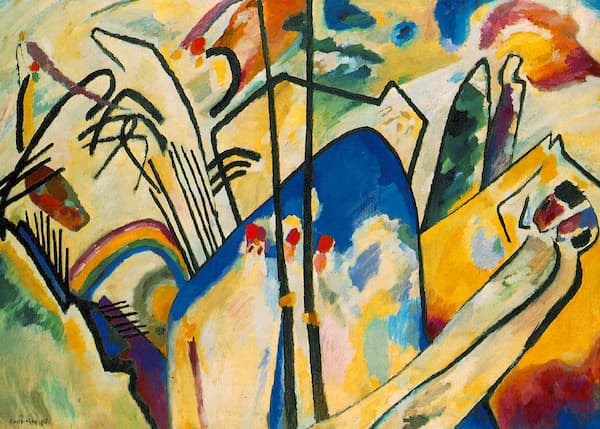
Kandinsky: Composition IV, 1911 (Düsseldorf: Kunstsammlung Nordrhein-Westfalen)
One especially noteworthy example is an exchange between Schoenberg and artist Wassily Kandinsky.
In 1911, Schoenberg wrote to Kandinsky, “I have just read your book [On the Spiritual in Art] from cover to cover, and I will read it once more. I find it pleasing to an extraordinary degree, because we agree on nearly all of the main issues…”
Kandinsky returned the praise to Schoenberg: “In your works, you have realised what I, albeit in uncertain form, have so greatly longed for in music. The independent progress through their own destinies, the independent life of the individual voices in your compositions, is exactly what I am trying to find in my painting.”
Kandinsky continued:
“At the moment there is a great tendency in painting to discover the ‘new’ harmony by constructive means whereby the rhythmic is built on an almost geometric form… I am certain that our own modern harmony is not to be found in the ‘geometric’ way, but rather in the anti-geometric, anti-logical way. And this way is that of ‘dissonance in art’, in painting, therefore, just as much as in music. And ‘today’s’ dissonance in painting and music is merely the consonance of ‘tomorrow’.”
Looking at and listening to their works simultaneously sheds light on the work of both men.
No one can fully understand modernism in art without understanding the role atonal music played in shaping it – and vice versa.
Conclusion
Even today, many audiences remain allergic to atonal music and don’t understand why composers would choose to write in such a style.
But before you write it off entirely, it’s worth taking some time to understand what it is and where it came from.
It was an inevitable outgrowth of the way harmony was treated in the late Romantic era; it reflected the chaos of life during the rapidly changing years of the early twentieth century; the intellectual and emotional challenge of writing it proved deeply magnetic to composers; and it developed side-by-side along similarly styled works by Kandinsky, Picasso, and others.
For these reasons and others, atonal music is worth learning more about. Even if you’re skeptical at first, you may grow to love it – or at least understand why it mattered, and still matters.
For more of the best in classical music, sign up for our E-Newsletter