‘You must have played well today, for I did not notice you.’
In his memoirs titled Am I Too Loud?, pianist Gerald Moore recalls the remark of famed (and famously egotistical) British singer John Coates, among many an anecdote from the singers of yesteryear. Such an insinuating ‘compliment’ is emblematic of the outdated expectations of accompanists as subservient, even mechanical labourers – expectations which, thanks to Moore’s advent of the collaborative musician, are confined to the past. Across Europe and America, collaborative piano emerges increasingly as a practice in its own right, with the vocal-piano dimension often at the fore.
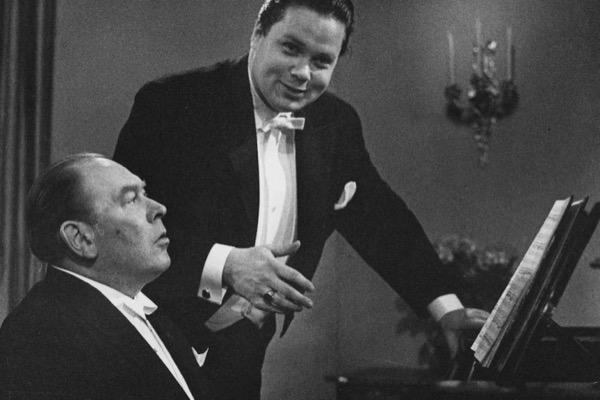
Pianist Gerald Moore rehearses with treasured singer-partner, Dietrich Fischer-Dieskau.
Today, art song finds itself at a disadvantaged junction in time. Its forebear, Liederabende, has morphed into the colloquial ‘karaoke with friends’, while those lovers of classical music often tend towards symphonic concerts in colossal venues. The miniature art song finds itself shadowed today, in the concert hall or at home. Nonetheless, the enthusiastic discourse on song from scholars and connoisseurs alike keeps the genre alive. Being at a place like Cambridge places me in the heart of this culture: as an active and eager performer, I have had the fortune to work with the crème de la crème of young singers, almost all of whom bring exciting, novel ideas and repertoire to my own musical maturation. Beyond university, such institutions as Leeds Song, Oxford Lieder, as well as the year-round Wigmore Hall concert series, enable these precious songs of (often) a foreign tongue to survive in an Anglophone world.
It is inevitable, however, that the nuances of accompaniment are subtle compared to the singer’s texted expression. In reality, the pianist takes on the role of a chameleon – changing one’s musical colour and stance constantly but seamlessly. The role of a song-pianist varies between composers, between songs, and even between subsections of a song. In this piece I divulge three less-considered roles that often highlight a ‘shadowed’ pianist; it is essential to remember that each song often sees a mixture of roles, and often beyond what I have but tersely prescribed here.
The Pianist as Dramatist – Benjamin Britten’s Canticles
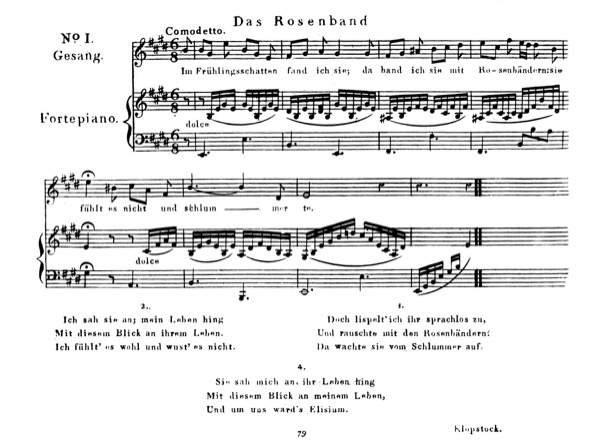
A setting of Friedrich Klopstock’s Das Rosenband by Carl Friedrich Zelter, one of the earliest composers of the modern-day lied. This simple setting is shadowed by famous settings by Schubert and Strauss.
When looking at an early Lied (before the fully-fledged Romantic idiom of the 1800s), one could be pardoned for understating the role of the piano. Composers often resort to stock Alberti or block-chords, in strophic form that seem to limit a song’s expressive variety. As the Romantic aesthetic emerged (pioneered by Schubert’s iconic lieder), it marked the start of generations of composers who insisted on the piano’s contribution to the drama. As the singer serves as actor, the pianist provides the set, sounds and spectacle that the actor acts upon.
Britten’s songs prove my point most succinctly – in particular, the Canticles that span his career serve as optimal examples. There is an unencumbered honesty and directness to Britten’s songs, especially those that depict jarring, tragic episodes. Take his third Canticle, Still falls the rain – one where Edith Sitwell excruciatingly negotiates pain and faith amidst the ‘raining’ bleakness of the London Blitz: partnering with a solo French horn, the piano not only dramatises the vocal recitative effectively, but extends to a number of variations that preface and segue into the new verse. Whether it be the ‘”pulse” of the heart’, the ‘”worm” with the brow of Cain’, the “Rain” [bullets], or the ‘”leaps” of the hunted hare’, a preceding horn-piano variation enacts the metaphor to the maximum, barren potential of tragedy. (The opening to the second Canticle, Abraham and Isaac, is a prime example of how the piano can portray the divine and the angelic!)
Some works, in turn, negotiate that engagement with drama with a lyrical Romantic essence. Out of his vast repertoire, Goethe’s Ganymed is perhaps the poem that Schubert treats with the most dramatic variety. The beauteous spring is revealed to be a means of seduction from Zeus to the titled boy, as he gradually submits to the god’s embrace. Schubert’s textures change literally every two lines, and so does the momentum in which the music flows. The pianist must act here as ‘enabler’: not so much narrating the drama directly but providing the canvas on which the singer can narrate their story – thus goes the mantra of ‘following’ and ‘being with’ the singer. As the embodied young boy sees the layer of clouds ‘surging upwards and upwards’ (hinauf, strebt’s hinauf!), the song goes into what is possibly the most exciting and expansive accelerando in all of lyric repertoire, all the while demanding an endless act of absolutely perfect coordination.
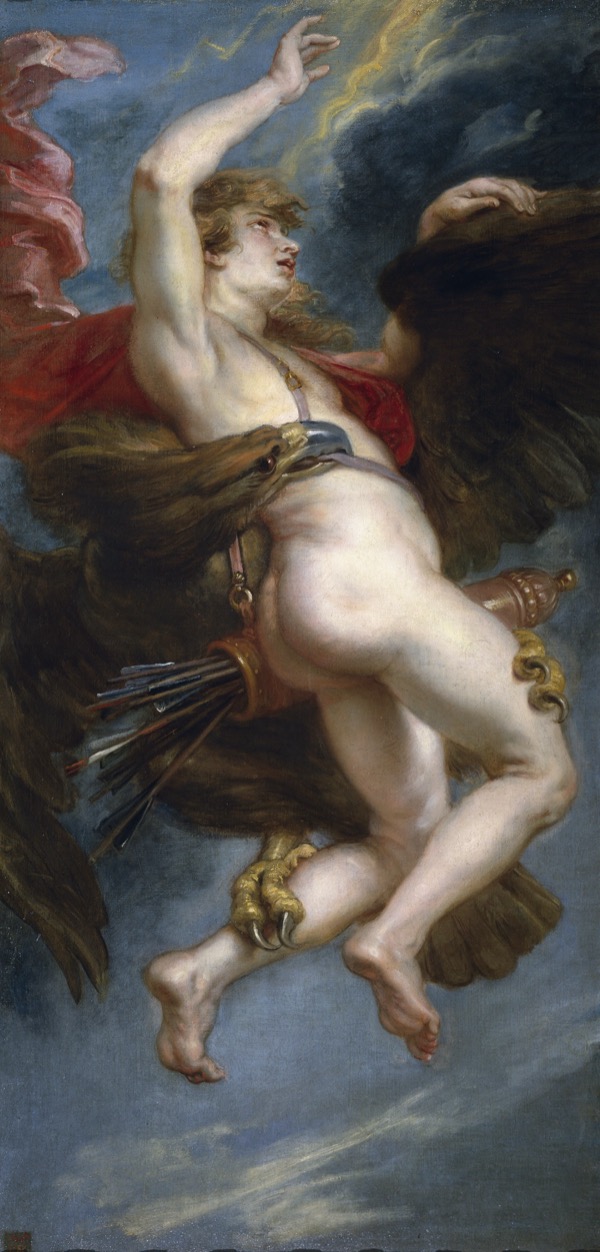
The Abduction of Ganymede (1638), by Peter Paul Rubens
Other examples include: Rachmaninoff’s In the mysterious silence of the night, where the piano diligently (in Rachmaninoff-esque fashion) underscores both a soundscape of churchbells, and of infatuated desire; Rebecca Clarke’s The Seal Man, which tells of a girl’s infatuation with a sea creature that leads to her fatal drowning, with the piano’s ever-haunting depictions of water; and Olivier Messiaen’s Doundou Tchil (from the cycle Harawi), where the pianist extensively narrates a male lover’s courtly, increasingly ecstatic serenade, while the voice’s syllabic utterances play mock-Peruvian bells.
The Pianist as Orchestra – Strauss’ Four Last Songs
The mid-19th-century advent of the orchestral song has left many loved gems in the concert-hall repertoire. In recital, performers adapt these orchestral songs into popular piano arrangements, in which pianists take on the imaginative task of convincing the listener that there is an orchestra stalled somewhere in, on, and between their ten fingers. Some composers, most notably Richard Strauss, take this one step further: between the youthful adventurism of his early songs and the aged pensivity of the late ones, he constantly wrote with an orchestral backdrop in mind. There are often instances where an accompanist’s sixth sense allows one to simultaneously realise ‘that’s an oboe solo’, ‘that’s a cello line’ etc. The resultant piano part is hence often virtuosic for one reason: (to quote Hermann Hesse in Beim Schlafengehn, Strauss’ third Last Song) because the texture is ‘profoundly thousandfold’ (Tief und tausendfach).
Take September, the second of Strauss’ Four Last Songs: this is, by comparison, the most practical (or least impractical, perhaps) song to perform in recital. The multilayer filigree is largely playable across the fingers, without the obligation to emulate any fifty-voice harmonies. But Strauss’ hallmark richness in texture is never forgiving. Regardless of the lines the pianist plays, there will always be some aspect in the sparkling canvas that remains uncaptured. There will be the most mellifluous figures on a cello that outrageously bend the rules of physics on the keyboard, or flittering flute trills that seem only arduous to the fingers. Not to mention, the infamous horn solo in the coda, which, when played on the piano, will leave most listeners thinking: ‘But that doesn’t sound like a horn…‘ As a pianist on the deep end of such all-encompassing textures, one can but imagine, and one can but try.
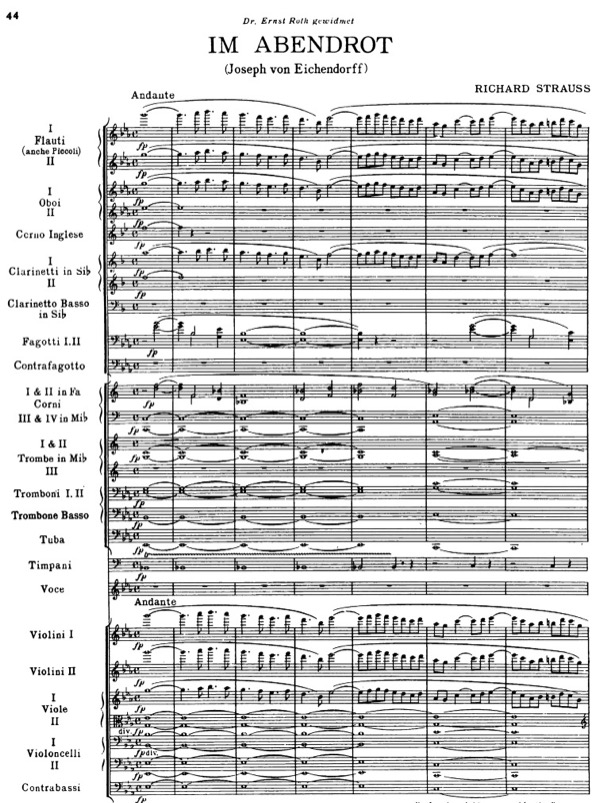
The expansive opening (in orchestral score) to Im Abendrot, the last of the Four Last Songs
Other examples include: Berlioz’s Le spectre de la rose (from the cycle Les nuits d’ete) – oft-considered the ‘original’ orchestral song. With roots from an unpopular piano version, Berlioz then morphed it into a dazzling, liquid orchestral palette that tells a melancholy tale of princely love; another is the second of Mahler’s Songs of a Wayfarer, which paints an uninhibited colour-palette of joy, was adapted into his First Symphony, and has been overshadowed by its orchestral counterpart (capable of convincingly imitating all kinds of ‘cuckoos’) ever since.
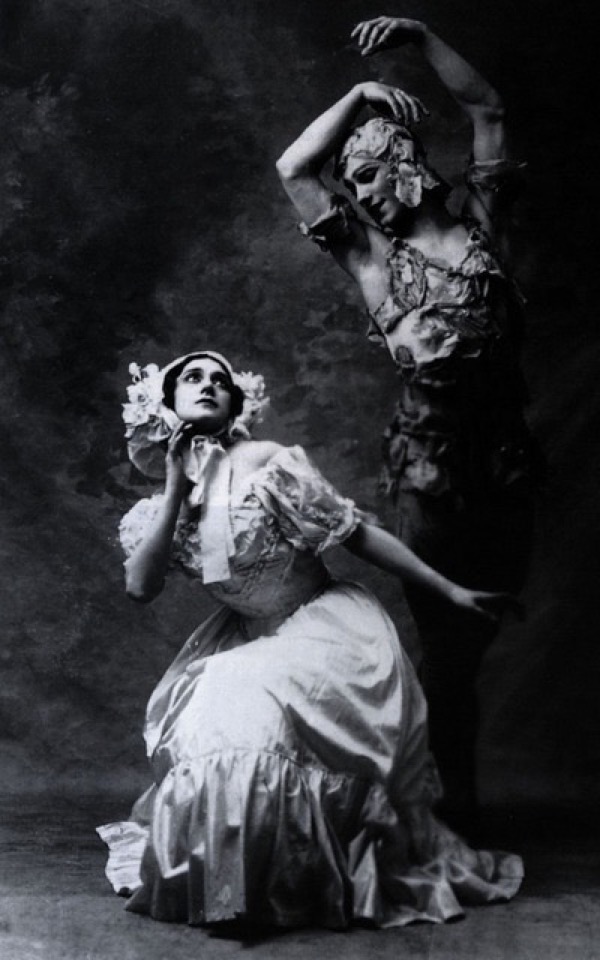
Michel Fokine’s ballet (1911), adapted from the same text by Theophile Gautier that Berlioz set to music.
The Pianist as Ironist – Mahler & Schumann
This is perhaps the rarest of those listed, and the one where the mantra of the accompanist ‘following’ the singer is called into question. The dissenting (and rather innovative) relationship between voice/text and texture finds itself in late 19th-century songs, at a time when all modes of art looked to explore more colours and timbres. Take Mahler’s Das himmlische Leben (The Heavenly Life): (this song from Des Knaben Wunderhorn was adapted into the final movement of Mahler’s 4th Symphony – yet another example of the ‘pianist as orchestra’!) With a poem that takes the perspective of a child enjoying ‘heavenly pleasures’ (die himmlischen Freuden), one would expect an ever serene idyll. But it’s never that simple: the jarring sleigh-bell figure (at the start of the Symphony) is reprised continuously – one which is fuelled with preternatural, even malicious hints. The ‘shopping list’ of pastoral, heavenly scenes is confronted with explicit, almost grotesque paintings of donkey and lamb sounds. Perhaps, in a way, the effect of starkly different sound worlds in combat provides something more memorable than a warm texture of ‘pure sensory candy’. A more humorous example is from Hugo Wolf’s Italienische Liederbuch: in Wie lange schon war…, the lady sings (when in duo-recital form, often feigning oblivion to a jealous partner) of having a musician-lover, and sings sensuously as she is approached by a fine, well-dressed violinist (one could imagine the signature ‘British restraint’!). Yet he is not exactly ‘Prince Charming’ – far from it, actually. His limping figures are sprinkled with accents in the most random moments (is our timid violinist tripping over?) – pianists often relish their moment to portray the most comical ‘Grade-1’-violinist impressions imaginable, and not least with a long trill that is anything but agile and smooth! Today we know Wolf as the poster ‘tormented artist’, but once every now and then he would put in his score: ‘Nicht ohne Humor’!
The irony works vice versa: when sentiments of negativity are relentlessly overwritten by delightful-sounding music. In Schumann’s Dichterliebe (set to Heine poems), the serenade Ein Jüngling liebt ein Mädchen musters all elements of folksy rhetoric, with some humorously limping syncopations. Yet by the end of the poem, when that eternal story of affair and heartbreak would ‘break your heart in two’ (bricht das Herz entzwei), the piano goes on limping (for uncomfortably long) in that overtly optimistic and earthy dance. Much discography of yesteryear abides by a cheery, ‘force-smiled’ irony in the play-out, but ideas diverge more recently; in particular, the Erl Kings’ uncanny reimagination lets the song ridiculously dash to oblivion. Such is the artistic licence of the ‘accompanist’ – one who plays Interpreter.
Coda: The Pianist as Poet – the ending to Dichterliebe
“I’m always telling students, ‘Don’t slouch like that; the song is not over yet!'” Samuel Sanders
The ‘play-out’, as commonly known, reveals another facet of a performer’s persona. Fast-forwarding to the epilogue of Schumann’s Dichterliebe (or mutatis mutandis, the epilogue of his Frauenliebe und -leben). An unexperienced singer may curtail the magnificent drama by going into ‘screensaver mode’ or leaving the song world entirely, while an impressive performer may conclude an ever-gripping act by performing the ‘loudest silence’. The pianist becomes the centre of this narrative – after a most jarring final line, where he ‘buries his love and his sorrow’ (senkt’ auch meine Liebe und meinen Schmerz), the pianist gets the last word. In an elegiac, musing reprise of a previous tune, is there a hint of optimism beyond this streak of intoxicated love? Perhaps there is a degree of fulfilment as the music states, but, with the lingering, illusory tune of the poet’s love ultimately haunting his persona, is that fulfilment in any way genuine?
(P.S. lieder is not all doom-and-gloom: listen to the ending of the final song of the Italian Songbook, as the pianist theatrically flourishes from the woman’s glorious exit. Every accompanist has to strum repeated chords regularly, but there are certain moments when the flamboyant side comes into good use!)
A playlist of great variety – suitable for accompanying summer downtime, or a pleasant commute! Creating this playlist was far from an easy task: I had endeavoured to feature as many piano-singer duos, with as much variety of composers as possible – and yet there are portions of the repertoire that scream out for appreciation beyond this list!
For more of the best in classical music, sign up for our E-Newsletter
Isaac Chan is an orchestral conductor currently pursuing Master’s studies at the Juilliard School. He recently graduated top-of-the-class from the University of Cambridge (Clare College) with triple starred-first-class honours in Music, and was awarded the University’s Holgate-Pollard Prize, as well as the William Barclay Squire Prize in musicology and the Donald Wort Prize (x2).
He was Conducting Scholar at Cambridge, in whose capacity he conducted the University’s Symphony Orchestra, and studied at the Royal Academy with Sian Edwards. He was also a pianist-scholar on the flagship Instrumental Award Scheme and Sir Arthur Bliss Lieder Scheme, and has performed/conducted at venues such as the Wigmore Hall, Bridgewater Hall, Ely Cathedral etc. In 2024, he was made conductor of the Hong Kong Youth Philharmonia, as well as having founded his own orchestra jointly affiliated with Trinity and Clare Colleges, Cambridge. He was formerly the Artistic Director of Cambridge’s West Road recital series, and, when in Hong Kong, is an associate artist on the James Legge Cultural Scheme at Ying Wa College, where he gives seminars and coaching on music and literature.
Here, he performs Britten’s Canticle I with his wonderful duo partner, Harry Gant.