Located in western Bonn, Germany, the village of Endenich dates back to the 8th century. It was incorporated into the city of Bonn in 1904, and today it feels like a gentle continuation of the urban landscape.
Driving into Endenich, we follow a broad avenue lined with mature chestnut trees and handsome 19th-century villas. The streets become quieter and the trees more abundant, and within a couple of minutes, we arrive at a building with an extraordinary history.
The building on today’s Sebastianstraße, formerly Magdalenenstraße, once housed the Richarz sanatorium, and it was home to Robert Schumann for the last two years of his life, arriving on 4 March 1854 and dying on 29 July 1856. Today, the building is the Schumannhaus, a memorial and museum, and home to Bonn’s music library.
Robert Schumann: Geistervariationen (Ghost Variations), WoO 24
The Road to Endenich
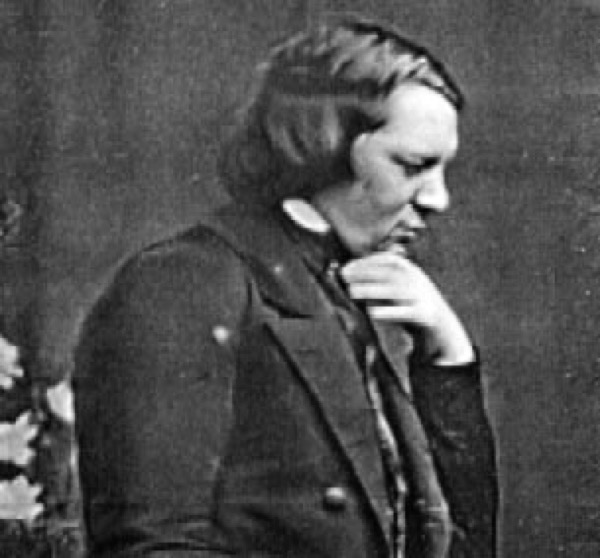
Robert Schumann, 1850 daguerreotype
The building dates to before 1790 and served as a country house for the mayor and head of the magistrates, Matthias Joseph Kaufmann. Dr Franz Richarz bought the property in 1844 and established a private sanatorium. So how did Robert Schumann end up there?
Robert Schumann had taken up the post of municipal music director in Düsseldorf in October 1850. Although he complained about the workload and occasional squabbles with the administration, he felt happy and content.
After roughly two years, however, an agonising state of nervous overstimulation took hold of him, and he suffered from delusions, was pursued by voices and tones, and finally experienced a fit of overwhelming anxiety. Unable to contain the voices in his head, Schumann left his home and jumped into the Rhine River.
Robert Schumann: Gesänge der Frühe, Op. 133
Rooms with a View
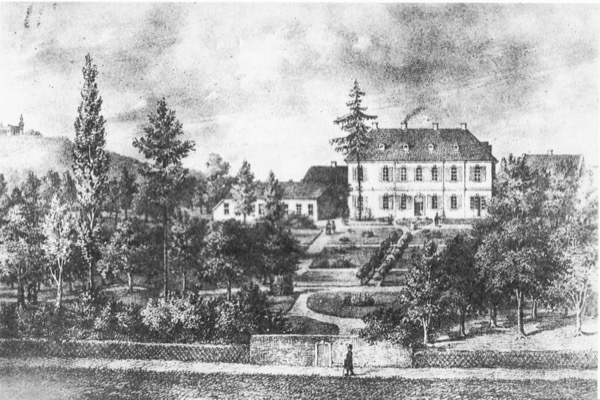
Nervenheilanstalt Endenich
Fishermen saved him, and friends of the family admitted him to Richarz’s private sanatorium after recommending it to Clara Schumann. Arriving by coach, Schumann would have found a reception room on the ground floor, along with examination rooms and doctors’ offices.
Small patient rooms were located on the upper floor, and Schumann would occupy two rooms at the left-hand end of the garden façade, facing toward the Kreuzberg. From there, Schumann would have seen the rising morning sun and had a view toward the Siebengebirge.
That upper floor also housed a salon-like room with a square piano. The property also included a large park and small buildings for extremely restless patients. The Richarz sanatorium was one of the more progressive institutions of its type, and Franz Richarz, whenever possible, practised the “no-restraint” method championed by the British physician John Conolly.
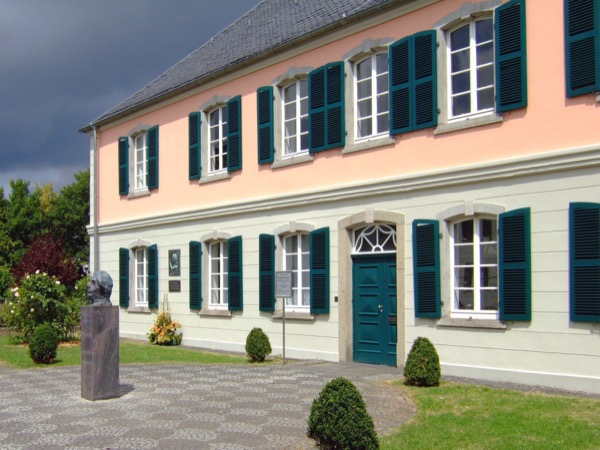
Schumannhaus, Bonn
Although he neither force-fed nor drugged his patients, Richarz discouraged direct contact with relatives in the belief that such meetings might set off untoward reversals. As a result, Clara did not see her husband until nearly two and a half years into his confinement, and just two days before his death.
Robert Schumann: Piano Trio No. 3 in G minor, Op. 110
Music Behind the Walls
While Schumann was severely psychotic when he was admitted to Endenich, his condition improved considerably in the following months. Apparently, he conversed mildly and in a friendly manner with his visiting friends Brahms and Joachim, played the piano, read, wrote letters, and composed a little.
He wrote to Clara on 18 September 1854, “Beloved Clara! What good news have you sent me again, that heaven gave you a magnificent boy. (Clara had given birth to a son named Felix, after Mendelssohn). It makes me very happy that the cello concerto, the violin fantasy, which Joachim played so wonderfully, and the fugues have been published… If you write to Joachim, say hello to him.”
And on 27 November 1854, he wrote to Brahms, “Dear! I wish I could see you myself and hear your wonderful variations, or from my Clara, about whose wonderful performance Joachim wrote to me. How the whole work rounds off so uniquely, as one knows in the richest, fantastic splendour and again in deep art, as I did not know, connected, the theme popping up here and there and very secretly, then so passionately and intimately… Just write soon to your adoring and loving one, R. Schumann.”
Robert Schumann: Four Fugues, Op. 72
Darkness Returns
Visitors were permitted to communicate with Schumann only through an aperture in the wall of his rooms, and Dr Richarz kept a logbook or diary, recording the activities of his famous patient. When his health permitted, Schumann took accompanied walks, strolling into Bonn to view the Beethoven monument. And during lucid moments, he even managed to undertake a few compositional projects.
According to Dr Richarz, Schumann might well have composed several works, but in April 1856, he apparently burned them together with other papers and letters. Schumann also jotted down other notes, including some medical details. For example, one such entry claims, “In 1832, I contracted syphilis and was cured with arsenic.”
The clinic was expensive, and at first Schumann’s salary paid for his treatment. Later on, Clara paid for the stay personally and refused financial support, including funds offered by the Mendelssohn family.
In 1856, Schumann got progressively worse and apparently suffered from the gradual loss of the ability to speak clearly, aggressive behaviour, and protracted periods of screaming. He was also convinced that he was being poisoned. Clara was kept in the dark about the exact severity of her husband’s condition, but when she learned from Brahms in June 1856 that Schumann had not left his bed for several weeks, she investigated for herself.
She was twice prevented from seeing Schumann, but was apparently admitted to his room on 27 July 1856. Schumann supposedly mumbled a few words of recognition, and Clara reports in her diary that he embraced her with great effort and said, “I know you.” However, at 4 in the afternoon on 29 July, he died quietly and alone. By this time, he was severely emaciated and profoundly weakened, and pneumonia was recorded in the autopsy findings.
Robert Schumann: Fantasy for Violin and Orchestra, Op. 131
What Remained
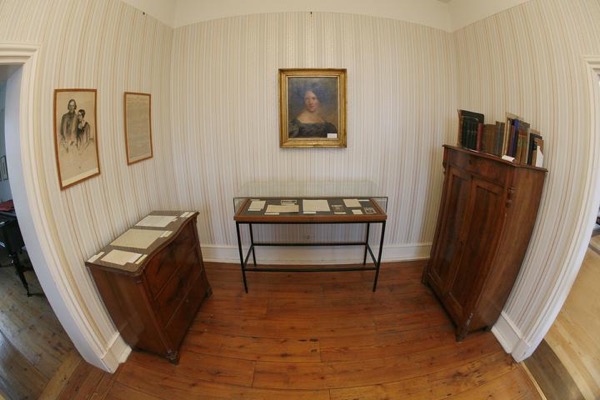
Schumannhaus, Bonn
His funeral was arranged two days later in the cemetery near the Sternentor in Bonn. Brahms, Joachim, Dietrich, Wasielewski, and Hiller attended the simple service. According to the poet Klaus Groth, the small cortège attracted a crowd of onlookers, who came “flooding from every street and lane as if to watch a prince pass by.”
The composer and friend Ferdinand Hiller said in his eulogy, “Your weary spirit! You asked too much from it. What may be granted to those who gratefully receive in a sacred hour, you demanded as a right at every moment. For a long time, your spirit obeyed willingly, and who can say how he fell out with you? Oh, maybe it was just a quick sulk, as best friends do, and only to our silly eyes did it seem like a rift. But you are back on good terms now, and smiling at everything we’re saying about you, and gently smiling, in hope that we may be forgiven.”
After Schumann’s death, the Schumannhaus remained a psychiatric institution until 1944, having undergone several renovations. The structure was severely damaged in 1944, and emergency repairs allowed for the establishment of a nursing home.
However, the building was in terrible shape, and demolition was proposed in 1956, on the 100th anniversary of Schumann’s death. Thankfully, a “concerned citizens’ initiative” led by musicology students from Bonn prevented demolition and began a gradual process of restoration.
The first floor opened as a music library in 1963, and the ground floor remained a nursing home until 1982. The Schumann House Association purchased the building, and the two small Schumann rooms were turned into a museum featuring objects from the Schumann family.
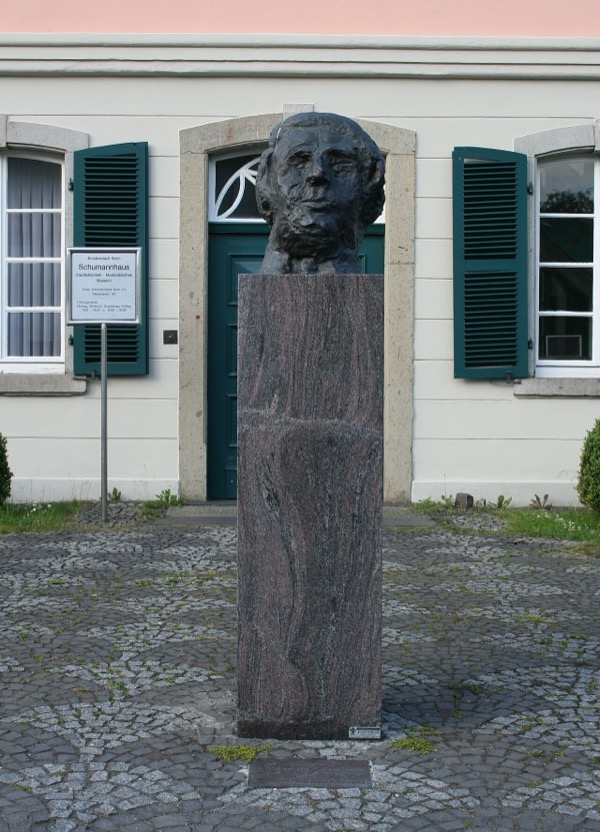
Robert Schumann bust by Alfred Hrdlicka, 2003, Schumannhaus Bonn
Visiting the Schumannhaus today, it is difficult to reconcile the museum’s quietness with the drama that unfolded within these walls. Schumann arrived here in despair, but he had moments when friendship, letters, and music could still reach him. His life ended behind these walls, yet his music did not. The Schumannhaus is a place of memory and tribute, but most fittingly, it is simply a building dedicated to music.
For more of the best in classical music, sign up for our E-Newsletter