Clara Schumann is best known as one of the great pianists of the nineteenth century. Her work as a composer, though, has often received less attention. In her new book, Madame Composer: The Virtuosic Genius of Clara Schumann, musicologist and writer Sarah Fritz invites readers to take another look at Clara’s place in music history. She explores not only Clara’s own music but also how she influenced the composers and musical traditions around her.

Madame Composer by Sarah Fritz
“I became fascinated by Clara very early on,” Fritz recalled, adding that her interest in Clara began with a musical discovery in college. Her professor compared Heinrich Heine’s poem “Die Lorelei” in Clara Schumann’s setting and in Franz Liszt’s version. Hearing the two works side by side left a lasting impression. That initial encounter eventually grew into a book that took years of research and preparation to publish.
Fritz spent two years conducting the initial research and securing a book deal, twice as long as it took to write the book. During that time, she found plenty of reasons to tell Clara’s story differently. She wanted to trace Clara’s life as a composer from the beginning, rather than treating composition as a side note to her career as a pianist.
“Mine’s the first biography to really tell her journey as a composer,” Fritz explained.
Fritz credits earlier scholars, particularly an influential academic biography of Clara that shaped her thinking during college. She wanted to take a different approach, combining historical research with storytelling to make Clara’s life accessible to readers beyond academic music circles.
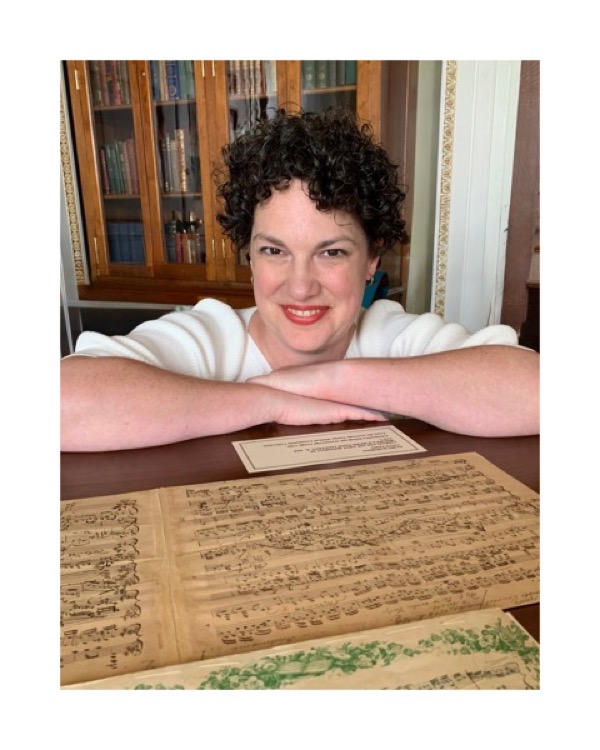
Sarah Fritz
The book also explores Clara’s influence on Robert Schumann, Johannes Brahms, and Franz Liszt. Fritz believes her contributions as a composer have received less attention. Instead, scholars tended to focus on her relationships with her male counterparts.
When asked whether some works attributed to Robert Schumann might actually have been composed by Clara, Fritz was careful to distinguish evidence from speculation.
Fritz found no evidence that Clara’s compositions were published under Robert’s name, but she believes Clara’s musical influence on her husband was unmistakable. The two worked closely together and knew each other’s music so well that, as Fritz put it, “Her fingerprints are everywhere.”
What is documented, though, is Clara’s role in preparing Robert’s music for publication. She edited his works, sometimes copied out the music, and helped prepare manuscripts for the printer. Robert constantly developed new ideas, and Clara often organised the material for publishers.
Fritz suspects Clara may have helped finish some of Robert’s unfinished works, though she found no direct evidence. More importantly, she argues that Clara’s musical language can be heard in Robert’s compositions because the two worked closely together and knew each other’s music so well.
Clara Schumann’s Piano Concerto in A minor, Op. 7: II. Romanze (performed by Beatrice Rana)
Fritz also identifies musical connections between Clara’s compositions and works by Liszt and Brahms. She points to similarities between Clara’s Piano Concerto and Liszt’s later concerto, including aspects of their form and the use of a cello solo. She also discusses connections with Robert Schumann’s Piano Concerto and both of Brahms’s piano concertos. In her book, she presents another discovery: a melody by Clara in one of Brahms’s works.
For Fritz, these connections show that Clara was not simply a pianist supporting male composers. She was an artist whose musical ideas contributed to the creative world around her.
The historical evidence, however, shows a contradiction. Although Clara was respected as a pianist, male composers trusted her musical judgment. Fritz points out that composers such as Anton Rubinstein, Edvard Grieg, and Max Bruch asked her for her opinion on their works. Yet the social views of the time made it hard for women to be acknowledged as composers.
“Clara never called herself a composer,” Fritz said. She pointed out that when Clara began her career, performers were often asked to compose as well, and composition has remained at the heart of Clara’s professional life, even as society became more inclined to regard it as an unsuitable ambition for women.
Fritz highlights the misogyny of a musical world that regarded Clara’s judgment as a pianist but doubted women’s capability to compose; she also mentions the dismissive remarks of some prominent people, such as the conductor Hans von Bülow, who in the 1880s stated that women could only act as copyists and not as creators.
These attitudes still matter today. During her research, Fritz came across some young women composers who had been told that Clara thought women should not be allowed to compose. The idea came from a remark in Clara’s diary, but Fritz argues it was taken out of context. Clara was referring to the attitudes she had encountered, not saying she opposed women composing.
Fritz wanted to correct this misconception; Clara had a passion for composing, she said, and the misinterpretation of her words has made it harder for present-day women composers to see themselves portrayed in Clara’s story.
Madame Composer has been met with an enthusiastic response, including positive reviews and a sold-out concert featuring Clara’s music and narration; at the same time, Fritz has drawn criticism from people who doubt her research or disagree with her views on Clara’s influence on Liszt.
These different reactions show that reevaluating Clara’s position in music history requires addressing a deeper problem. Although her works have been performed and studied for decades, Fritz thinks they have not yet received the recognition they merit for their artistic and historical significance.
“It can no longer be claimed that her work has been ignored,” she said. “Although it has been played, the point now is to persuade people of its value and importance.”
In addition to her compositions, Clara’s contributions cannot be separated from the history of nineteenth-century German music. Fritz also stresses Clara’s contribution to the formation of the classical repertoire by promoting Bach’s fugues, Beethoven’s sonatas, and difficult pieces by Chopin, and by helping to bring forward the music of Robert Schumann and Brahms to a broader audience. The works she selected for performance shaped what audiences heard and what later generations came to consider essential repertoire.
With Madame Composer, Fritz hopes Clara to be recognized not simply as Robert Schumann’s wife or a celebrated pianist, but as a composer and influential musician who helped shape the musical world around her.
For more of the best in classical music, sign up for our E-Newsletter