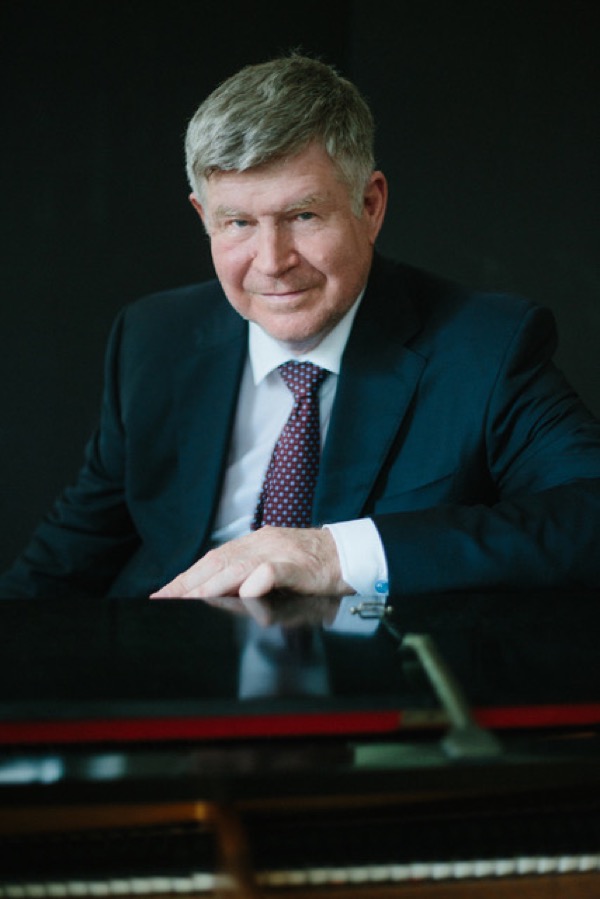
Just think of any Hungarian musician or composer you know. Chances are pianist Dénes Várjon has worked on their music or with them. The list includes, but is not limited to, Zoltán Kodály, Sándor Végh, György Ligeti, György Kurtág, Ferenc Rados, Miklós Perényi, Iván Fischer, Zoltán Kocsis, and András Schiff—a pantheon of the Bartók Conservatory and Liszt Academy.
Várjon’s pianism speaks of poetry. Watching him with Antje Weithaas over three October nights on STAGE+ from Pierre Boulez Saal brought back memories. The two supreme interlocutors enlivened all of Beethoven’s violin sonatas last September in Shanghai. This autumn, Várjon returns with Bach, Beethoven, and Schumann, following, in his own words, “an entire month devoted to Bartók”.
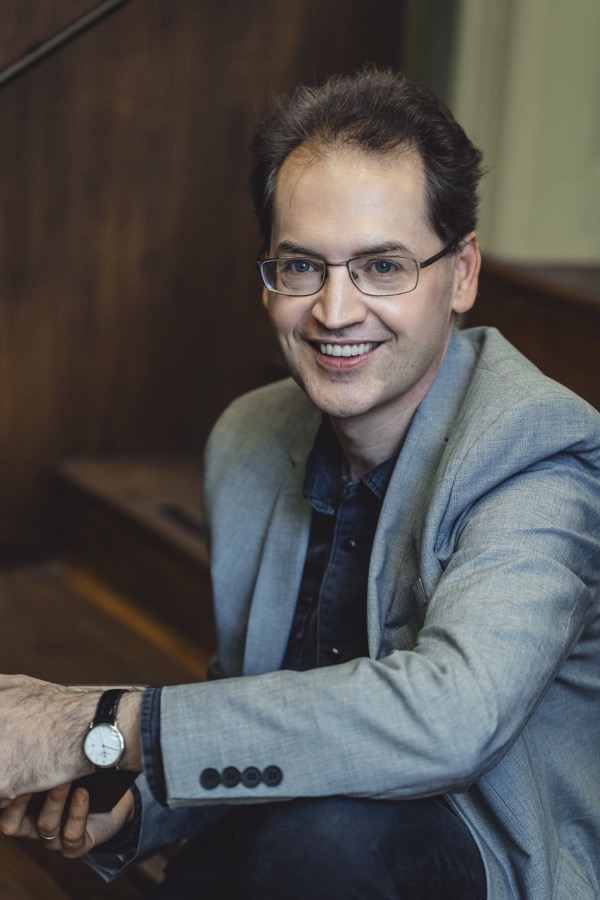
Dénes Várjon (Photo by Liszt Academy Mihály Kondella)
What did the poet say in Der Dichter spricht from Schumann’s Kinderszenen?
For me, Schumann is one of the most personal composers. When I listen to or play his music, I often feel he is sharing his most intimate feelings and thoughts with us. It is as though we are reading his diary.
I feel that Kinderszenen was not intended for children, but rather as an adult’s retrospective reflection on childhood, filled with remembrance and nostalgia. It is a bit like opening a photo album and reliving our past: what it was like when an important event happened, how we played tag, warmed ourselves by the fireplace, dreamed about adult life, and experienced sorrow and absolute happiness—in other words, what it meant to be a child.
This kaleidoscope of experiences concludes with the penultimate chapter, “Child Falling Asleep,” and for me, “The Poet Speaks” suddenly rings out in an adult voice. It feels like confronting our own deepest emotions, as if the composer were asking: What kind of adult have you become? What have you realised from all of this? How true have you remained to yourself? Schumann closes many of his works with a “Poet Speaks” epilogue. For me, these are ineffably personal and moving confessions.
Robert Schumann: Kinderszenen (Scenes of Childhood), Op. 15: No. 13. Der Dichter spricht (The Poet Speaks) (Dénes Várjon, piano)
Do you think the original titles of Schumann’s Fantasie in C major accurately describe the three movements (Ruinen, Trophäen, Palmen)?
Schumann composed the Fantasie in C major during a difficult period in his life, when his beloved and future wife, Clara, was kept from him by her strict father, Friedrich Wieck. In Schumann’s own words, it was the most passionate music he had ever written.
The piece is extraordinarily complex—simultaneously a fantasy and a sonata form—and can be understood as a romantic, revitalising rethinking of the sonata form. The quotation from Beethoven’s song cycle An die ferne Geliebte at the end of the first movement (as well as in the so-called “Budapest ending” of the third movement) is very important, echoing the motto: through all the wild noise of the world, one faint sound reaches the one who quietly listens.
After the first movement’s huge emotional arc, the second movement is both a march and a carnival. The Schumannian carnival plays an important role; beneath the masks lie hidden secrets and emotions about to come to life. Schumann is present in this carnival as Florestan and Eusebius, culminating in a strikingly virtuosic finale.
The third movement is itself a “Poet Speaks,” crowning this personal and poignant work with vast emotional spaces. The original movement titles are evocative, but I feel no loss in Schumann ultimately discarding them. The piece is technically demanding, but the real challenge lies in discovering, living through, and communicating its musical and emotional inner life.
Robert Schumann: Fantasie in C Major, Op. 17: I. Durchaus phantastisch und leidenschaftlich vorzutragen (Dénes Várjon, piano)
How has working on all of Beethoven’s violin sonatas informed your approach to his piano pieces?
I consider it essential to explore Beethoven’s oeuvre, from the Op. 1 works through to his late compositions, so we can grasp the immense inner journey Beethoven himself undertook. Beethoven’s works have many faces. He is an indescribably rich composer. He always expresses himself strongly; he never compromises or takes an easy path.
In the late works, such as the Piano Sonata Op. 109, the highest order of simplicity and complexity are present at the same time. In the third movement, the music ascends to transcendent heights. Studying these late pieces accompanies a musician throughout an entire lifetime. One must return to them repeatedly, striving to comprehend and feel ever more deeply this world that can never be entirely reached. Recording all of the violin sonatas with Antje Weithaas was a deeply significant milestone for me.
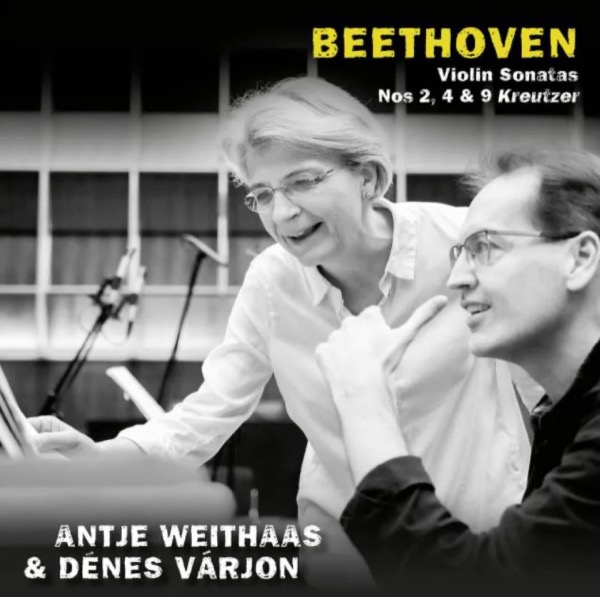
Dénes Várjon and Antje Weithaas’ Recording
I watched videos of you playing Beethoven’s various variations with Miklós Perényi. Can you talk about how Beethoven’s variations have evolved?
Beethoven composed extensively in variation form, and these works vary widely. A profound difference exists between a set of variations that stands as an independent piece and one that serves as a movement within a sonata. It also matters whether the variation form appears in the first movement—as in the Sonata Op. 26 in A-flat major—or in the final movement, as in Op. 109.
In these sonatas, the variation cycle forms an integral part of the whole, binding the movements together psychologically. It is also fascinating to observe how a set of variations changes depending on whether Beethoven uses his own theme or a popular opera excerpt of his day. Equally intriguing is the range of variations: themes from Die Zauberflöte prompted relatively short series, while he built one of his most monumental works from the very simple Diabelli theme.
For me, Op. 109 is one of the finest examples. The variation set in the third movement grows organically out of the preceding two movements—which are themselves closely intertwined—and guides us into an entirely new world. Drawing a comparison with Schumann (who, in my view, drew immense inspiration from Beethoven), one could say that when the theme returns at the end of the movement, it is Beethoven’s own “The Poet Speaks.”
Miklós Perényi and Dénes Várjon play Beethoven in 2019
You recently performed concerts in honour of György Kurtág. Since you will bring Bach’s English Suite this time, can you share a bit more about Bach and Kurtág?
György Kurtág was my teacher at the Liszt Academy for more than ten years, an experience of inestimable value. As a composer, Kurtág crafted and realised his own musical voice in such a way that, though unique and groundbreaking, every fibre of it remains rooted in the past, born of a profound, intimate knowledge of the old masters.
As his student, it was an extraordinary experience to witness his encounters with the music of Bach, Mozart, Beethoven, Haydn, Schubert, Schumann, Brahms, Bartók, and others—to observe how such a monumental composer approaches the works of the great masters, breathing life into them with his immense imagination, and forging the unity of content, emotional presence, and form.
On many occasions, I heard his four-hand Bach transcriptions performed with his wife, Márta Kurtág. Every time, I felt I was hearing the music of Bach and Kurtág simultaneously, as though they had composed these pieces hand in hand. Kurtág did not merely arrange them; he shared his own vision of them with us, becoming an equal creative partner to Bach.
Márta and György Kurtág play Bach Transcriptions
How has András Schiff, another Bach expert, influenced you?
I recently attended András Schiff’s concerts in Budapest. He was performing in Hungary for the first time in 16 years, and both concerts were truly exceptional and festive. For me, András Schiff is the greatest interpreter of Bach’s music who has ever lived. He perceives, feels, and understands Bach’s music with such depth and richness that it captivates me completely every time.
I have known András Schiff since I was 17, and he has been one of the greatest musical influences in my life. I am grateful that he worked with me regularly during my formative years, fundamentally shaping my approach to music. It was an enormous privilege to hear him perform almost the complete works of Bach, all the sonatas of Mozart, Beethoven, and Schubert, as well as compositions by Schumann, Brahms, Mendelssohn, Haydn, Bartók, Dvořák, and Janáček, to name just a few.
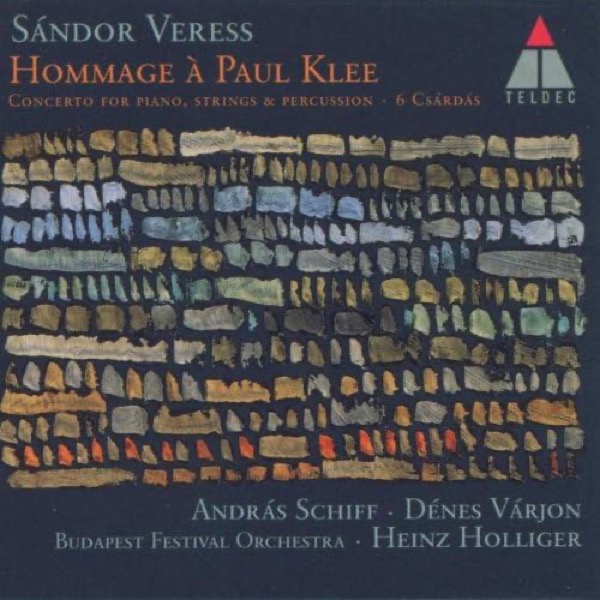
Dénes Várjon and András Schiff’s Recording
Your latest album focuses on Bartók and includes his Three Hungarian Folksongs from Csík. Can you talk about why you often play it as an encore?
Bartók has been an important composer to me since childhood. I grew up with his works, and for us Hungarian musicians, his music is like our mother tongue. I am very attached to his music in many ways, and this admiration has only grown in recent years.
My entire past month has been dedicated to Bartók: we recorded all three piano concertos with Concerto Budapest under the baton of my friend András Keller, and we will soon record the Op. 1 Rhapsody and the Op. 2 Scherzo as well. Bartók’s chamber music is also very dear to my heart, particularly the two Sonatas for Violin and Piano.
Three Hungarian Folksongs from Csík is a beautiful example of what folk music meant to Bartók. The extraordinary simplicity of this piece has an almost poignant effect; one can practically see and sense the beauty of the landscape where these songs were sung, through the distinctive sound of the peasant flute. I often perform this piece as an encore, especially after piano concertos. It feels fitting not only after works by Bartók, Liszt, or Dohnányi, but even after Beethoven.
Dénes Várjon plays Bartók’s Three Hungarian Folksongs from Csík
What made you decide to record a four-hand version of Mahler’s Symphony No. 1?
My wife, the pianist Izabella Simon, and I frequently perform Bruno Walter’s magnificent four-hand arrangement of Mahler’s Symphony No. 1. The idea did not originate with us; rather, a few years ago, the fantastic conductor Iván Fischer invited us to perform the piece as part of the Budapest Festival Orchestra’s Mahler concerts in Bruges.
We were both thrilled by the invitation, as we are great admirers of Mahler’s music, and there are very few opportunities to explore it on the piano, aside from the songs and the piano quartet movement. Preparing the work was a pure delight as we immersed ourselves in this wondrous world. We grew so fond of the arrangement that we recorded it and have been performing it ever since. Perhaps one day audiences in China will have the opportunity to hear us perform it, too.
A crucial realisation for us was that we should not attempt to “compete” with the orchestra. That would be impossible. On the piano, however, the piece’s harmonic landscape comes to life in a more tangible, sculptural way, and musical timing comes more naturally in the four-hand setting. When we play four hands, Iza always plays the upper part, and I play the lower secondo part. This feels entirely natural to us, so we never change it.
Izabella Simon and Dénes Várjon play Mahler: Symphony No. 1
See Dénes Várjon’s calendar at https://www.instagram.com/varjon.denes.pianist/
For more of the best in classical music, sign up for our E-Newsletter