Sergei Prokofiev’s piano music has played a significant role in Latvian pianist Antonina Suhanova’s artistic development since her adolescence. As a young listener in Riga, she was first captivated by Prokofiev’s distinctive sound world, and his piano sonatas have remained central to her growth as a musician. With her debut recording, Prokofiev: Piano Sonatas 6, 7 & 8, Suhanova presents three works that have accompanied her throughout various stages of her career.

Antonina Suhanova © Kaupo Kikkas
The album was recorded at Wyastone Hall in Monmouth, UK, produced by Grammy Award-winning Andrew Keener and engineered by Oscar Torres. For Suhanova, this project fulfils a longstanding artistic ambition, even though she had not initially envisioned it as her debut recording. “It was always my artistic dream to record this specific repertoire,” she explains. “Life went like this that it is becoming my first album.”
Suhanova’s connection with Prokofiev dates back to childhood, when she listened to classical music radio broadcasts in Riga and was particularly taken with his Fifth Piano Concerto. “It was such a new sound world, and I was absolutely amazed. I really loved Prokofiev.” Her musical education in Latvia’s demanding system of specialised music schools, rooted partly in the Soviet tradition, emphasised technical rigour through extensive work on scales, exercises, and repertoire. Yet she credits her early teachers with instilling discipline while making the learning process exciting and rewarding. During her teenage years, she also began exploring Prokofiev’s piano sonatas, starting with the Seventh.
Moving to London at 21 marked another important stage in her artistic development. “I think it gave me artistic freedom, opening my eyes to more modern composers,” she says. At Guildhall, she studied with Ronan O’Hora and met many great pianists like Matti Raekallio, Robert Levin, and Yefim Bronfman, who influenced and encouraged her to explore new musical directions. During this period, she continued exploring Prokofiev’s sonatas, particularly the Eighth, which became especially important to her. She approached the Sixth later, when she felt she had something to say through the work.
Although the three sonatas are often grouped under the collective label War Sonatas, Suhanova deliberately avoids the term. Prokofiev himself never referred to them that way, and she feels the label can limit how listeners perceive the works.
Composed between 1939 and 1940, the Sixth Sonata opens with a powerful musical statement. Suhanova acknowledges the work’s connection to the turbulent historical period in which it was written, yet she hears more than the forcefulness often associated with it. She also finds Prokofiev’s characteristic humor and zest for life in the music. She believes its technical and interpretive demands call for a mature approach.
Completed two years after the Sixth Sonata, the Seventh Sonata presents virtuosity and excitement that are balanced by significant expressive depth. Suhanova highlights the second movement, noting its introspective and haunting character, which contrasts sharply with the surrounding material. She also perceives echoes of Prokofiev’s earlier Tales of an Old Grandmother, suggesting a link between the composer’s youthful imagination and his mature piano writing.
The Eighth Sonata, completed in 1944, is particularly remarkable with its constantly changing textures, tempos, and moods. She finds the moment of hope when it settles into a clear B-flat major at the first movement’s closing passage. She describes the second movement through an evocative image: “When you walk through the park in any city in the spring, you can feel just the warm air through the harmony.” The movement’s shifting colours create an almost picturesque atmosphere, while the writing throughout the sonata reveals the composer’s extraordinary imagination. In the final movement, she hears a possible literary association with Mikhail Bulgakov’s The Master and Margarita. Prokofiev and Bulgakov knew each other in the 1930s, although no documented evidence connects the novel directly to the sonata. For Suhanova, however, these associations offer another way to engage with the imaginative world surrounding the music.
Suhanova’s interest in Prokofiev led her to understand the composer’s personality and life by reading his diaries and biographies. She is particularly struck by how he maintained his artistic individuality despite censorship and the political climate after his return to the Soviet Union. “He had this very pragmatic sort of understanding: I can do this, but I have to do that. But he always stayed true to his artistic beliefs,” she observes. The diaries also reveal a more personal side of the composer, from his enjoyment of good restaurants, cars, and travel to his struggles to make a living and find acceptance in different countries. Although Prokofiev left few written explanations of how his sonatas should be performed, Suhanova finds his musical notation remarkably precise. “He was so precise in his notation in the music. It’s pretty clear what he wanted from us.”
She feels the three sonatas are full of interpretive possibilities. “It’s the repertoire you can always find something new to say.” On the other hand, recording works you’re already familiar with has an inherent self-reflective quality. She’s already noticed things she might do differently in the future, and she sees that as part of the artist’s journey: each time you come back to the music, you’ll find something new.
With this debut recording, Suhanova brings together three works that have accompanied her through different stages of artistic growth. Rather than treating them simply as monuments of twentieth-century piano repertoire or reflections of a particular historical period, she approaches each as an individual musical world. Her interpretations invite listeners to look beyond Prokofiev’s reputation for forceful rhythms and striking sonorities and discover the humour, lyricism, imagination, and humanity that she finds at the heart of his music.
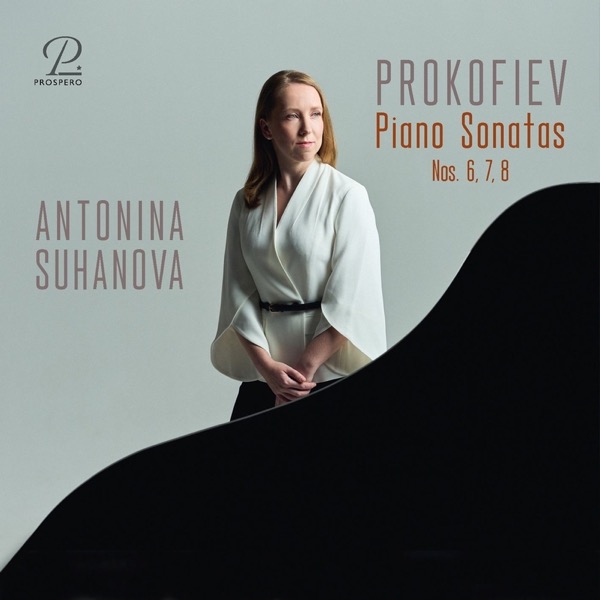
Prokofiev: Piano Sonatas 6, 7 & 8
Performer: Antonina Suhanova
Label: Prospero
Release Date: 4 September 2026
For more of the best in classical music, sign up for our E-Newsletter