One of the most important pieces of musical life that we have to take for granted is improvisation. It’s not written down, it’s not preserved, it’s kept solely in the mind of the performer. We get some hints of this in classical music when, for example, a piano part the composer intended to play is blank in the score at the premiere. For publication, s/he had to write something down, but for the premiere, with the composer at the keyboard, that wouldn’t have been necessary.
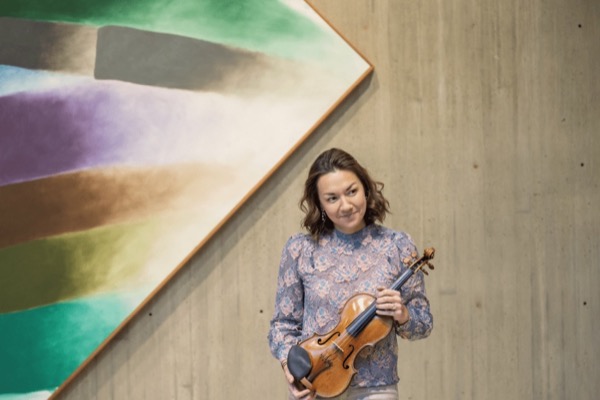
Ariana Kim (photo by Rachel Philipson)
That was the case with Mozart’s Violin Sonata in B flat major, K. 454. Written for the violin virtuoso (and graduate of Venice’s Ospedale della Pietà) Regina Strinasacchi for her appearance in Vienna in 1784. They appeared together at the Theatre am Kärntnertor with Emperor Joseph II in the audience.
As Roger Moseley reveals in the notes, given the short time for preparation (only 5 days), although Strinasacchi’s part was written fully out, Mozart’s keyboard staves were blank, as observed by the Emperor. When the composer is the accompanist, s/he is free to react to the performance on the spot, and Mozart left that spot open for himself.
Wolfgang Amadeus Mozart: Violin Sonata in B-flat Major, K. 454 – III. Allegretto
Ariana Kim tries to follow the sound of the time: she not only tunes her violin down to 430 Hz, uses gut strings and also has the accompaniment performed on a historical fortepiano. Kim considered what she had to do to adjust her violin technique to accommodate the sound of the ‘buzzy but smaller piano’ after being used to playing on a modern Steinway. Could the performer (Roger Moseley) use the moderator (a lever that changes the colour and volume of the instrument) to its best advantage? Were there hidden problems in the use of an earlier tuning system? These are all questions and problems that someone accustomed to older pianos and older piano technique can advise on, and Kim thanks Malcolm Bilson for his help in this regard.
The other work that uses a fortepiano was Beethoven’s Violin Sonata in E-flat Major, Op. 12 No. 3. Written in 1798, only 5 years after Mozart’s work, Beethoven substitutes a greater reliance on rhythmic possibilities for Mozart’s infinite spinning out of melodies.
For the second half of the album, we shift from classical to world music. From India, we have Kim’s improvisation on the Raga Aalapana, three works by percussionist Shane Shanahan, traditional songs from Macedonia and Bulgaria, and a work by the violinist herself, Migrating Home, for violin and looper pedal. A looper pedal is more usually used in electric guitar performance: it records your playing and then plays it back to you in a loop. The sound can be cumulative: you record your playing; as it loops back, you play over the top of it and record both voices; then 2 voices loop back, etc.
It’s an excellent example of Kim’s theory of improvisation. She says she’s exploring ‘freedom and spontaneity’ within the language not only of 18th-century European art music but also of Indian music and contemporary improviser-composers. For us, the listeners, it’s an education in motion and in linking the many musics of the world.
As she says, in keeping with the always-moving world of the improviser, this ‘music serves as a “snapshot” in aural time, representing our musical imaginations of the moment’. It’s only when something is put down on paper that improvisation stops – the live performance world the improvisation lives on!

(un)common thread: exploring improvisation from Mozart to Macedonia
Ariana Kim, violin, with Roger Moseley, fortepiano, and Shane Shanahan, percussion
Saffron Soul Records SNH0ED-519061
For more of the best in classical music, sign up for our E-Newsletter