Music has long served as a powerful means of connection—transcending nationality, race, ethnicity, and cultural boundaries. It is a language without borders, capable of bridging distances that geography and politics often impose. In today’s complex global climate, this role feels more vital than ever.
As a musician from Iran, I have always felt a deep responsibility to share and represent my culture through my art. Living in the United States has given me the freedom and platform to express my personal, cultural, and even political perspectives, and to engage Western audiences in a meaningful dialogue. Each work in this project reflects a different facet of our shared human experience, creating a bridge between Iranian and Western musical traditions.
Nearly five years ago, I began developing the idea for a project that would connect Western classical music with Iranian musical language, culture, and identity. After consulting with composer and educator Karen Keyhani, I began reaching out to a group of composers whose voices I deeply admire.
The first concert in this series will take place on April 21 at 5:30 PM in Doc Rando Hall at the University of Nevada, Las Vegas, followed by a studio album scheduled for release in summer 2026.
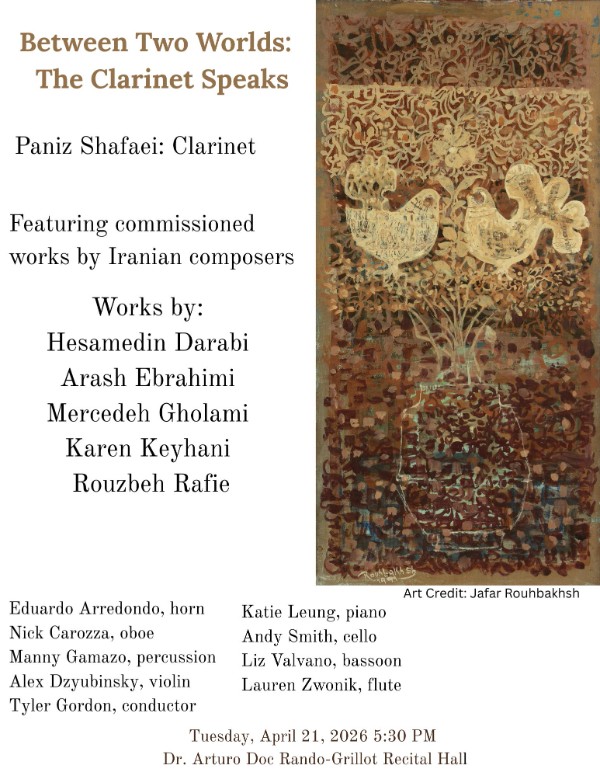
This program features five newly commissioned works, all written for and dedicated to me, alongside a U.S. premiere for solo clarinet. These composers—Hesamedin Darabi, Arash Ebrahimi, Mercedeh Gholami, Karen Keyhani, and Rouzbeh Rafie—represent diverse artistic backgrounds, generations, and geographic experiences.
Darabi, Ebrahimi, and Keyhani are active composers and educators based in Iran, contributing significantly to both academic and professional musical communities. Gholami and Rafie, having studied in Europe, continue to live and work internationally. Each composer brings a unique perspective, drawing inspiration from sources such as Persian poetry, political events, folk traditions, and the natural world. The instrumentation varies widely across the program, further enriching its sonic landscape.
Ella be Roozgaran
Karen Keyhani
Karen Keyhani’s Ella Be Roozgaran (“Over the Endless Years”) is written for solo clarinet and fixed media. The electronic sounds are derived from lamentation traditions of Iran’s Zagros region, rituals that express collective grief among Kurdish, Luri, and Bakhtiari communities. The work incorporates folk instruments such as the sorna and dohol, along with characteristic vocal styles. The title is drawn from a poem by the 13th-century Persian poet Saadi: “The love that has settled in one’s heart over time cannot be removed, except with time itself.”
Arash Ebrahimi
Arash Ebrahimi’s Va Anche Mand Tanha Pezhvaki Bood (“And all that remained was only an echo…”) is a duet for clarinet and piano. The piece reflects his personal experiences and was shaped during the onset of the Iran–Israel conflict in June 2025. Ebrahimi often describes Persian music as inherently minimalist, a concept that resonates throughout this work. Drawing on Persian modes, intervals, and rhythmic structures, he also reimagines the clarinet as a ney, using air sounds, ornamentation, multiphonics, and nuanced timbral shifts.
Mercedeh Gholami
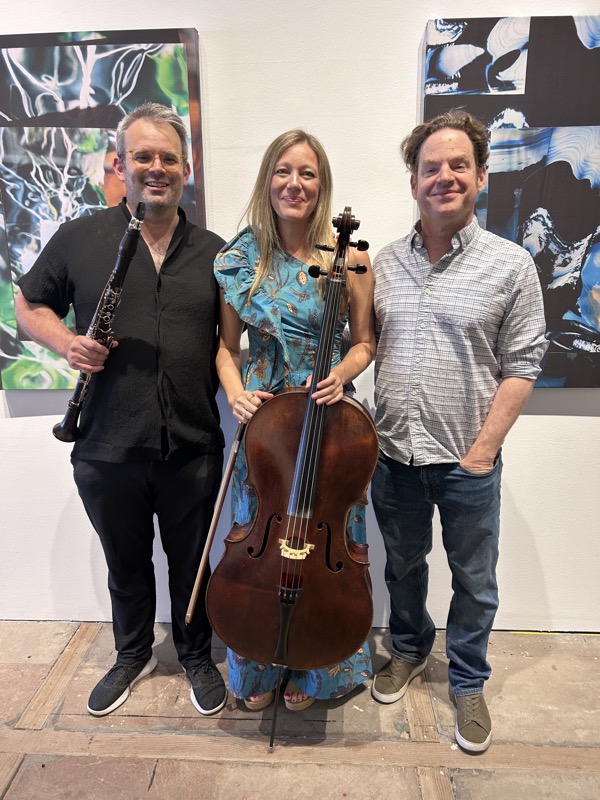
Mercedeh Gholami’s A Piercing Moan, written for clarinet, cello, and horn, is a deeply moving work dedicated to the memory of Mohsen Mohammadpour, a 17-year-old who was killed during the November 2019 protests in Iran. Gholami, a recent graduate of the Royal Academy of Music in Denmark, is known for her socially and politically engaged compositions. This trio serves as a musical narrative of Mohsen’s tragic story, capturing both grief and remembrance.
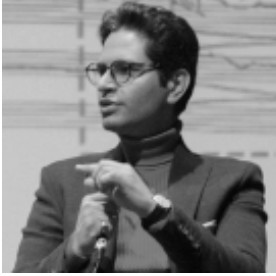
Hesamedin Darabi
Hesamedin Darabi’s Seyr (“Process”) reflects his distinctive compositional voice. While he frequently writes for Western instruments, Darabi considers the essence of his music fundamentally Iranian. He approaches elements such as rhythm, modes, and form as flexible tools, shaping them through a highly personal and contemporary lens.
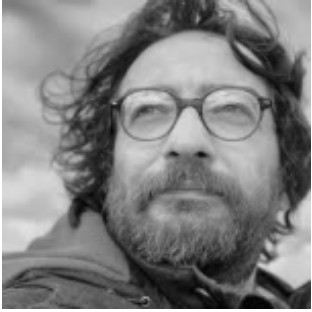
Rouzbeh Rafie
Rouzbeh Rafie’s Shimmering Landscapes is a chamber work in three movements, each inspired by natural scenes in the Netherlands, where he resides. Rafie is particularly interested in the raw timbral qualities of folk instruments, often incorporating techniques such as air sounds to evoke a sense of imperfection and earthiness. His harmonic language is based on gradual transformations between closely related pitch fields, mirroring the shifting sand landscapes that inspire the piece.
His additional work, Air Sound, a three-movement solo clarinet piece receiving its U.S. premiere, explores the developmental journey of a clarinettist, from beginner to professional.
This project is deeply personal to me. I believe that the classical music repertoire must continue to evolve, embracing greater diversity, new voices, and broader perspectives. By collaborating with Iranian composers, I aim to expand the clarinet repertoire with works that emerge from outside the Western tradition, works that carry distinct histories, sound worlds, and ways of musical thinking.
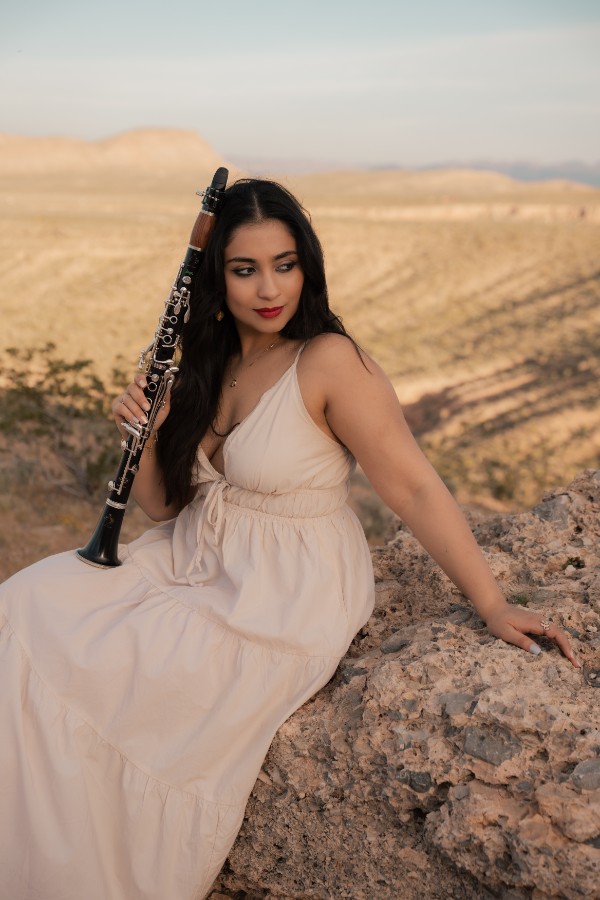
Paniz Shafaei
Paniz Shafaei is a clarinettist and doctoral candidate at the University of Nevada, Las Vegas. She has performed with the Las Vegas Philharmonic, Opera Las Vegas, and in international festivals and recordings. Her work focuses on commissioning and promoting music by Iranian and Persian-speaking composers, fostering cross-cultural dialogue through performance and recording.
For more of the best in classical music, sign up for our E-Newsletter