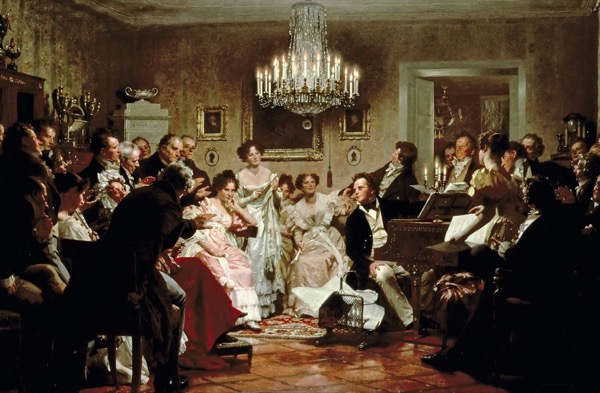
Franz Schubert died in November 1828 at the age of thirty-one. He left behind an extraordinary circle of friends: poets, singers, publishers, pianists, and fellow composers who gathered around him in Vienna’s coffeehouses, salons, and intimate gatherings known as Schubertiades.
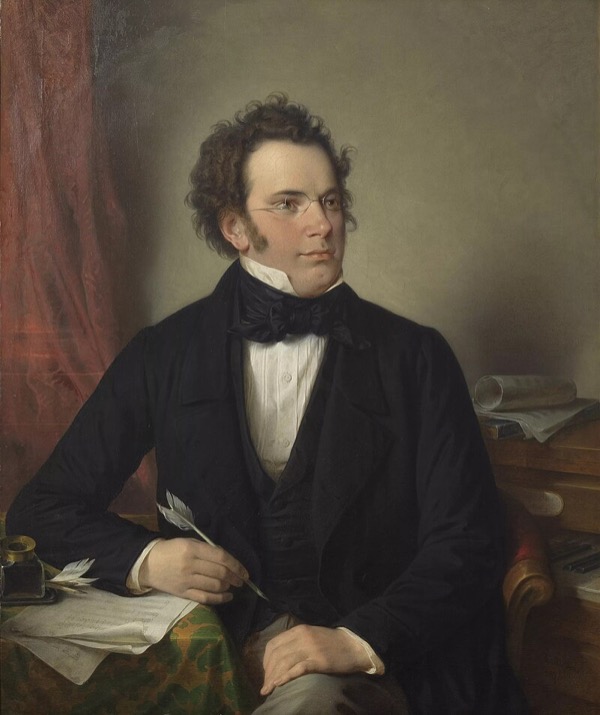
Wilhelm August Rieder: Franz Schubert, 1875 after 1825 watercolour (Vienna Museum)
These weren’t peripheral figures in his life. They were his collaborators, his roommates, and even his favourite performers.
So what happened to Schubert’s friends after he died?
Johann Mayrhofer (1787–1836)
Schubert’s “Beim Winde” (“When the wind blows”)
Johann Mayrhofer was a poet born in Steyr, Austria, who studied theology and jurisprudence at the University of Vienna. He befriended Schubert in 1814, then took rooms with him in 1818.
He never married, and historians agree that he was gay.
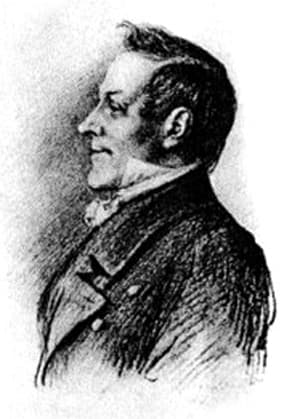
Schwind: Johann Mayrhofer
Schubert admired Mayrhofer’s poetry and drew heavily on it in his own music. Mayrhofer provided the texts to two operas and nearly fifty songs (including “Beim Winde” above).
After Schubert died in November 1828, Mayrhofer wrote down his memories of his friend in a document titled Memories of Franz Schubert, which was published the following year.
Less than a decade after Schubert’s death, Mayrhofer died by suicide in 1836, jumping from his office window during a cholera epidemic.
We looked at the close relationship between Schubert and Mayrhofer here: https://interlude.hk/muses-musingslusty-eye-music-guy-johann-mayrhofer-franz-schubert/.
Johann Michael Vogl (1768–1840)
Schubert’s “Erlkönig”
Like Mayrhofer, Vogl was born in Steyr. He moved to Vienna in 1786 to study and practice law, but music was his true vocation; he was a talented baritone. In 1795, at 27, he made his operatic debut at the Vienna Hofoper.
Nearly two decades later, in 1813, a teenage Schubert heard him sing in a production of Gluck’s Iphigénie en Tauride. From that night, it became Schubert’s dream to have Vogl sing his work – a dream that was realised when the two finally met in 1817.
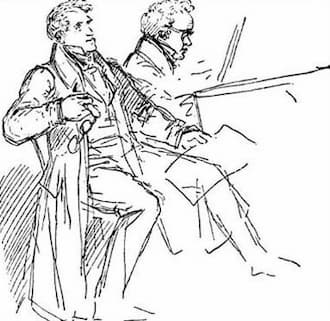
Franz Schubert and Johann Michael Vogl
Schubert wrote one of his most famous songs, “Erlkönig,” in 1815, but he revised it several times before publishing it as Op. 1 in 1821. The public premiere took place that March with Vogl as the singer.
After Schubert died in 1828, Vogl continued to sing and popularise his late friend’s works. He died on the twelfth anniversary of Schubert’s death, in 1840.
Today, “Erlkönig” is recognised not just as one of Schubert’s greatest songs, but as one of the greatest songs of the century.
Anton Diabelli (1781–1858)
Schubert’s variations on Diabelli’s waltz for the Vaterländischer Künstlerverein anthology
Anton Diabelli was born in 1781 in the town of Mattsee, half an hour outside Salzburg. As a boy, he took music lessons from Michael Haydn, Joseph Haydn’s brother.
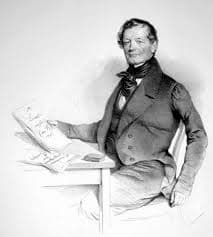
Anton Diabelli
Diabelli moved to Vienna in 1803 and began working as a music teacher and score proofreader. In 1817, he started his own music publishing business. He specialised in easy, accessible arrangements of popular music.
In March 1821, Schubert participated in his anthology project, Vaterländischer Künstlerverein (which, in Beethoven’s hands, would evolve into the famous Diabelli Variations).
That same year, Diabelli became Schubert’s first publisher and agreed to print “Erlkönig.”
Unfortunately, their friendship was short-lived; they quarrelled in 1823, and Schubert began working with other publishers.
But after Schubert died, Diabelli was shrewd enough to buy Schubert’s manuscripts from his brother Ferdinand. Ferdinand sold him so many manuscripts that Diabelli could continue selling “new” works of Schubert’s for thirty years after his death.
Josef von Gahy (1793-1864)
Schubertiade
Franz Schubert: Piano Trio in E-Flat Major, Op. 148, D. 897, “Notturno” (arr. J. von Gahy) (Anthony Goldstone, piano; Caroline Clemmow, piano)
Josef von Gahy was born in Hungary in 1793. He became a civil servant, but he was a talented pianist.
Around 1818, he moved to Vienna, where he joined Schubert’s social circle. At Schubertiad gatherings, they’d play his four-hand piano works together. He became Schubert’s favourite piano duo partner.
After Schubert died in 1828, von Gahy began making four-hand piano transcriptions of his late friend’s works, including the Trout Quintet, Octet, Arpeggione Sonata, and the Notturno from the Piano Trio in E-flat Major.
These transcriptions are deeply touching tributes to Schubert’s legacy from a devoted, admiring friend.
Anselm Hüttenbrenner (1794–1868)
Schubert’s Unfinished Symphony
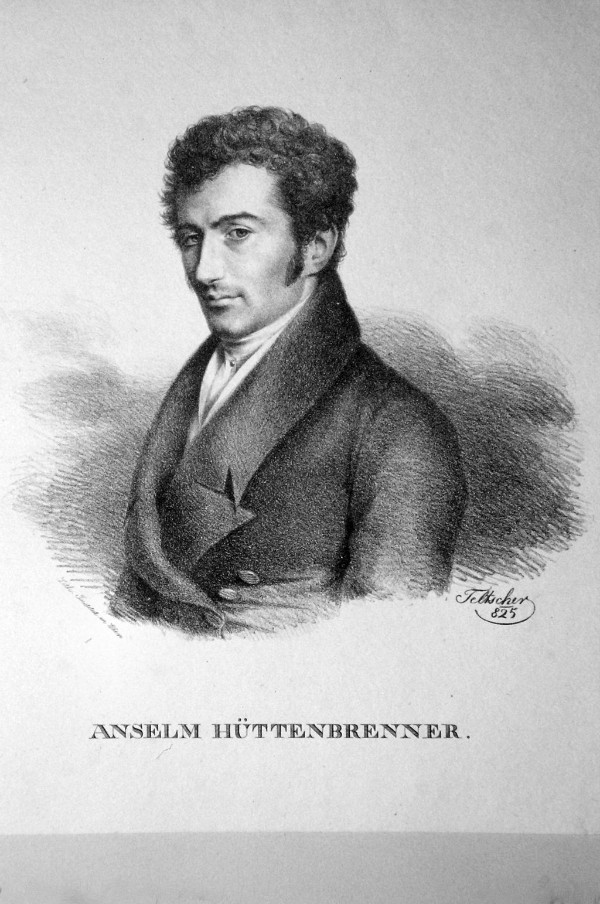
Anselm Hüttenbrenner was born in Graz to a wealthy landowning family. Like many of Schubert’s friends, he studied law but was drawn to music instead.
In 1815, he relocated to Vienna to study with Antonio Salieri. He began publishing his compositions soon after.
Although he kept his day job as a government worker, he became so integrated into the Viennese music scene that he was one of the two people at Beethoven’s bedside when he died in 1827.
Anselm Hüttenbrenner
In 1823, Schubert gave him the score to his Unfinished Symphony. Hüttenbrenner kept that score for decades after Schubert’s death.
It only changed hands in 1865, when a young conductor named Johann von Herbeck – born after Schubert had died – took possession of the score to give the work its premiere over forty years after its composition.
Franz von Schober (1796–1882)
Schubert’s “Viola” on a text by Schober
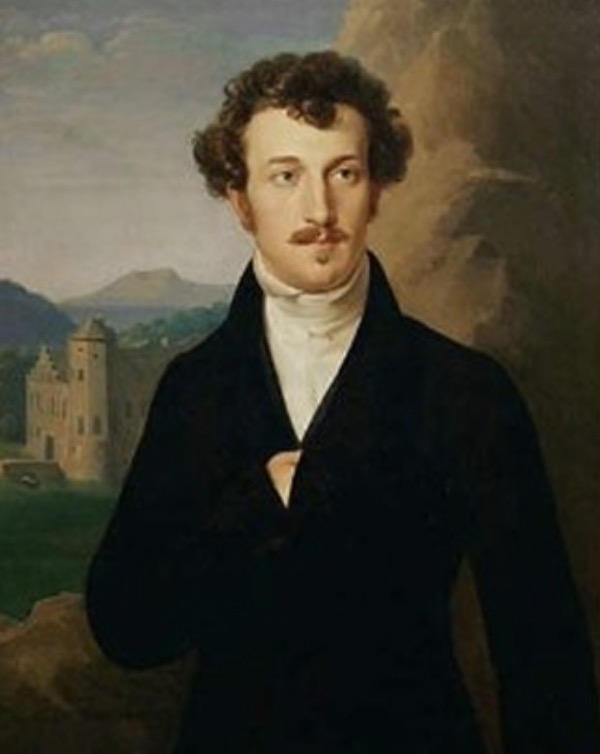
Franz von Schober was born in 1796 in Sweden to Austrian parents. When he moved to Vienna to study philosophy, he befriended various musicians, including Johann Mayrhofer and Franz Schubert. Schober became so close to Schubert that the two nicknamed themselves Schobert.
Rumours have circulated about the nature of their relationship, given that in 1823 Schubert wrote to Schober, “Only you, dear Schober, I shall never forget, for what you mean to me, no one else can mean, alas!”
Like Mayrhofer, he wrote texts that Schubert set to song. One of the best known is “Viola.”
Franz von Schober
In 1822, when Schubert first began showing symptoms of his fatal syphilis infection, Schober invited Schubert to share his one-room apartment with him. Schubert wrote parts of the Unfinished Symphony there.
After Schubert’s death, Schober travelled Europe and befriended Liszt. He even convinced Liszt to mount a production of Schubert’s opera Alfonso und Estrella. (Awkwardly, Liszt liked the music and hated Schober’s libretto.)
Decades later, when asked about Schubert’s love life, Schober replied that there had been “a great love story”, but that he feared it was unpublishable – leaving readers to draw their own conclusions.
Conclusion
Schubert’s friends outlived him by years, decades, and in Franz von Schober’s case, more than half a century.
But none of them ever forgot him. Vogl kept performing his songs. Von Gahy kept transcribing his scores. Diabelli kept publishing his manuscripts. Hüttenbrenner kept his Unfinished Symphony tucked away for forty years. Schober spoke years later of the friendship – and maybe something more – he’d enjoyed with the great composer.
When Schober died in 1882, it marked the end of Schubert’s living memory: the closing of a world that had existed in coffeehouses and cramped apartments and late-night musical gatherings.
But the music, and the devotion of the people who had loved him, had already ensured his legacy would outlive them all.
For more of the best in classical music, sign up for our E-Newsletter