Early in his career, under both his own name and pseudonyms, George Gershwin recorded roughly one hundred forty player piano rolls. Most of these recordings were popular music of the day, and they were a main source of his income.
Once he generated substantial income from writing for the music theatre, his regular roll-recording became increasingly sporadic. However, he still recorded his main hits for the Aeolian player piano in the 1920s.
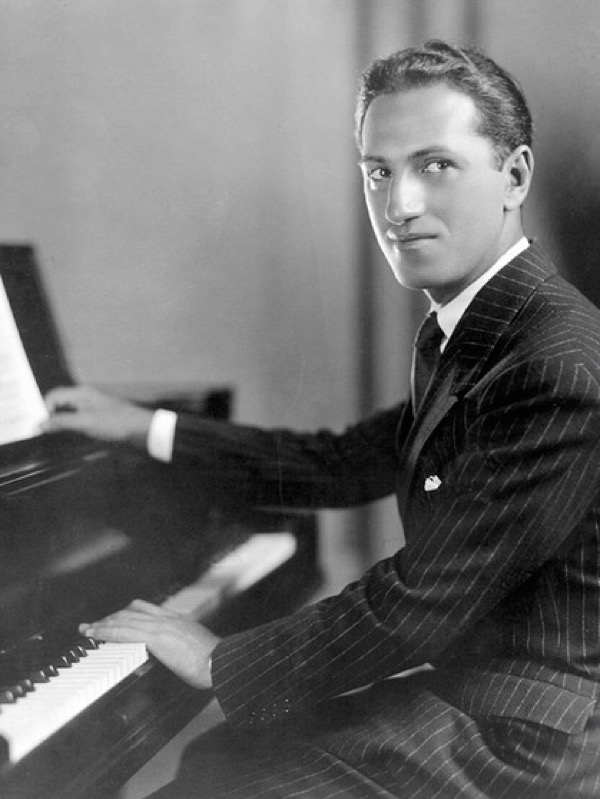
George Gershwin at the piano
This included a complete piano-roll version of his Rhapsody in Blue, and to celebrate his birthday on 26 September, let’s look at Gershwin’s career as a piano plugger and later player-piano recording artist.
George Gershwin plays Gershwin: “Sweet and Lowdown”
The Boy Taking Over the Piano
When the Gershwin family bought a piano around 1910, it had been intended for Ira, “but George immediately took it over.” Ira later reports, “No sooner had the upright been lifted through the window of the front room than George sat down and played a popular tune of the day.”
“I remember being particularly impressed by his left hand. I had no idea he could play and found that despite his roller-skating activities, the kid parties he attended, the many street games he participated in, with an occasional resultant bloody nose, he had found time to experiment on a player piano at the home of a friend.”
Cole Porter: Leave It to Me: From now on (George Gershwin, piano)
Learning from the Player Piano
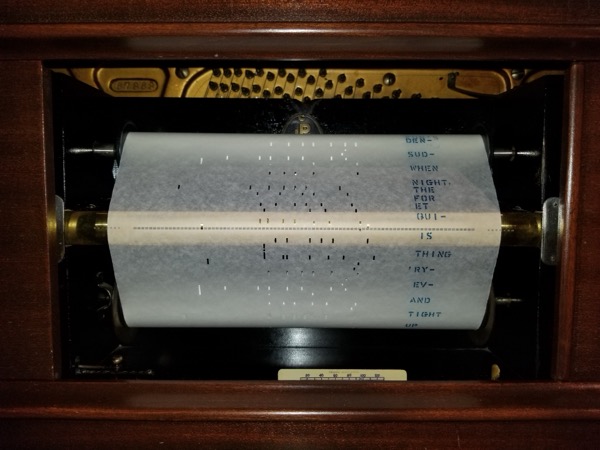
Player piano roll
George began experimenting with the player piano around age 10, slowly foot-pumping through a roll and placing his fingers over the keys. The roll-playing mechanism depressed the keys, and this method of learning was successful enough to impress Ira.
The player piano, or self-playing piano, operates the piano action using perforated paper or metallic rolls. These rolls consist of a continuous sheet of paper rolled onto a spool. It fits into the spool box, from which it unwinds at an even pace.
Louis Silvers: Just Snap Your Fingers at Care (George Gershwin, piano)
The Piano That Played Itself
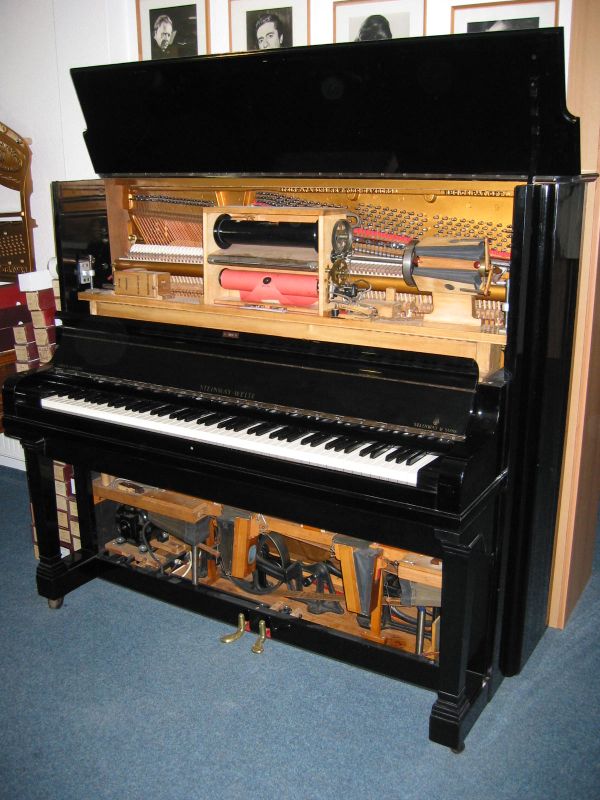
Steinway-Welte (1919)
The music is programmed onto the paper through perforations. The music is programmed in several ways, including creating a master stencil on a purely metronomic basis directly from the printed sheet music, leaving the player-pianist to create their own musical performance.
The player piano was a global force in its heyday, and homes, concert halls, restaurants, saloons, and stores featured various automatic pianos, pianolas, and reproducing pianos. They were like normal acoustic pianos, except for an internal, air-powered piano-playing mechanism.
Maceo Pinkard: Waitin’ for Me (George Gershwin, piano)
Musical rolls were manufactured extensively worldwide, and many rolls survive to this day. The popularity of mass-produced player pianos dramatically increased in the late 19th century, with sales peaking around 1924. The 1929 stock market crash virtually wiped out production.
After his initial piano demonstration, George began lessons with a neighbourhood teacher, including performer and composer Charles Hambitzer. He learned pieces by Chopin, Liszt, and Debussy, and according to an anecdote, “Ragging the Träumerei” was one of his first compositions.
Irving Berlin: For Your Country and My Country (George Gershwin, piano)
From Piano Pounder to Professional
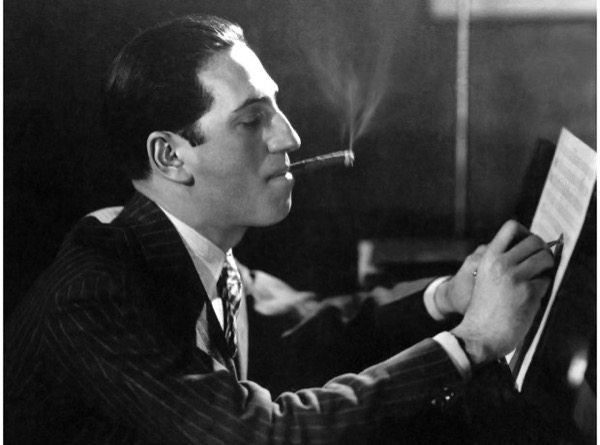
George Gershwin
While his parents demanded that George become an accountant, he looked for an opening in Tin Pan Alley, an area between Fifth and Sixth Avenues in Manhattan. It was home to a vast collection of music publishers and songwriters in New York City that dominated popular music in the late 19th and early 20th centuries.
The job description advertised for a “pianist in the professional department” of Jerome H. Remick & Co., on West Twenty-eight Street. After some hesitation, the manager offered Gershwin fifteen dollars a week to join his staff as a “piano pounder,” demonstrating Remick’s songs, accompanying “pluggers” (essentially vocal demonstrations), and pushing Remick’s songs on vaudeville performers, musicians, and dancers.
As biographer Edward Jablonski writes, “in 1914 the weekly wage was considerable, and George wanted the money more than a high school diploma, or life as an accountant.” His father was relieved, and his mother eventually relented.
Oscar Gardner: Chinese Blues (George Gershwin, piano)
Sitting at the piano for hours every day, Gershwin became highly skilled at transposing and embellishing tunes, and he soon became good enough to play some terribly difficult tricks. And it was precisely these keyboard skills that led him to make piano rolls.
As Artis Wodehouse explains, “making piano rolls that were spin-offs of his other keyboard work was a relatively easy way for Gershwin to make some quick extra money. Pop piano rolls had to be made and released very quickly because they capitalised on the popularity of tunes that had recently been released as sheet music.”
“Still, roll arrangers were always looking for new musical tricks to amaze and excite the prospective purchaser. One such trick was to overdub; many more notes could be encoded into a roll than a single pianist could lay down by hand. The result was a full, busy, and exhilarating sound.” (Wodehouse, AlbumLinerNotes.com, 2026)
John Schonberger: Whispering (George Gershwin, piano)
Gershwin Meets the Machine
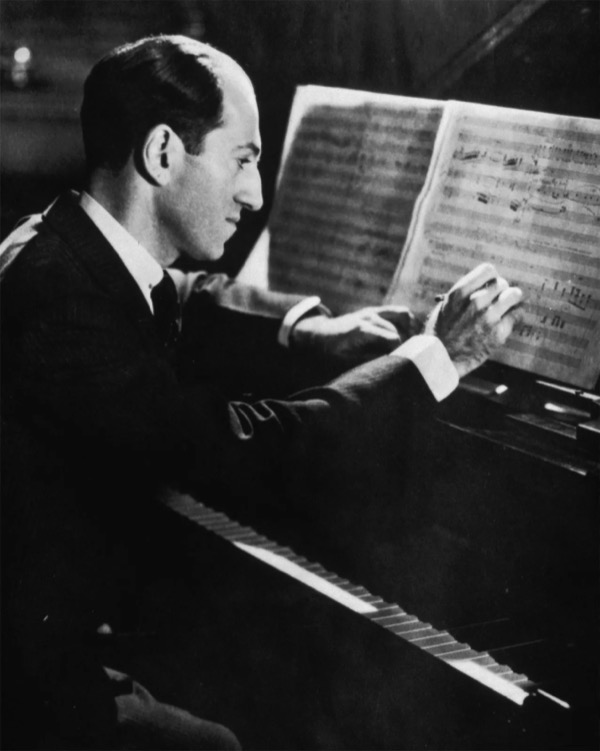
George Gershwin, Porgy and Bess score (1935)
In general, Gershwin recorded two types of rolls. The Mel-O-Dee and Universal rolls were designed for playback on player pianos equipped with interactive mechanisms that allowed for expressive performance.
The second and more technologically sophisticated type of roll was the Duo-Art and Welte rolls. They were called reproducing rolls and were intended for playback on instruments called reproducing pianos that could automatically execute dynamics.
Encoding a piano roll was a collaboration between Gershwin and his roll editors, who jointly assigned dynamics and decided on roll-arranging tricks. While some rolls relied exclusively on Gershwin’s hand-playing, “others seem to be an amalgam of his hand playing, his own arranging ideas about scoring, and the arranging style of the editor with whom he was working at the time the roll was made.” (Wodehouse, AlbumLinerNotes.com, 2026)
George Gershwin: 1920 Original Piano Rolls
Gershwin Plays Gershwin
As Wodehouse explained, the best pop music rolls reached a level of artistry. These arrangements could effectively mimic the rhythmic vitality of live performance and introduce keyboard pyrotechnics a single performer could not achieve.
Gershwin issued his first piano roll in 1916 and his last in 1927. Improvements to the sound of the much less expensive phonograph and the rise of radio undermined the player piano’s popularity. As the roll industry started to decline, Gershwin went on to make disc recordings and to host his own radio programme.
For more of the best in classical music, sign up for our E-Newsletter