Irish composer Charles Wood (1866–1926) wrote six string quartets, all of which were unpublished at his death. Oxford University Press issued his complete quartets, along with the Variations on an Irish Folk Tune, in 1929, as a tribute to the late composer. It was funded by his old Cambridge college, Gonville and Caius, and was overseen by his successor, Professor Edward Dent.
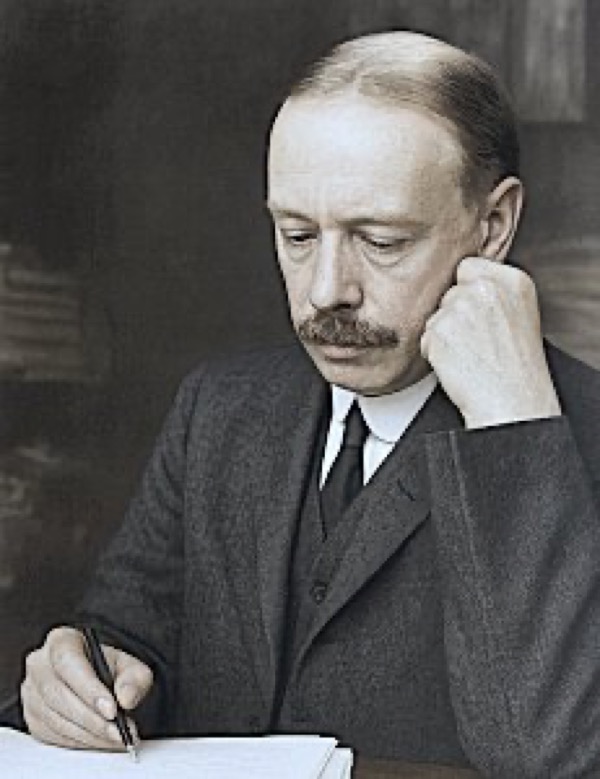
Charles Wood
Violinist Madeleine Mitchell and her Quartet, the London Chamber Ensemble Quartet (formed in 2019), already issued Wood’s String Quartet No. 6 (SOMM Recordings, SOMM CD0692) in 2024. Now, they are joined by Wood’s String Quartets Nos 2 and 4, plus the Variations.
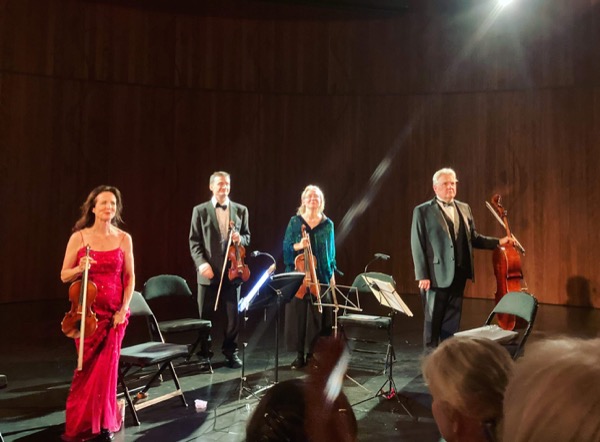
London Chamber Ensemble Quartet
Wood was born in Armagh, Ireland, on 15 June 1866. All his brothers sang in the cathedral choir, as did their father, a choral vicar. Despite his start in sacred music, and his study with Thomas Osborne Marks, the cathedral organist, it was his instrumental side, and his playing of the oboe that captured his musical imagination.
He was writing chamber music by his mid-teens, and it formed the basis for his application to the newly opened Royal College of Music. There, he studied with Charles Villiers Stanford, who encouraged his explorations in chamber music. Chamber music was easier to perform (rather than works for larger ensembles), and the young composer could hone his skills in counterpoint. He was already skilled at writing fugues and soon added counterpoint and canon to his compositional quiver.
He graduated from the RCM in 1888 and took up a position at the College of Gonville and Caius as an organ scholar. He returned to London weekly to teach at the RCM and, at Cambridge, was very much following in the footsteps of his teacher, Stanford. Stanford promoted the Cambridge University Musical Society (CUMS), and this, along with R. R. Terry’s Cambridge University Music Club, gave Wood ready access to interested student players. Wood was awarded the B.A. and Mus. Bac. in 1890.
Two years later, he completed his second string quartet, nicknamed Highgate, after the section of London where his brother William was music master at Highgate Grammar School. He would visit him and used those visits to the little town on top of Highgate West Hill for inspiration. Knowing of his facility in counterpoint, we’re not surprised to see such things as the ‘inventive invertible counterpoint’ of the first movement’s development section.
The striking movement is the third, which uses a 7-bar ground bass as the inspiration for a set of variations. He really shows off his writing skills with ‘contrapuntal devices of invertibility, canon, countermelody and lyrical transformation, rhetoric amplified by the rapid changes of tempo and (at the centre) a change of mode to the major’.
Wood’s String Quartet No. 4 in E flat major was completed in 1912, twenty years after the 2nd string quartet. Carrying the name Harrogate after the Yorkshire spa where his wife was ‘taking the waters’, the quartet is more modern but still carries Wood’s distinctive contrapuntal signature, particularly in the development section of the first movement. A particular cue in the scherzo movement is its use of whole-tone scales. Is this a bow towards modernism or an extension of the work’s Beethovenian qualities?
The slow-movement Adagio is, just as in the 2nd string quartet, a set of variations, using an Irish folk song, ‘Oh breathe not his name’ and the air ‘The Brown Maid’, for its source.
This use of Irish materials is completed in the 1916 work. Variations on an Irish Folk Tune, which is based on a melody (No.749) from the Pigot Collection included as a supplement in P.W. Joyce’s Old Irish Folk Music and Songs, published in 1909. Wood frequently used Joyce as his reference for his Irish arrangements. This 10-part set of variations is very much in a 19th-century style, organised into groups with common attributes such as key, tempo, or metre. In the final variation, the folk tune makes one last appearance ‘metamorphosed into an Irish reel’.
As a teacher of harmony, counterpoint and composition at the RCM and Cambridge, Wood taught some of the finest composers of the following generation, including Ralph Vaughan Williams, Hugh Allen, W.C. Denis Browne, Edward Dent, Armstrong Gibbs, Arthur Bliss, Cyril Rootham, Michael Tippett and Elizabeth Maconchy. Dent, as mentioned above, would organise the publication of his six string quartets three years after Wood’s death.
This recording marks the centenary of the death of Charles Wood and is the world premiere recording of these quartets. The London Chamber Ensemble plays with authority and warmth, using Wood’s distinctive contrapuntal writing to great effect.
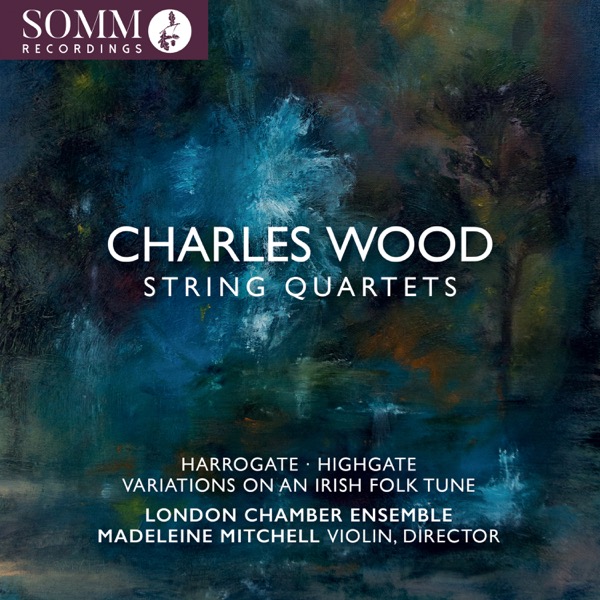
Charles Wood: String Quartets
London Chamber Ensemble; Madeleine Mitchell, director
SOMM Recordings SOMMCD 0723
Official Website
For more of the best in classical music, sign up for our E-Newsletter