The composer Sofia Gubaidulina, born on 24 October 1931 in Chistopol, a small town on the Volga in the Tartar ASSR, decidedly explored the tensions between Western and Eastern music.
Her innovative use of microtonality and chromaticism, along with contrasting tonalities, produced works of emotional intensity. She is rightly considered one of the foremost composers of the former Soviet Union, yet during the 1970s, she was labelled irresponsible and overly religious.
Against the Grain

Sofia Gubaidulina (2016)
Instead of yielding to the pressures of the Soviet system, Gubaidulina famously drew strength from a meeting with Dmitri Shostakovich. According to her account, he told her, “My wish for you is that you should continue along your mistaken path.” (Gubaidulina, Perspectives of New Music, 1998)
To celebrate her birthday on 24 October, let’s have a look at her Märchenpoem (Fairytale Poem), composed in 1971 for a children’s radio programme.
Sofia Gubaidulina: Märchenpoem (Fairytale Poem)
From Blackboard to Freedom
The original story comes from a tender fairy tale titled The Little Piece of Chalk, by Czech writer Miloš Macourek. Gubaidulina recalled that “the fairy tale appealed to me so much and seemed so symbolic of the fate of an artist that I developed a very personal relationship with this work…”
“The main character of this fairy tale is a small piece of chalk that is used to write on blackboards—the chalk dreams of drawing marvellous castles, beautiful gardens with pavilions, and the sea.
But day in, day out, the chalk is forced to write boring words, numbers, and geometric shapes on the blackboard. While the children grow every day, the chalk gets smaller and smaller. Gradually, the chalk becomes desperate and loses all hope of ever being allowed to draw the sun or the sea.
It soon becomes so small that it can no longer be used in the classroom and is thrown away. The chalk then finds itself in total darkness and thinks it has died. However, the supposed eclipse of death turns out to be a boy’s trouser pocket.
The child’s hand brings the chalk into light and begins to draw castles, gardens with pavilions and the sea with the sun on the tarmac. The chalk is so happy that it doesn’t even realise how it is dissolving as it draws this beautiful world.” (Gubaidulina, Boosey & Hawkes, Fairytale Poem)
Between Dissonance and Beauty

Sofia Gubaidulina (F. Hoffmann-La Roche Ltd)
Sofia Gubaidulina’s compositional style is recognised for its intense spiritualism and exploratory soundscapes. For Gubaidulina, music is not a purely abstract or academic exercise but an act of human transcendence.
In her Fairytale Poem, Gubaidulina recognised the tale as “symbolic of the fate of an artist,” and developed a deeply personal relationship with the work. The story’s simple message about the longing to create freely suggests a deeper meaning than a reading of it as political allegory.
The work is scored for an unusual orchestra of woodwinds, percussion, harp, piano, and strings. The resulting sound world is restless and sharply coloured, yet it opens into transcendent passages of lyrical beauty.
A Dream Fulfilled
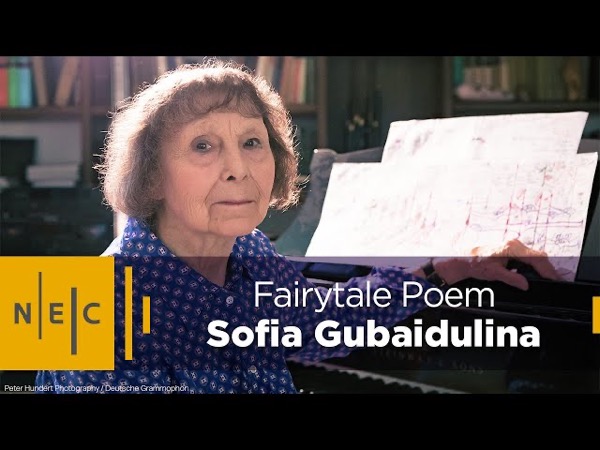
Fairytale Poem
The opening is easy to remember, as it establishes the unpredictable atmosphere of a fairy tale. Bright, penetrating woodwinds contrast with sustained strings as the music keeps shifting perspective.
Contrasting instrumental colours are set against one another, with rhythmic figures and changes in texture creating a sense of busyness, which suggests the chalk’s monotonous daily existence.
Instrumental colour becomes an expressive element in its own right, with harp and percussion broadening the orchestral sound. Meanwhile, the strings move toward more sustained, expressive writing. Broad melodic gestures emerge in a language marked by dissonance. This is not a traditional fairy-tale happy ending, but a recognition that beauty entails a certain fragility.
We should not force a one-to-one correspondence between the fairy tale and specific musical events. Instead, it is probably easier to hear the essential emotional paradox. The very act that brings the little chalk its greatest fulfilment also ends its own existence.
For more of the best in classical music, sign up for our E-Newsletter