Greek National Opera made its Carnegie Hall debut on Thursday, 15 October, with a spectacular program entitled Nikos Kazantzakis: An Odyssey in Music that took audiences on a tour of 20th-century Greek music.
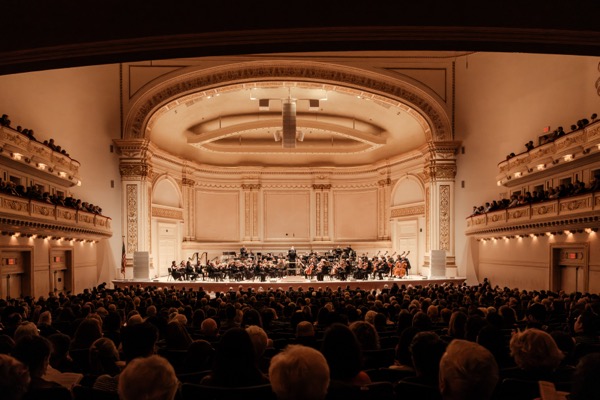
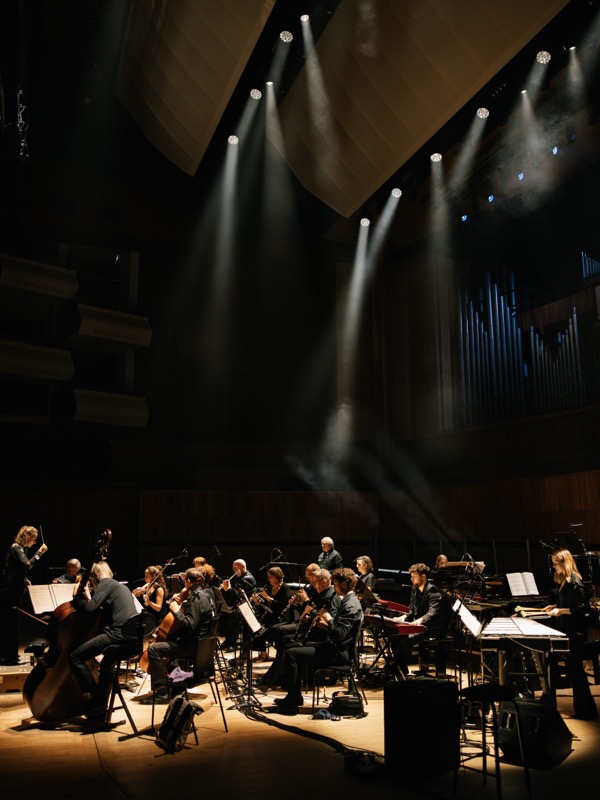
The Greek National Opera Orchestra, 2026 (photo by Giannis Antonoglou)
The focus on the Greek writer and poet Kazantzakis gave the evening a focus that centred on Crete, his home island. Born in 1893 in Heraklion, Crete, still under Ottoman rule, he came to Athens to study law before continuing to Paris. He considered himself primarily a poet, but for the larger world outside Greece, it’s his prose that has captured his readers.
Over the evening, we had Greek conductor and composer Dimitri Mitropoulos’ Cretan Feast, written in 1919 for piano and here presented in the 1923 orchestration by Nikos Skalkottas. Mitropoulos sought to illustrate the folk music of Crete while also creating the dramatic situation of a feast: the abundance and the bad feeling, the outdoor setting and the individual conversations. The music is approached in a somewhat abstract fashion, and much of the 19th century is present in the work. In the hands of its orchestrator, up-and-coming composer Nikos Skalkottas (this is his earliest surviving score), the work becomes something that more closely resembles the folk-music work of Béla Bartók, including the striking use of percussion and how texture defines sections.
Dimitri Mitropoulos: Cretan Feast (orch. by N. Skalkottas) (Iceland Symphony Orchestra; Byron Fidetzis, cond.)
Three selections from Skalkottas’ own 36 Greek Dances followed. Series 1 was written between 1931, when Skalkottas was in Berlin, and finished in 1935, when he completed the first 12 dances. Cretikos, series 1, no. 2, was one of the most popular and was one of the few works published during the composer’s lifetime. Bartók is mentioned earlier and certainly carries through here.
Nikos Skalkottas: 36 Greek Dances, AK 11, Series 1: No. 2. Cretikos (Athens State Orchestra; Stefanos Tsialis, cond.)
Two more dances based on songs, I/5: I Enjoy No Other Dance, and II/3: Early at dawn I will rise, are also based on Cretan music. Skalkottas wanted Greek traditional music to enter the symphonic tradition while retaining its character as a living art form, not merely an image of the past. Skalkottas’ work not only includes Greek dances such as the pentozális and the syrtós, but also music from folk songs of resistance to the Turkish occupiers. The first four Greek dances premiered in January 1934, led by Dimitri Mitropoulos and the Athens Conservatoire Symphony Orchestra.
The final composer in the first half of the program was Giorgos Koumendakis, a noted contemporary Greek composer and Artistic Director of the Greek National Opera. Also hailing from Crete, he included Cretan themes in his composition Amor Fati (Love your Fate), which brings together the dichotomies inherent in the Apollonian and Dionysian worldviews, here given to the strings (Apollo) and the winds (Dionysus). A lovely slither of sound closes it.
The second half of the evening brought the opera. Soprano Maria Kostraki was joined by the Manos Hadjidakis Ensemble for music by Manos Hadjidakis from Captain Michalis. This Cretan novel by Kazantzakis, published in 1953, is a tale of love and betrayal, shame and pride, and fighting the Turks. Hadjidakis’ music, written for a 1966 stage adaptation of the novel, draws the story in broad strokes. Unfortunately, the program booklet did not lay out the sections and, even more disappointing, didn’t give us the texts for the words being sung. For a program that emphasised the importance of a writer, not giving us his text was inexcusable.
The Ensemble’s choice of sound was interesting. 2 guitars and 2 mandolins joined Western instruments (harpsichord, violin, cello and double bass). The mix of Western and traditional instruments gave a unique sound, such as the reinforcement of the mandolin line by the harpsichord and did well to bring out the conflict in the story between the East (Turkey and Greece) and the West. This was the first place in the entire program where the audience met the music with an exuberant response.
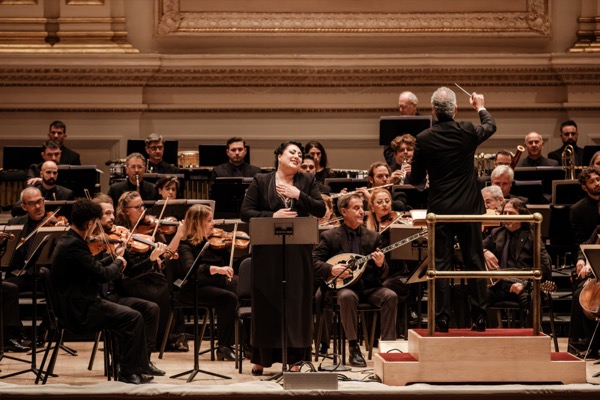
Soprano Maria Kostraki with conductor Vassilis Christopoulos and members of the Manos Hadjidakis Ensemble, 2026
(photo by Giannis Antonoglou)
So far there had been a beautiful overview of Greek musical writing in the 20th century – the style changes from German-influenced to music that included the local traditions. But over all of this, Zorba hangs. The invented traditions of the 1964 film Zorba the Greek are presented here in line with the serious work and folk research of Mitropoulos, Skalkottas, Koumendakis, and Hadjidakis, and work to subvert the whole idea of the evening.
The film is set in Kazantzakis’ 1946 novel The Life and Times of Alexis Zorba. The film’s music is fine, expressing the film’s emotions, and mezzo-soprano Anita Rachvelishvili gave a beautiful presentation of the otherwise unidentified song before it all descended into what forms the final scene of the movie: Zorba’s Dance. The invented dance, the sirtaki, created and choreographed for the film, has come to define Greek music in modern culture – circle dances, a gradually accelerating pulse, repetition, etc. – that had not appeared much in the symphonic music all evening. As with the Captain Michalis music, the audience response to the dance-final was immediate. They clapped along, they moved in their chairs, and I’m sure, their feet were moving as well.
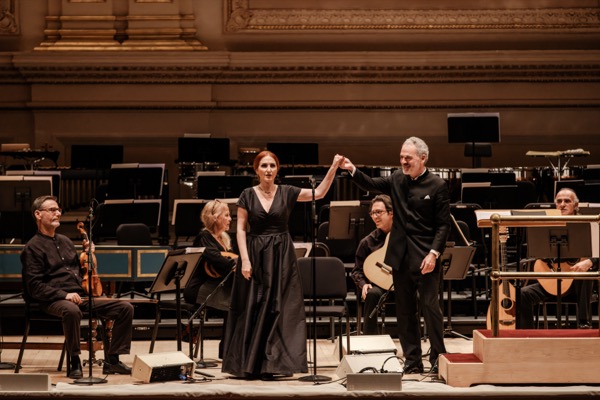
Mezzo-soprano Anita Rachvelishvili with conductor Vassilis Christopoulos and The Greek National Opera Orchestra, 2026
(photo by Giannis Antonoglou)
This is where the composer could have used some editing – moving film music to the symphonic stage without the images means you have repetitions without meaning. The piece seemed to have three different places where it ended… and then started up again. In the end, the story gets lost, and the sound becomes a muddled jumble.
It’s a pity that the vision for the evening was lost at the end in an appeal to pop culture. Nikos Kazantzakis: An Odyssey in Music was a great vision, using the ideas and songs of the leading 20th-century writer to explore the country’s musical development. It’s also a pity that, in a program based on Kazantzakis’s words and vision, we weren’t given the songs’ words when needed.
The orchestral playing was top-notch and didn’t suffer from the usual problem at home of burying the singers in sound. A triumph of an evening, marred slightly by not thinking through the whole process.
For more of the best in classical music, sign up for our E-Newsletter