Yvonne Lefébure (1898–1986) was born on 29 June 1898 in Ermont, in the northern suburbs of Paris. At age 8, she was introduced to the French pianist Marguerite Long, who spoke with her parents about having her pursue serious musical training. She left her local teacher and was accepted at the Paris Conservatoire where she was awarded a gold medal in the Concours des Petits Prodiges at age 9. She went on to study with Alfred Cortot and was awarded a premiere prix in 1912 for her performance of Beethoven‘s Appassionata Sonata, Op. 57, when she was 14. She also took first prize for harmony (1915), counterpoint (1918), and fugue (1919).
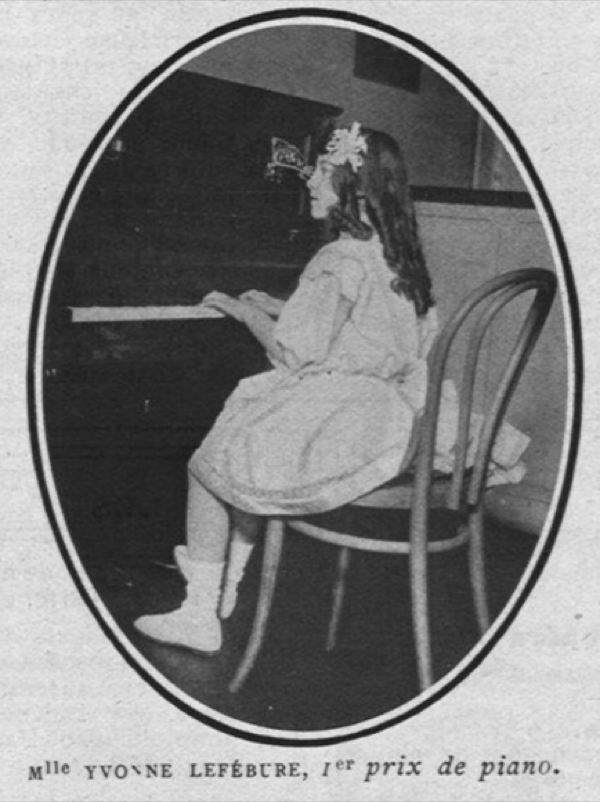
Yvonne Lefébure in 1908
Even as a teenager, Lefébure realised that her years of self-study did not stand her in good stead, and she began to relearn her piano technique. This was an important part of her success as a teacher in getting student to self-analyse their problems.
During WWII, she fled Paris to live in Perpignan by the Spanish border. There she lived with her Dutch-born French-Jewish partner, the musicologist and conductor Fred Goldbeck, and her mother. She performed at home, in a few public performances, and on the radio, and it was through the radio that she could give voice to her criticism of Germany’s occupation of France. Economics forced Lefébure to stay in France, as the group had no money to flee to the US, either for visa payments or boat tickets.
Although during the war, the BBC had special programming created for, directed at, and produced by French citizens, Lefébure couldn’t get to England to record. In France, she performed on Radiodiffusion Nationale (RDN), the national radio station located in the Free Zone run by the Vichy government in southern France. This was a way for her to keep in touch with her students, friends, and family. For her part, Lefébure performed French music in her broadcasts, including Fauré‘s Nocturne and Dukas’ Variations.
Paul Dukas: Variations, interlude et finale sur un thème de Rameau (Yvonne Lefébure, piano)
Part of Lefébure’s anti-German activities included her refusal to perform on Radio-Paris, which was clearly Nazi-controlled. On RDN, between July 1941 and June 1942, she appeared 19 times, in everything from recitals, chamber music concerts and concerto performances with orchestra. In those 12 months, she appeared at least once a month except between December 1941 and January 1942. Between July and November 1942, she stopped playing on RDN when its politics turned ‘virulently and overtly anti-Semitic’. She appeared twice in 1943 and then stopped her radio performances entirely when the Resistance music journal Le Musicien patriote published a manifesto asking French musicians to interfere with projects from the Vichy government.
Her next radio appearance was in February 1945, when she played Ravel’s Concerto in G major on the BBC, as she was then able to travel to England.
Throughout her life, she maintained an active concert schedule and performed with conductors such as Igor Markevitch, Sir Adrian Boult, Wilhelm Furtwängler, and Pablo Casals. Casals frequently had her appear in the festivals he held in Perpignan in the 1950s and 1960s.
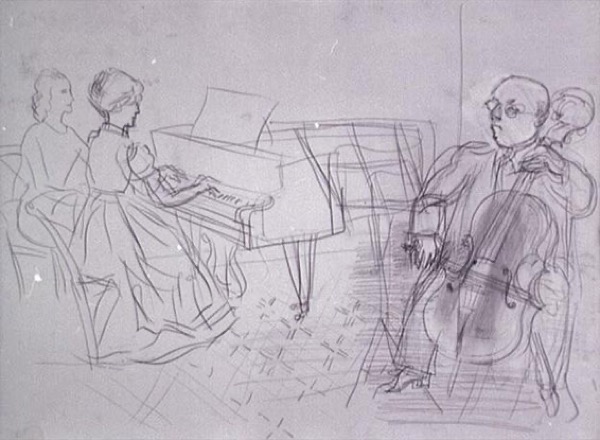
Raoul Dufy: Yvonne Lefébure playing with Pablo Casals
Wolfgang Amadeus Mozart: Piano Concerto No. 20 in D Minor, K. 466: I. Allegro (Yvonne Lefébure, piano; Perpignan Festival Orchestra; Pablo Casals, cond.)
Beyond her concert career, she was also known as a phenomenal teacher. She had two major teaching appointments: first at the École Normale de Musique in Paris, starting in 1928, and later at the Paris Conservatoire, where she taught from 1952 to 1967. A measure of her success can be seen in 1963, when all 7 of her students took first prizes. After 1967, Lefébure taught at the European Conservatory.
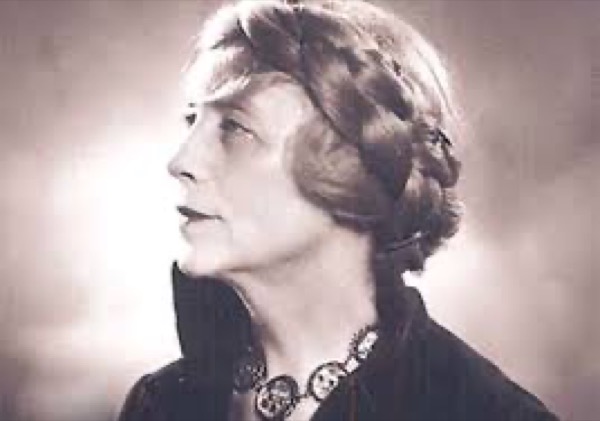
Yvonne Lefébure
Some of her commentary and teachings were published posthumously in a volume entitled La leçon de musique de Yvonne Lefébure, which is still sold today.
Albert Roussel: 3 Pieces, Op. 49: No. 1. Allegro con brio (Yvonne Lefébure, piano)
She made a few recordings (for HMV, Le Chant du Monde, EMI, and Solstice), but some video survives of her masterclasses, including this one, where she’s teaching how to play Debussy.
Yvonne Lefébure teaches how to play Debussy
The effect of teachers can only be seen through their students, and Yvonne Lefébure made her mark as one of the finest piano teachers in 20th-century France. Her notable students include Hélène Boschi, Dinu Lipatti, Samson François, Sébastien Risler, Pierre Reach, Catherine Collard, Michaël Levinas, Setrak, Françoise Thinat, Imogen Cooper, and others. The extended documentary Une leçon de vie (A Lesson in Life) by Yvetter Carbou covers her life and teachings.
Lefébure credited Alfred Cortot, her first teacher at the Conservatoire, for her power, grandeur, and great sensitivity. He was her primary influence in her explorations of the Romantic repertoire. Casals introduced her to Bach, rigour, emotion, and how constant questioning should drive one’s daily work. As a focus for this, she gave her students something that few other teachers could provide: a wide-based, sensitive technique and the ability to question their own work.
For more of the best in classical music, sign up for our E-Newsletter