
Ludwig van Beethoven’s impact on classical music is impossible to overstate.
Born in 1770, Beethoven redefined what music could be. He managed that redefinition by rewriting formal boundaries, finding new ways to express emotion, and making a living in a new way.
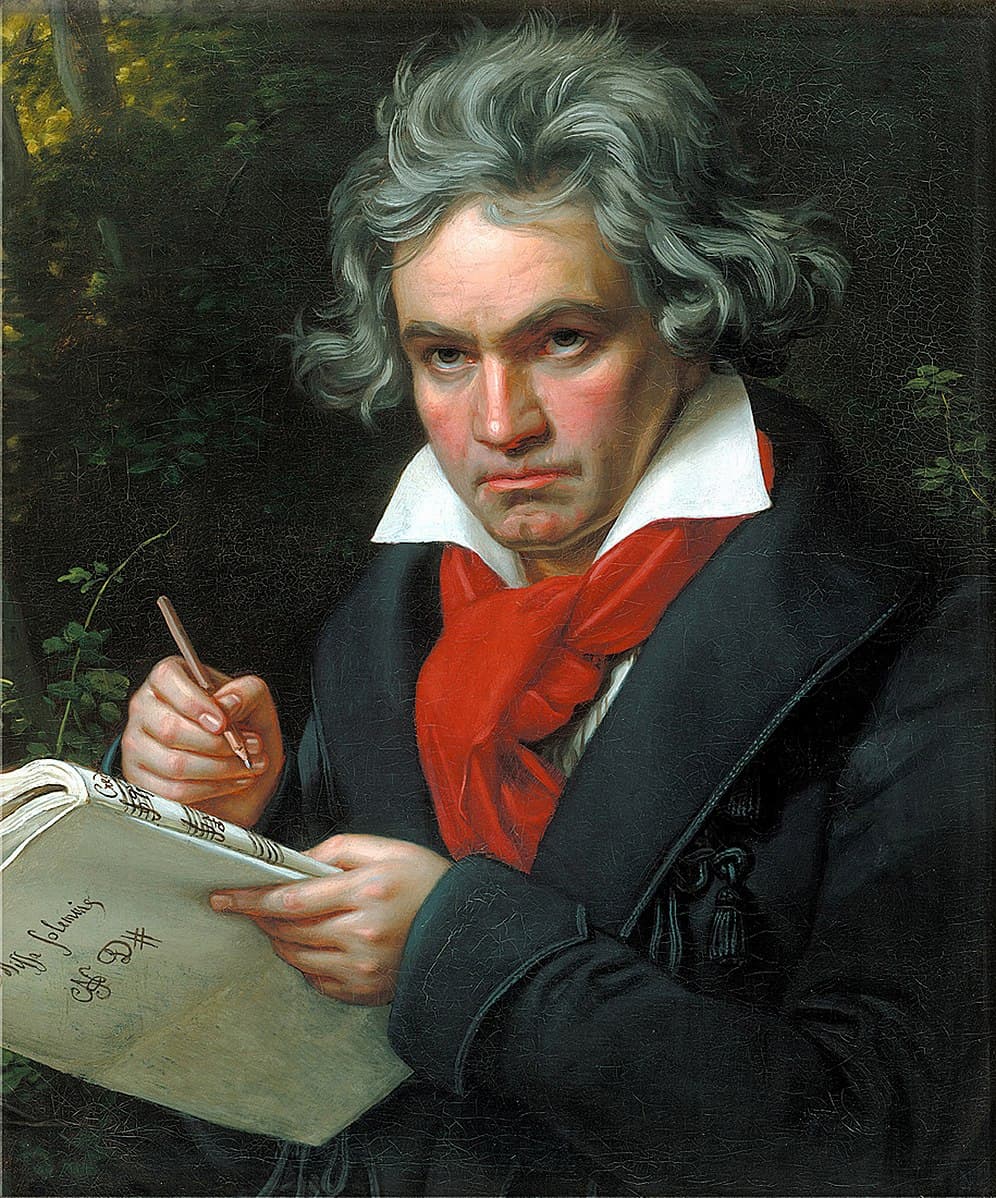
Portrait of Ludwig van Beethoven
Almost singlehandedly, he built a bridge from the Classical Era of Mozart and Haydn into the Romantic Era, serving as a pivotal figure who transformed the art form.
Today, we’re looking at seven ways that Beethoven changed classical music forever.
1. Beethoven made it acceptable for composers to expand traditional forms, resulting in works that were longer and more complicated.
At the time of the premiere of Beethoven’s Third Symphony in 1805, an entire symphony could have fit inside the runtime of the first movement alone.
He took the Classical Era symphonic structure that Haydn and Mozart had perfected, then fearlessly – maybe even recklessly – expanded upon it.
Beethoven’s Symphony No. 3
Importantly, that push for expansion didn’t stop with his symphonic works.
Take his piano sonatas and string quartets, which also grew longer and more complex as his career went on.
For example, his fourteenth string quartet (his Op. 131) consists of seven connected movements played without pause. A performance of the entire work lasts around forty minutes.
His example helped to make longer works acceptable for the composers who followed him.
- Between 1824 and 1826, Franz Schubert wrote his Ninth Symphony, nicknamed the Great for its hour-long length.
- In 1830, Hector Berlioz wrote his hour-long Symphonie Fantastique.
- In the late 1800s, Bruckner wrote symphonies that ran around sixty to eighty minutes long.
- Mahler’s Third Symphony, dating from 1902, runs around a hundred minutes.
Without Beethoven opening the door to this development, it’s uncertain whether composers would have felt free to dream about writing works of this length.
2. Beethoven experimented with harmonies, dissonances, and accents that were – to the ears of early listeners – shocking. This experimentation accelerated after he went deaf.
The drama and violence of Beethoven’s music are sometimes attributed to his deafness, but signs of his strong, mercurial voice were there from the beginning.
His first symphony, written in the late 1790s, contains dozens of sforzandos. They create a gripping atmosphere of turmoil and instability.
Beethoven’s Symphony No. 1
His third symphony famously includes a dissonant C-sharp in the work’s seventh bar. We are used to it today and have a hard time recognising how truly striking it is, but at the work’s early rehearsals, musicians thought they were playing wrong notes!
Beethoven continued challenging listeners until the very end of his career. By the time he was writing his late string quartets, he was notating harmonies that sound modern even today. These harmonies led some people to wonder if he’d gone mad.
Here, the courtly elegance of Mozart has vanished completely, replaced by a demanding, muscular musical language.
Beethoven’s Grosse Fugue, Op. 133
3. He used and expanded the instrumentation of the orchestra in a way that influenced all of the composers who followed him.
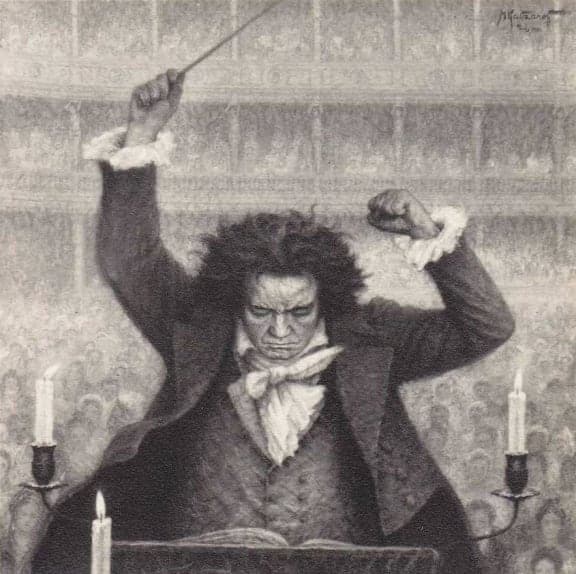
Beethoven conducting
Beethoven’s teacher Haydn wrote for a relatively small orchestra (we’d likely label it a chamber orchestra today).
Beethoven, however, refused to write for an ensemble of that size. He began writing for new instruments, expanding various sections’ power and volume.
His fifth symphony includes trombones, a contrabassoon, and a piccolo, none of which were standard at the time. This enabled him to create colours – and powerful auditory and emotional effects – that other composers hadn’t even imagined.
Beethoven’s Symphony No. 5
He also helped to cement the practice of using instruments to imitate happenings in the real world. Baroque composers such as Vivaldi had written birdsong and other natural phenomena into their works. But in his sixth symphony, Beethoven took the practice to new heights, portraying a babbling brook, peasants’ dance, and thunderstorm with a larger orchestra.
Beethoven’s Symphony No. 6
One of his most exciting innovations came later in his career: successfully incorporating a chorus and solo voices into his Ninth Symphony.
The daring experiment helped to bridge the gaps between church music, opera, and absolute instrumental music…and set a towering example for the composers of the nineteenth century who followed.
The final movement of Beethoven’s Symphony No. 9
4. He opened the door to emotional expression in a way that composers before him never had.
Beethoven used his music as a means of self-expression. His life was often challenging and depressing, and one gets the sense that he needed to portray those inner struggles in music.
The funereal opening movement to his Moonlight Sonata is deeply emotional, and continues to touch listeners in a visceral way even today.
Beethoven’s Piano Sonata No. 14 (“Moonlight”)
And in his Ninth Symphony’s Ode to Joy, he created some of the most thrilling and life-affirming music ever made.
Broadly speaking, before Beethoven, composers tended to prioritise traditional form over emotional expression.
But thanks to Beethoven, and shifts in European culture that arose after the French Revolution and the rise of Napoleon, music began to express deep emotion more openly.
This shift helped to pave the way for overtly emotional works by Berlioz, Chopin, Liszt, Tchaikovsky, and others.
5. He became deified in a way no other composer had been until that time.
During Beethoven’s lifetime, most music that was performed was new. There wasn’t necessarily an expectation that a composer was writing for generations to come.
However, in the decade or two immediately following Beethoven’s death, the field of musicology began developing in earnest.
Musicians and audiences became interested in preserving and revisiting not just the music of Beethoven, but also Schubert, Mozart, and even Bach.
As the century progressed, more and more music of the past was programmed and passed down.
This led to contemporary composers beginning to feel the weight of the accomplishments of the generations preceding them in new ways.
Johannes Brahms (born in 1833, less than a decade after Beethoven’s death) was so intimidated by Beethoven’s symphonic output that he spent twenty years writing his first symphony. It wasn’t premiered until 1876! When it was, one conductor gave it the nickname “Beethoven’s tenth”, testifying to the perception of its lineage.
What would Brahms – and others – have written if they hadn’t felt so intimidated by Beethoven’s output? It’s an interesting thought experiment.
Brahms’s Symphony No. 1
6. During the eighteenth century, composers were often viewed as servants of the aristocracy. Beethoven shifted that perspective. By the Romantic Era, composers were more often viewed as freelancers whose primary allegiances were to their art and self-expression.
Before Beethoven, composers spent a large part of their careers working for wealthy, powerful institutions such as the aristocracy or the church.
Bach took jobs as a court musician and a church musician. Haydn famously worked for the noble Esterhazy family, wiling away most of his career in their Versailles-like country palace.
Mozart was the first major composer to break the mould somewhat when he left a job he didn’t like and moved to Vienna to make a go as a freelance piano player, composer, and teacher.
But Beethoven was the first big name in classical music history who never took a job in a court or church.
Instead, along with teaching, performing, and selling his compositions, he sought support from individual aristocrats who could influence – but not dictate – his career path.
This dynamic parallels the declining power of the European aristocracy during the French Revolution and its aftermath.
It also hints at the populism and nationalism that would become major influences in the second half of the nineteenth century.
7. Beethoven helped to create the archetype of the isolated Romantic Era genius composer that’s still embedded in our culture today.
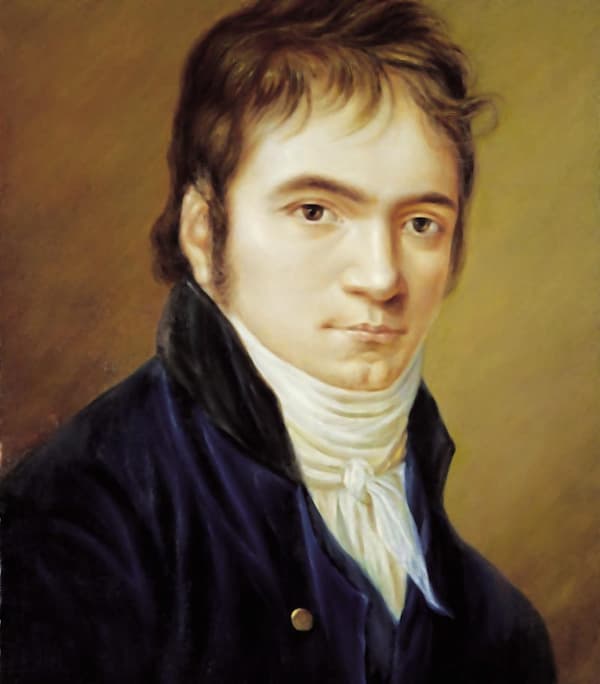
Beethoven in 1803
Beethoven’s biography had bones to it that appealed deeply to a rapidly industrializing nineteenth century society.
Here was an abused prodigy who left the small town of Bonn to make his way in the big city of Vienna. He never found love and sublimated his romantic desires into his music, a sacrifice that (in the eyes of many) elevated his art. He lost his hearing. He battled depression and alcoholism. He could be gruff, rude, and isolated…yet, because of the talent that everyone around him acknowledged as God-given, he still found himself respected and celebrated. He was living proof that an artist with conviction could not only make their way in the world but also change it.
In the 1800s, one aristocrat named Prince Lichnowsky began paying Beethoven an annuity. Six years later, Lichnowsky infuriated the patriotic Beethoven by asking him to play for French soldiers. A fight ensued between benefactor and beneficiary, and Beethoven famously wrote:
“Prince! What you are, you are by circumstance and birth. What I am, I am through myself. Of princes, there have and will be thousands. Of Beethovens, there is only one!”
Beethoven helped to create the stereotype of a great artist. It is so embedded in our culture today, we’re still coming to terms with what it means…and whether it makes any sense for writers, musicians, and artists to still aspire to it today.
For more of the best in classical music, sign up for our E-Newsletter






One of your best. Thank you.
RE: Beethoven Violin Concerto. Explain to me again, how is the five-note timpani solo (D-D-D-D-D) dissonant against the opening woodwind chord (root postion D chord) that follows? I will wait.