Symphonic composers usually undergo a striking creative evolution between the first and last works they write in the genre.
Their first symphonies are often youthful or rooted in tradition, while their final symphonies often look to the future and exemplify the growth achieved over the course of a career.
Today, we’re assessing the creative journey of eight major classical music composers, from Haydn to Shostakovich, as exemplified by their first and last symphonies.
Come along with us on the journey, and see if this framing helps you to better appreciate these incredible works.
Joseph Haydn (1732–1809)
Symphony No. 1 (1759) and Symphony No. 104 (1795)
Haydn’s Symphony No. 1
Haydn began his career in the early years of the Classical Era.
The symphony genre hadn’t fully developed yet, and his first symphonies were simple three-movement works modeled on the structure of Italian overtures (i.e. a fast section, then a slow section, then a fast section).
His first symphony is a brief piece for a small court ensemble consisting of strings, a few winds, two horns, and continuo.
It exemplifies the light, courtly galant style common in mid-18th-century Austria.
Haydn’s Symphony No. 104
Over the following three decades, Haydn was on the front lines of transforming the symphony into the genre we recognize today.
His final symphonies (Nos. 93–104, all composed for performances in London) are much grander in scale.
He has also added an additional minuet or scherzo movement, reflecting the fully developed classical form.
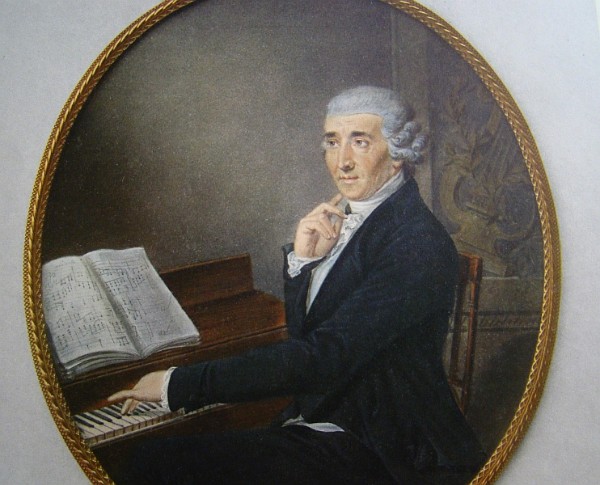
Joseph Haydn
Haydn’s Symphony No. 104 opens with a slow and stately introduction.
The orchestration is greatly expanded, featuring pairs of flutes, oboes, clarinets in A, bassoons, horns, and trumpets, as well as strings and timpani. This combination of instruments yields a richer, more powerful sound than the sparse forces from his first symphony.
Wolfgang Amadeus Mozart (1756–1791)
Symphony No. 1 (1764) and Symphony No. 41 (1788)
Mozart’s Symphony No. 1
Written when Mozart was eight years old, this short three-movement piece was simply scored for two oboes, two horns, and strings.
It follows the early Classical Era style and was clearly influenced by the works of his father, Leopold Mozart and J.C. Bach.
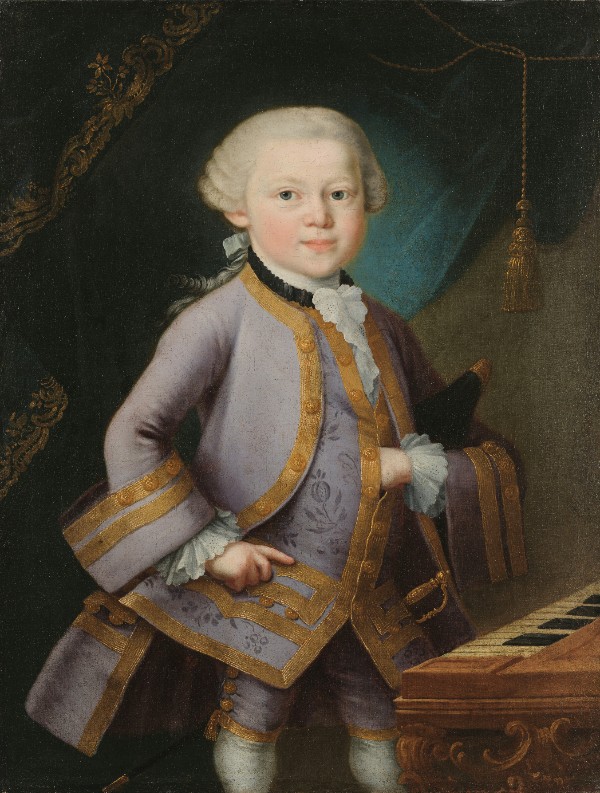
Wolfgang Amadeus Mozart
This is charming and straightforward music: hugely impressive for an eight-year-old, of course, but also very short and very simple.
Mozart’s Symphony No. 41
Meanwhile, Mozart’s 41st (nicknamed “Jupiter”) stands as the pinnacle of his orchestral output.
Unlike the little first symphony, the Jupiter is a full four-movement work for a grand Classical Era orchestra, including parts for flute, oboes, bassoons, horns, trumpets, strings, and timpani.
It is Mozart’s longest and most complex symphony, and earned a godlike nickname to indicate its Olympian grandeur.
The finale features a famous five-voice fugue that is widely considered to be one of the most impressive technical achievements in classical music history.
The emotional tone also differs: the adorable little First is pleasant and polite, while the “Jupiter” exudes confident, exhilarating joy.
Ludwig van Beethoven (1770–1827)
Symphony No. 1 (1795–1800) and Symphony No. 9 (1822–1824)
Beethoven’s Symphony No. 1
Beethoven’s first symphony, begun in his mid-twenties, stands firmly in the classical tradition of composers like Haydn and Mozart.
It employs a typical late-18th-century orchestra (pairs of winds, horns, trumpets, strings, and timpani) and consists of four standard movements.
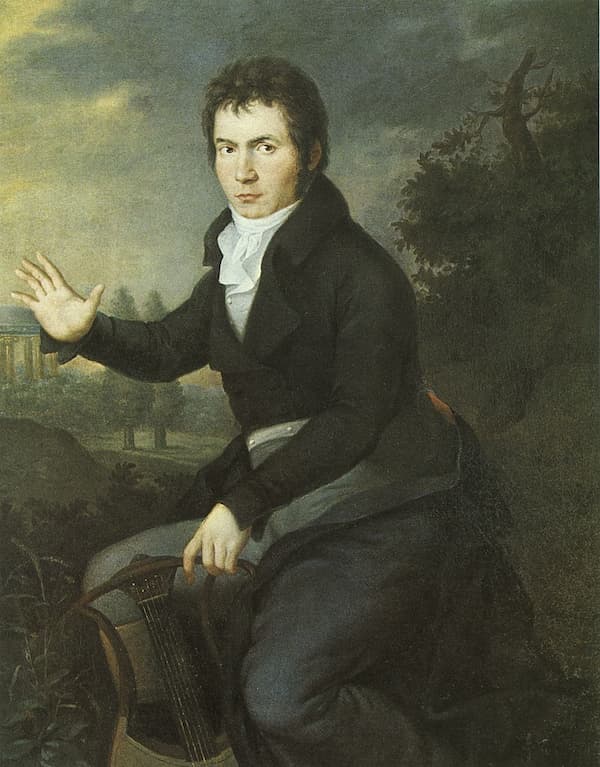
Joseph Willibrord Mähler: Ludwig van Beethoven, ca 1804–1805 (Vienna Museum)
Much of Symphony No. 1 follows Classical Era conventions in form and style (for instance, a graceful slow introduction and a minuet-like third movement).
But, importantly, there are hints of Beethoven’s mature voice already peeking through here.
For instance, the symphony’s title proclaims that it is in C major, but its opening chord features a B-flat: a note that is decidedly not in C, creating a dissonance and witty subversion of expectation. And the third movement, labeled a Menuetto, is actually a hearty scherzo, faster and more dynamic than a courtly dance.
Beethoven’s Symphony No. 9
By contrast, Beethoven’s final symphony is practically the thesis statement for the Romantic Era.
The Ninth expands the symphonic form on every front: its length (it is around seventy minutes long), its instrumentation (it features piccolo, contrabassoon, trombones, triangle, bass drum, and an entire chorus), and the way it incorporates poetry (it sets words by writer Friedrich Schiller). That last innovation in particular became an inspiration for later composers seeking to push the symphonic form to its limits.
Anton Bruckner (1824–1896)
Symphony No. 1 (1868) and Symphony No. 9 (1887–1896)
Bruckner’s Symphony No. 1
Anton Bruckner nicknamed his Symphony No. 1 “Das kecke Beserl” – Viennese dialect for “the saucy maid.”
Indeed, this symphony is bold and a bit impudent in spirit, brimming with youthful energy.
It adheres to the established four-movement symphonic form (Bruckner was deeply influenced by Beethoven and Schubert).
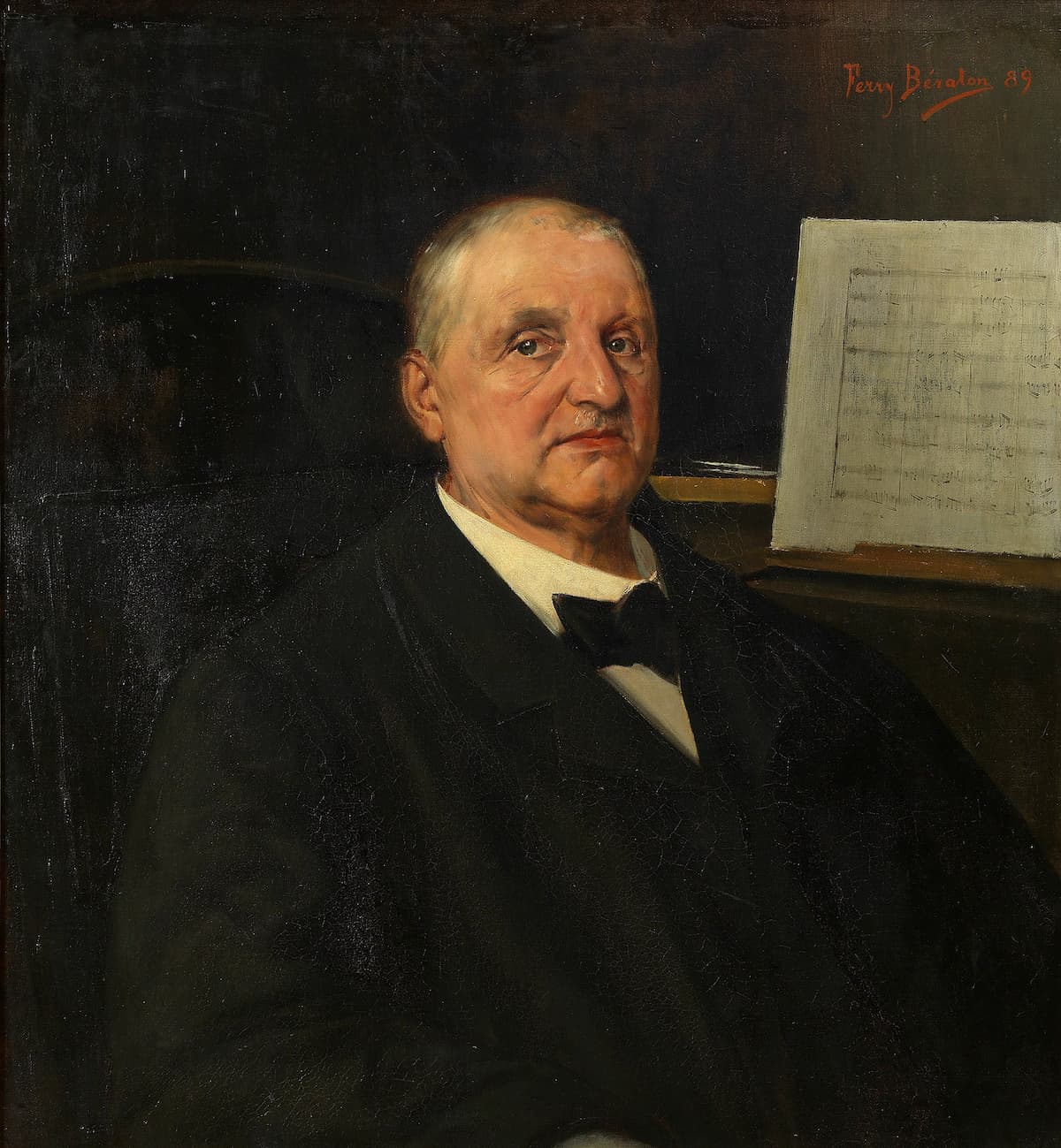
Anton Bruckner, 1889
The orchestration is standard for the time, and the structure, while expansive, is more straightforward than his later works.
But you can also hear elements of Bruckner’s mature voice peeking through: grand pauses, powerful unison brass passages, string tremolos, and a rugged, rustic scherzo.
Overall, the First comes across as confident, aggressive, and somewhat unpolished.
Bruckner’s Symphony No. 9
In stark contrast, Bruckner’s Ninth (consisting of three movements completed before his death in 1896) is a towering, mystical work that the composer dedicated “to the beloved God.”
Bruckner knew that this would be the final major work of his life, and it carries a valedictory, sacred atmosphere.
The Ninth is scored for a large orchestra including Wagner tubas (in the Adagio) and dense brass, giving it a much richer sonority than the leaner First.
The harmony pushes toward twentieth century modernism by embracing unexpected dissonances, each one conveying a sense of existential religious struggle.
All in all, the tone of the symphony is solemn and ethereal, about as far away from the mood of a “spirited maid” as it is possible to get.
It lacks the tidy resolution of a finale (Bruckner died, leaving only sketches for one), but this only adds to the symphony’s enigmatic aura.
Johannes Brahms (1833–1897)
Symphony No. 1 (1855–1876) and Symphony No. 4 (1884)
Brahms’s Symphony No. 1
From the earliest days of his career, Brahms was pressured by the friends and colleagues around him to write a symphony.
He was hugely intimidated by Beethoven’s output and needed to take his time writing his first.
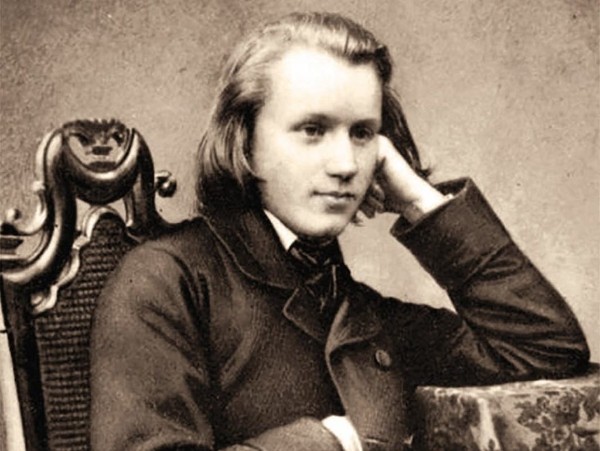
Johannes Brahms
In the end, Brahms’s first symphony took two decades to write, and he didn’t finish it until he was 43 years old!
The result is a stormy, monumental work very much in the vein of Beethoven. In fact, it was immediately hailed as “Beethoven’s Tenth” symphony.
The First is serious in tone. Brahms chose to write in the key of C minor, which sets the stage for a dramatic journey from a dark, tragic beginning to a triumphant C major finale.
Brahms uses a classical four-movement structure and traditional sonata form, but embraces the Romantic Era’s length and complexity (the finale alone is nearly twenty minutes long).
The emotional character is one of heroic struggle, resolving in victory – clearly inspired by Beethoven’s model.
This is, without a doubt, the most mature first symphony of any of the major composers.
Brahms’s Symphony No. 4
So if Brahms started out with such a mature and masterful work, where did he evolve from there?
Brahms’s Fourth is an autumnal, introspective work. It reverses the narrative of the First, ending not in triumph but in tragedy, with a powerful final movement that concludes in stark E-minor.
That finale is a passacaglia, a set of variations over a repeating bass line. This is an homage to Bach and an unusual, highly sophisticated structure for a symphonic finale. It illustrates Brahms’s fascination with and embrace of Baroque forms, and symbolises his desire to be perceived as part of a historical musical lineage.
Only nine years elapsed between the premiere of Brahms’s First and Brahms’s Fourth, but the music proves that he continued developing as a composer during that time.
Gustav Mahler (1860-1911)
Symphony No. 1 (1887–1888) and Symphony No. 9 (1908–1909)
Mahler’s Symphony No. 1
Mahler’s First Symphony is an audacious debut, a sprawling work (originally five movements long with a descriptive program, later pared down to four) that announced a startlingly original musical voice.
Nicknamed “Titan” (after a novel by Jean Paul), it was semi-programmatic and full of youthful imagination.
Mahler employs a mix of broad late-Romantic melodies and folk-like themes, but also delights in twisting them ironically, like when he creates a dark, funeral march minor-key parody on the theme of “Frère Jacques.”
The orchestration, for the time, was remarkably large, with Mahler expanding the standard orchestra to include extra horns, woodwinds, percussion, etc., to create novel timbres.
The overall mood of Mahler’s first symphony is one of “youthful vitality” culminating in heroism – the finale famously ends in a blaze of D-major triumph, with the bells of the horns raised high.
Today, it’s widely considered to be one of the more impressive first symphonies ever written.
Mahler’s Symphony No. 9
On the other hand, Mahler’s Ninth, his final completed symphony, is a farewell.
Written after Mahler had suffered a series of personal tragedies and been diagnosed with a serious heart condition, the Ninth is imbued with an acute awareness of mortality.
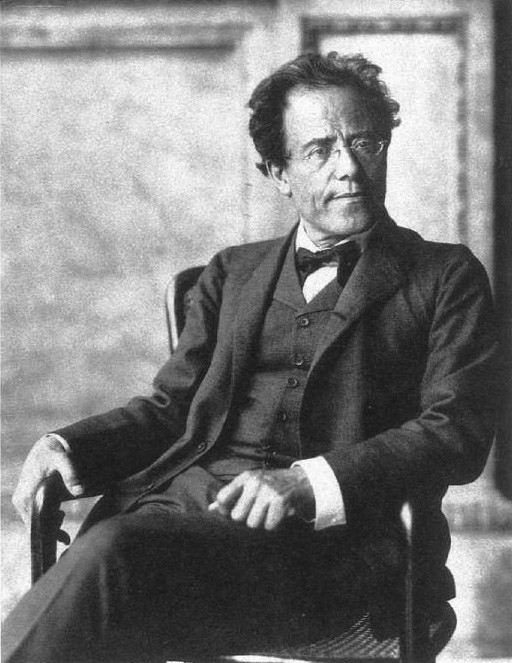
Gustav Mahler
Stylistically, it pushes further into modern territory. There are passages of eerie fragmentation and near-atonality, and the structure is unconventional (four movements with a slow adagio finale of heartbreaking beauty).
The orchestration remains huge, but Mahler uses it more subtly than in the First. For example, Mahler employs frequent, delicate chamber-like textures and moments of sparse, ghostly sound. The ending isn’t like his First; it just fades quietly away.
Two years later, Mahler would be dead.
Jean Sibelius (1865–1957)
Symphony No. 1 (1898–1899) and Symphony No. 7 (1914–1924)
Sibelius’s Symphony No. 1
Sibelius’s passionate First emerged at the end of the nineteenth century and is strongly influenced by Tchaikovsky and Finnish folk idioms.
The work opens with a haunting unforgettable clarinet solo over a timpani roll, and from there proceeds through a series of sweeping melodies and dramatic climaxes.
It follows a fairly traditional structure (allegro first movement, big slow movement, punchy scherzo, and a dramatic finale) and runs a standard 35 to 40 minutes.
In mood, it is yearning and nationalistic. It is easy to imagine this as program music to any number of folk legends.
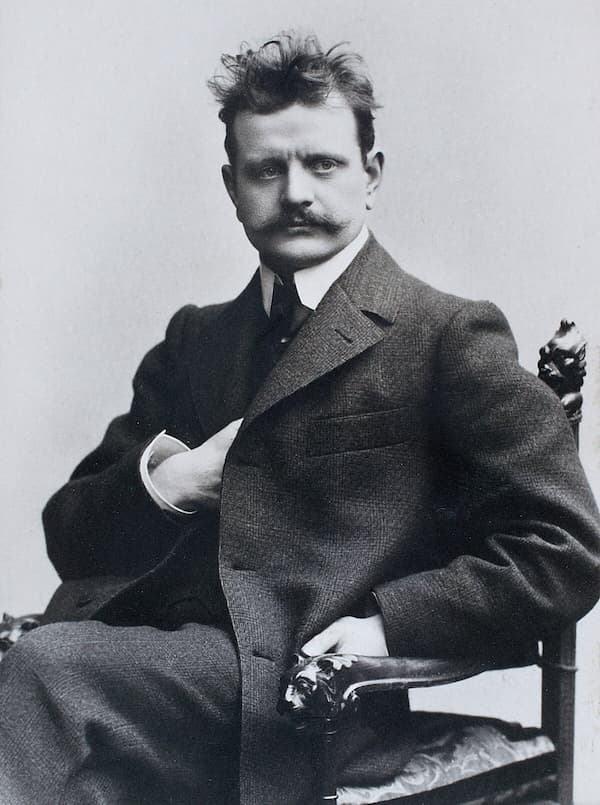
Daniel Nyblin: Jean Sibelius, ca 1898–1900
Critics often note the influence of composers like Dvořák and Brahms in the symphony’s energetic rhythms and richly orchestrated themes.
Sibelius’s Symphony No. 7
Sibelius’s final symphony is a radical departure from not only his First but from symphonic norms in general.
The Seventh is a single continuous movement about 22 minutes long, essentially compressing the essence of a symphony into one seamless arc.
Over the course of his seven symphonies, Sibelius’s style had become increasingly concise, and the Seventh is the ultimate example of his ever-increasing love for brevity.
He embraced an austere atmosphere, lean and transparent orchestration, and ambiguous emotion.
It remains one of the more shocking evolutions of a composer’s symphonic aesthetic in classical music history.
Sibelius worked on an eighth symphony for decades, but died without ever finishing it, and burned what he’d written before he died. In retrospect, the disappearance of the Eighth is understandable. After all, where exactly could a composer go after evolving from Sibelius’s First to Sibelius’s Seventh?
Dmitri Shostakovich (1906–1975)
Symphony No. 1 (1924–1925) and Symphony No. 15 (1970–1971)
Shostakovich’s Symphony No. 1
Shostakovich wrote his first symphony as a Leningrad Conservatory graduation project when he was nineteen.
It demonstrates his early style: lean orchestration, sharp contrasts, and touches of ironic humour.
The First Symphony has a neo-classical spirit in some ways – he embraces a brisk tempo and clarity of orchestration – but there’s also a quirky, brittle, sarcastic edge to the whole affair, an attitude that became a hallmark of Shostakovich’s music.
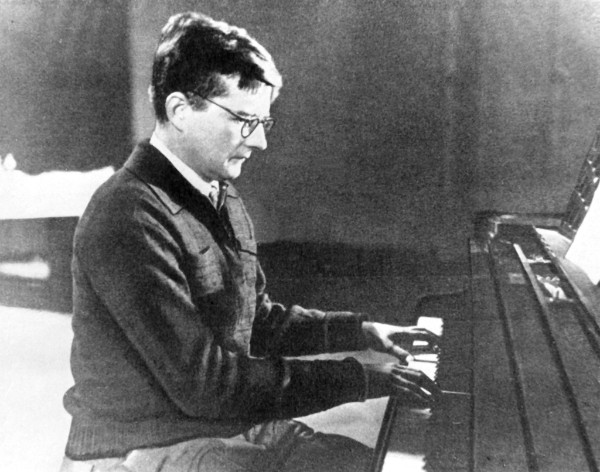
Dmitri Shostakovich
One can hear the influence of contemporary trends (i.e., Prokofiev, Stravinsky), yet also hints at the composer’s unique voice.
Shostakovich’s first symphony was immediately successful and praised for its brilliance the world over.
Shostakovich’s Symphony No. 15
Shostakovich’s final symphony, written nearly half a century later under very different circumstances, is an enigmatic, inward-looking work.
By 1971, Shostakovich was in ill health and had spent a lifetime operating in the long shadow of Soviet political pressures.
In the first movement, the symphony includes whimsical quotes from Rossini’s William Tell Overture, then continues on to include other cryptic self-quotations and references (interestingly, motifs from Wagner’s Ring Cycle and Tristan und Isolde appear in the final movement).
It sounds like an old man paging through a scrapbook of memories of the life he made in classical music, with his own memories superimposed on top.
The symphony ends quietly and ambiguously, with eerie percussion taps and celesta, leaving audiences with an uneasy and open-ended final impression.
Conclusion
All composers grow over the course of their careers, but these eight grew in especially major and profound ways. No doubt that’s one reason why their symphonic output continues to attract listeners today.
Which composer’s trajectory of growth is your favourite?
For more of the best in classical music, sign up for our E-Newsletter